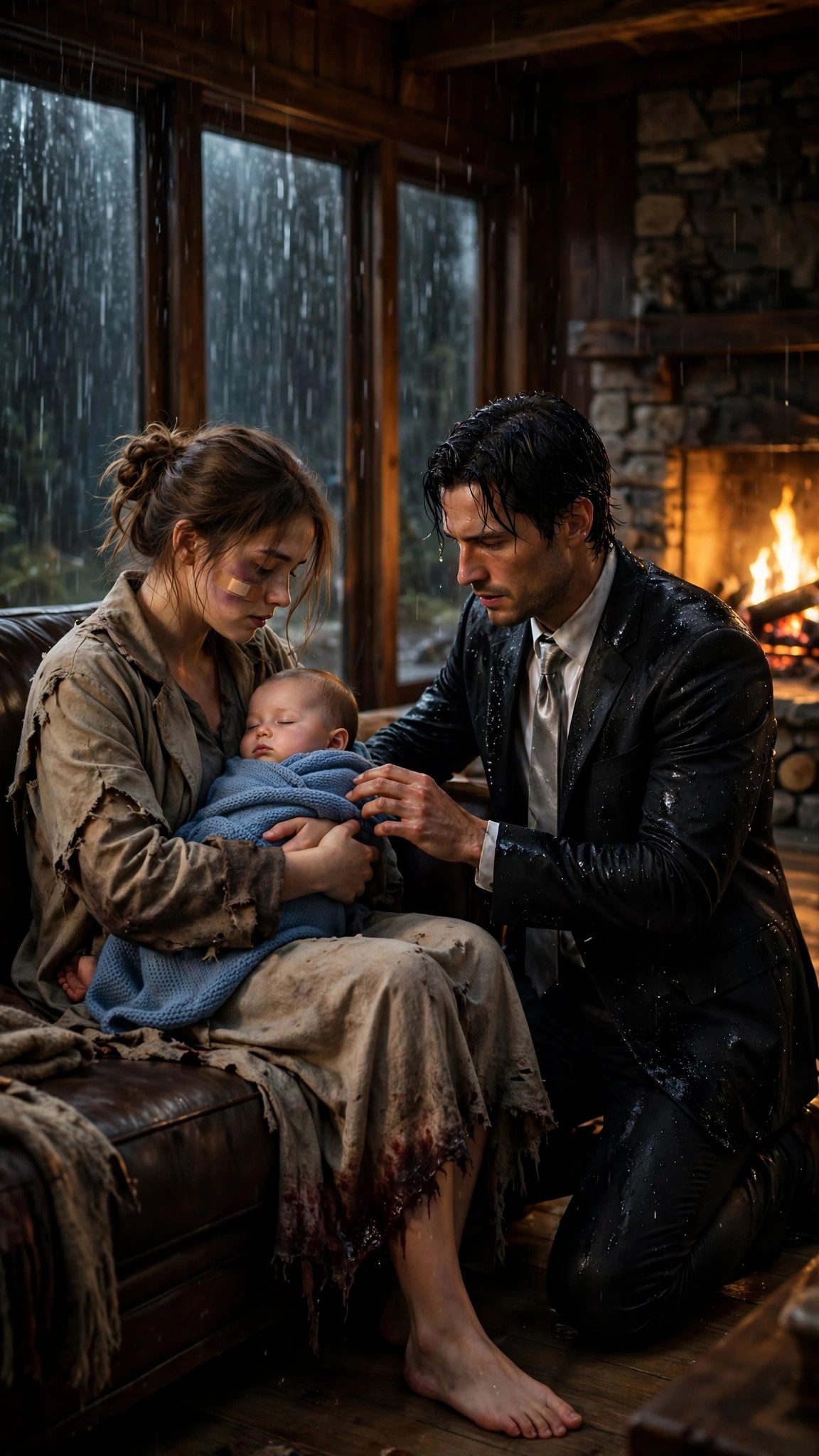
Marcus Webb broke in eleven minutes.
I know that because Mason told me, the next morning, while I was sitting in the kitchen with a cup of tea I couldn't hold properly — my wrist was splinted, my ribs hurt every time I breathed, and Rosa kept putting toast in front of me as if toast were medicine — and Mason came in with mud on his shoes and a look on his face I had never seen before.
"He talked," Mason said. He said it to Gabriel, who was standing by the window with his back to the room, holding Eli in one arm the way a man holds something he is afraid of dropping. "Eleven minutes. He didn't even wait for the chair. He just started talking."
"What did he say?" Gabriel asked. He didn't turn around.
"He said Asher Voss paid him forty thousand dollars to cut the GPS and give up the convoy route," Mason said. "He said Asher has been paying him for fourteen months. He said the shell companies were Asher's idea — the payments under one hundred twenty thousand, the rotating vendor names, all of it. He said Asher wanted the family to look weak. He wanted people to think Gabriel was losing control. And then, when the time was right, he wanted the baby."
Gabriel turned around then. His face was calm. His eyes were not.
"Where is Webb now?" he asked.
"In the basement," Mason said. "Tied to a chair. Crying. He says he didn't know they were going to take the baby. He says he thought it was just about the route, just about the money. He says Asher told him nobody would get hurt."
"Nobody would get hurt," Gabriel repeated. His voice was very quiet. "Tommy is dead. Grace is in the hospital with a broken arm. Claire has three broken ribs and six stitches in her face. And Eli —" He looked down at the baby in his arms, who was chewing on his own fist with great concentration. "Eli is six months old, and he spent three hours in a warehouse with men who wanted to shut him up."
Mason didn't say anything. He didn't need to.
"Find Asher," Gabriel said. "Find him, and bring me everything. His houses. His men. His money. I want to know where he sleeps, where he eats, who he calls. I want to know it by tonight."
Mason nodded and left. The kitchen went quiet, except for the sound of Eli chewing his fist and Rosa scraping toast crumbs off the counter with great determination, as if the crumbs had personally offended her.
Gabriel came and sat down across from me. He put Eli on his knee, facing me, and Eli looked at me with his dark grey eyes and smiled — a wide, gummy, completely unafraid smile — and I felt my throat close up, because a baby who had been through what Eli had been through had no business smiling like that, and yet there he was, smiling, as if the world had never hurt him at all.
"Tell me about Asher Voss," I said. "All of it. Not the short version."
Gabriel looked at me for a long moment. Then he nodded, the way a man nods when he has decided to trust someone with something he doesn't trust anyone with.
"Asher Voss grew up with Daniel and me," he said. "We were boys together, in this city, in a different time, when our fathers were still alive and the families were still one family. Asher's father and my father were partners. They built the docks together. They built the freight business together. And then, when our fathers died, the partnership was supposed to pass to Daniel and Asher, equally. That was the deal. That was the promise."
He paused. Eli grabbed at his tie, and Gabriel let him, the way a man lets a baby do something he would never let anyone else do.
"But Daniel was the heir," Gabriel said. "Not Asher. Daniel was older. Daniel was the one our father trusted. And Asher — Asher never forgave that. He smiled, and he shook Daniel's hand, and he said all the right things, and then he spent the next ten years building his own empire in the dark, buying people, making promises, waiting for the day Daniel would make a mistake."
"And Daniel didn't make a mistake," I said.
"No," Gabriel said. "Daniel didn't make a mistake. Daniel fell in love, and married a nurse, and left the business, and was happy — and Asher couldn't stand it. He couldn't stand that Daniel had everything and didn't even want it. So he took it. The crash on the Kennedy. The brakes. The rain. The curve. It was Asher. I have always known it was Asher. I just couldn't prove it, because Asher is careful, and Asher is patient, and Asher never does anything himself. He pays other people to do it. Small payments. Under the threshold. People like Marcus Webb."
I thought about the shell companies. I thought about the seventeen small payments. I thought about the way Asher had built his whole plan out of pieces too small to see, the way a man builds a house out of bricks, one at a time, until one day you look up and there's a wall where there used to be a road.
"And now he wants Eli," I said.
"He wants the docks," Gabriel said. "Eli is just the way to get them. If he has my nephew, he has me. If he has me, he has the family. It's that simple. It's always been that simple."
He stood up. He walked to the window, Eli still on his arm, and looked out at the garden, where the rain had stopped and the sun was coming through the trees.
"I've spent eleven months waiting for him to make his move," Gabriel said. "Eleven months of convoys and guards and safe houses. And last night, he made it. And he failed — because of you." He turned around. "Do you understand what that means, Claire? He failed because of a woman in a cardigan who hit a man with a fire extinguisher. He spent fourteen months and forty thousand dollars building a plan, and you broke it in eleven minutes with a piece of safety equipment."
I didn't know what to say to that. I had never thought of myself as someone who broke plans. I thought of myself as someone who found them, in invoices, in the quiet of my office, with a cup of tea gone cold beside me.
"I didn't break it alone," I said. "Eli helped. He didn't stop crying. If he'd stopped crying, they might have —" I stopped. I couldn't finish the sentence.
"I know," Gabriel said. "I know."
That afternoon, while Gabriel was in his office making calls I wasn't allowed to hear, I did the only thing I knew how to do. I asked Mason for a laptop, and I asked Rosa for a pot of tea, and I sat down at the kitchen table with my splinted wrist and my taped ribs, and I went looking for Asher Voss in the only place I knew how to look.
The numbers.
Marcus Webb had given Mason names — three shell companies, a handful of account numbers, a few dates. It wasn't much. But it was enough for a person like me, because numbers are never just numbers. They are footprints. And Asher Voss, for all his patience and all his care, had left footprints everywhere.
I started with the shell companies. I traced the payments backward, through the vendor names, through the approval signatures, through the dates. And I saw what I had seen before, only bigger this time: the same pattern, the same careful hand. Small payments, just under the threshold. Rotating names. Approvals from the same two people. It was the Aldous theft all over again, except this time the money wasn't being stolen. It was being spent — on men, on cars, on a warehouse lease near Hammond, on a mechanic named Eddie Marcone who had been paid fifty thousand dollars eleven months ago, on the same week Daniel Kane's car went off the Kennedy Expressway.
I found the mechanic's payment at four in the afternoon. It was buried in a freight invoice for a company that didn't exist, approved by a man who had retired two years earlier, for "brake system consultation" — a phrase so bland it was almost funny, except that it wasn't funny at all, because Daniel Kane's brakes had failed on a rainy night, and a man named Eddie Marcone had been paid fifty thousand dollars to make sure they did.
I wrote it all down. I wrote it in the plain, polite, impossible-to-argue-with language I always used, and I put it in a folder, and I carried it into Gabriel's office with my splinted wrist and my stitched cheek, and I put it on his desk, and I said, "Here. This is how you find him."
Gabriel read the first page. He read the second. He read the third. Then he looked up at me, and his face was the face of a man who has just been handed the answer to a question he has been asking for eleven months.
"You found the mechanic," he said. "In one afternoon."
"I found the payment," I said. "The mechanic is just the man who took it. But the payment is the thread. Pull it, and everything comes with it — the warehouse, the cars, the men, all of it. Asher built his whole plan out of small payments, Mr. Kane. Small payments leave small trails. But they still leave trails."
He stood up. He came around the desk. He looked at my folder, and then he looked at me, and he said, "You know what you are, Claire Bennett?"
"An accountant," I said.
"No," he said. "You're the woman who found my brother's killer in an afternoon, with a broken wrist and three broken ribs, sitting at my kitchen table. Do you understand what that means? It means there is nothing in this world I wouldn't do for you. Nothing."
I didn't know what to say to that. I had never been told anything like it. I had been told my reports were accurate. I had been told my work was good. I had never been told that my work was the reason a man could finally sleep at night.
"Then go," I said. "Go and finish it. Eli and I will be here when you get back."
He looked at me for a long moment. Then he nodded, and he kissed Eli on the forehead, and he looked at me, and he said, "Lock the doors. Mason stays. Nobody comes in, nobody goes out. I'll be back before morning."
That night, Gabriel went out.
I didn't sleep. I sat in the nursery with Eli, in the rocking chair by the window, and I watched the city lights, and I listened for sounds that didn't come. Rosa brought me tea. Mason stood in the hallway. And somewhere out in the dark, Gabriel Kane was doing what Gabriel Kane does — the thing the newspapers whisper about, the thing nobody photographs, the thing that makes men like Asher Voss afraid to sleep at night.
He came back at four in the morning. I heard the front door. I heard footsteps on the stairs. And then he was standing in the nursery doorway, in a black suit with no tie, his shirt torn at the shoulder, blood on his knuckles — not his blood, I could tell, because he was moving the way a man moves when he is unhurt and furious — and he looked at me, and at Eli asleep in my arms, and he said, "It's done."
"What's done?" I asked.
"Asher's houses are empty," Gabriel said. "His men are gone. His money is frozen. The police have Marcus Webb's statement, and the shell companies, and the payments, and the mechanic who cut the brakes on Daniel's car — a man named Eddie Marcone, who took fifty thousand dollars from Asher and has been drinking himself to death with the guilt ever since. Asher himself —" He paused. "Asher is in custody. He tried to run. He didn't get far."
"In custody," I repeated. "Not —"
"Not dead," Gabriel said. "I wanted him dead. God knows I wanted him dead. But dead men don't testify, and dead men don't give you the names of everyone they bought. So he's alive, and he's talking, and by the time he's finished, there won't be anything left of his empire but a story people tell to scare their children." He came into the room. He knelt beside the rocking chair. "Daniel is avenged, Claire. Anna is avenged. Eli is safe. And it's because of you."
I looked at him — this man, with blood on his knuckles and a torn shirt and eyes that had seen things I would never see — and I thought about how, two years ago, I had been a woman who apologized when someone bumped into her. And now I was sitting in a nursery at four in the morning, holding a baby that wasn't mine, while the most feared man in Chicago knelt in front of me and told me I had avenged his brother.
"You're hurt," I said. It was all I could think of. "Your shirt —"
"It's not my blood," he said.
"I know," I said. "That's not what I meant." I reached out, with my good hand, and touched his shoulder, gently, where the shirt was torn. "Are you hurt?"
He looked at my hand on his shoulder like it was the most surprising thing in the world. Then he covered it with his own, and he said, very quietly, "No. I'm not hurt. For the first time in eleven months, I'm not hurt at all."
And then, in the nursery, with Eli asleep between us and the city still dark outside the window, Gabriel Kane put his head down on the arm of my chair, and he slept — really slept, the way Dr. Reyes had said he never did — and I sat there, rocking the baby, watching the man, and I understood that something had changed between us, something I didn't have a word for yet, something that felt like the beginning of a family.