Gabriel proposed to me on Eli's first birthday, in the garden behind the Lincoln Park house, under the maple tree he had planted the week after we came home from the cemetery.
It was not a grand proposal. There were no fireworks. There was no orchestra. There was a small cake with one candle, and a baby in a blue shirt who had just learned to clap, and a man in a black suit who knelt down in the grass — ruining his trousers, Rosa would later inform him, in a tone of great suffering — and held out a ring, and said, "Claire Bennett. Will you marry me?"
I said yes before he had finished the sentence. I said yes the way you say yes to something you have already decided, the way you say yes to the sun coming up, to the rain stopping, to the baby in your arms who has just learned to clap. I said yes, and Eli clapped, and Rosa cried, and Mason — Mason, who never cried about anything — turned around very quickly and pretended to check the locks on the garden gate.
The ring was simple. A thin band of gold, with a single small diamond. Gabriel told me later that he had bought it the week after the warehouse, on the day Dr. Reyes told him my ribs were healing, and that he had carried it in his pocket for a month, waiting for the right moment, waiting until he was sure I was staying for the right reasons and not because I felt sorry for him.
"I don't feel sorry for you," I told him, when he finally confessed this. "I never have. I feel —" I stopped. I didn't have the word. I had spent my whole life being good at numbers, and numbers have words for everything, but love — love doesn't fit in a ledger. It doesn't add up. It doesn't balance. It just is, the way the sun is, the way the rain is, the way a baby's hand feels when it closes around your finger.
"I know," Gabriel said. He slipped the ring onto my finger, and it fit perfectly, the way things fit when they were always meant to be there. "I know. That's why I asked."
We were married three months later, in the same garden, under the same maple tree, with the same small group of people: Rosa, who cried through the whole ceremony and then denied it; Mason, who stood at the back with his arms crossed and his eyes suspiciously bright; Dr. Reyes, who had been invited because Gabriel said she was the only person in the world he was actually afraid of; Harold Finch, who had worked for the company for thirty years and had never once been invited to anything, and who kept saying, "Well. Well, now. Isn't this something"; and my mother, who had taken the train from Evanston with her best dress on and her piano-student smile, and who looked at Gabriel Kane — the most feared man in Chicago — and said, "So you're the young man my daughter has been telling me about," in the exact voice she used to use when she caught me lying about practicing.
Eli was the ring bearer. He was one year old, and he took his job very seriously, carrying the small velvet pillow with both hands, walking down the garden path with the grave concentration of a baby who knows he is doing something important. Halfway down the path, he stopped. He looked at me. He looked at Gabriel. And then he said, very clearly, in a voice that carried across the whole garden —
"Mama."
It was his first word.
Not "Dada." Not "ball." Not "no." Mama. He looked at me, in my white dress, standing under the maple tree, and he called me Mama, and the whole garden went silent, and then Rosa burst into tears, and my mother burst into tears, and Gabriel — Gabriel Kane, the most feared man in Chicago — put his hand over his mouth, and his shoulders shook, and I understood that he was crying, too, silently, the way men like him cry, with their hands over their faces and their whole bodies shaking with something too big to hold.
I knelt down in my white dress, in the grass, ruining it the way Gabriel had ruined his trousers, and I held out my arms, and Eli walked — actually walked, three wobbly steps, the first steps he had ever taken — straight into them, and I held him, and I said, "I'm here. I'm here, sweetheart. I'm your mama. I'm home."
And that was the moment I understood what the title of this story really means. Not the title anyone else would give it. The title I would give it, if anyone asked me what happened that night in the tunnel, and in the warehouse, and in the drainage, and on the twenty-eight miles home.
I brought his family home. Not just Eli — though Eli was the beginning, and Eli was the reason, and Eli was the baby who held my finger and wouldn't let go. I brought all of it home. I brought Gabriel home — home to himself, home to his grief, home to the man he had been before his brother died, the man who could sit on the floor and make faces at a baby and cry in a garden and not be ashamed of any of it. I brought Daniel home, too, in a way — because Gabriel goes to the cemetery now, and he doesn't just tell Daniel about the business. He tells him about us. He tells him about Eli's first word. He tells him about the wedding. He tells him that his son is safe, and loved, and growing up in a house full of people who would do anything for him. And I think — I hope — that Daniel hears it, wherever he is, and that he knows his baby is all right.
Asher Voss went to trial in the spring. Marcus Webb testified. Eddie Marcone testified — the mechanic, who had been drinking himself to death with the guilt for eleven months, who stood in the witness box and cried and told the court everything, about the brakes, about the money, about the night Daniel Kane died on the Kennedy Expressway. Asher was convicted on every count. He will spend the rest of his life in prison, and his empire — the one he built out of small payments and bought men — is gone, dismantled piece by piece, the way I dismantled his shell companies at Gabriel's kitchen table, one invoice at a time.
Tommy's family received a pension from the Kane family that will take care of them for the rest of their lives. Grace the nurse recovered, and she came back to work, and she still tells everyone that she was there on the night the quiet accountant from the fourteenth floor walked into a warehouse and walked out again with the baby. She tells it like a legend. She tells it like a story about a woman who was braver than she knew.
The morning after the wedding, I woke up in a house that felt different — not because anything had changed, but because everything had, and I was only just beginning to understand it.
Gabriel was already awake. He was standing by the window in his shirtsleeves, holding Eli, who was chewing on a wooden spoon Rosa had given him, and they were both watching the sun come up over the garden, over the maple tree, over the small white chairs that were still set out in rows from yesterday, like the garden itself hadn't quite believed the wedding was over.
"Good morning, Mrs. Kane," Gabriel said, without turning around. He said it casually, the way a man says good morning to a woman he has known for years, and then he turned around, and he smiled, and I saw that he was nervous — actually nervous, the most feared man in Chicago, nervous on the morning after his own wedding — because he wasn't sure what came next.
"Good morning, Mr. Kane," I said. I sat up. I put my feet on the floor. "What comes next?"
He thought about it. He looked at Eli, who was still chewing the spoon. He looked at the garden. He looked at me.
"Breakfast," he said, finally. "Rosa is making pancakes. Eli likes pancakes. I like pancakes. And after breakfast —" He paused. "After breakfast, we live. That's what comes next. We just live. Together. One day at a time."
And that is what we did.
We lived. Gabriel went to work. I went to work. Eli went to the nursery, and then to a small school, and then to a bigger school, and every day he came home with a new word, a new trick, a new story about something he had seen. Rosa cooked. Mason guarded. Dr. Reyes came to dinner once a month and told Gabriel he looked healthier than she had ever seen him, which Gabriel pretended not to hear and Rosa pretended not to notice.
And once a year, on the anniversary of the night in the tunnel, Gabriel and I would sit in the garden after Eli was asleep, and we would talk about it — not the fear, not the blood, but the rest of it. The fire extinguisher. The drainage. The twenty-eight miles. The way Eli had held my coat and wouldn't let go. Gabriel would laugh, and I would laugh, and we would sit there under the maple tree, holding hands, and we would remember that the worst night of our lives was also the night our family began.
My mother came to stay for a month, that first summer. She played the piano in the corner of the living room — the real piano, not the small upright she taught on — and Eli sat beside her on the bench, banging the keys with both hands, and my mother laughed, and Gabriel stood in the doorway watching them, and I knew, without anyone saying it, that my mother had finally stopped worrying about me. She had seen the house. She had seen the man. She had seen the baby. And she knew what I knew: that her quiet daughter, who had spent her whole life apologizing for existing, had finally found a place where she didn't have to apologize for anything.
On Eli's second birthday, Gabriel gave me a gift. It wasn't jewelry. It wasn't a car. It was a small, framed photograph, taken by a surveillance camera on a wall in Hammond, on the night of the escape — a grainy, black-and-white image of a woman in a torn beige coat, holding a baby against her chest, looking straight into the camera. Me. Looking for help. Looking for someone to know we were alive.
"I had it restored," Gabriel said. He was standing behind me, his arms around my waist, his chin on my shoulder, looking at the photograph with me. "I wanted you to have it. I wanted you to see what I saw, the first time Mason showed it to me. I saw a woman who was bleeding, and terrified, and alone — and who was still standing. Still holding the baby. Still looking for a way home. That is the woman I married, Claire. That is the woman who brought my family home."
I hung the photograph in my office, on the wall beside my desk, where I could see it every day while I worked. Not because I wanted to remember the fear. Because I wanted to remember the rest of it — the courage, and the baby, and the twenty-eight miles, and the fact that a woman who apologized when someone bumped into her had turned out to be the bravest person in the whole story.
And me? I still work in the accounting division. I still read invoices. I still find the gaps, and I still write them up in memos so plain and so polite that nobody can argue with them. Gabriel still reads every one of my reports all the way through. He still drinks his coffee black, with one sugar, from the same chipped mug. He still arrives at seven in the morning and leaves after dark. Some things don't change.
But some things do. I don't apologize anymore — not when someone bumps into me, not when I walk into a room, not when I have something to say. I say it. I say it the way I said it in Gabriel's office, on the day I named the thief: plainly, and without fear, because the numbers are on my side, and the truth is on my side, and the most feared man in Chicago is on my side, too.
My mother still calls every Sunday. She asks if I'm eating properly. I say yes, and this time it's true, because Rosa feeds me three times a day and stands there with her hands on her hips until I finish. My mother asks about Eli. I tell her he's learning new words every day — Mama, Dada, ball, no, more — and that he has Gabriel's eyes and my stubbornness, which Gabriel says is a terrible combination and my mother says is a perfect one.
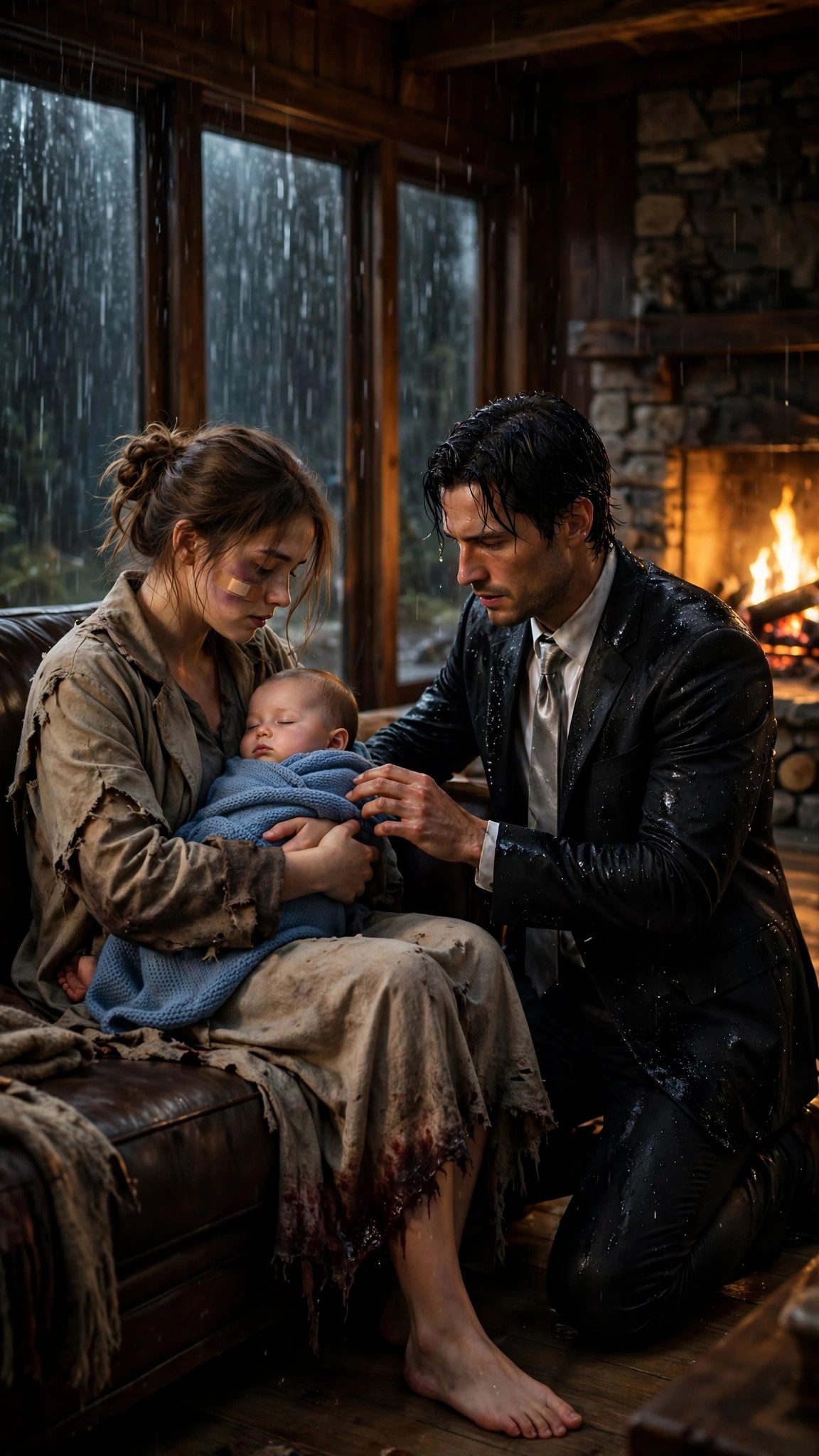
And on quiet nights, when the house is asleep and the rain is falling on the windows, I sometimes think back to that night in the safe house — the blood on my coat, the baby asleep on my chest, Gabriel on one knee beside me, soaked from the storm — and I think about how small my life used to be, and how big it is now, and how it changed, all at once, in the space of one morning, because a car broke down and a driver offered me a ride and I said yes.
I said yes to a ride. I said yes to a convoy. I said yes to a baby who needed me. I said yes to a man who needed me. I said yes to a family that needed me.
And in the end, that is what this story is. Not a story about a mafia boss, or a kidnapping, or a warehouse in Hammond. A story about a woman who said yes — yes to the baby, yes to the man, yes to the family, yes to the life she had never dared to want — and who discovered, in saying yes, that she had finally found the thing she had been looking for all along, in the quiet of her office, with her numbers and her cardigans and her sensible shoes.
Home.
I am Claire Bennett Kane. I am an accountant. I am a wife. I am a mother — not by blood, but by choice, by courage, by twenty-eight miles in the rain with a baby who wouldn't let go of my coat. And every morning, when I wake up in a house full of people I love, and I hear Eli laughing in the nursery, and Gabriel singing to him in a voice nobody else in the world ever hears, I think the same thing I thought on the night I brought him home.
They are not taking this baby. Not while I'm alive.
And they never will. Because I am home now. We are all home now. And home is the one thing no one can take from us — not Asher, not the men in the tunnel, not anyone. Not ever again.
The End.
THE END