The neonatal intensive care unit was on the fourth floor, and it was the quietest loud place I had ever been in.
That sounds strange, but anyone who has ever sat in a NICU will understand it. The room was full of sound: the soft beeping of monitors, the rhythmic sighing of ventilators, the hushed voices of nurses, the occasional alarm that made every mother in the room look up at the same time. But underneath all of that sound, there was a silence that pressed down on you, a silence made of waiting. Every parent in that room was waiting. Waiting for numbers to go up. Waiting for numbers to go down. Waiting for a doctor to come and say a word that would change everything.
My son was in an incubator at the far end of the room, beneath a window that looked out over the Chicago skyline. The morning light came through that window in a pale, thin stream, and it fell across his tiny white hat, and for a moment, when I first saw him, I thought he looked peaceful. I thought he looked like he was sleeping. Then I saw the breathing tube, and the wires, and the way his chest rose and fell too fast, too shallow, like a bird's chest, and I understood that peaceful was the wrong word. He was fighting. Every breath was a fight.
Nurse Elena Ruiz was waiting for me beside the incubator. She was a small woman with dark hair pulled back in a braid and hands that moved the way good nurses' hands move, gently and without hesitation, as if they already knew what to do before her mind had finished deciding. She showed me the opening in the side of the incubator, a small round port with a soft rubber edge, and she said, "Put your finger in, Mama. Slowly. Let him feel you."
I slipped one finger through the opening. His little hand, no bigger than my thumb, curled weakly around it. I started crying, and I did not try to stop. Elena put her hand on my shoulder and left it there, and for a long time neither of us said anything.
"Hi, sweetheart," I whispered. "It's Mommy."
His fingers barely moved. But to me, that tiny movement meant everything. It meant he knew I was there. It meant he was not alone. It meant that in a room full of machines, there was still a mother and a son, and that was the only thing that mattered.
Elena explained everything to me in a low voice, the way you explain things to someone who is drowning. His lungs were underdeveloped, because he had come ten weeks early, and the tiny air sacs inside them were collapsing every time he exhaled. The ventilator was breathing for him, pushing air in, keeping the sacs open. The wires on his chest measured his heart rate and his oxygen. The tube in his arm gave him fluids and medicine. The white hat kept his head warm, because babies this small lose heat faster than they can make it.
"Two pounds, nine ounces," she said. "He is small, Claire, but he is strong. I have seen smaller babies make it. I have seen babies surprise everyone."
I held on to that sentence the way a person holds on to a rope in deep water. Smaller babies have made it. Babies surprise everyone. I repeated it to myself all morning, while the monitors beeped and the light moved across the floor and the nurses came and went with their quiet, efficient footsteps.
At 8:30, Dr. Hayes came to the incubator. He was a tall man with gray hair and tired eyes, and he had the manner of someone who has spent his whole career standing in rooms like this one, delivering news that no one wants to hear. He checked the numbers on the monitor. He looked at the ventilator settings. He listened to my son's chest with a stethoscope so small it looked like a toy.
"He is stable for now," he said. "That is the best word I can give you. Stable. His heart is strong. His lungs are the concern. We are giving him surfactant to help the air sacs stay open. We are watching his oxygen very closely. The next twelve hours will tell us a great deal."
Twelve hours. I did the math in my head without meaning to. Twelve hours from 3:17 in the morning was 3:17 in the afternoon. I did not know then that twelve hours and six minutes would be the exact length of my son's life. I only knew that twelve hours felt both impossibly long and terrifyingly short, and that I would spend every minute of it sitting beside that incubator, holding his tiny hand through the opening, whispering to him.
I called Damian on video at 9:15. I had already called him eight times that night, and I had spoken to him twice, and both times he had promised me he was coming. But I needed him to see. I needed him to understand that this was not a problem that could be solved with money or men or a phone call. This was our son, and he was smaller than a loaf of bread, and he was fighting for every breath.
When Damian answered, I turned the camera toward the incubator. "Look at him, Damian. He looks just like you."
For several seconds, my husband couldn't speak. I saw his face on the small screen, and for the first time in months, I saw the man I had married. Not the boss. Not the man in the black suit. The man who had sat with me at three in the morning. His eyes filled with tears, and his mouth opened, and nothing came out.
Then I heard him whisper, "Oh, God."
"He's beautiful, isn't he?"
"Claire…"
"Please hurry."
"I'm coming. I swear."
I wanted to believe him. I needed to believe him. Because every time I looked at our son's fragile chest rising and falling, I wondered how many breaths he had left.
The morning passed slowly. Elena brought me a chair with a cushion, and a blanket for my shoulders, because I was still shaking from the surgery. She brought me water, and toast I did not eat, and she told me about the other babies in the room, the way nurses do when they are trying to keep a mother from falling apart. There was a little girl in the incubator two rows over who had been born at twenty-six weeks and was now six weeks old and gaining weight every day. There was a boy at the end of the room who had come in at two pounds even and was now almost four pounds. "They fight," Elena said. "These little ones, they fight harder than anyone. You would not believe how hard they fight."
At 10:40, my son's heart rate dipped. An alarm sounded, soft but insistent, and Elena was at the incubator in three steps, her hands already moving, adjusting something, checking the wires. The numbers steadied. She looked at me and smiled, a small, tired smile, and said, "He is all right. That happens. His heart is still learning how to work."
A little while later, a lactation nurse came to see me. Her name was Sarah, and she was gentle in the way that only people who do the hardest jobs in a hospital can be gentle. She explained that my body had begun producing milk, and that even though my son was too small to nurse, my milk could help him, that the doctors could feed it to him through his tube, that it was one of the best medicines they had for babies like him. She brought me a small pump, and she showed me how to use it, and she sat with me while I did it for the first time, and I cried, because it felt like the only useful thing I could do for my son, the only way my body could help him when everything else was failing. She put the tiny bottle in the refrigerator with his name on it, Elias Moretti, and she said, "You are doing something wonderful, Mama. He is getting the best of you."
Across the room, there was another mother, a woman about my age with dark circles under her eyes, sitting beside an incubator that held twins. She had been there for three weeks. Her babies had been born at twenty-five weeks, even earlier than mine, and they were still fighting. She caught my eye at one point, and she gave me a small, tired smile, the smile of one soldier to another, and she whispered, "How old is yours?" I told her twelve hours. She nodded. "The first day is the hardest," she said. "After that, you learn the rhythm. You learn to read the numbers. You learn to hope in small pieces." I never learned her name. I never saw her again. But I have never forgotten her, or the kindness in her face, or the way she made me feel less alone in the quietest loud place I had ever been.
My body was still recovering from the surgery. The incision ached when I stood. The nurses brought me pain medicine, and I took it, because Elena told me I needed to be able to sit beside my son without passing out, and she was right. But the pain in my body was nothing compared to the pain in my chest, the feeling that my heart had been taken out of me and put into a small plastic box with wires coming out of it, and that I could not breathe properly until it was back where it belonged.
At 11:08, his oxygen levels began dropping. This time it was not a small dip. The alarm sounded louder, and two nurses came, and then Dr. Hayes, and they moved around the incubator with quick, practiced movements, and Elena gently moved me aside, her hand on my arm, her voice low and steady. "Stand here, Mama. Let them work. He can feel you near. That is enough."
I stood against the wall, pressing my hands over my mouth. I had never felt so helpless in my life. I was a nurse. I had spent years in hospitals. I knew what the numbers meant. I knew what the alarms meant. I knew that the people working around my son's incubator were the best people in the city at what they did. And none of that knowledge helped me, because knowledge is not the same as power, and I had no power in that room. I could only stand against the wall and pray, and I prayed the way I had never prayed before, not with words, but with my whole body, with every breath I took.
After a few minutes that felt like hours, the numbers steadied again. Dr. Hayes came to me and said, "He is stable again. But I need to be honest with you, Claire. His lungs are very weak. We are doing everything we can."
At 12:22, Dr. Hayes sat down beside me and explained, in the quiet, careful voice of a man who has had this conversation a hundred times, that my son's lungs were dangerously weak, that the surfactant was helping but not enough, that his body was using all of its energy just to breathe, and that there might not be enough energy left for anything else. I asked whether he could survive. The doctor's expression told me more than his words ever could.
At 1:03, I called Damian again. I did not want to call him. I was angry, and I was afraid, and I knew that if I heard his voice I might say something I could never take back. But I called him anyway, because our son was dying, and his father deserved to know, and I deserved to hear him say he was coming.
"Where are you?" I asked.
"The plane just took off."
For a moment, I thought I'd misunderstood. "Just took off? Damian, you promised you'd be here hours ago!"
"Claire, there were complications."
"What complications?"
Silence. Then I asked the question that had been burning inside me all day, the question I had been afraid to ask because I already knew the answer.
"Was it Alessia?"
He didn't answer. Not immediately. Not after I asked again. And somehow, that silence hurt worse than any confession. While our son was struggling to breathe, Damian had still been caught up in his life with another woman.
I slowly ended the call. For the first time in our marriage, I didn't wait for him to call back.
At 2:46, Dr. Hayes approached me. His eyes were gentle. Too gentle. I had seen that look before, on the faces of doctors in my own hospital, when they came to tell a family that there was nothing more to do.
"Claire," he said, "would you like to hold your baby?"
My heart seemed to stop. I knew what he was really offering me. Not an ordinary first cuddle. A goodbye.
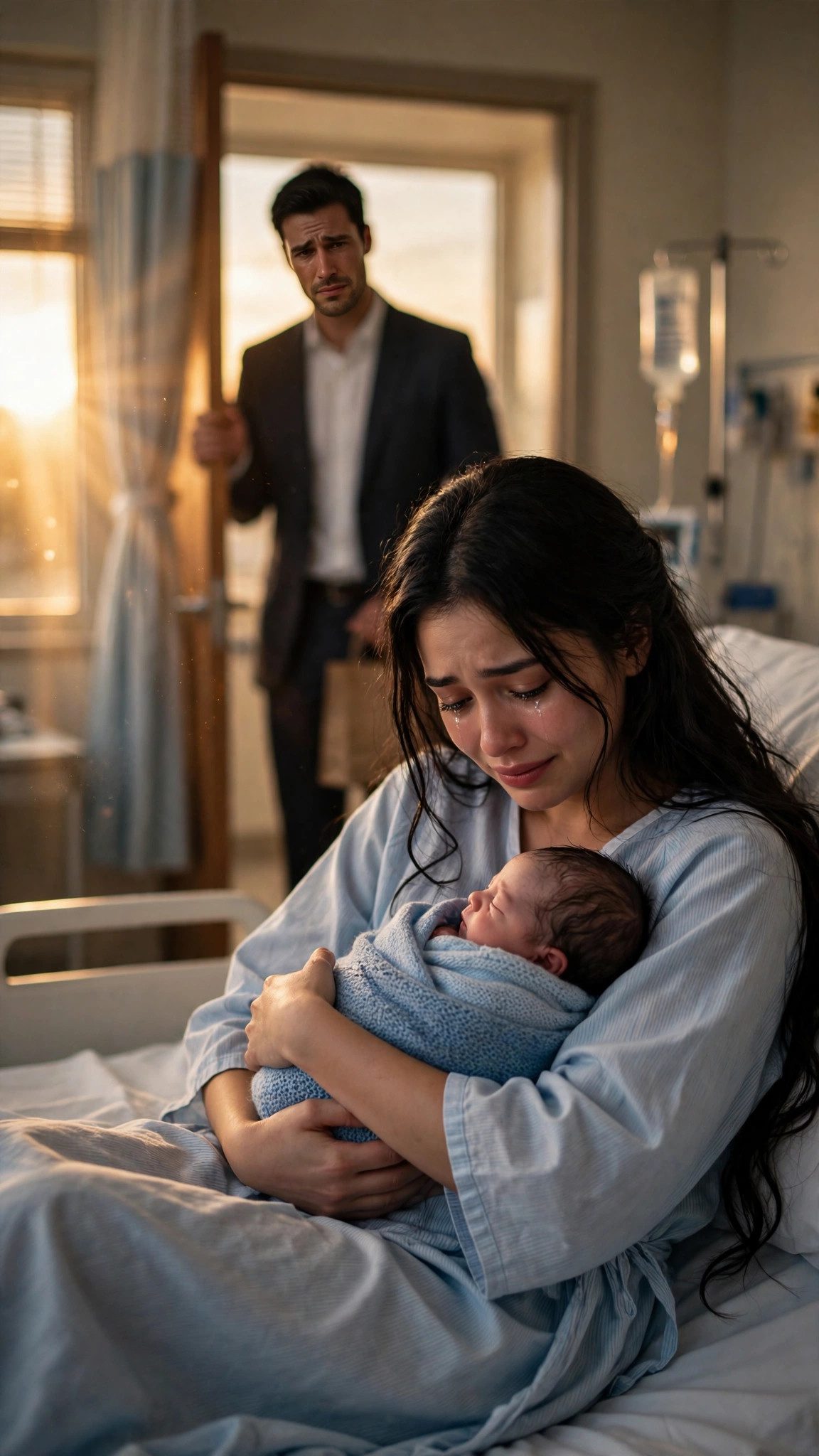
They wrapped my little boy in a soft blue blanket and carefully placed him against my chest. He was so light. So warm. So terribly small. I could feel his heartbeat against my own chest, fast and fluttering, like a moth's wings. I kissed his forehead.
"Hello, my beautiful boy."
My tears fell onto the blanket. "Mommy's here."
I rocked him gently, afraid that even the smallest movement might hurt him. Elena stood beside me, her hand on my back, and Dr. Hayes stood at the foot of the bed, and the whole NICU seemed to go quiet, as if every machine and every nurse and every baby in the room understood what was happening.
Then I made the promise I had been making all morning.
"Daddy's coming home, sweetheart. He's just a little late."
At 3:16, I called Damian one last time. My voice was steady now, the way a person's voice gets steady when there is nothing left to be afraid of, because the worst thing has already happened, or is about to.
"How much longer?"
"About two hours."
I looked toward the monitor. My throat tightened. "You're not going to make it."
"Claire, don't say that."
"Please. Just talk to your son."
I held the phone close to our baby's ear. Damian's voice trembled through the speaker, small and far away, a voice from across an ocean.
"Hey, little man. It's Daddy."
There was a pause.
"Just wait for me a little longer, okay?"
I closed my eyes. I wanted to scream at him. I wanted to beg. Instead, I whispered, "He can hear you."
But my son was slipping away. I could feel it in the way his tiny body grew heavier against my chest, in the way his breathing slowed, in the way the room seemed to tilt. Elena leaned closer. Dr. Hayes stepped forward.
At 3:23 P.M., the monitor changed. The doctor stepped closer. And the tiny heartbeat I'd spent months loving inside my body disappeared.
Twelve hours and six minutes. That was his entire life.