One year later, I stood in a garden in Lake Geneva, Wisconsin, holding my daughter in my arms, and I thought about how strange it is that a life can break apart completely and then, slowly, piece by piece, become something new.
It had not happened quickly. It had not happened easily. There were no miracles in our story. There was only time, and presence, and a man who kept his word, one day at a time.
Damian came to Lake Geneva the day after our conversation at my mother's kitchen table, and he stayed. He rented a small house two streets away from my mother's cottage, a house with a leaky roof and a garden full of weeds, and he fixed the roof himself, and he pulled the weeds himself, and he came to my mother's house every morning at eight o'clock, and he asked what needed doing, and he did it. He helped my mother in the garden. He fixed the fence. He painted the porch. He learned how to make my mother's soup, badly at first, and then a little less badly, and then, one day, almost well.
He did not try to fix my grief. He did not tell me to move on. He did not buy me things. He sat with me in the garden, in the silence, and he listened when I wanted to talk about Elias, and he was quiet when I did not want to talk at all. He went with me to the rosebush every Sunday, and we stood there together, and sometimes I cried, and sometimes he cried, and sometimes we just stood there, two people who had lost the same child, learning how to carry the same grief without letting it pull them apart.
In the autumn, we went back to Chicago together, for one day, to close the house. We walked through the rooms, and we packed the things that mattered, and we left the rest. I stood in the nursery for a long time, looking at the pale yellow walls, and the mobile with the wooden stars, and the crib that had never been slept in. Damian stood in the doorway, and he did not come in, because he understood that this was something I needed to do alone. When I came out, I took his hand, and I said, "I'm ready." And we drove back to Lake Geneva, and we did not look back.
In the winter, Damian's testimony sent Vincent Castellano to prison for life. Tony Russo testified. Sal Ferraro testified. The trial lasted three weeks, and Damian was in court every day, and when it was over, Agent Daniel Reyes shook his hand, and he said, "You did the right thing, Mr. Moretti." Damian told me later that those were the first words of respect he had heard from a stranger in twenty years that had nothing to do with fear.
In the spring, we sold the last of the criminal businesses. The warehouses went to a logistics company. The shipping routes went to a legitimate firm. The properties went to families who needed homes. Damian kept the restaurants and the hotels, the clean ones, the ones that had always been clean, and he ran them the way a businessman runs them, with meetings and budgets and early mornings and late nights that ended with him coming home. He came home every night. That was the rule. That was the promise he had made, not with words, but with his life: he came home every night.
In the summer, I went back to nursing. Not at St. Agnes, not yet. At a small clinic in Lake Geneva, three days a week, with children who needed someone patient and kind. It felt good to be useful again. It felt good to hold a baby who was crying and know that I could help. It felt good to be Claire Bennett Moretti again, not just a woman defined by what she had lost.
And in the autumn, one year and three months after Elias died, I found out I was pregnant again.
I sat in the bathroom of my mother's cottage, holding a small white stick with two pink lines on it, and I cried. I cried because I was happy, and I cried because I was terrified, and I cried because I thought of Elias, and I wondered if it was all right to be happy when he was gone. Then I went into the kitchen, and I told Damian, and he held me, and he cried too, and he said, "We will do this together, Claire. Every appointment. Every ultrasound. Every night. I will be there. I promise you, I will be there."
And he was. He was there for every appointment. He sat beside me in Dr. Hayes's office, and he asked questions, and he took notes, and he held my hand when the ultrasound showed a tiny heartbeat, strong and steady. Dr. Hayes, the same doctor who had warned me at twenty-seven weeks, looked at us both and said, "This is a different pregnancy, Claire. Your body is healthy. Your baby is healthy. But we will watch you closely. We will not take any chances." And Damian nodded, and he said, "Whatever it takes."
The pregnancy was long and careful and, in the end, ordinary in the best possible way. There were no emergencies. There were no middle-of-the-night phone calls. There were only checkups, and vitamins, and a nursery painted pale yellow in the small house two streets away from my mother's cottage, and a mobile with wooden stars, and a crib that Damian assembled himself, swearing at the instructions, the same way he had done before, only this time I laughed, and he laughed, and it felt like a beginning instead of an ending.
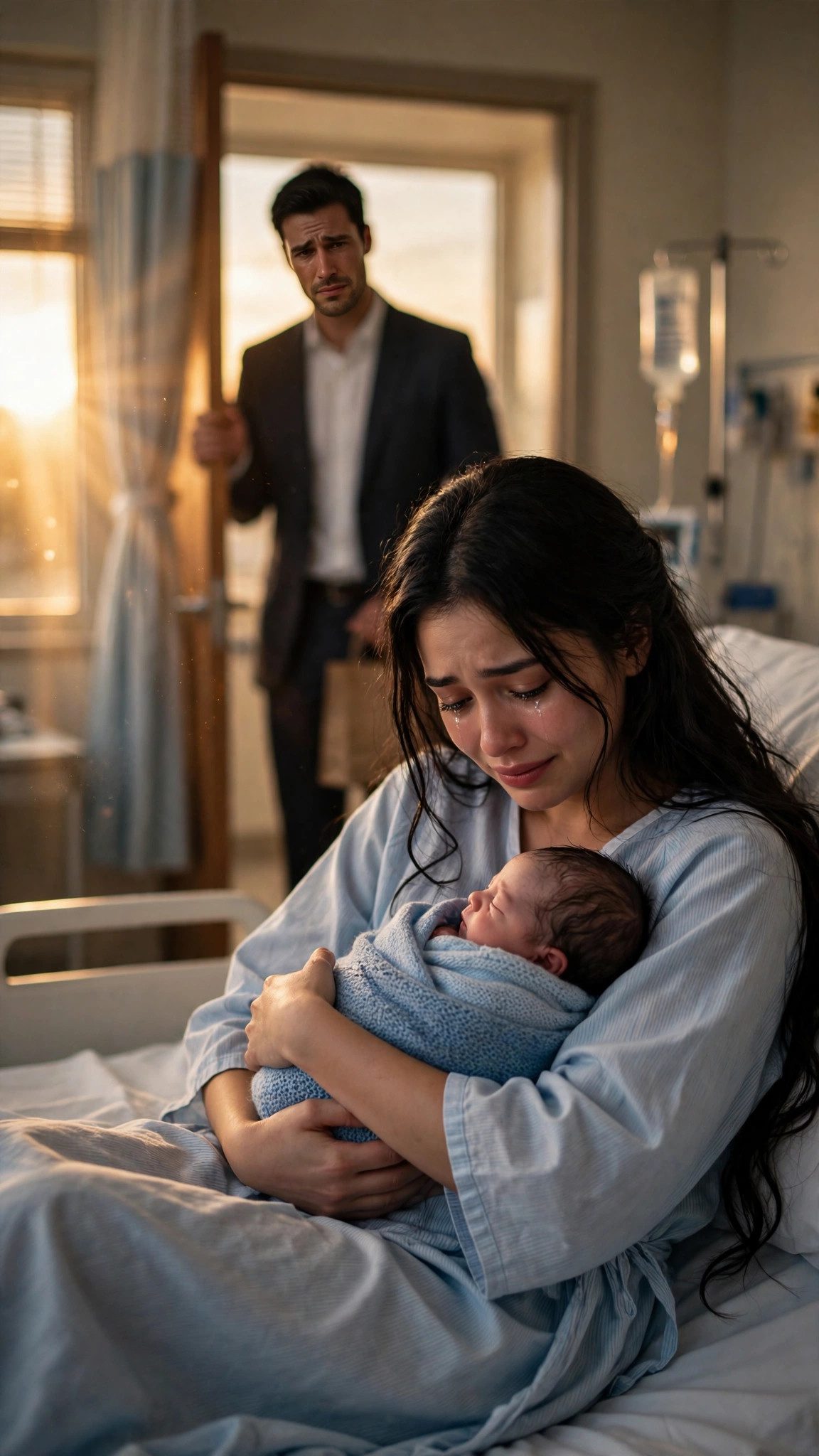
Our daughter was born on a Tuesday morning in May, at 8:14, after nine hours of labor, in the same hospital where Elias had been born. She weighed seven pounds, four ounces. She cried the moment she was born, loud and strong, and the sound of it filled the whole room, and I cried, and Damian cried, and Dr. Hayes smiled, and Nurse Elena Ruiz, who had asked to be there, put our daughter in my arms, and she said, "She is beautiful, Mama. She is perfect."
We named her Elena, after the nurse who had held my hand through the worst day of my life, and who had helped Damian find me when I needed to be found, and who had stood in the delivery room and cried when our daughter took her first breath.
Damian held her first. He took her in his arms, so gently, as if she were made of glass, and he looked down at her tiny face, and he whispered, "Hello, sweetheart. I'm Daddy. Daddy's here."
Those were the words Elias had never heard. Those were the words Damian had spoken into a phone, across an ocean, too late. Now he was saying them in person, in a hospital room, holding his daughter, and he was not too late. He was right on time.
We brought Elena home to the small house in Lake Geneva. My mother moved in with us, because she said a baby needs a grandmother, and she was right. Tony Russo came to visit, and he held Elena, and he cried, and he said, "She looks like her mother." Sal Ferraro came, and he brought a teddy bear almost as big as he was. Agent Reyes sent a card. Even Grace, my friend from the hospital, came all the way from Chicago, and she held Elena, and she said, "She is going to be trouble, Claire. I can tell already."
Every Sunday, we go to the rosebush in my mother's garden. We bring flowers. We sit for a while. I tell Elias about his little sister. I tell him she has his eyes. I tell him she cries loud, the way he never got the chance to. I tell him I love him, and that I will always love him, and that twelve hours and six minutes was enough for me to love him completely, and that no one can ever take that away from me.
Damian stands beside me, holding Elena, and he tells Elias about the garden, and the house, and the life we are building, and he says, "I am sorry I wasn't there, son. I am sorry every day. But I am here now. I am here for your mother. I am here for your sister. I am not going anywhere."
The first night we brought Elena home, Damian was afraid to hold her. He stood in the doorway of the nursery, looking at the crib, and he said, "What if I do something wrong? What if I hold her the wrong way?" I took his hands, and I put them around her, the way Elena Ruiz had shown me in the hospital, one hand under her head, one hand under her back, and I said, "You are not going to do anything wrong. You are her father. That is enough." He held her for two hours that night, sitting in the rocking chair, not moving, just watching her breathe. Every few minutes, he put his hand on her chest, to feel her heartbeat, and every time he felt it, he closed his eyes, as if he were thanking someone.
At her first pediatrician appointment, Damian asked the doctor seventeen questions. I counted. He asked about her weight, and her feeding, and her sleep, and whether her breathing sounded normal, and whether the little sound she made when she yawned meant anything. The doctor, a kind woman named Dr. Patel, answered every question patiently, and then she looked at me and smiled, and she said, "Your husband is very thorough." I said, "He is making up for lost time." And Damian nodded, because it was true, and he was not ashamed of it.
When Elena was three months old, we held a small naming ceremony in my mother's garden. It was not a big event. It was my mother, and Damian, and me, and Elena, and Tony Russo, and Sal Ferraro, and Grace, and Nurse Elena Ruiz, who had driven all the way from Chicago in the rain. We stood beneath the rosebush, and my mother read the same poem she had read for Elias, and then she read a different one, about new life, about a child being a promise that the world keeps making, even after it has broken your heart. Damian held Elena up, the way fathers have held their children for a thousand years, and he said, "Elena Moretti. You are named for a woman who saved our family. You are loved. You are wanted. You are home." And everyone cried, even Tony, who pretended he had something in his eye.
There were hard days, too. I will not pretend there were not. There were nights when Elena cried for hours and nothing would soothe her, and I would stand in the nursery, rocking her, exhausted, and I would think of Elias, and I would wonder if I was doing something wrong, if I was a bad mother, if I had failed one child and was about to fail another. On those nights, Damian would come into the nursery, and he would take Elena from my arms, and he would walk with her, up and down the hallway, singing to her in a low voice, a song his own mother had sung to him, and he would say to me, "Go to sleep, Claire. I have her. I am here." And I would go to sleep, and I would wake up to find him still awake, still holding her, still singing, and I would know that this was the man I had married, the man who had been there all along, underneath the empire and the fear and the mistakes.
Then we go inside, and my mother makes soup, and Elena sleeps in her crib beneath the mobile with the wooden stars, and Damian sits beside me on the porch, and he takes my hand, and we watch the lake go dark, and I think about the woman I was a year ago, sitting on a train to Lake Geneva with a small box in her lap, thinking her life was over.
My life was not over. It was beginning again, in a way I could not have imagined. I had lost a son. I had almost lost a husband. I had almost lost myself. And now I had a daughter, and a husband who came home every night, and a mother who made soup, and a garden full of roses, and a rosebush where my son's ashes rest, and a future that felt, for the first time in a long time, like something I could trust.
When Elena was eleven months old, she took her first steps in my mother's garden, on the grass beside the rosebush. She wobbled, and she fell, and she got up again, and she walked three steps into Damian's arms, and he picked her up and spun her around, and she laughed, a bright, fearless laugh, and I thought of Elias, and I thought of how he had never taken a single step, and I felt the grief and the joy at the same time, the way a mother does, holding both in her heart, because love does not divide itself. It multiplies.
Her first word was "Dada." Damian cried when he heard it. He had been waiting for it for months, saying her name to her every day, pointing at himself, saying, "Dada, Dada," and when she finally said it back, he picked her up and held her against his chest, and he whispered, "That's right, sweetheart. Dada's here. Dada's always here."
That night, after Elena had fallen asleep, Damian leaned over her crib, and he kissed her forehead, and he whispered, "Daddy's here, sweetheart. Daddy's here. And Daddy is never leaving again."
And this time, I believed him.
THE END