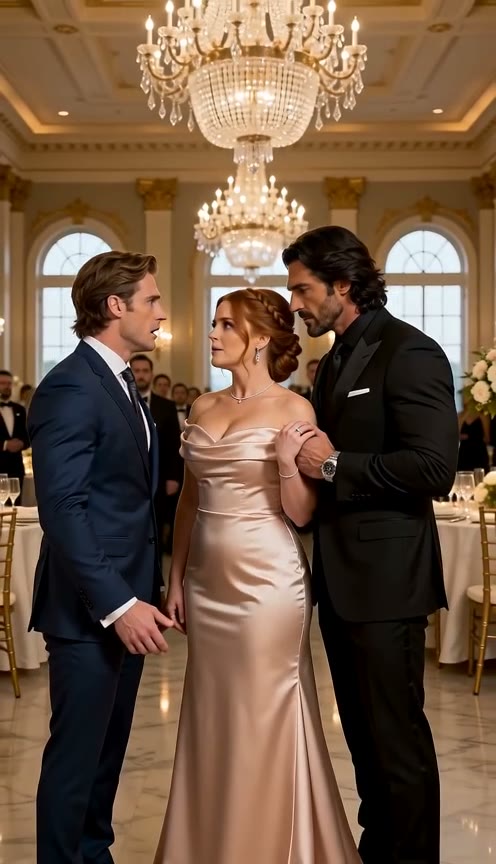
She ran his gala the way she ran everything — like a woman defusing something beautiful.
For eleven weeks, Penelope lived inside the architecture of the Russo Foundation's spring gala: six hundred guests, a silent auction, a string orchestra, a dinner for which the Governor's office, two hospital boards, and half the old money in New York were expected to sit down at the same time and behave. She rebuilt the evening from the floor up. She renegotiated vendors who had been overcharging the foundation for years because no one on the Russo side had ever cared to notice. She found the money leaks with the cold pleasure of a surgeon finding the bleed, and she stopped them. When the foundation's finance director — a Russo cousin with a loud watch and louder opinions — tried to route the floral contract to his brother-in-law at triple the market rate, Penelope put the competing bids in a folder, laid the folder in front of Damian at their weekly meeting, and said nothing at all.
Damian looked through the folder. Then he closed it and looked at her for a long moment.
"My family has employed forty people to protect our money," he said. "You just did it with a spreadsheet and silence."
"Bold of you to pay the other thirty-nine," she said, and was rewarded with something she would come to treasure more than any compliment: Damian Russo, caught off guard, laughed — a real one, brief and warm and surprised out of him.
It became, over those weeks, the most dangerous part of her week: the Tuesday meeting. Dangerous because she prepared for it like a state dinner. Dangerous because he listened to her the way no one had ever listened — completely, without glancing at a phone, without finishing her sentences, weighing every word as if her judgment were a currency he trusted. Dangerous because she learned things in the margins of agendas. That he took his coffee black and his meetings short. That he called his mother every Sunday and his voice changed when he did. That the empire's legitimate face was not a face at all — that he had spent twenty years dragging his grandfather's shadow empire into the light, contract by contract, and that the men who whispered his name in fear were increasingly men from a world he was leaving, furious at being left.
"You're not what the articles say," she told him once, when the meeting had run long past dark and the office windows held the whole glittering city.
"No," he agreed. "I'm worse at dinner parties and better at contracts." He turned a page of her seating plan. "The articles are written by people my enemies pay. You're the first person in years who's bothered to watch me work instead." He looked up. "It's why I trust your seating chart more than my security team's."
She should have kept it professional. She tried. God knows, and Damian knew, that she tried.
It was the foundation's work that kept betraying her resolve. She had expected galas and ledgers. She had not expected the children's hospital on a grey Tuesday, where the new Russo wing — imaging suites, a family residence floor, a garden — was being fitted out under her gala's endowment, and where Damian, who was supposed to tour it in twelve minutes between meetings, stayed for two hours. She watched the most intimidating man in New York sit down on a floor cushion built for a four-year-old, in a three-piece suit, and submit to a full medical examination administered by a patient named Lucia, age six, with a plastic stethoscope and absolute professional authority. "Your heart is loud," Lucia informed him. "That's because it's old," Damian said gravely, and then, at Lucia's command, breathed in and out for her three times, obedient as a altar boy, while two nurses stood in the doorway with their hands pressed to their mouths. Walking back to the car he was quiet for a block, and then said, "My grandfather built the name so men would fear it. I would like the name to retire doing this instead. That's the whole plan, Penelope. Everything else is accounting." She understood, walking beside him in the grey light, that she was being shown the actual building — not the empire, not the rumors — the plan. And that almost no one alive had been shown it.
Nor had she expected to be defended before she was even his. At the menu tasting for the gala's patron circle — a lunch of twelve, all crystal and quiet money — a society matron at the far end of the table, a woman whose family name was on a museum wing, had studied Penelope's efficient progress through the courses and remarked, to the table at large, with a smile like a paper cut: "How refreshing that the Russo Foundation's new planner doesn't have to worry about fitting into the chairs she arranges." The table froze. Penelope, who had survived Bradley Farnsworth, did not flinch; she simply noted, with professional clarity, that the woman had confused cruelty for wit in front of the wrong audience. Damian set down his fork. He did not raise his voice. He said, "Mrs. Whitmore. The foundation thanks your family for forty years of generosity." A pause that went on until it had edges. "It will not require a forty-first." And then, turning to Penelope with the full, courteous attention of a host consulting his most valued colleague: "The veal course. Your call entirely — I trust it." The Whitmore seat at the gala, when the invitations went out, did not exist. Neither, it was noticed by everyone whose job it was to notice, did the Whitmore name on the new wing's donor wall, when the engravers' list circulated that spring.
The night the trying ended was the night of the venue walkthrough, three weeks before the gala, at a converted bank hall in the Financial District they were vetting for the after-party. A storm had come in off the harbor; the marble hall was empty except for their small team, the rain hammering the great arched windows, when the caterer's delivery truck blocked the loading dock and Penelope — in heels, in the rain, because some things you simply do yourself — went down into the parking garage to move her own car out of the service lane.
The man was waiting by the concrete pillar where the light didn't reach.
She would learn later — much later, from a file Damian never meant her to see — that he was a leftover: a runner for a dock crew whose territory the Russo companies had legally bought out from under them, a man with a grudge, a knife he never got the chance to show, and a plan to take "the Russo boss's woman" and trade her for leverage. She never learned his name. She only ever knew the moment: a shape separating from the shadow, a hand closing hard around her upper arm, the smell of wet concrete and cheap cigarettes, and her own voice — startlingly calm, trained by a decade of crises — saying, "Let go of me. Right now."
He didn't. He pulled her toward the service stairwell.
And then, from the dark at the end of the row of cars, a voice — quiet, almost gentle, and more frightening than any shout she had ever heard.
"Take your hand off her."
Damian came out of the shadows the way weather comes over a harbor. He was not hurrying. He had his suit jacket over one arm, his sleeves folded once at the cuff with terrible neatness, and he walked the length of the garage as if the armed man holding Penelope were a minor scheduling error he intended to correct personally. The man's grip tightened for one second — and then, as Damian got closer and the garage lights found his face, Penelope felt the fingers on her arm begin, unmistakably, to shake.
"You know who I am," Damian said. It wasn't a question. "Then you know there is no version of the next sixty seconds where you walk out of this garage a free man — except one." He stopped an arm's length away. "Let her go, put your hands where I can see them, and sit down against that pillar. My men are already on the stairs. If she is unharmed, you'll answer for this to the police like a citizen. If she is harmed—" He paused, and the temperature of the concrete room seemed to drop through the floor. "—then you'll answer to me like a rumor. Choose quickly. She's getting wet."
The man let go so fast Penelope stumbled. Damian caught her — one arm, solid as a wall, never taking his eyes off the stranger — and held her against his side while his security poured down the stairwell and the whole ugly thing ended in handcuffs, rain, and a police sergeant who shook Damian's hand with both of his and called him Mr. Russo with something like gratitude.
He drove her home himself. The car was silent for twenty blocks. Her arm bore four finger-shaped bruises, blooming purple, and every time the streetlights crossed the windshield she saw his jaw tighten at the sight of them.
"You knew," she said finally. "In the garage. You knew he was there before you came down. That's why you came down."
"Yes."
"How long have you had men watching me, Damian?"
He didn't lie to her. It was the first thing she had ever been able to count on from a man: he didn't lie to her. "Since the catering warehouse," he said. "Since a man at my own table asked who the brilliant woman running the floor was, and I realized that everyone in my world would eventually ask the same question — and not all of them to be polite." He looked at her then, fully, and in his face she saw the thing he permitted almost no one to see: fear. Not of the man in the garage. Of the bruises on her arm. Of how close a world he was trying to leave had come to touching her. "I should have told you. I told myself it was strategy. It was not strategy."
They had reached her building. The rain had thinned to a silver mist. He walked her to her door, and in the small, bright hallway, with her keys in her hand and his body filling the doorway like a held breath, Damian Russo — who commanded rooms by entering them — asked for something, for once, instead of deciding it.
"Marry me."
Penelope stared at him.
"Not tonight," he said quickly. "Not as a reaction to that garage. I've rehearsed this badly, which you should know has never happened to me before." A muscle moved in his jaw. "I've spent twenty years building walls, Penelope. You're the only person who ever walked through one carrying a seating chart. I want you where I can keep you. I want—" He stopped. Started again, simpler, and it undid her entirely. "I want to be the man standing next to you in every room. For all of it. The rest of it."
She had a hundred questions, and she asked the only one that mattered, in a voice that shook:
"When you look at me — what do you see? Because I've been looked at by a man who saw a phase. I need to know what you see."
Damian's answer came without one second of hesitation, and she would carry it into every hard room for the rest of her life.
"I see the woman who held my whole evening together and thought no one noticed," he said. "I notice. I will always notice. That's not a phase, Penelope. That's the foundation."
And Penelope Hart, who did not drop things, who had not cried in eight years, put her forehead against the black wool of Damian Russo's chest, in her own doorway, and wept like a girl — while the most feared man in New York stood perfectly still and held her as if she were made of something the whole world should have been more careful with.