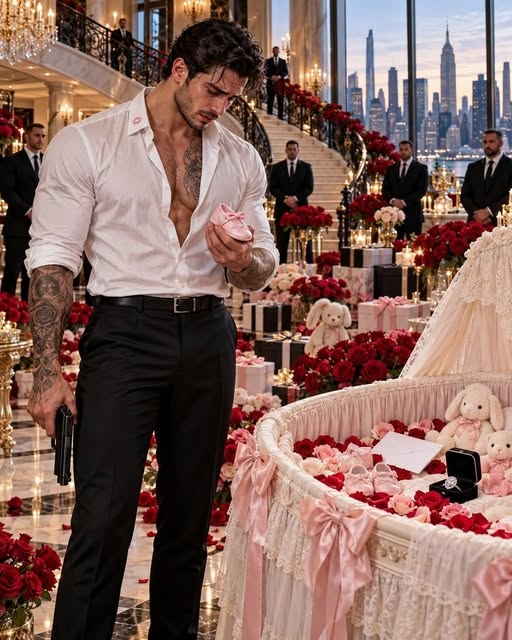
My name is Vincent Romano, and at forty-three, I had built an empire that made powerful men afraid to speak my name aloud.
They whispered it in back rooms in Brooklyn and in boardrooms in Manhattan. They whispered it when a debt came due, when a shipment disappeared, when a rival needed to understand, quickly and without confusion, whose city this was. Six hundred lives moved because I told them to move. Six hundred men ate, worked, kept silent, and, when I required it, bled, because a Romano order was not a request. I had decided who prospered and who vanished. I had sat at the heads of tables where judges and councilmen lowered their eyes. I had walked out of shootings with other men's blood on my cuffs and my own pulse perfectly steady.
Nothing in that life had ever frightened me.
And nothing I had ever done — not the violence, not the bargains made in the dark, not the funerals I had caused and the funerals I had survived — was as unforgivable as what I did to my wife.
Grace Sullivan had become Grace Romano twelve years before, in a small church in Queens with rain on the windows and my mother crying in the front pew. She was twenty-six then, a schoolteacher's daughter with a laugh that embarrassed her in quiet rooms, and she married me knowing exactly what I was. That was the thing no one understood about Grace. She was not naive. She had stood beside me through shootings. She had washed my shirts when there was blood at the collar and never once asked whose it was. She had sat through funerals with her hand locked in mine while men who had tried to kill me were lowered into the ground, and men who had died for me were lowered beside them. She had lived through nights — so many nights — when she did not know whether I would come home alive, and she had learned to sleep, or pretend to sleep, on the left side of our bed so that the right side would be ready for me if I did.
She asked for very little in return. Loyalty, I suppose. Presence, when it mattered. I gave her neither when it mattered most.
For eight years we tried to have a child.
People who know my name imagine that money solves everything, and in my world it usually does. Money buys doctors. It does not buy miracles. Three fertility treatments. Two miscarriages. I held Grace in a hospital bathroom in 2019 while she cried so quietly that the nurse outside the door never heard her. I stood in a white corridor in 2021 and watched a doctor shake his head, and I understood that there were rooms in this world where my name opened nothing.
Then, last year, against the arithmetic of grief, she conceived.
A daughter. Lily. We learned the name the way other couples learn it, slowly, testing it in the air of the nursery at night. Lily Romano. Grace painted one wall the softest green. She folded clothes so small they seemed like a joke the world was playing on my hands. She laid a pink ribbon on the rail of the crib and left it there for luck.
When her blood pressure rose in the seventh month and the doctor warned that Grace might deliver prematurely — that the baby could come weeks early, fragile, fighting — I took my wife's face in my hands in that bright office and I made a promise.
"I won't leave your side," I said. "Whatever happens, whenever she comes, I will be there."
Grace believed me. God forgive me, she had twelve years of reasons to believe me, because in every crisis except the ones that concerned my own appetites, I had always come home.
Three days later, Vanessa Cole called about her thirtieth birthday.
Eleven months. That is how long the affair had lasted. Eleven months of hotel suites and lies arranged with the same precision I used to arrange everything else. Grace had quietly known for almost six of those months. I learned that later. At the time I told myself she suspected nothing, because she never confronted me, never raised her voice, never left a suitcase by the door. Perhaps she still believed — this is the part I cannot outrun — that whatever I did in the dark, I would be there when she needed me most. Perhaps she was saving her one confrontation for a day she hoped would never come.
Vanessa wanted Chicago. Vanessa wanted a celebration worthy of the life she believed I would eventually give her in the open. And I, who could stare down armed men without blinking, did not have the courage to tell a mistress no.
"Please," Grace whispered, as I packed. She stood in the doorway of our bedroom in a loose dress, one hand resting, as it always rested then, on the curve of her belly. Her ankles were swollen. She looked tired in the way she had looked tired for weeks, a tiredness that had nothing to do with sleep. "Answer if I call."
"I promise, sweetheart."
That promise lasted until Vanessa's birthday party.
I spent sixty-four hours in Chicago. I bought Vanessa a diamond necklace for four hundred and fifty thousand dollars, a white stone on a platinum chain that the jeweler presented on black velvet while she cried prettily into a tissue she did not need. I bought her a sports car for three hundred and thirty-five thousand dollars, red as a warning, delivered to the hotel with a bow she tore off for the cameras her friends were holding. I threw her a birthday party for twenty-three guests in a private room above Lake Michigan, with string musicians and champagne I did not drink and a cake taller than the lie I was living. Twenty-three people sang to her. Twenty-three people watched me put that necklace around her throat and believed they were watching a love story.
At 10:17 p.m. on the second night, my phone lit up on the table beside my glass.
Grace.
Vanessa's hand closed around my wrist before I could lift it. Her nails were perfect. Her voice was low and sweet and entirely deliberate.
"Do you really want to answer that?" she asked. "Tonight?"
I looked at the screen until it went dark.
I told myself Grace was probably only uncomfortable. I told myself a premature warning was only a warning, that women called their husbands in late pregnancy for a hundred small reasons, that if it were serious someone else would call. A man who wants an excuse can build one out of anything. I built mine out of my wife's patience, because she had forgiven my silences before.
At 11:42 p.m., Marco Leone called.
Marco had been my adviser — my consigliere, in the old word nobody used in front of civilians — for twenty years. He did not panic. He did not call twice for the same thing. When I answered, his voice was stripped of everything except fact.
"Vincent. It's Grace. She's in premature labor. They're taking her in now. The baby is coming tonight, weeks early. You need to be on a plane."
I was already standing. I reached for my jacket where it hung over the back of a chair, and I remember the room going very quiet in the way rooms do when the most powerful man in them suddenly looks afraid.
Vanessa stepped between me and the door.
She did not shout. She never needed to shout. She stood in the doorway in a silver dress I had paid for, with four hundred and fifty thousand dollars glittering at her throat, and she said, clear as a contract:
"If you go back to your wife tonight, don't come back to me."
There are moments a man's whole life quietly pivots on, and he knows it, even as he chooses wrongly. I knew it. I want that on whatever record God keeps. I was not confused. I was not drunk. Marco's words were still ringing in my ears — premature labor, tonight, weeks early — and Grace's name was still warm on the dark screen of my phone, and I looked at Vanessa, and I weighed my wife and my unborn daughter against a threat from a woman I did not love.
I stayed.
I hung my jacket back over the chair. I sat down. Somewhere behind my eyes Marco was still saying my name when the line went dead, because I ended the call, too. The musicians started playing again because someone, perhaps Vanessa, signaled them to. The party recovered itself the way water closes over a stone. And in New York, my wife labored alone.
At 3:12 a.m., my daughter was born.
Seven weeks early. One point nine kilograms. Less than the weight of the gun I carried most days of my adult life. She could not breathe properly on her own. While doctors fought to keep her small chest moving, while they threaded her into the bright machinery of intensive care, Grace lay in the aftermath of surgery and anesthesia and fear and asked, over and over, where I was.
At that exact minute — 3:12 a.m. — a photographer outside a luxury hotel in Chicago captured me leaving with Vanessa on my arm.
I did not know about the photograph until later. I did not know about Lily until later still, and that sequence is my shame to carry in the correct order: first I chose not to know, and then knowledge had to hunt me down.
By morning, Grace had received the photograph.
She did not call me screaming. She did not call me at all, ever again, in the way she once had. From a hospital bed, hours after giving birth to a daughter who could not breathe unassisted, my wife called her attorney.
Meanwhile the hospital called me. Marco called me. Word reached Chicago in fragments I kept refusing to assemble — Lily in intensive care, Lily in an incubator, Grace asking for me, Grace no longer asking for me. Vanessa cried, then begged, then arranged her face into the injured softness that had worked on me for eleven months, and asked me to stay a few more hours. Just until she fell asleep. Just until the car was photographed properly. Just until I had proved that choosing her once meant choosing her always.
Those hours became another night.
Men have confessed smaller sins to priests and wept. I stayed another night in Chicago while my daughter fought for breath in New York. I will not dress it in any other language. I stayed.
When I finally returned to New York, I had missed twenty-nine calls.
Thirteen from Grace.
Nine from the hospital.
Seven from my own men.
I have had men count money, ammunition, and bodies for me with less precision than I counted those calls in the car from the airport, scrolling with a hand that would not stay steady. Thirteen. Nine. Seven. The arithmetic of abandonment, itemized by the people who had needed me in descending order of innocence.
I went home expecting — what? Anger, I think. A scene. Grace in bed, furious and alive, with a bassinet somewhere in the penthouse and a nurse I would overpay and an ending in which my lateness was a crime but not yet a verdict. Even then, even counting those calls, some arrogant chamber of my heart believed my home would be where I had left it, because my home had always waited for me.
The penthouse was silent.
Not empty — worse than empty. Prepared. The hall blazed with warm light. Red roses climbed the curved staircase where Grace had told the florists to wind them for the baby's homecoming. Gifts stood stacked in silver and black paper. There were teddy bears with pink ribbons, candles burned down to their beautiful ends, a skyline of cold blue glass beyond the windows and my whole empire's idea of celebration arranged in a grand room for a child who was not there.
I found the nursery door open.
The crib stood in the foreground of that terrible, perfect room, white and ornate, draped in pink ribbons — and filled with roses. Red and pink roses heaped where my daughter should have been sleeping. Gifts. A teddy bear propped like a mourner. An open ring box, black velvet, gleaming foolishly among the flowers, a relic of some plan I had made for Grace's push present and forgotten to cancel.
And inside the crib, on the roses, lay a single pink ribbon beside a white note card.
I picked up the tiny pink garment draped over the crib's rail first. I do not know why. It was softer than anything my hands were built for. In my other hand, without my having made a decision to take it out, hung my gun — lowered, forgotten, as useless in that room as I was. Men were standing silent on the stairs behind me, my own guards, and not one of them would meet my eyes.
I lifted the card.
Grace's handwriting. Steady, which somehow hurt more than shaking would have.
"Your daughter was born 31 hours ago."
Thirty-one hours. I read it three times, and each time the number got worse. Thirty-one hours in which Lily had existed in the world without my having seen her face. Thirty-one hours in which Grace had counted, precisely, the length of my absence, and written it down for me like an entry in a ledger. My wife had always understood that in my world, numbers are confessions.
I was still standing over that crib when the video arrived on my phone.
Grace's face filled the screen, pale and stripped of sleep, filmed close by someone holding the phone for her — a nurse, perhaps, or Marco's wife, I never asked. Her voice, when it came, was a whisper, as if she were afraid of waking the child she then turned the camera to show me.
"Vincent, this is your daughter."
Lily. Inside an incubator, behind clear walls, impossibly small among tubes and lights, her chest laboring in quick, shallow movements that no child should have to work that hard to make. My daughter. The first sight of my daughter was on a phone screen, in a video my wife had to send me like evidence.
"While she was fighting to breathe," Grace whispered, "you were with another woman."
Her voice cracked. She did not hide the crack. She let me hear what twelve years of loyalty sounded like when it finally broke.
"I knew about the affair. But I believed that when our baby needed you, you'd choose us."
Then she showed me the photograph. Someone had sent it to her and she had saved it, and now she held me inside its frame the way a prosecutor holds a jury. A timestamp burned at its corner.
3:12 a.m.
The exact minute Lily was born. I was smiling in that photograph. I want to be honest here too, because honesty is the only coin I have left that Grace might one day accept: in the photograph, leaving that hotel with Vanessa, I was almost smiling.
"You didn't lose your phone, Vincent. You made a choice."
I could not speak. There are men I have silenced with a look. My own wife silenced me with the truth, delivered in a whisper from a hospital bed.
"And the worst part?" she continued. "If you loved Vanessa, perhaps I could understand. But if you didn't, you abandoned your daughter for a woman you never even wanted to keep."
The video ended.
The screen went dark, and in the black glass I saw my own face, bowed over an empty crib, and understood for the first time that all my money and all my power could not buy back a single minute of 3:12 a.m. Some moments, once missed, are not postponed. They are lost, and they stay lost, and a man carries the losing of them for the rest of his life like shrapnel near the heart.
I did what I had always done. I reached for force, because force was the only language I spoke fluently.
"Find her," I said to the room. "Find Grace. Find my daughter. Every man we have. Hospitals, airports, her sister's place in Connecticut — turn the city over."
My men moved. Of course they moved. Six hundred lives move when I speak.
Marco did not move.
Marco Leone stood by the crib with his hands folded, looking at the roses, at the ribbon, at the small pink garment still crushed in my fist, and he asked me one question, quietly, in the voice of a man who had earned the right to ask it over twenty years.
"Boss," he said. "If she refuses to return, will you force her?"
I opened my mouth — to say yes, I think. God help me, I think the yes was already formed, the yes of every year of my life, the yes that had built everything I owned. Kidnapping charges, custody, pressure, money: I had a hundred instruments and every one of them was a kind of force.
Before I could answer, my phone rang.
Not Marco's phone. Mine. As if the universe had been waiting for Marco's question to hang in the air before it replied.
An unknown number. I answered with my name like a weapon.
"Mr. Romano." A woman's voice. Composed, precise, middle-aged, wholly unafraid — and something in that absence of fear told me, before she said another word, that she was not one of the people my name worked on. "My name is Evelyn Hart. I am Grace Romano's attorney."
I looked at Marco. Marco had gone very still.
"Your wife," Evelyn Hart said, "has made a decision about your daughter. And before you see Lily again, there is something you need to understand."
"Where is she?" I said. "Where is my daughter?"
"That," she said, "is precisely what you need to understand."
And then Evelyn Hart told me what Grace had done, in the calm, enumerated cadence of a woman reading from documents she had already filed, and I felt my knees — knees that had never once buckled under me, not under bullets, not under grief — begin to give out beneath me as I stood beside my daughter's empty crib.
"First," she said, "your daughter's birth has been registered under your wife's maiden name. Her legal name is Lily Grace Sullivan. The space for the father's name has been left blank."
Blank. As if I had never existed. As if the blank were not an omission but a description.
"Second, Mrs. Romano has filed for divorce, and for emergency sole custody, in New York family court. The petition was granted an emergency hearing because of the circumstances of the birth — circumstances, Mr. Romano, that include a dated photograph of you in Chicago at the minute of your daughter's delivery."
"She can't—" I began.
"Third," Evelyn Hart continued, in the same level tone, as if I had not spoken, "Lily's neonatal care has been transferred to a sealed facility. Her location is undisclosed and protected by a court order. Mrs. Romano is named her sole medical decision-maker. No information about your daughter's whereabouts or condition will be released to you, your employees, your attorneys, or any hospital you may attempt to approach, except through my office and only as the court permits. Your money cannot find her, Mr. Romano. Your men cannot find her. The order was drafted, I assure you, with your capabilities specifically in mind."
The room tilted. The guards on the staircase were statues. Marco had taken one step toward me — not to obey me, I understood, but to catch me if I fell.
"And fourth," she said. "There is one condition, and it is not negotiable, and Mrs. Romano has asked me to read it to you in her own words. 'Vincent may meet Lily only if and when I invite him. There will be no force. No searching. No surveillance. No pressure through third parties. If he wants to be a father to her, his first act as one will be to accept that she is not his to take.'"
"Evelyn — Ms. Hart —" I heard myself say. My voice did not sound like mine. "What does she want from me? Name it. Anything."
"She wants you to sign a legal undertaking accepting exactly those terms," Evelyn Hart said. "That is your first step. Not a payment. Not a gesture. Not an apology delivered through flowers to a hospital you are not permitted to know the name of. A signature, Mr. Romano, underneath a promise to do the one thing you have never done in this entire matter."
She paused, and in the pause I heard, faintly through the phone, nothing at all — no hospital noise, no clue, nothing she had not chosen for me to hear.
"She didn't hide your daughter to punish you, Mr. Romano," Evelyn Hart said. "She hid her because the only thing you have never done is ask permission."
I went down.
Not all the way — Marco caught my arm, and the crib caught the rest of me, my hand closing on its rail among the ribbons and the roses, the gun in my other hand hanging forgotten toward the marble floor. But my knees bent under the full weight of it at last, under Grace's blank space on a birth certificate and a court seal over my daughter's breathing, and for the first time in forty-three years, the most feared man in New York understood that there existed a door in this world that he could not break down, buy, or frighten open.
He could only knock. And wait to be invited in.
"Tell her," I said, and my voice broke on it in front of my own men, and I did not care. "Tell Grace I'll sign."