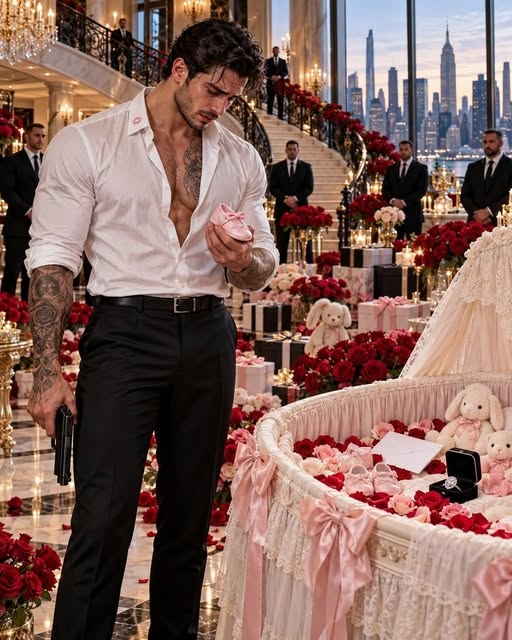
Change, I learned, is not an event. Men in my world love events — a sit-down, a verdict, a funeral, a signature — because events can be attended in a good suit and then left behind. Change was nothing like that. Change was a Tuesday. Change was a hundred Tuesdays, each one unphotographed, each one asking the same question the day before had asked, in a voice too quiet to argue with: and what will you do today, Vincent, now that no one is watching and nothing you do will be rewarded on any schedule you can control?
I began with the only appointment I had kept in months, and I kept it the way other men keep confessions.
Dr. Helen Price had an office on the Upper East Side with no name on the door that mattered and a waiting room deliberately too ordinary to remember. Marco had found her through channels he refused to describe — she had treated, I gathered, other men whose professions could not be written on intake forms, and she had survived the knowledge. She was sixty-one, gray-haired, unimpressed in a way that felt like standing in cold, clean water. On my first visit, three days after I saw Lily through the glass, she let me sit in silence for eleven minutes by the clock on her wall. I know it was eleven because I counted, the way I count exits.
"You are waiting for me to ask about your childhood," she said at last.
"Isn't that the procedure?"
"Eventually. First I want to know why you're here, in one sentence, and I want the sentence to contain no one else's name."
I tried. I produced a sentence about Grace, and she shook her head. I produced a sentence about Lily, and she shook her head again. My third attempt came out of me like something pulled from a wound: "I am here because I chose a woman I did not love over my daughter being born, and I do not know what kind of man does that, and I have to find out, because if I don't, I will do the next version of it."
Dr. Price nodded once, as if I had finally given her the correct time. "That," she said, "we can work with."
I went twice a week. I will not dress it up: in the beginning I went the way I had attended every obligation in my life, as a performance of attendance, waiting for the credit. Dr. Price declined, session after session, to give me credit. She was interested in the wrist. I came back to the wrist for a month. Vanessa's hand on my wrist at 10:17 p.m., my phone ringing with my wife's name, and the small, silken question — do you really want to answer that? — and my hand, my own hand, turning the phone face down on the table like a man concluding a piece of business. I had rehearsed a hundred versions in which I was seduced, distracted, drunk, pressured. Dr. Price took each version apart with the patience of a woman unpicking stitching.
"You weren't overwhelmed," she said. "You were relieved. Answering meant becoming a husband and a father in real time, with no control over the outcome. Not answering meant remaining the man at the party, where everything obeyed you. You did not choose Vanessa. You chose the room where you were God."
I walked out of that session and stood on Park Avenue in the rain for a long time, because she was right, and being right about me was a thing no one in my employ had dared in decades.
The letters went out every day.
That was not a metaphor, and it was not romantic, and Grace would have been the first to say so. Every morning, before anything else, I sat at the desk in my study — the desk where I had signed orders that ruined men — and I wrote one letter by hand, because Evelyn had mentioned, months of protocol ago, that typed pages from my office would go straight into a shredder, while handwriting at least proved a man had sat still. I wrote to Grace, and some days, on a second sheet, to Lily, care of Grace, for a future I had no right to assume. I wrote about what Dr. Kim's updates said, filtered twice through Evelyn, and what they did not say. I wrote about the nursery, which I had ordered left exactly as it was, roses removed, crib empty, door open. I wrote about Chicago without decorating it. That letter took four days and nine drafts, and the final version was two pages long and contained the sentence: there is no version of that night in which you failed me; there is only the version in which I failed, in sequence, at 10:17, at 11:42, and at 3:12, and then again the next night, which was the worst one, because by then I knew. I wrote about my father, which I had never done for anyone. I wrote about the two miscarriages, and how I had held Grace in a hospital corridor in 2019 and promised her the next child would know a different father than the boy I had been — I wrote that I had broken that promise before Lily was an hour old, and that knowing it did not entitle me to her forgiveness, only to my own work.
Evelyn received the letters. Evelyn, presumably, delivered them. What Grace did with them, I was not told, and after the first month I stopped asking. That, too, was part of the work, Dr. Price said: to write without an audience's reaction, to give without a receipt. It was, I told her, the first honest business I had ever conducted. She said, "Then conduct more of it."
So I did, and the next piece of it was the money.
I will be plain about my money: much of it had been made in ways that would not survive daylight, and all of it, clean and unclean, had one property in common — it had my name attached to its power. Romano money arrived like weather. It announced itself. That winter I learned to move it the other way. Through a blind charitable trust that Evelyn vetted line by line — I insisted she vet it, which I think was the first thing I ever did that genuinely surprised her — I funded the neonatal unit that was keeping my daughter alive. Not Lily's care; Grace had refused that absolutely, and she was right, because paying for Lily would have been a purchase dressed as love. The trust funded the unit itself: two additional incubators of the newest generation, a dedicated respiratory team for the night hours when crises come, a fund that covered costs for families in that corridor who fell asleep against the glass because the alternative was a billing office. My name appeared nowhere. The plaque by the nurses' station, when it went up in the spring, read only: GIVEN IN HONOR OF THE CHILDREN WHO ARRIVE EARLY, AND THE MOTHERS WHO WAIT. Nurse Okafor, who knew exactly where it came from — nothing in that unit escaped her — said nothing to me about it ever, except once, on a later visit, when she paused beside me at the hand-washing sink and said, "The new machines are quieter. The babies sleep deeper. That's all I'm saying, Mr. Romano," and walked on.
I did not tell Grace. I want to be precise about that, because it would be easy, later, to remember it as a courtship, and it was not. A gift announced is an invoice. I told Evelyn, because the trust required a lawful channel and because secrets between my wife and me had done enough damage for one lifetime; Evelyn told me, with something approaching respect, that whether Grace ever learned of it would be Grace's discovery, not my announcement. Months later I found out she had learned of it within a fortnight — nurses talk to the mothers who live beside them — and had said only, "Then he is learning the difference between giving and buying," and had gone back to holding Lily's hand through the porthole. When Evelyn finally repeated that sentence to me, in the summer, I had to sit down in my own kitchen, because it was the first sentence of Grace's about me in half a year that was not a verdict. It was an assessment. A man can live on an assessment, if he is honest about how starved he is.
And then there was the empire, which is the word everyone else used. Marco and I began, that winter, to dismantle the thing I had built and rebuild it as something that could sign its name in daylight.
I will not pretend this was noble from the first hour. It was terrifying, and it was slow, and twice it nearly went wrong in ways that do not belong in these pages except to say that men do not surrender profitable darkness because their boss has found his conscience, and that Marco Leone earned his twenty years of loyalty in that season more than in all the years of danger before it. We sold the clubs first — all of them, including the one in Chicago, which I disposed of without setting foot in that city, through lawyers, at a price slightly below market because speed mattered more than pride and because I could not have walked past that hotel again and remained the man I was trying to become. The import businesses were audited — really audited, by a firm that did not know my name until the engagement letter — and the parts of them that could not survive an auditor's questions were closed, wound down, their people paid severances I doubled out of my own accounts, because a man does not push his sins downhill onto the men who carried them for him. What remained — the real estate, the legitimate shipping contracts, the construction holdings that had always been half-clean — we consolidated under a holding company with independent directors whose job, I explained to their bewildered faces, was to be able to say no to me.
"You're building a cage for yourself," Marco said one night, over the spreadsheets, at two in the morning, in the study where the letter to Grace lay unfinished under a paperweight.
"I am building a house my daughter can visit," I said. "There's a difference. A cage is to keep something in. I want a place she can walk into with her shoes on and read the name on the door."
He was quiet for a while. Then he said, "Twenty years I've watched you make men afraid. I didn't know you knew how to make anything else." He initialled the page in front of him. "For what it's worth, boss — it's better work."
We did not speak of Grace's case in those sessions, Marco and I, except once, when the first custody review came and went and the court continued everything exactly as Grace had set it — the certificate unchanged, the protection order renewed, my visitation existing solely at her invitation. My lawyers, new ones, daylight ones, asked me if I wanted to contest. I said no so quickly that the senior partner blinked. "Mr. Romano, with your resources, a court might—"
"My resources are why she hid her," I said. "File the response. We accept. We thank the court for its time, and we accept."
Word of that reached Grace too, eventually. In that season, everything true reached her eventually. That was how I finally understood the system she had built: she had not cut me off from information about Lily; she had cut me off from control, and then she had simply watched — through Evelyn, through the court, through nurses and lawyers and the quiet reports of a world that talks — to see what a man does when control is taken away and only conduct remains. She was not waiting to be persuaded. She was waiting to see.
The letters changed before she answered them.
In the early weeks they had been long — confessions, inventories, apologies arranged like legal briefs, as if grief with enough exhibits might win. Dr. Price read none of them, but she asked me one question that altered all the rest: "Are you writing to be forgiven, or to be known? They are different letters." After that they got shorter, and stranger, and truer. I wrote about ordinary things. I wrote that the penthouse plants were dying because Grace had always been the one who knew their names. I wrote that I had learned to cook one thing badly and eaten it standing up. I wrote that I had passed a shop window with a yellow dress in it in a size Lily would not reach for two years and had stood there like a fool, and had not bought it, because buying things for a future I had not been given was the old man's trick. I wrote that I missed Grace's laugh in the specific room of the kitchen at seven in the morning. I wrote, once, only this: Lily's monitor numbers were good today. I sat in the study and cried at a percentage sign. I thought you should know that percentages can do that now.
In March, Evelyn called me on a matter of paperwork, and at the end of the call — after the signatures, after the dates — she said, in the tone of a woman placing something breakable on a high shelf, "You may stop sending two copies of the letters, Mr. Romano."
"I only send one," I said.
"I know," Evelyn said. "I am telling you that the archive copy I have been keeping is no longer necessary. Mrs. Sullivan has begun keeping them herself. In a box. In order." A pause, while she let the architecture of that sentence settle over me. "She read the Chicago letter twice, I am told. I am not told anything else, and neither, sir, are you."
I thanked her with a steadiness I did not feel and sat in my study for a long time after the call ended, with my hands flat on the desk, in the posture of a man at a glass wall, waiting.
Grace was reading the letters.
She had not answered one. She had not lifted a single condition, changed a single name, invited me to a single additional hour that was not earned some other way first. Nothing was forgiven. But somewhere across the city, in a quiet room I had never seen, my wife had opened a box instead of a shredder, and had begun, in order, from the first page, to read the truth as fast as I could learn to tell it.
Dr. Price asked me, that week, how it felt. I told her the truth, which by then had become almost a habit.
"It feels," I said, "like a hand on the other side of glass. Not touching mine. Just there. Just — there, on its own terms, where I can see it."
"And can you live with that?" she asked. "If that is all there is, for as long as it takes?"
I thought of a green line jumping on a monitor. I thought of a hand smaller than my thumbprint, closing in its sleep. I thought of Grace at 3:12 in the morning, in every year to come, and whether I would be a man who had once failed that hour or a man who had spent his life answering for it, hour by ordinary hour.
"Yes," I said. "I can live with that. That is what living with it means."