Story Genres: MAFIA BOSS

  • Chapter 7: THE FAMILY THAT FINALLY CAME HOME

    Chapter 7: THE FAMILY THAT FINALLY CAME HOME

    The letter had been written twelve years earlier.

    Daniel Bell had been a quiet man.

    He had never wanted power, money, or recognition.

    He had loved music, books, and the small house in Providence where he and Alessandra had built their life.

    He had also understood that his wife had never stopped missing her family.

    Before his death, he had written a letter addressed to Adrian Moretti.

    Alessandra had kept it in a wooden box with their wedding photographs.

    She had never sent it.

    “I didn't know whether I wanted you to read it,” she explained.

    Adrian took the envelope.

    “Why now?”

    “Because I think Daniel would have wanted us to stop carrying the past.”

    Adrian opened it.

    The handwriting was neat and careful.

    Mr. Moretti,

    You do not know me, but I have known about you for most of my adult life.

    Your sister has spoken about you many times.

    She remembers the boy who protected her when she was frightened, the brother who made her laugh, and the young man who promised to take her dancing when she was old enough.

    She also remembers the brother who never came looking for her.

    I cannot judge you for that. I do not know what you were told.

    But I know what your sister lost.

    She lost her mother, her home, and the brother she loved.

    She built a life with me, and I was grateful for every day of it. But I never pretended that I could replace her family.

    If you ever find this letter, please understand that she never wanted revenge.

    She wanted to know that she had not been forgotten.

    Daniel Bell.

    Adrian lowered the paper.

    For a moment, he could not speak.

    Alessandra stood beside him.

    “He loved you,” she said.

    Adrian looked at her.

    “I never met him.”

    “He knew you through me.”

    “Then I owe him more than I can repay.”

    She shook her head.

    “You owe him nothing. Just don't waste what we have left.”

    Adrian folded the letter carefully.

    “I won't.”

    —

    The following morning, the family gathered in the west drawing room.

    Adrian had asked the lawyers, investigators, and the new foundation board to attend.

    Salvatore sat near the fireplace.

    Enzo stood beside the door.

    Matteo and Isabella were seated together, with Sophia between them.

    Alessandra sat near the piano.

    Adrian entered carrying a folder.

    He placed it on the table.

    “I have spent my entire life believing that the Moretti name was something I had to protect.”

    Nobody interrupted.

    “I believed that our family could survive anything as long as the truth remained hidden.”

    He looked at Salvatore.

    “I was wrong.”

    Then he looked at the lawyers.

    “Every property that was transferred unfairly will be reviewed. Every rightful owner or surviving family will be contacted. Where restitution is possible, we will make it.”

    Thomas Hale nodded.

    “And the foundation?”

    “It will be restructured under independent management.”

    “Your position?”

    Adrian looked around the room.

    “I will step down as chairman.”

    Matteo's eyes widened.

    “Father—”

    Adrian raised one hand.

    “I am not asking you to take my place.”

    He turned toward his son.

    “I am asking you to build something better.”

    Matteo looked at him for a long moment.

    Then he nodded.

    “I will.”

    Adrian continued.

    “The records surrounding my mother's death will be provided to the appropriate authorities. Salvatore has agreed to cooperate. Dr. Conti has provided his testimony. Enzo will provide everything he remembers.”

    Salvatore lowered his head.

    “I will tell the truth.”

    Adrian looked at him.

    “Even when it hurts?”

    “Especially then.”

    The old man paused.

    “I cannot ask you to forgive me.”

    “You shouldn't.”

    Salvatore nodded.

    “But I can still do what I should have done thirty-one years ago.”

    Adrian extended his hand.

    “Then do it.”

    Salvatore looked at the offered hand.

    He hesitated before taking it.

    It was not forgiveness.

    Not yet.

    But it was the beginning of accountability.

    —

    The legal process took months.

    The investigation uncovered several improper transfers involving the old foundation.

    Some properties were returned directly.

    Others were compensated through settlements.

    A number of historical records were corrected.

    The Moretti name appeared in newspapers, but not in the way Vittorio had once demanded.

    There were no grand speeches about power.

    No declarations of victory.

    Instead, there were public apologies, signed agreements, and families receiving documents that finally recognized their ownership.

    Adrian attended several of the meetings personally.

    At one small house outside the city, he met an elderly couple who had spent years believing their family property had been lost forever.

    The husband held the restored deed.

    His wife began to cry.

    “Why are you doing this?” she asked.

    Adrian looked at the paper.

    “Because it should never have been taken.”

    “Your father did this?”

    “Yes.”

    “And you are his son.”

    Adrian nodded.

    “I am.”

    The woman studied him.

    “Then perhaps you can do something different.”

    Adrian looked at her.

    “That is what I am trying to do.”

    He left without accepting their gratitude.

    He did not deserve it.

    Not yet.

    —

    The opening ceremony of the Evelyn Moretti Foundation took place on a bright Saturday morning.

    The ballroom had been transformed.

    The heavy velvet curtains were open, the chandeliers illuminated the room, and flowers decorated the tables.

    But there were no expensive business speeches.

    No displays of family wealth.

    Instead, the room was filled with music students, their parents, teachers, philanthropists, and families who had received assistance from the foundation.

    Alessandra stood beside the piano.

    Adrian watched from the front row.

    She played the melody their mother had taught them as children.

    When the music ended, the room applauded.

    Then a young girl approached the stage.

    She was eight years old and held a small violin.

    “Miss Bell,” she said nervously, “I'm ready.”

    Alessandra smiled.

    “Then show everyone what you've learned.”

    The girl began to play.

    Her performance was imperfect.

    She missed a note and stopped briefly.

    Adrian watched her face.

    She looked frightened.

    Then Alessandra nodded encouragingly.

    The child began again.

    This time, she completed the melody.

    The applause was warm and genuine.

    Adrian turned toward Matteo.

    “Your grandmother would have loved this.”

    Matteo nodded.

    “She would have wanted every child to have a chance.”

    “Even if they made mistakes?”

    “Especially then.”

    Adrian smiled.

    After the ceremony, he approached the young violinist.

    “What is your name?”

    “Lucy.”

    “Do you enjoy playing?”

    She nodded.

    “Very much.”

    “Then keep practicing.”

    She looked up at him.

    “Are you Mr. Moretti?”

    “I am.”

    “Thank you for helping me.”

    Adrian paused.

    “You earned this opportunity. I only helped make it possible.”

    The girl smiled and ran toward her mother.

    Alessandra approached.

    “You did well.”

    “I didn't do anything.”

    “You spoke to her.”

    Adrian looked toward the child.

    “She was frightened.”

    “Most people are when they begin something important.”

    He smiled.

    “Mother used to say that.”

    “Yes.”

    Alessandra looked around the room.

    “Do you think she would recognize this place?”

    Adrian considered the question.

    “I think she would recognize the music.”

    “And the people?”

    He looked at the families gathered around the tables.

    “I think she would recognize the happiness.”

    Alessandra slipped her arm through his.

    They stood together.

    For thirty-one years, the mansion had been a place of locked rooms, concealed letters, and unanswered questions.

    Now it was filled with children learning music.

    It was not a perfect family.

    It was not a perfect history.

    But it was finally becoming the kind of place Evelyn had wanted.

    And that was enough.

    —

    Salvatore's confession was formally recorded.

    He admitted his role in the false death documentation and the concealment of Evelyn's correspondence.

    He also confirmed the circumstances surrounding the medical delay.

    He did not ask for special treatment.

    He did not blame Vittorio for every decision.

    He described what he had done and accepted responsibility.

    Afterward, he returned to the mansion.

    Adrian found him in the garden.

    The old man was sitting on the stone bench.

    “May I sit?” Adrian asked.

    Salvatore looked surprised.

    “Of course.”

    Adrian sat beside him.

    For several minutes, they watched the apple tree.

    “Your mother loved this place,” Salvatore said.

    “I know.”

    “She used to come here every morning.”

    “I remember.”

    “She said the garden was the only place in the mansion where nobody could tell her what to think.”

    Adrian smiled faintly.

    “That sounds like her.”

    Salvatore looked down.

    “I should have protected her.”

    “Yes.”

    “I should have called the doctor.”

    “Yes.”

    “I should have told you the truth.”

    Adrian turned toward him.

    “Yes.”

    Salvatore's eyes filled.

    “I don't expect forgiveness.”

    Adrian looked at the old man.

    “I don't know if I can give it.”

    Salvatore nodded.

    “But I can promise you something.”

    “What?”

    “I will never again allow fear to make my decisions.”

    Adrian extended his hand.

    Salvatore took it.

    They sat together beneath the apple tree.

    For the first time in thirty-one years, neither man was hiding anything.

    —

    Alessandra began visiting the mansion.

    At first, she stayed only for an hour.

    Then she stayed for lunch.

    Eventually, she began spending entire afternoons in the music room.

    She had not decided whether she wanted to return permanently.

    She had a life in Providence.

    Her students depended on her.

    Her home was filled with memories of Daniel.

    She did not intend to abandon everything simply because her brother had finally found her.

    Adrian understood.

    He did not ask her to move.

    Instead, he had the old piano restored.

    The instrument had belonged to Evelyn.

    He placed it beside the window overlooking the garden.

    When Alessandra saw it, she stopped in the doorway.

    “You remembered.”

    “I remember more than I thought.”

    She walked toward it.

    The keys were polished.

    The wood had been repaired.

    A small silver plaque rested above the keyboard.

    For Evelyn Moretti, who believed music could bring a family home.

    Alessandra touched the plaque.

    “You shouldn't have done this.”

    “Why?”

    “Because now I'll have to forgive you.”

    Adrian looked at her.

    “I don't expect that.”

    She sat down.

    Then she began to play.

    The melody filled the mansion.

    It was the same one Evelyn had played when her children were young.

    Adrian stood behind her.

    He did not interrupt.

    When the music ended, Alessandra looked over her shoulder.

    “Do you remember the words?”

    “What words?”

    “Mother used to sing them.”

    Adrian shook his head.

    She smiled.

    “She said that even when a house becomes cold, someone can always bring back the light.”

    He looked toward the window.

    The garden was bright with afternoon sunlight.

    “Perhaps she was right.”

    —

    Sophia became fascinated by her new great-aunt.

    She called Alessandra “Auntie Allie.”

    Alessandra loved it.

    She taught the little girl how to press piano keys gently and how to water the plants without flooding the soil.

    One afternoon, Sophia brought her a small drawing.

    It showed three figures standing beside an apple tree.

    A tall man with gray hair.

    A woman with long silver hair.

    And a little girl wearing red shoes.

    Alessandra stared at it.

    “Who are these people?”

    Sophia pointed.

    “Grandpa.”

    Then she pointed to the silver-haired figure.

    “Grandma.”

    “And who is this?”

    “Me.”

    Alessandra smiled.

    “That's a lovely picture.”

    Sophia looked toward the window.

    “Grandma says the garden is happy.”

    Alessandra's smile faded slightly.

    “What do you mean, sweetheart?”

    “She doesn't look sad now.”

    The little girl returned to her crayons.

    Alessandra looked at Adrian.

    He was standing near the doorway.

    He had heard every word.

    Neither spoke.

    —

    The mansion changed gradually.

    The old portrait of Vittorio was removed from above the fireplace.

    Adrian did not destroy it.

    He placed it in a private archive with the documents that recorded the family's history.

    He wanted the next generation to understand that a person's mistakes should not be erased simply because they were uncomfortable.

    The west drawing room became a family room.

    The old piano was moved closer to the garden windows.

    The library remained, but the heavy curtains were replaced with lighter ones.

    The gardener's shed was restored.

    Adrian refused to remove the hidden compartment.

    Instead, he placed a small protective case inside it.

    The original letter, photograph, and silver key were preserved there.

    Not as secrets.

    As reminders.

    A small plaque was placed beside the compartment.

    Truth is not a betrayal of family. Silence can be.

    —

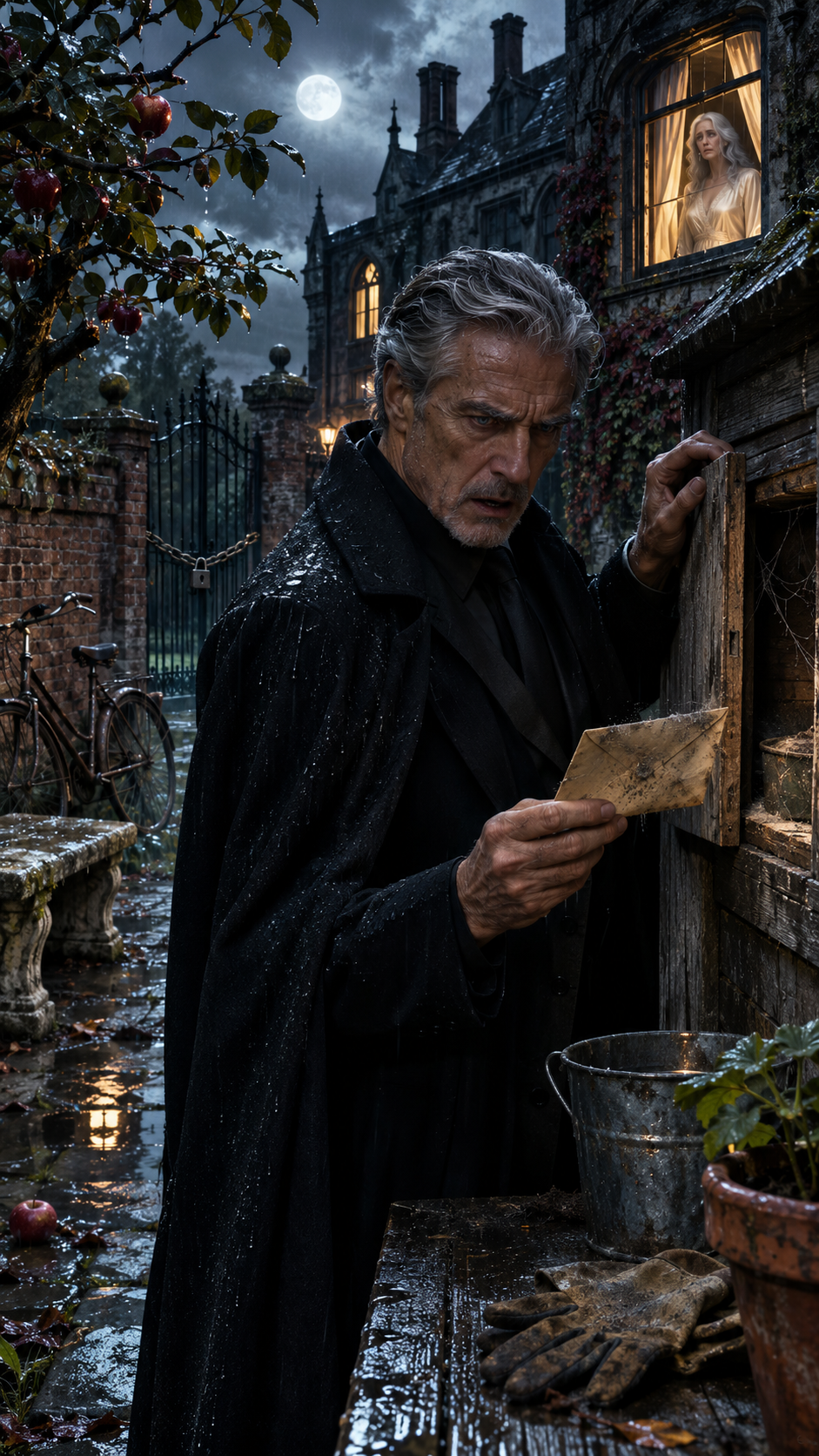
    On the first anniversary of the discovery, the family gathered in the garden.

    It was a clear evening.

    The old iron gate stood open.

    The stone bench had been cleaned.

    The old bicycle had been restored and placed against the redbrick wall.

    The gardening gloves lay beside a fresh plant pot.

    Sophia wore a little red dress and a matching ribbon.

    She carried a drawing.

    “Grandpa!”

    Adrian turned.

    “Yes, sweetheart?”

    “I made something.”

    He bent down.

    She handed him the paper.

    It showed the mansion, the apple tree, and the garden shed.

    There were four people standing together.

    A tall man with gray hair.

    A woman with long silver hair.

    A woman with brown hair.

    And a little girl with red shoes.

    Adrian looked at the drawing.

    “Who is everyone?”

    Sophia pointed.

    “That's you.”

    He smiled.

    “And this?”

    “Grandma Evelyn.”

    Adrian looked at the silver-haired figure.

    “And who is this?”

    “Auntie Allie.”

    Alessandra laughed.

    “And the little girl?”

    Sophia pointed at herself.

    “Me!”

    Adrian held the drawing carefully.

    “You made us all together?”

    Sophia nodded.

    “Because nobody is missing now.”

    The old man looked at his sister.

    Alessandra's eyes were wet.

    Matteo stood beside Isabella, holding their daughter's small jacket.

    Enzo watched from the terrace.

    Salvatore sat quietly near the garden entrance.

    For the first time in decades, the mansion felt like a home rather than an institution.

    Adrian placed the drawing in his coat.

    Then Sophia took his hand.

    “Grandpa, can we go see Grandma?”

    He looked toward the upstairs window.

    The warm yellow light was glowing.

    “Of course.”

    He walked with her toward the mansion.

    —

    That night, Adrian went upstairs alone.

    He entered Evelyn's old bedroom.

    The white curtains moved gently in the evening breeze.

    Her photograph stood beside the music box.

    He wound it.

    The familiar melody began.

    Adrian sat on the edge of the bed.

    “Mother,” he whispered.

    For several seconds, nothing happened.

    Then he noticed the window.

    A pale figure stood outside the glass.

    Evelyn.

    Her long silver hair rested over her white silk nightgown.

    Her face was peaceful.

    Her eyes were no longer filled with sorrow.

    Adrian rose slowly.

    “I found her.”

    The woman smiled.

    “I told her everything.”

    He swallowed.

    “I told her how sorry I was.”

    The figure lifted one hand.

    Adrian approached the window.

    “I don't know whether I did enough.”

    Evelyn's expression softened.

    For a moment, he saw the woman who had held him when he was a child.

    The woman who had kissed his forehead before school.

    The woman who had believed in him even when he had stopped believing in himself.

    Then she moved her lips.

    He could not hear the words.

    But he understood them.

    I love you.

    Adrian placed his hand against the glass.

    “I love you too, Mother.”

    The room filled with the soft melody of the music box.

    A warm breeze moved through the curtains.

    And the figure disappeared.

    The window remained illuminated.

    But the sadness was gone.

    —

    The following morning, Adrian made one final change.

    He called a meeting of the foundation's new board.

    “I want the foundation renamed.”

    Thomas Hale looked up.

    “What name would you prefer?”

    Adrian placed a photograph on the table.

    It showed Evelyn beneath the apple tree.

    “Evelyn Moretti Foundation.”

    Matteo smiled.

    “That is fitting.”

    Adrian nodded.

    “The foundation will support families facing financial hardship, preserve historic homes, and provide scholarships for children who want to study music and the arts.”

    Alessandra looked at him.

    “Mother would have loved that.”

    “I know.”

    “And what will happen to the old family business?”

    Adrian looked toward the window.

    “It will continue only where it can operate honestly. Anything that cannot survive without deception will end.”

    The board members exchanged glances.

    One of them asked, “And your personal position?”

    Adrian considered the question.

    “I will remain available during the transition. But I will no longer rule the family as my father ruled it.”

    Matteo smiled.

    “What will you do instead?”

    Adrian looked at his son.

    “I will be a father.”

    Then he looked at his granddaughter.

    “And a grandfather.”

    Sophia was sitting on Isabella's lap, coloring.

    She looked up.

    “Can you be a gardener too?”

    Adrian laughed.

    “I suppose I can try.”

    “You have to water the apple tree.”

    “I can do that.”

    “And no forgetting.”

    “I promise.”

    —

    Several months later, the garden was filled with flowers.

    The old shed had become a small reading room for the foundation's visiting children.

    The wooden wall remained intact, and the hidden compartment was preserved behind a clear protective panel.

    Visitors could see the original box, the silver key, and the photograph of Evelyn with her two children.

    A small description explained the history.

    Not the scandal.

    Not the accusations.

    The truth.

    A mother who had refused to let her children remain separated.

    A family that had hidden a terrible mistake.

    And a man who had finally chosen to face it.

    —

    That evening, the Morettis gathered beneath the apple tree.

    Alessandra had returned from Providence.

    Matteo and Isabella brought dinner outside.

    Enzo joined them with a small cake.

    Even Salvatore came down from the eastern wing.

    Nobody made a speech.

    Nobody discussed business.

    Nobody mentioned the past unless they wanted to.

    They simply sat together.

    Adrian watched his sister laugh with his son.

    He watched Sophia chase a butterfly across the grass.

    He watched Isabella help Enzo arrange the plates.

    And he realized that his mother had never wanted a powerful family.

    She had wanted a family that loved one another.

    For thirty-one years, he had mistaken the mansion for her legacy.

    Now he understood.

    Her legacy was not the walls.

    It was not the garden.

    It was not the name above the gate.

    It was the truth she had left behind, and the love that had survived even when everyone believed it was lost.

    When the moon rose above the gothic roof, Adrian stood beside the old gardener's shed.

    He opened the wooden compartment one last time.

    Inside, the protective case held Evelyn's letter.

    He read its final line.

    Do not let grief turn into another prison.

    He closed the compartment gently.

    Then he turned toward the family.

    Sophia was waving at him.

    “Grandpa! Come here!”

    Adrian walked toward her.

    For once, he did not look back.

    Behind him, the upstairs window glowed with warm yellow light.

    And in the reflection of the glass, for one brief moment, Evelyn Moretti appeared to stand smiling beside the curtains.

    She watched her son return to his family.

    Then the light softened.

    The figure disappeared.

    Not because the truth had been forgotten.

    But because it had finally been heard.

    And for the first time in thirty-one years, Evelyn could rest.

    THE END
  • Chapter 6: THE PRICE OF THE TRUTH

    Chapter 6: THE PRICE OF THE TRUTH

    The family vault stood beneath the oldest part of the mansion.

    It was not a place of treasure in the ordinary sense.

    There were no gold bars or jewels.

    Instead, it contained deeds, family records, sealed agreements, photographs, and documents that had shaped the Moretti family for generations.

    A heavy oak door separated it from the rest of the house.

    Matteo stood before it with a small brass key.

    Adrian watched him.

    “Are you sure?”

    “No.”

    “Good.”

    Matteo looked at his father.

    “You always told me certainty was important.”

    “I was wrong about many things.”

    The younger man turned the key.

    The door opened.

    Inside, a single desk stood beneath a wall of shelves.

    A sealed envelope rested in the center.

    The Moretti family crest had been stamped into the wax.

    Matteo picked it up.

    His name appeared on the front.

    To Matteo Moretti, when the family is finally ready to hear the truth.

    He broke the seal.

    Inside was a letter from Vittorio.

    Matteo read silently.

    Then he looked at Adrian.

    “Father.”

    “What?”

    “You should read this.”

    Adrian took the paper.

    The letter was short.

    To my grandson,

    If you are reading this, then your father has discovered the truth about Evelyn.

    I have spent many years convincing myself that I acted for the good of the family. I believed that a family could survive any secret if the secret remained buried.

    I was wrong.

    Your grandmother wanted to save this family from itself.

    I stopped her.

    I told myself that her illness would have taken her eventually. I told myself that the doctor might not have saved her. I told myself that the documents mattered.

    But I knew she needed help, and I delayed it.

    I have no excuse.

    I ask you not to defend me.

    I ask you to protect the people I failed to protect.

    Vittorio Moretti.

    Adrian lowered the letter.

    For thirty-one years, he had imagined his father as a powerful man who had been wronged by a cruel world.

    Now he saw him clearly.

    A man who had been given a choice.

    And who had chosen pride.

    Matteo looked at the final paragraph.

    “There's more.”

    He turned the page.

    A second note was attached.

    The properties listed in the enclosed register were not acquired fairly. If the family has any honor left, return them to their rightful owners.

    Adrian looked at the register.

    It contained dozens of names.

    Families.

    Small businesses.

    Individuals who had trusted the Moretti Foundation.

    He recognized some addresses.

    Several properties were still held by companies under his control.

    The truth had become larger than his mother.

    It was no longer only about what had happened in one room thirty-one years ago.

    It was about what the family had built afterward.

    “What are you going to do?” Matteo asked.

    Adrian looked at the documents.

    “Everything.”

    —

    The following weeks changed Moretti Mansion.

    Lawyers arrived daily.

    Accountants reviewed old records.

    Independent investigators examined property transfers.

    The family foundation temporarily suspended several operations while an outside board conducted a full review.

    Adrian signed documents authorizing the release of records.

    He did not attempt to hide his father's involvement.

    He did not attempt to remove his own name from the history.

    For the first time, he allowed the family to be examined without controlling the result.

    Salvatore provided a sworn statement.

    He described the false death certificate, the concealed correspondence, the medical delay, and his own participation.

    Dr. Conti supplied his original records.

    Enzo gave a statement explaining how Evelyn had hidden the letters.

    Alessandra provided copies of the correspondence she had received.

    Every document became part of the official record.

    —

    [CẢNH MỚI 1 — ADRIAN PHÁT HIỆN CHỮ KÝ CỦA CHÍNH MÌNH]

    Near midnight, Matteo returned to the library with a thin folder. Adrian was still at the desk, reading the names of families whose histories had been reduced to dates and signatures.

    “There's something you need to see,” Matteo said.

    The first page was a renewal agreement dated eleven years after Vittorio's death. The original transfer had been made under the old foundation, but the renewal had kept the property under a Moretti-controlled company for another twenty years.

    At the bottom was Adrian's signature.

    He stared at it. “I signed this?”

    “The signature is yours. It was approved during the annual review.”

    “I remember the review. There were hundreds of pages.”

    “Did you read this one?”

    Adrian turned to the attached schedule. A family had been living in the property when the original transfer was made. The renewal had extended the arrangement without giving them a chance to challenge it.

    “I was told these were routine renewals,” he said.

    “Maybe that is what you believed.”

    Adrian looked up. “You think I should have known?”

    “I think you should have asked. I'm not saying you knew what the papers concealed. I'm saying your name helped keep the arrangement in place.”

    Adrian remembered signing the papers without asking whose home appeared on the schedule.

    “Add this to the disclosure,” he said.

    Matteo hesitated. “Your own signature?”

    “Especially my own signature. Do not separate my name from the decision.”

    “You could let the lawyers explain the circumstances.”

    “They can explain them. They cannot erase them.”

    Alessandra appeared in the doorway. She looked from the papers to her brother.

    “What happened?”

    Adrian showed her the agreement. She read it carefully.

    “Mother used to say that a signature is only as honest as the attention behind it,” she said.

    “I remember.”

    “She said people often signed things because they trusted whoever placed the paper in front of them. But trust didn't excuse them from looking.”

    Adrian lowered his eyes. “She was trying to teach me.”

    “She was trying to teach all of us.”

    He pushed the folder toward Matteo. “Send a copy to the independent board in the morning. Include the original schedule and the date. I want them to know I approved it.”

    “This may make the review harder,” Matteo said.

    “It should be hard. If the truth is inconvenient, that doesn't make it less true.”

    Alessandra rested a hand on the chair. “Mother would not have wanted you to destroy yourself over this.”

    “I am not trying to punish myself.”

    “Then what are you trying to do?”

    Adrian looked at his signature. “Make sure nobody else discovers that a decision affecting their home was hidden inside a pile of papers someone considered routine.”

    Matteo gathered the folder.

    “I'll make sure it is included.”

    “Thank you.”

    When his son had gone, Alessandra remained.

    “You know Mother always believed you could choose differently.”

    Adrian looked toward the doorway. “I wish I had chosen sooner.”

    “So do I.”

    She did not soften the answer. But she stayed beside him while he read the agreement again.

    There were consequences.

    Some business partners withdrew.

    Several trustees resigned.

    Newspapers began asking questions.

    A few old acquaintances called Adrian to suggest that he stop the investigation.

    He refused.

    One afternoon, a senior associate named Richard Voss came to the mansion.

    He had worked with the family for more than twenty years.

    “Adrian, this is becoming dangerous for the business.”

    Adrian looked at him.

    “Which part?”

    “The public statements. The property review. The records being handed to investigators.”

    “Those records belong to the truth.”

    “Your father would never have allowed this.”

    Adrian's expression became cold.

    “My father is the reason it needs to happen.”

    Richard lowered his voice.

    “You are destroying everything he built.”

    Adrian stood.

    “No. I am discovering what he built.”

    “You cannot simply abandon the family.”

    “I am not abandoning anyone.”

    “Then why expose us?”

    Adrian walked toward the window.

    “Because the people who lost their homes deserve to know what happened.”

    Richard shook his head.

    “You are choosing strangers over your own blood.”

    Adrian turned.

    “My mother was my blood.”

    The room fell silent.

    “She begged this family to do the right thing. We ignored her. I will not make the same mistake.”

    Richard left without another word.

    Adrian watched him go.

    He knew that more people would walk away.

    For the first time, he did not consider that a tragedy.

    —

    [CẢNH MỚI 2 — CHIẾC XÍCH KHÓA CỔNG VƯỜN]

    Adrian found Enzo in the garden just before dusk. The old steward stood beside the iron gate, holding a small brass key. The chain still crossed the gate's two handles.

    “Why are you here?” Adrian asked.

    “Because it is time you knew why this gate was locked.”

    “It has been locked for as long as I can remember.”

    “Your mother asked me not to lock it. She said Alessandra might come home one day, and she wanted her to walk into the garden without asking permission.”

    Adrian looked toward the apple tree. “Then why was it chained?”

    “Your father ordered it after the funeral. No one was to enter or leave the grounds without his approval.”

    “And you obeyed.”

    Enzo lowered his eyes. “I told myself I was keeping the peace. I was really keeping the door closed.”

    He held out the key.

    “I kept it all these years. I thought throwing it away would mean your mother's wish no longer mattered.”

    Adrian took it. “Did Alessandra ever try to come back?”

    “Once. She wrote asking whether she could visit the garden. Your father saw the letter before I could answer. He told me to say the family did not want visitors.”

    “Did you send that reply?”

    “I did.”

    The admission settled between them.

    “Then you helped keep her away twice,” Adrian said.

    “Yes.”

    Enzo did not ask to be excused.

    Adrian placed the key in the lock. It resisted, then turned. He lifted the chain from the handles and let it fall gently against the brick post.

    The gate swung inward.

    “Leave it open,” he said.

    “Even at night?”

    “Especially at night.”

    “When Alessandra comes back,” Adrian said, “she should not have to wait outside.”

    Enzo gathered the chain and carried it away. Adrian remained beside the open gate until the mansion lights came on.

    —

    That evening, Matteo found his father in the library.

    The desk was covered with documents.

    Adrian was reading the same property register he had examined earlier.

    “You haven't eaten,” Matteo said.

    “I am not hungry.”

    “You haven't slept properly either.”

    Adrian looked up.

    “Are you keeping a record?”

    “Someone should.”

    Matteo sat opposite him.

    For a moment, neither spoke.

    Then Matteo asked, “Are you afraid?”

    Adrian looked at him.

    “Of what?”

    “Of losing everything.”

    The old man considered the question.

    “Yes.”

    Matteo seemed surprised.

    Adrian continued.

    “I spent most of my life believing that losing control was the same as losing myself.”

    “And now?”

    “Now I think I was wrong.”

    Matteo leaned forward.

    “Father, the investigation may involve decisions you made personally. You understand that?”

    “Yes.”

    “You might have to answer difficult questions.”

    “I expect to.”

    “And some people may blame you for things your father did.”

    Adrian nodded.

    “They may have reasons.”

    Matteo studied him.

    “You don't have to take responsibility for every mistake in this family.”

    “No. But I have to take responsibility for what I allowed to continue.”

    He closed the register.

    “Do you remember when you were a child and I told you that the Moretti name was the most important thing you would ever inherit?”

    Matteo smiled faintly.

    “Yes.”

    “I was wrong.”

    “What should I have told you?”

    Adrian looked toward the portrait of Evelyn.

    “That your character would matter more than your surname.”

    Matteo became quiet.

    His father rarely spoke this way.

    “I don't want Sophia growing up believing she must protect a name at any cost,” Adrian continued. “I want her to be free to become whoever she chooses.”

    “She will be.”

    “Promise me.”

    “I promise.”

    Adrian reached across the desk.

    Matteo took his hand.

    For several seconds, they remained that way.

    Then Matteo smiled.

    “You know, Father, you could still learn to play the piano.”

    Adrian looked at him.

    “Absolutely not.”

    “Grandmother wanted you to.”

    “She wanted many things.”

    “And you are finally doing some of them.”

    Adrian shook his head, but a small smile appeared.

    “Perhaps.”

    Matteo stood.

    “Come downstairs. Isabella has made dinner.”

    Adrian gathered the papers.

    “I'll be there.”

    As Matteo reached the door, Adrian spoke again.

    “Thank you.”

    His son turned.

    “For what?”

    “For not allowing me to become my father.”

    Matteo smiled.

    “Grandmother would be proud.”

    After his son left, Adrian looked at Evelyn's photograph.

    For the first time, the thought of the future did not frighten him.

  • Chapter 5: THE NIGHT THAT TOOK HER

    Chapter 5: THE NIGHT THAT TOOK HER

    Dr. Samuel Conti lived in a quiet coastal town outside Providence.

    He was ninety-one years old, retired, and increasingly reluctant to discuss the past.

    When Adrian's car arrived at his home, the doctor was sitting on the porch with a blanket over his knees.

    He recognized the Moretti name immediately.

    “I wondered when someone would come,” he said.

    Adrian approached.

    “Then you know why I am here.”

    The doctor nodded.

    “I have wondered for thirty-one years whether this day would come.”

    “Did you treat my mother?”

    “Yes.”

    “Did you know she had a serious heart condition?”

    “Yes.”

    “Did you know she was supposed to receive immediate treatment if she experienced another episode?”

    The doctor looked at him.

    “I gave her those instructions personally.”

    “Then explain why you arrived twenty-three minutes after she collapsed.”

    Dr. Conti closed his eyes.

    “Because I was told not to come.”

    Adrian did not move.

    “By whom?”

    “Vittorio.”

    The old man's voice was almost inaudible.

    “He telephoned my office and said Mrs. Moretti had suffered a mild episode but was recovering. He instructed me to wait until he called again.”

    “Did you believe him?”

    “I was his physician. I should have known better.”

    “Why didn't you come immediately?”

    The doctor looked down.

    “I was afraid of losing my position. I had been treating the family for years. Your father was a powerful man.”

    Adrian's expression hardened.

    “My mother was dying.”

    “I know.”

    “And you waited.”

    “Yes.”

    The doctor began to cry.

    “I have regretted that decision every day since.”

    Adrian stood silently.

    He wanted to shout.

    He wanted to ask why a man entrusted with human lives had chosen his position over his duty.

    But the doctor's face was already filled with the knowledge of what he had done.

    “Could she have survived?” Adrian asked.

    Dr. Conti took a long breath.

    “Possibly. I cannot promise she would have. Her condition was serious.”

    “But?”

    “But the delay reduced her chances significantly.”

    Adrian looked toward the sea.

    The wind moved through the trees.

    “Did she regain consciousness?”

    The doctor nodded.

    “For a brief period.”

    “What did she say?”

    “She asked whether her children were safe.”

    Adrian closed his eyes.

    “Did you tell her?”

    “I told her that her son was on his way.”

    The doctor paused.

    “She asked me to give you something.”

    “What?”

    “A message.”

    Adrian turned.

    “What message?”

    Dr. Conti looked directly at him.

    “She said, 'Tell Adrian that I never wanted him to inherit his father's fear.'”

    The words entered Adrian like a blade.

    He had inherited everything else.

    The business.

    The properties.

    The power.

    The name.

    And the fear.

    He had spent decades believing that being feared was the same as being respected.

    His mother had known better.

    “Was that all?”

    “No.”

    The doctor looked toward the house.

    “I kept a copy of my original medical report.”

    He rose slowly and disappeared inside.

    When he returned, he carried a thin folder.

    He handed it to Adrian.

    Inside were treatment notes, call records, and a statement signed by Dr. Conti.

    The record showed that the first call requesting medical assistance had been placed at 11:48 p.m.

    The second call, made after Vittorio gave permission, had been placed at 12:11 a.m.

    Twenty-three minutes.

    But there was another document.

    A handwritten note from the doctor.

    At 11:52 p.m., Mr. Salvatore Moretti requested that I disregard the earlier instruction and come immediately. Mr. Vittorio Moretti personally intervened.

    Adrian looked at his uncle.

    Salvatore had accompanied them.

    The old man's face was pale.

    “You tried to call the doctor?” Adrian asked.

    Salvatore nodded.

    “After your mother collapsed, I wanted help.”

    “Then why didn't you tell me?”

    “Your father threatened to expose my involvement in the false documents.”

    Adrian stared at him.

    “You were willing to let my mother die to protect your own reputation?”

    Salvatore's eyes filled.

    “I thought I could convince him.”

    “You had twenty-three minutes.”

    “I know.”

    “Twenty-three minutes!”

    Adrian's voice echoed across the porch.

    The doctor looked down.

    Salvatore began to tremble.

    “I am sorry.”

    Adrian turned away.

    For the first time in his life, he had no interest in hearing the apology of a man who had allowed fear to become an excuse.

    —

    They returned to the mansion the following evening.

    Alessandra had agreed to accompany them.

    She stood at the entrance for several minutes, looking at the grand staircase.

    “I used to race down those steps,” she said.

    Adrian stood beside her.

    “You always cheated.”

    “I was faster.”

    “You were smaller.”

    She smiled faintly.

    Then she looked toward the portrait of Vittorio.

    “Is he still there?”

    “Yes.”

    “Why?”

    Adrian followed her gaze.

    “I never thought about removing it.”

    “Perhaps you should.”

    He nodded.

    “I will.”

    They walked through the hall together.

    Every room seemed to contain a memory.

    The dining room where Evelyn had insisted that everyone eat together.

    The library where Adrian had learned to read.

    The music room where Alessandra had practiced piano.

    The west drawing room where their mother had spent her final evening.

    Alessandra stopped outside the room.

    “I don't want to go in.”

    “You don't have to.”

    She looked at him.

    “Did you?”

    Adrian shook his head.

    “Not for years.”

    “Why?”

    “Because I was afraid I would remember.”

    She touched his arm.

    “Remembering isn't the same as suffering.”

    He looked at her.

    It was the first time she had touched him since their reunion.

    He did not move.

    He simply allowed her hand to remain there.

    —

    That night, they gathered in the library.

    On the desk lay the documents from the garden shed, the medical records, Vittorio's diary, and the photograph of Evelyn.

    Adrian had asked Salvatore to sit with them.

    The old man looked exhausted.

    “I have one more thing to tell you,” he said.

    Adrian nodded.

    “Speak.”

    Salvatore removed a folded sheet from his coat.

    It was a letter.

    “I found this among your father's personal papers after his death.”

    Adrian took it.

    The envelope had never been opened.

    It was addressed to Vittorio.

    Evelyn's handwriting appeared on the front.

    For my husband, if he ever remembers that I am his wife before I am his enemy.

    Adrian unfolded it.

    The letter was dated September 14, 1995.

    Vittorio,

    I have spent most of my life trying to make this family something it could be proud of.

    I raised our son to respect you. I protected our daughter when you wanted to control her. I stayed beside you when your decisions hurt people who had trusted us.

    But I will not remain silent anymore.

    I have seen the documents. I know what has been done to those families. I know the foundation has been used to conceal the transfers.

    I am going to tell Adrian.

    He deserves the opportunity to choose a different life.

    If you stop me, you will not be protecting this family. You will be protecting your pride.

    Evelyn.

    Adrian lowered the paper.

    Alessandra was crying.

    Salvatore looked at the floor.

    Matteo stood behind his father.

    For several minutes, nobody spoke.

    Then Adrian asked the question that had been waiting inside him.

    “Did my father ever read this?”

    Salvatore nodded.

    “He found it that night.”

    “And what did he do?”

    “He kept it.”

    “Why?”

    “Because he knew she was right.”

    Adrian looked at the letter again.

    His father had known.

    He had understood.

    And he had chosen to protect himself anyway.

    —

    Alessandra had not spoken for several minutes.

    She stood beside the piano, holding the old photograph.

    Then she began telling them about the final telephone conversation.

    “I remember the weather,” she said.

    “It was raining in Providence. Daniel had gone to bed, and I was sitting in the kitchen.”

    Adrian listened.

    “Mother called shortly before midnight. She sounded different.”

    “How?”

    “Like someone who had made a decision and was frightened by how much it would change.”

    Alessandra closed her eyes.

    “She asked whether I still had the photograph of the three of us beneath the apple tree.”

    “I remember that photograph,” Adrian said.

    “She told me to keep it. She said she was going to bring everything home.”

    Alessandra looked at her brother.

    “I asked what she meant. She said she had found the documents and that she was going to tell you.”

    “Did she say Father knew?”

    “Yes.”

    “What did she say about him?”

    “She said he was angry. But she wasn't going to let him frighten her anymore.”

    Alessandra sat down.

    “She also asked me something strange.”

    “What?”

    “She asked whether I remembered the game we used to play in the garden.”

    Adrian frowned.

    “The one with the shed?”

    She nodded.

    “When we were children, Mother would hide little objects behind the wooden panels. We had to find them.”

    Adrian smiled faintly.

    “She always cheated.”

    “She said the wall had a secret.”

    He looked at her.

    “What were her exact words?”

    Alessandra thought for a moment.

    “She used to say, 'It hides behind the wall, it hides behind the wall…'”

    Adrian went completely still.

    Sophia's words echoed in his mind.

    Alessandra noticed his expression.

    “What is it?”

    “Nothing.”

    But he looked toward the garden.

    She continued.

    “Mother said she had hidden something there for you. I asked whether she wanted me to retrieve it. She said no. She wanted you to find it.”

    Adrian slowly sat down.

    “She knew I would come eventually.”

    “I think she hoped you would.”

    Alessandra looked at the photograph.

    “Then I heard Father in the background.”

    “What did he say?”

    “He told her to put down the telephone.”

    “And she?”

    “She said she was speaking to her daughter.”

    Adrian's jaw tightened.

    Alessandra continued.

    “Then I heard a noise. Something fell. Mother said my name.”

    Her voice broke.

    “I asked what was wrong. She told me not to worry.”

    Adrian moved closer.

    “What happened next?”

    “She said, 'Tell your brother that the garden still remembers him.'”

    Alessandra wiped her eyes.

    “Then the call ended.”

    Adrian stared at the floor.

    He understood now why Sophia had known the words.

    They had belonged to a family game.

    A phrase repeated by a mother to her children.

    A small memory that had survived longer than the people who first created it.

    And somehow, thirty-one years later, it had returned through a little girl who had never met Evelyn.

    —

    The following morning, Adrian summoned the family lawyers.

    He placed the documents on the conference table.

    “I want an independent review of every property held through the Moretti Foundation.”

    The senior lawyer, Thomas Hale, adjusted his glasses.

    “Mr. Moretti, that would be a substantial undertaking.”

    “Then begin immediately.”

    “There may be legal consequences.”

    “I am aware.”

    “Some of the transfers date back decades.”

    “Then we will investigate every one.”

    Thomas looked at Salvatore.

    “Does your uncle agree?”

    Salvatore nodded.

    “I will provide my statement.”

    Adrian turned toward him.

    “Not a family statement. A truthful one.”

    The old man lowered his head.

    “Yes.”

    Thomas examined the medical records.

    “These documents could reopen the circumstances surrounding Mrs. Moretti's death.”

    “Good.”

    “Your father was responsible for several of the decisions described here.”

    “My father is dead.”

    “That does not necessarily end the matter.”

    Adrian nodded.

    “I understand.”

    The lawyer hesitated.

    “And your own position?”

    Adrian looked at him.

    “What about it?”

    “You inherited the businesses. Some of these properties remained under your control for years.”

    The room became quiet.

    Matteo watched his father carefully.

    Adrian looked down at the papers.

    He had not known about every transaction.

    But he had benefited from them.

    He had enjoyed the comfort, the authority, and the security they provided.

    His mother's letter had been clear.

    She wanted him to choose a different life.

    He had not.

    Not yet.

    “Prepare the documents,” he said.

    Thomas nodded.

    Then Salvatore spoke.

    “There is something else.”

    Adrian turned.

    “Not another secret.”

    The old man looked at him.

    “Your father left instructions for the family foundation. A private trust was established shortly before his death.”

    “What does it contain?”

    “Properties, financial accounts, and a sealed statement.”

    Adrian frowned.

    “Why have I never heard of it?”

    “Because it was not intended to be opened until the family changed leadership.”

    “Who controls it?”

    Salvatore looked toward Matteo.

    “Your son.”

    Matteo stared.

    “Me?”

    Salvatore nodded.

    “Your father named you as the next trustee.”

    Adrian's expression hardened.

    “What statement?”

    Salvatore hesitated.

    “The document contains your father's final explanation of the night your mother died.”

    Adrian stood.

    “Where is it?”

    “In the old family vault.”

    “Then bring it here.”

    Salvatore shook his head.

    “It cannot be opened without the trustee's signature.”

    Adrian looked at Matteo.

    His son was pale.

    “Why did my father leave it to me?” Matteo asked.

    Salvatore's answer was quiet.

    “Because he knew that one day Adrian would discover the truth.”

    He paused.

    “And he wanted the person Adrian loved most to decide whether it should ever be revealed.”

  • Chapter 4: THE WOMAN WHO CHANGED HER NAME

    Chapter 4: THE WOMAN WHO CHANGED HER NAME

    Providence welcomed Adrian Moretti with cold November rain.

    He had not visited Rhode Island in decades.

    The city looked smaller than he remembered, with narrow streets, old brick buildings, and shops whose windows glowed warmly against the gray afternoon.

    He sat in the back of a black sedan beside Matteo.

    Salvatore traveled in the front passenger seat.

    For the entire journey from the airport, the elderly uncle had barely spoken.

    Adrian did not force him.

    There were questions that deserved answers, but he wanted to hear them from his sister first.

    The address led them to a modest music school on a quiet residential street.

    A small sign above the entrance read:

    BELL MUSIC HOUSE.

    Children's drawings decorated the windows.

    Inside, a piano was playing.

    Adrian stopped at the door.

    The melody was familiar.

    He had heard it in his mother's bedroom the night before.

    It was the same song that had played from the old music box.

    Matteo glanced at him.

    “Are you ready?”

    “No.”

    “Then we can wait.”

    Adrian looked at his son.

    For once, he appreciated the suggestion.

    He had spent most of his life entering rooms without hesitation.

    This door frightened him more than any business negotiation.

    “Let's go.”

    He opened it.

    A small bell rang overhead.

    The room smelled of polished wood, paper, and coffee.

    A woman stood near the piano, arranging sheet music.

    She was fifty-nine, with shoulder-length chestnut hair touched with silver at the temples. Her green eyes were focused on a young student who had just finished playing.

    “Beautifully done, Emma,” she said.

    “Thank you, Miss Bell.”

    “Remember to relax your shoulders. Music should never feel like a punishment.”

    The girl smiled.

    Then the woman noticed the visitors.

    “Can I help you?”

    Adrian could not speak.

    He was looking at her face.

    The eyes.

    The shape of her smile.

    The small dimple beside her left cheek.

    He had seen those features in a photograph for thirty-one years.

    “Alessandra,” he whispered.

    The woman froze.

    The young student looked between them.

    “Miss Bell?”

    “Emma, sweetheart, would you mind waiting in the practice room for a moment?”

    The girl nodded and disappeared down the hallway.

    The woman looked at Adrian.

    “Who are you?”

    He swallowed.

    “Adrian.”

    Her expression changed.

    “No.”

    “I'm sorry.”

    “No.”

    “Alessandra—”

    “Don't.”

    She stepped backward.

    “You cannot walk into my school and say that name.”

    Adrian stood motionless.

    “I have been looking for you.”

    “Thirty-one years too late.”

    The words struck him harder than he expected.

    Matteo stepped forward.

    “My aunt, I'm Matteo.”

    Alessandra looked at him.

    “Matteo?”

    “Your nephew.”

    She stared at him.

    Then her gaze returned to Adrian.

    “You have a son.”

    “Yes.”

    “And he knows about me?”

    “He knows now.”

    She laughed bitterly.

    “Of course. You came with the family.”

    Adrian lowered his head.

    “I came alone in every way that mattered.”

    “That sounds like something a Moretti would say.”

    Salvatore entered last.

    Alessandra saw him.

    Her expression became cold.

    “Uncle Salvatore.”

    He nodded.

    “Alessandra.”

    “You look older.”

    “So do you.”

    “Thirty-one years will do that.”

    Nobody spoke.

    Then she pointed toward the door.

    “Leave.”

    Adrian looked at her.

    “I understand.”

    “No, you don't.”

    “I know I have no right to ask you for anything.”

    “Then don't.”

    He nodded.

    He reached into his coat and removed the photograph from the garden shed.

    He placed it on the counter.

    Alessandra looked down.

    It showed herself standing beside Evelyn beneath the apple tree.

    Her fingers trembled.

    “Where did you get this?”

    “Mother hid it.”

    Alessandra's eyes filled.

    “She kept it?”

    “She kept everything.”

    The woman covered her mouth.

    For a moment, she looked twenty-eight again.

    Then she turned away.

    “Please leave the photograph.”

    Adrian nodded.

    “We will.”

    He moved toward the door.

    “Adrian.”

    He stopped.

    Alessandra was still looking at the photograph.

    “Did she suffer?”

    He turned slowly.

    “I don't know everything yet.”

    “Was she alone?”

    Adrian could not answer.

    He looked at Salvatore.

    The old man lowered his head.

    Alessandra understood.

    Her eyes closed.

    “Then you don't know enough.”

    Adrian nodded.

    “No.”

    “Come back when you do.”

    He left the photograph.

    Then he walked out into the rain.

    —

    They waited in the sedan.

    Matteo watched his father.

    “Are you all right?”

    “No.”

    “Do you want to go back?”

    Adrian shook his head.

    “I want to understand why she looked at me as though I were the person who abandoned her.”

    Matteo was quiet.

    Then he said, “Because from where she stood, you did.”

    Adrian looked at him.

    The answer hurt because it was true.

    He had not known.

    But she had lived with the consequences.

    A man could be innocent of a crime and still be responsible for the damage caused by his silence.

    “Your grandmother tried to tell me,” Adrian said.

    “Then perhaps you should spend less time thinking about what you didn't know and more time listening now.”

    Adrian looked out at the music school.

    Through the window, he could see Alessandra standing beside the piano.

    She had picked up the photograph.

    She was crying.

    He wanted to go inside.

    He did not.

    —

    Adrian asked the driver to take him through Providence before returning to the hotel.

    He did not tell Matteo where he wanted to go.

    He simply gave him an address.

    The car stopped outside a small church with an old stone entrance.

    Adrian stepped out.

    “Why are we here?” Matteo asked.

    “Your aunt married Daniel here.”

    Matteo looked toward the building.

    “How do you know?”

    “I found the address in your grandmother's diary.”

    They entered quietly.

    The church was empty except for an elderly woman arranging flowers near the altar.

    She looked up.

    “Can I help you?”

    Adrian introduced himself.

    The woman's expression changed when she heard the surname.

    “Moretti?”

    “Yes.”

    She studied him.

    “Are you related to Alessandra?”

    “She is my sister.”

    The woman smiled.

    “Then you must be Adrian.”

    He nodded.

    “I am.”

    “I remember your sister. She used to come here with Daniel. They were very happy.”

    Adrian looked around.

    “Did they marry here?”

    “Yes. A small ceremony. Nothing extravagant.”

    The woman pointed toward the second row.

    “She sat there before the ceremony. She was nervous.”

    Adrian imagined his sister at twenty-eight, standing in a church without her family.

    “Was anyone from her family present?”

    The woman shook her head.

    “Only a few friends.”

    He lowered his eyes.

    “I am sorry.”

    The woman looked at him.

    “You don't have to apologize to me.”

    “I know.”

    He paused.

    “But I should have been here.”

    The woman smiled gently.

    “Perhaps you are here now.”

    She led them to a small memorial book.

    Daniel's name appeared among the people remembered by the church.

    Adrian read it.

    Daniel Bell. Beloved husband, friend, and teacher. A man who believed that kindness was a form of courage.

    He stood quietly.

    Matteo placed a hand on his shoulder.

    “Father.”

    Adrian nodded.

    “I know.”

    They left the church and walked along the street.

    A small café stood opposite.

    Adrian looked through its window.

    “Do you think she used to come here?”

    Matteo smiled.

    “Probably.”

    “Your grandmother would have liked this place.”

    “Then perhaps Aunt Alessandra can take us here.”

    Adrian nodded.

    He looked at the buildings around him.

    For thirty-one years, his sister had lived an entire life without him.

    She had married.

    She had worked.

    She had made friends.

    She had buried her husband.

    She had built a music school.

    And all that time, he had remained in the mansion, surrounded by the possessions of a family that had told him she was gone.

    He turned to Matteo.

    “I want to know everything about her life.”

    “Then ask her.”

    “I will.”

    “And listen.”

    Adrian smiled faintly.

    “Yes.”

    Before returning to the car, he looked once more at the church.

    He had arrived expecting to find evidence of his sister's absence.

    Instead, he had found proof that she had been loved.

    And that knowledge, strangely, brought him comfort.

    —

    Later that evening, Matteo returned to the music school alone.

    He carried a small package.

    Inside was the silver music box from Evelyn's bedroom.

    He had brought it without telling his father.

    When Alessandra opened the door, she looked surprised.

    “You again?”

    “I'm sorry to disturb you.”

    She glanced at the box.

    “What is that?”

    “Something I thought belonged with you.”

    She opened it.

    The ballerina began to turn.

    The familiar melody filled the hallway.

    Alessandra's face changed.

    “Oh, Mother.”

    She touched the tiny figure.

    “She used to wind this before bedtime.”

    Matteo nodded.

    “My father found it in her bedroom.”

    “Does he still have the house?”

    “Yes.”

    “Does he still live there?”

    “Yes.”

    She looked at the music box.

    “Does he still sleep in the same room?”

    Matteo was uncertain.

    “I think so.”

    Alessandra smiled sadly.

    “He always hated sleeping alone.”

    Matteo looked at her.

    “You remember him.”

    “Of course I remember him.”

    She closed the lid.

    “He was my brother.”

    “Then why won't you see him?”

    Her expression tightened.

    “Because he was the one person I wanted to hear from.”

    Matteo lowered his eyes.

    “He didn't know you were alive.”

    “He knew I was gone.”

    “That isn't the same thing.”

    “No,” she said. “It isn't.”

    She sat down.

    “Your grandfather told him I was dead. Your grandmother tried to contact him. I know that now. But I spent years believing my brother had accepted the story because it was convenient.”

    Matteo sat opposite her.

    “My father isn't good at admitting he was wrong.”

    “Neither was mine.”

    “I'm not asking you to forgive him.”

    “Then what are you asking?”

    “Give him the chance to tell you what he knows.”

    Alessandra looked at the music box.

    “And if I don't like what he says?”

    “Then you can ask him to leave.”

    She studied Matteo.

    He had his father's blue eyes, but his expression was different.

    There was warmth in it.

    A gentleness that reminded her of Evelyn.

    “All right,” she said.

    Matteo smiled.

    “Thank you.”

    “But I want the truth.”

    “You'll have it.”

    —

    The following morning, Adrian returned to the music school.

    This time, Alessandra invited him inside.

    They sat in a small office overlooking the street.

    For several minutes, neither knew how to begin.

    Finally, Adrian spoke.

    “I remember when you were six and broke Mother's favorite vase.”

    Alessandra looked at him.

    “You told her it was your fault.”

    “You were crying.”

    “You were ten. You didn't have to.”

    “I thought she would punish you.”

    “She made us clean it together.”

    Adrian smiled faintly.

    “She made us polish every piece of furniture afterward.”

    Alessandra laughed.

    It was a small sound.

    But it was the first genuine laughter either had shared since he arrived.

    Then the silence returned.

    “Why did you never come?” she asked.

    Adrian looked down.

    “I believed you were dead.”

    “You never questioned the story?”

    “I questioned the lack of a body.”

    “And?”

    “Father said the remains had not been recovered.”

    Alessandra closed her eyes.

    “That is how he explained it to Mother too.”

    Adrian looked up.

    “What?”

    “He told her that I had died.”

    “I know.”

    “No, Adrian. He told her I had died because she was beginning to ask questions. She believed him for several months.”

    Adrian stared at her.

    “Mother believed you were dead?”

    “She was devastated. Then she discovered a letter I had sent through a family friend. She learned I was alive.”

    Adrian leaned forward.

    “When?”

    “1988.”

    The answer made his chest tighten.

    “For seven years, she knew.”

    “She wrote to me. I wrote back. She sent photographs. She told me about you.”

    “What did she tell you?”

    “That you were lonely.”

    Adrian looked away.

    “That you were becoming more like Father every year. That she was afraid you had forgotten how to be happy.”

    He closed his eyes.

    “She wanted me to visit.”

    “She wanted you to know the truth.”

    “Why didn't she tell me?”

    “Because Father controlled every message entering the house. She said he had people checking the mail and the telephone records. She was afraid that if he discovered our correspondence, he would find me.”

    Adrian's voice became quiet.

    “And in 1995?”

    Alessandra's eyes filled.

    “She told me she had finally found a way to tell you everything.”

    “Did she?”

    “No.”

    Adrian looked at her.

    “She wrote to me on September thirteenth. She said she was going to the garden shed the next evening to retrieve something she had hidden.”

    Adrian's fingers tightened.

    “The letter.”

    “Yes.”

    “She never got the chance.”

    Alessandra nodded.

    “She called me that night.”

    Adrian became very still.

    “What?”

    “She called me before midnight.”

    “What did she say?”

    “She said she was frightened.”

    Alessandra looked toward the window.

    “She told me your father had discovered the documents. She said he was angry. She said she wanted to leave the mansion and come to me.”

    Adrian's face changed.

    “Did she say anything else?”

    Alessandra hesitated.

    “She told me to remember the date.”

    “Why?”

    “Because she said it would be the last night she ever allowed someone else to decide what happened to her.”

    The room fell silent.

    Adrian felt his heart beating heavily.

    “What happened after that?”

    “She said she needed to speak to someone.”

    “Who?”

    “She didn't tell me.”

    “Did she call again?”

    “No.”

    Alessandra looked at him.

    “The next morning, I received a message from Uncle Salvatore.”

    Adrian turned toward the old man.

    Salvatore had remained near the door.

    “What message?” Adrian asked.

    Alessandra answered.

    “He told me Mother had died.”

    Salvatore lowered his head.

    “He said I should never contact the family again.”

    Adrian stared at his uncle.

    “You sent that message?”

    “Yes.”

    “Why?”

    “Your father ordered me to.”

    Alessandra stood.

    “You could have told me the truth.”

    “I was afraid.”

    “You were afraid for thirty-one years?”

    Salvatore did not answer.

    She walked to the piano.

    On top of it sat a small framed photograph of Evelyn.

    “I kept this because it was the only thing he couldn't take from me.”

    She looked back at Adrian.

    “Do you know what Mother told me during our last conversation?”

    He shook his head.

    “She said she had hidden a second letter.”

    “Where?”

    “She wouldn't tell me.”

    “Why?”

    “Because she said it would only be safe when you were ready to read it.”

    Adrian looked at the photograph.

    “Do you have any idea what it says?”

    Alessandra shook her head.

    “No.”

    She paused.

    “But there is something I never told anyone.”

    “What?”

    “The night Mother called me, I heard Father speaking in the background.”

    Adrian leaned forward.

    “What did he say?”

    Alessandra's voice trembled.

    “He said, 'If Adrian finds out, the family will never survive.'”

    She looked directly at her brother.

    “And I think he was talking about you.”

  • Chapter 3: THE MAN WHO KEPT THE CLOCK

    Chapter 3: THE MAN WHO KEPT THE CLOCK

    Salvatore Moretti was eighty-eight years old, but he still carried himself with the pride of a man who had once believed the entire world belonged to his family.

    He lived in the eastern wing of Moretti Mansion.

    His room overlooked the garden and the old iron gate. Heavy curtains covered the windows, and the furniture had remained unchanged for decades.

    He had never married.

    He had never had children.

    And he had spent most of his life serving the interests of his older brother, Vittorio.

    When Adrian entered his room that morning, Salvatore was seated beside the fireplace.

    “Adrian,” he said.

    “Uncle.”

    “You look troubled.”

    “I have a reason.”

    Salvatore glanced at the diary.

    “Enzo has been speaking.”

    “Yes.”

    The older man sighed.

    “Enzo was always too sentimental.”

    Adrian walked toward the desk.

    “Tell me what happened to my mother.”

    Salvatore looked at him.

    “Your mother had a weak heart.”

    “I know that.”

    “She suffered an attack.”

    “I know that too.”

    “Then what else do you want?”

    Adrian placed the letter on the desk.

    “I want to know why she wrote that my father did not let her die alone.”

    Salvatore's expression changed.

    Only slightly.

    But Adrian saw it.

    He had inherited his father's ability to recognize fear.

    “Where did you find this?”

    “In the garden shed.”

    Salvatore looked down.

    For several seconds, neither man spoke.

    Then the old uncle leaned back.

    “Your mother always had a dramatic imagination.”

    Adrian's voice became cold.

    “Do not insult her.”

    “I am not insulting anyone.”

    “You are avoiding the question.”

    Salvatore looked toward the window.

    “Your father was a complicated man.”

    “He was a liar.”

    “Your father built this family.”

    “He also destroyed it.”

    Salvatore's eyes hardened.

    “Be careful, Adrian.”

    The younger man smiled without warmth.

    “I have spent thirty-one years being careful. Look where it brought me.”

    He placed the photograph of Alessandra on the desk.

    Salvatore stared at it.

    “Do you recognize her?”

    The old man's hands trembled.

    “Of course.”

    “Then say her name.”

    “Alessandra.”

    “Is she alive?”

    Salvatore closed his eyes.

    “Yes.”

    The word seemed to drain the room of air.

    Adrian leaned forward.

    “Tell me everything.”

    —

    Salvatore did not begin with the night Evelyn died.

    He began with the year Alessandra left.

    “She was twenty,” he said. “Your father had arranged for her to marry a man from a family he considered useful. Alessandra refused. She was in love with Daniel Bell.”

    Adrian looked at the photograph.

    “Why was Daniel unacceptable?”

    “He was an ordinary accountant.”

    “That is not an answer.”

    “Your father believed a marriage should strengthen the family.”

    “And my mother?”

    “She believed her daughter should choose whom she loved.”

    Adrian remained silent.

    Salvatore continued.

    “Evelyn helped them leave. She arranged money, documents, and a place to stay. She also made me promise not to tell your father.”

    “Did you keep that promise?”

    “For a while.”

    “And then?”

    “Your father discovered the truth.”

    “What did he do?”

    “He told Evelyn that if Alessandra ever returned, the family would disown her. He also instructed the lawyers to prepare documents declaring that Alessandra had died abroad.”

    Adrian's jaw tightened.

    “A false death certificate.”

    Salvatore nodded.

    “Your father believed it would end the matter.”

    “And you signed it?”

    “I did.”

    Adrian looked at him with open disgust.

    “You signed a document declaring your own niece dead.”

    “I thought I was protecting her.”

    “From whom?”

    “Your father.”

    Adrian stepped back.

    “You protected him.”

    Salvatore did not answer.

    That silence was more revealing than any confession.

    —

    For years, Evelyn had secretly corresponded with Alessandra.

    She had received photographs of her daughter's life.

    She had learned that Daniel and Alessandra had married.

    She had even received a photograph of their small home in Providence.

    But she had never stopped wanting her children together.

    In 1995, she decided the time had come.

    She wrote to Alessandra and asked her to visit.

    She planned to tell Adrian everything.

    She also intended to give him the documents she had collected about Vittorio's business arrangements.

    Those documents concerned several properties that had been transferred through companies controlled by the family.

    Some belonged to elderly owners who had been pressured into accepting unfair settlements.

    Others had been acquired through false financial statements.

    Evelyn had discovered the pattern while reviewing the records of the family foundation.

    She had been horrified.

    She wanted the properties restored and the foundation reorganized.

    Vittorio considered that betrayal.

    “He told her she had no understanding of the business,” Salvatore explained.

    Adrian stared at him.

    “She understood more than he wanted.”

    “Yes.”

    “What happened on the night she died?”

    Salvatore looked at the fireplace.

    “Your mother confronted him.”

    “About Alessandra?”

    “About everything.”

    “Where?”

    “In the west drawing room.”

    Adrian remembered the room.

    It had once been his favorite place as a child.

    A large window overlooked the garden. Evelyn used to sit there with a book while rain fell outside.

    Salvatore continued.

    “Your father had discovered the letter she intended to send you. He also found the documents she had gathered. They argued for nearly an hour.”

    “What did they argue about?”

    “Your sister. The foundation. The properties. Your future.”

    Adrian's voice dropped.

    “And then?”

    “Your mother began feeling unwell.”

    “Her heart?”

    “Yes. She had been diagnosed with a serious condition several months earlier.”

    Adrian closed his eyes.

    “Was she receiving treatment?”

    “She had medication. Her doctor had warned her to seek immediate medical attention if she experienced certain symptoms.”

    “And did she?”

    Salvatore looked away.

    “She collapsed.”

    The words were quiet.

    But they struck Adrian like a physical blow.

    “Who was with her?”

    “Your father. Enzo. Me.”

    “Where was the doctor?”

    “Not there.”

    “Why?”

    Salvatore's mouth trembled.

    “Your father told us to wait.”

    Adrian became very still.

    “How long?”

    “Twenty-three minutes.”

    The old man could barely speak.

    “Twenty-three minutes before he allowed anyone to call the doctor.”

    Adrian stared at him.

    “Why?”

    “He was trying to find the documents.”

    Adrian's voice was almost inaudible.

    “My mother was dying, and he was searching for papers?”

    Salvatore nodded.

    “He believed she had hidden copies of the records.”

    “And you?”

    “I should have called immediately.”

    “But you didn't.”

    “No.”

    “Why?”

    Salvatore looked at him with exhausted eyes.

    “Because I was a coward.”

    —

    Salvatore fell silent.

    Adrian waited.

    The old man looked toward the fireplace, but his attention seemed to be somewhere thirty-one years away.

    “I remember the clock,” Salvatore said.

    “What clock?”

    “The grandfather clock in the west drawing room. Your mother loved it. She said its sound made the house feel alive.”

    Adrian knew the clock.

    It had stood beside the drawing-room doors since before he was born.

    “What happened?”

    Salvatore closed his eyes.

    “Your mother collapsed at 11:48.”

    The old man's voice became distant.

    “I remember looking at the clock. Your father was standing beside the desk. Enzo was calling for help.”

    “Then why did nobody call the doctor?”

    “Your father said he needed five minutes.”

    Adrian's expression hardened.

    “Five minutes for what?”

    “He wanted to find the missing papers.”

    Salvatore rubbed his forehead.

    “I told him the doctor needed to come immediately. He said we would lose everything if those papers reached you.”

    “What did you say?”

    “I told him Evelyn was his wife.”

    Salvatore's voice broke.

    “He looked at me and said that the family had survived worse things than a sick woman.”

    Adrian stood abruptly.

    Salvatore continued.

    “I had never heard him speak about her like that. I knew he was angry, but I believed he would come to his senses.”

    “Twenty-three minutes later?”

    “Yes.”

    “What changed?”

    “Your mother spoke.”

    Adrian looked at him.

    “What did she say?”

    “She asked for the telephone.”

    “Why?”

    “She wanted to call you herself.”

    Salvatore swallowed.

    “She could barely speak. Your father took the telephone away.”

    Adrian's face became pale.

    “Did she understand?”

    “I believe she did.”

    Salvatore looked down.

    “She looked at him and said, 'You have taken enough from me.'”

    Adrian closed his eyes.

    “What happened next?”

    “She asked whether Alessandra was safe. I told her yes. Then she asked me to promise that you would know the truth.”

    “Did you promise?”

    “Yes.”

    “And you broke that promise.”

    “I did.”

    The old man began to cry.

    “I have heard that clock every night since. Sometimes I wake at the exact time she collapsed. I hear the first strike, then the second, and I remember that I could have done something.”

    Adrian stared at him.

    “Why didn't you tell the authorities?”

    “I was afraid of your father, even after he died. I was afraid of losing the family. I was afraid that you would discover what I had done.”

    “You were afraid of the consequences.”

    “Yes.”

    “While my mother was afraid she would never see her children again.”

    Salvatore lowered his head.

    “Yes.”

    Adrian walked toward the fireplace.

    He had spent years believing that his father's greatest strength had been his ability to make others obey.

    Now he understood the uglier truth.

    Vittorio had not built loyalty.

    He had built fear.

    And Salvatore had allowed that fear to make a decision that could never be undone.

    “Did my mother look toward the garden?” Adrian asked.

    Salvatore nodded.

    “She kept looking at the window.”

    “Why?”

    “I think she wanted to see the apple tree.”

    Adrian turned toward the old man.

    “She loved that tree.”

    “I know.”

    Salvatore wiped his eyes.

    “Her final request was that someone open the garden gate.”

    Adrian frowned.

    “Why?”

    “She said she wanted her children to have a way home.”

    —

    Adrian walked to the window.

    Outside, the garden looked peaceful.

    The apple tree stood near the shed.

    The old bicycle leaned against the brick wall.

    The weathered stone bench was still where Evelyn had loved to sit.

    He imagined his mother lying in the drawing room, unable to breathe properly, waiting for someone to help her.

    He imagined his father searching through drawers.

    He imagined Salvatore standing nearby.

    And he imagined the clock continuing to move.

    One minute.

    Then another.

    Then another.

    “Did she speak?” Adrian asked.

    Salvatore nodded.

    “She asked for you.”

    Adrian closed his eyes.

    “What did she say?”

    “She said she wanted to see her son.”

    The old man swallowed.

    “She asked whether Alessandra was safe.”

    Adrian's face tightened.

    “And?”

    “I told her that Alessandra was safe.”

    “Did she believe you?”

    “Yes.”

    Salvatore looked down at his hands.

    “Then she asked me to tell you that she had never stopped loving you.”

    Adrian turned.

    “Why didn't you?”

    “Your father told us to say she had died peacefully.”

    “And you obeyed.”

    Salvatore's eyes filled.

    “Yes.”

    Adrian looked at him.

    For a long moment, he said nothing.

    Then he asked the question that had haunted him since childhood.

    “Could she have survived?”

    Salvatore's face collapsed.

    “The doctor said that if he had been called immediately, she might have.”

    “Might have?”

    “Yes.”

    “Was there a chance?”

    “A significant one.”

    Adrian gripped the windowsill.

    The truth was worse than he had imagined.

    His mother had not simply died from an illness.

    She had been denied the chance to receive help.

    And the people responsible had spent three decades protecting the reputation of a dead man.

    —

    “Where is the diary?” Adrian asked.

    Salvatore looked at the leather book.

    “Here.”

    “Give it to me.”

    The old man placed his hand on the cover.

    “There are things in it that will damage this family.”

    Adrian looked at him.

    “This family has already been damaged.”

    “Your father is dead. Why reopen everything?”

    “Because my mother is still waiting for an answer.”

    Salvatore's fingers tightened.

    “You cannot bring her back.”

    “No.”

    Adrian's eyes were cold.

    “But I can stop lying about her.”

    He took the diary.

    Salvatore did not resist.

    Adrian opened it to the final pages.

    The handwriting was Vittorio's.

    The entries described the events of September 14, 1995.

    One line had been underlined.

    Evelyn refused to surrender the documents. She insisted that Adrian deserved to know. I instructed Salvatore to keep the doctor away until I recovered the missing papers.

    Adrian's face became expressionless.

    He turned the page.

    Another entry.

    The doctor arrived too late. The family must remain united. No one will speak of the argument.

    Adrian closed the diary.

    He felt as though something inside him had finally broken.

    Not his heart.

    Something older.

    The belief that his father had been a great man.

    “Uncle,” he said.

    Salvatore looked up.

    “What?”

    “Did my mother hide the documents?”

    “Yes.”

    “Where?”

    Salvatore hesitated.

    “I don't know.”

    Adrian opened the diary again.

    A folded sheet fell from between the pages.

    It was a map of the mansion.

    A small circle had been drawn around the west drawing room.

    Below it was a handwritten note.

    The room remembers what the family forgot.

    Adrian studied the map.

    “What does this mean?”

    Salvatore's expression changed.

    “I thought your father had destroyed that.”

    “Destroyed what?”

    The old man looked toward the door.

    “Your mother's second hiding place.”

    Adrian moved closer.

    “Where?”

    Salvatore whispered.

    “Behind the fireplace in the west drawing room.”

    —

    Adrian went there immediately.

    The room had not changed much since 1995.

    The curtains were old, the furniture had been replaced, and the fireplace had been sealed for safety.

    Matteo followed him.

    “Father, what are we looking for?”

    “A place where my mother hid something.”

    They examined the fireplace.

    The stone surround was decorated with carved flowers and small birds.

    Adrian ran his fingers along the edge.

    He found a narrow indentation behind the lower panel.

    Matteo brought a flashlight.

    Together, they removed the decorative cover.

    A small metal box was hidden inside.

    Adrian opened it.

    There were property records, correspondence, a medical report, and a photograph of Evelyn taken shortly before her death.

    She looked tired.

    But she was smiling.

    On the back, she had written:

    For the day Adrian becomes brave enough to choose the truth.

    Matteo looked at his father.

    “What does it say?”

    Adrian unfolded the medical report.

    The doctor's notes were clear.

    Evelyn had a heart condition that required immediate treatment during an episode of acute distress.

    The report included the time the doctor was first contacted.

    And the time he arrived.

    Adrian calculated the difference.

    Twenty-three minutes.

    He looked at the signature.

    Dr. Samuel Conti.

    The physician was still alive.

    Adrian looked at Matteo.

    “Find him.”

    “Do you know where he lives?”

    “Somewhere outside the city.”

    “And if he refuses to speak?”

    Adrian folded the report.

    “Then I will ask him again.”

    He placed the photograph back in the box.

    As he did, he noticed another document.

    A small card with an address.

    And a name.

    Anna Bell.

    Beneath it was a handwritten sentence.

    My daughter, Alessandra, lives here.

    Adrian looked at the address.

    Providence, Rhode Island.

    Then he looked at his son.

    “Book a flight.”

    Matteo hesitated.

    “Father, what about Uncle Salvatore?”

    Adrian turned toward the door.

    “He will come with us.”

    “Why?”

    “Because he has spent thirty-one years hiding behind my father's name.”

    He paused.

    “Now he will stand beside me when I find my sister.”

    Behind them, the old fireplace gave a soft creak.

    A small piece of paper slipped from the hidden compartment.

    Adrian picked it up.

    It contained only one sentence.

    Before you find Alessandra, ask Dr. Conti who told him to wait.

  • Chapter 2: THE HOUSE OF UNFINISHED PROMISES

    Chapter 2: THE HOUSE OF UNFINISHED PROMISES

    Enzo Bellini had worked for the Moretti family for fifty-two years.

    He had entered the mansion as a young man with little money and a great deal of ambition. He had become its steward, caretaker, and eventually the person who knew every room, every locked cabinet, and every family habit.

    He was seventy-two now.

    His hair was almost entirely white, his back slightly bent, and his hands marked by decades of gardening and household work.

    He had never been a particularly talkative man.

    But he had always been loyal.

    At least, that was what Adrian had believed.

    When Matteo found him in the old kitchen, Enzo was polishing a silver serving tray.

    “Mr. Bellini.”

    The old steward looked up.

    “Mr. Matteo.”

    “My father wants to see you.”

    “Is something wrong?”

    Matteo hesitated.

    “He found something in the garden.”

    Enzo's hand stopped.

    “What did he find?”

    “A letter.”

    The tray slipped slightly against the cloth.

    For the first time in many years, Enzo looked genuinely frightened.

    “From whom?”

    Matteo studied him.

    “My grandmother.”

    Enzo closed his eyes.

    “Oh, Mrs. Moretti.”

    “Did you know about it?”

    The old steward placed the tray on the counter.

    “I have been waiting for this day.”

    Matteo frowned.

    “Waiting for what?”

    Enzo looked toward the kitchen window.

    Outside, rain tapped against the glass.

    “For someone in this family to ask the right question.”

    —

    Adrian waited in the library.

    The room was enormous, with dark oak shelves, leather furniture, and a fireplace that had not been used since his father's death.

    A portrait of Vittorio Moretti hung above the mantel.

    The old patriarch appeared stern and dignified, with dark hair, a strong jaw, and eyes that seemed permanently suspicious.

    Adrian had inherited his father's face.

    He hoped he had not inherited everything else.

    Enzo entered quietly.

    “Sir.”

    Adrian remained standing.

    “Close the door.”

    Enzo obeyed.

    Adrian placed the letter on the desk.

    “Do you recognize this?”

    The old steward looked at it.

    His face changed.

    “Yes.”

    “Did you know my mother wrote it?”

    “Yes.”

    “Did you know it was hidden in the gardener's shed?”

    Enzo swallowed.

    “Yes.”

    Adrian moved around the desk.

    “Then explain why I spent thirty-one years believing she had nothing left to say to me.”

    Enzo lowered his head.

    “Because I was afraid.”

    Adrian walked closer.

    “Of whom?”

    “Your father.”

    “Vittorio is dead.”

    “I know.”

    “Then your fear should have died with him.”

    Enzo looked up.

    “Fear does not always understand when the person who created it is gone.”

    Adrian stared at him.

    He had expected denial.

    He had expected confusion.

    He had not expected an admission.

    “Start talking.”

    Enzo took a breath.

    “Your mother asked me to help her hide something in the garden shed. She said she would return for it after speaking with you.”

    “When?”

    “September 1995.”

    “The month she died.”

    “Yes.”

    Adrian's expression became colder.

    “What was she hiding?”

    “A letter. A photograph. Documents.”

    “About Alessandra?”

    “Yes.”

    Adrian looked toward the photograph on his desk.

    “My sister was alive?”

    Enzo nodded.

    “I never believed she had died.”

    Adrian's voice became dangerously quiet.

    “You knew?”

    “I suspected. Then I learned the truth.”

    “And you said nothing?”

    Enzo's eyes filled.

    “I am sorry.”

    “Sorry?”

    Adrian struck the desk with his palm.

    The sound echoed through the library.

    “You watched me bury my mother. You watched me attend a funeral for a sister who was alive. You watched me spend thirty-one years believing I had lost both women. And you are offering me an apology?”

    Enzo did not move.

    “I have no defense.”

    “Then give me the truth.”

    The old steward looked at the letter.

    “Your mother wanted to tell you everything. She had discovered that Alessandra was living under another name. She had been corresponding with her secretly for years.”

    Adrian closed his eyes.

    “How long?”

    “Since 1987.”

    The year Alessandra disappeared.

    “She had helped her escape?”

    “Yes.”

    “From whom?”

    “Your father.”

    Adrian slowly opened his eyes.

    Enzo continued.

    “Miss Alessandra had fallen in love with a young accountant named Daniel Bell. Your father wanted her to marry a man whose family had business connections with the Morettis. She refused. He considered her refusal an insult.”

    “Alessandra was twenty years old.”

    “She was an adult, sir. But your father never accepted that.”

    Adrian turned toward the window.

    He remembered Alessandra's laughter.

    Her arguments with Vittorio.

    The way she used to hide in the garden when their father became angry.

    He remembered her telling him that she wanted a life of her own.

    He had dismissed her concerns.

    He had told her to be patient.

    He had told her their father knew best.

    “Did she leave with Daniel?”

    “Yes.”

    “Where did they go?”

    “Providence, Rhode Island, eventually.”

    Adrian turned sharply.

    “You know where she is?”

    Enzo nodded.

    “I know where she lived. I don't know whether she still lives there.”

    “Why didn't my mother tell me?”

    “She tried.”

    Adrian said nothing.

    Enzo continued.

    “Your father intercepted several letters. He made sure you never received them.”

    “Why?”

    “Because he believed your sister's return would threaten the family's reputation and the arrangements he had made.”

    Adrian's face hardened.

    “My father made arrangements involving my sister's life?”

    “Yes.”

    “Did he force her to leave?”

    Enzo hesitated.

    “He made it clear that she would never be allowed to choose her own future while she remained in this house.”

    Adrian walked to the fireplace.

    He stared at the portrait.

    His father had always taught him that control was the foundation of power.

    Now he was beginning to understand what that lesson had cost.

    —

    Enzo did not leave the library immediately.

    He remained beside the door, turning his cap between his hands.

    “Sir, may I tell you something about Mrs. Moretti?”

    Adrian looked up.

    “You have already had thirty-one years to tell me things.”

    “I know.”

    “Then make this worth my time.”

    Enzo nodded.

    “Your mother used to come to the kitchen every Thursday morning.”

    Adrian frowned.

    “Why?”

    “She liked preparing breakfast herself. She said the kitchen was the only room where everyone was allowed to make mistakes.”

    Adrian almost smiled.

    “That sounds like her.”

    “She would make too much food. Always too much. Then she would ask me to put two extra plates on the table.”

    “For whom?”

    “For Miss Alessandra and you.”

    Adrian looked at him.

    “Even after Alessandra disappeared?”

    “Yes.”

    “Why?”

    “Because she believed her children would return.”

    Enzo walked toward the window.

    “Sometimes she would sit at the kitchen table with the two plates in front of her. She would leave them there for hours.”

    Adrian looked down.

    “How long did she do that?”

    “Until your father ordered the servants to stop setting the plates.”

    The old steward swallowed.

    “She cried that day, sir. Not loudly. She simply removed the plates herself.”

    Adrian stood.

    “Why didn't anyone tell me?”

    “You were working in the city. Your father told us not to disturb you with household matters.”

    “Household matters?”

    Enzo lowered his eyes.

    “Your mother considered her children the most important part of the household.”

    Adrian walked to the fireplace.

    He remembered countless evenings when he had returned home late and found his mother waiting in the drawing room.

    He had assumed she was simply unable to sleep.

    Now he wondered how many times she had waited for him to sit down and talk.

    “Did she ever speak about me?”

    “Every day.”

    “What did she say?”

    “That you worked too hard. That you never ate properly. That you needed someone who could make you laugh.”

    Adrian shook his head.

    “She was always trying to arrange my life.”

    Enzo smiled sadly.

    “She was trying to give you one.”

    The old steward reached into his pocket.

    He removed a small folded photograph.

    “I kept this.”

    Adrian took it.

    It showed Evelyn standing in the kitchen, holding a cake. Alessandra was beside her, laughing, while Adrian stood behind them with an expression of exaggerated annoyance.

    On the back, Evelyn had written:

    Thursday breakfast. The children came home.

    Adrian stared at the photograph.

    “Where did you find this?”

    “Your mother gave it to me.”

    “When?”

    “Shortly before she died. She told me to keep it safe.”

    “Why?”

    “She said that one day you would need to remember what the family looked like before it became afraid of itself.”

    Adrian placed the photograph beside the letter.

    “Thank you, Enzo.”

    The old steward looked surprised.

    “You don't have to thank me, sir.”

    “No. But I should have listened to you more often.”

    Enzo lowered his head.

    For the first time, Adrian saw something other than fear in the old man's expression.

    He saw grief.

    And perhaps, finally, a little hope.

    —

    Later that night, Adrian sat alone in his mother's old bedroom.

    The room had remained almost untouched since her death.

    The curtains were cream-colored. A small piano stood near the window. A silver-framed photograph rested on the bedside table.

    Evelyn was smiling in it.

    She looked younger than Adrian remembered.

    On the dresser stood a glass perfume bottle and a small jewelry box.

    He opened the box.

    Inside were two pearl earrings, a silver bracelet, and a folded piece of paper.

    The paper contained a handwritten list.

    Adrian's birthday.

    Alessandra's favorite music.

    The apple tree.

    The garden bench.

    The shed.

    He read the words several times.

    His mother had left herself reminders.

    Little details.

    Things that had mattered to her.

    At the bottom, she had written:

    If they cannot find their way back to each other, the garden will remember.

    Adrian sat down.

    He had not cried at her funeral.

    He had not cried when he saw her coffin.

    He had not cried when the priest spoke about a life devoted to kindness.

    He had believed that tears were an unnecessary luxury.

    But now his eyes burned.

    “I'm sorry, Mother,” he whispered.

    The room remained silent.

    Then a soft melody drifted through the hallway.

    The piano.

    Adrian turned.

    The instrument was in the bedroom.

    Nobody was there.

    Yet one key sounded again.

    A single note.

    Then another.

    He stood.

    “Who's there?”

    No answer came.

    He approached the piano.

    A small music box rested on top of it.

    He remembered it.

    Evelyn used to wind it every evening when he was a child.

    He lifted the lid.

    A tiny ballerina turned slowly while a familiar melody played.

    Beneath the velvet lining, he noticed a small folded card.

    He removed it.

    The handwriting was his mother's.

    For Adrian, when he finally learns to listen.

    He unfolded the paper.

    Your father will tell you that Alessandra abandoned us. That is not true. She left because I helped her leave. I would do it again.

    Adrian read the sentence twice.

    Then he noticed a second line.

    But there is another truth you must discover. I was not the only person your father silenced.

    He sat very still.

    A knock sounded at the door.

    Matteo entered.

    “Father?”

    Adrian folded the note.

    “Come in.”

    Matteo looked at the music box.

    “Was that hers?”

    “Yes.”

    “Mother used to tell me stories about it.”

    Adrian looked up.

    “Your mother?”

    “My mother, Elena. She said Grandmother Evelyn loved music and wanted you to learn piano.”

    Adrian's expression softened.

    “She tried.”

    “Why didn't you?”

    “Because I was busy learning other things.”

    Matteo sat opposite him.

    “Father, what are you going to do?”

    Adrian looked at the note.

    “I am going to find my sister.”

    “And after that?”

    “I don't know.”

    Matteo nodded.

    For once, he did not challenge his father's answer.

    He simply placed a hand on his shoulder.

    “You don't have to know everything tonight.”

    Adrian looked at his son.

    He realized how rarely they had touched without a practical reason.

    For years, he had mistaken distance for authority.

    He did not want Sophia to grow up remembering him as a man who could command everyone except himself.

    “Matteo.”

    “Yes?”

    “If you ever discover something terrible about me, promise you won't hide it from your daughter.”

    Matteo looked surprised.

    “I promise.”

    Adrian nodded.

    “Good.”

    —

    The following morning, Adrian returned to the garden.

    The rain had stopped.

    Water clung to the apple tree's leaves, and the stone bench remained damp.

    He stood before the gardener's shed.

    Enzo waited nearby.

    “Did you know about the second note?” Adrian asked.

    “No, sir.”

    Adrian handed him the paper.

    Enzo read it.

    His expression grew troubled.

    “Your mother was afraid of something.”

    “What?”

    “I don't know.”

    Adrian looked at the shed.

    “Then we find out.”

    He opened the hidden compartment again.

    The wooden box had a false bottom.

    Beneath it was a small envelope containing several pages.

    One was a letter from Alessandra.

    Another was an old photograph.

    The last was a handwritten list of dates.

    Adrian examined the letter.

    It was addressed to Evelyn.

    Mother, Daniel and I are safe. Please tell Adrian that I never stopped loving him. I wanted him to come with us, but I know he was not ready to leave Father. I hope one day he will understand.

    Adrian lowered the paper.

    His sister had not abandoned him.

    She had been waiting for him.

    He looked at the photograph.

    It showed Alessandra standing beside a man with dark hair and a gentle smile.

    On the back was a name.

    Daniel Bell.

    Beneath it, another line had been written.

    September 14, 1995. The night Mother promised to bring us home.

    Adrian's fingers tightened.

    “Enzo.”

    “Yes, sir?”

    “What happened on September fourteenth?”

    The old steward looked toward the mansion.

    His expression became almost unbearable.

    “That,” he said, “is something you must ask your uncle.”

    “Salvatore?”

    Enzo nodded.

    “Your father's younger brother was the last person to see your mother alive.”

    Adrian stared at him.

    “Why have I never heard that?”

    “Because he told everyone he had left the mansion before midnight.”

    “And?”

    Enzo lowered his voice.

    “He lied.”

    Adrian looked toward the upper window.

    A pale figure stood behind the curtains.

    Evelyn.

    She was watching the garden.

    Her eyes seemed to move from the shed to the mansion, then back to her son.

    Adrian took one step forward.

    “Mother?”

    The figure raised her hand.

    Then she disappeared.

    Adrian turned to Enzo.

    “Bring my uncle here.”

    Enzo hesitated.

    “Sir, there is something else.”

    “What?”

    “Your uncle has been keeping a diary for thirty-one years.”

    Adrian's eyes narrowed.

    “Where?”

    “In his private room.”

    “Then why haven't we taken it?”

    Enzo looked toward the house.

    “Because he has finally decided to destroy it.”

  • Chapter 1: THE LETTER THAT SHOULD HAVE REMAINED HIDDEN

    Chapter 1: THE LETTER THAT SHOULD HAVE REMAINED HIDDEN

    “Grandfather, don't open it yet.”

    Adrian Moretti stopped with one hand resting against the weathered wooden door of the gardener's shed.

    Behind him, the magnificent ballroom of Moretti Mansion glowed with crystal chandeliers, golden candlelight, and the reflections of hundreds of expensive diamonds. Guests in black evening suits and elegant gowns had gathered for the annual Moretti Foundation benefit. Champagne glasses stood on silver trays. A string quartet played beneath the vaulted ceiling.

    But none of that mattered anymore.

    His three-year-old granddaughter sat beside him on the stone garden bench, holding a dusty envelope between her small hands.

    “Where did you find that, sweetheart?” Adrian asked.

    Sophia Moretti wore a tiny black suit, a white shirt, black tights, and little red shoes. A red ribbon held her hair away from her face.

    She looked at the envelope, then at the old shed.

    “It hides behind the wall, it hides behind the wall…”

    Adrian's expression changed.

    “What did you say?”

    Sophia pointed toward the shed.

    “Grandma showed me.”

    The old man's fingers tightened.

    “Which grandma?”

    “The pretty one.”

    A strange silence settled over the garden.

    The ballroom doors stood open behind them. Several guests had followed Adrian outside, including his son Matteo and daughter-in-law Isabella. They had been laughing only minutes earlier. Now they watched from the terrace, uncertain whether they should approach.

    Adrian slowly turned toward the mansion.

    One upstairs window was illuminated.

    A woman stood behind the glass.

    She had long silver hair falling over a white silk nightgown. Her face was pale, almost translucent, and her sad eyes were fixed on him.

    Adrian stopped breathing.

    For a moment, the garden disappeared.

    He saw the woman who had raised him. The woman whose funeral he had attended thirty-one years earlier. The woman whose photograph still occupied the center of his private study.

    His mother.

    Evelyn Moretti.

    “Impossible,” he whispered.

    The woman did not move.

    She simply watched him.

    Then the curtains shifted, and the window became empty.

    “Papa?” Matteo called from the terrace.

    Adrian did not answer.

    He turned back toward the shed.

    The wooden structure had stood at the far end of the garden for generations. Its redbrick foundation was covered in moss, its roof sagged slightly, and its narrow door had been secured with an old iron latch.

    Nobody had entered it in years.

    Adrian had ordered the entire garden restored twice, yet he had never instructed anyone to demolish the shed.

    He had never thought about why.

    “Stay behind me,” he told Sophia.

    She nodded obediently.

    Adrian pulled the iron latch.

    The door opened with a long, unpleasant creak.

    Inside, the air smelled of damp wood, soil, and old leaves. A metal bucket stood beside a shelf. Gardening gloves lay on a workbench. An empty terracotta pot rested beneath a small window.

    Everything looked ordinary.

    Except for the back wall.

    Sophia pointed.

    “There.”

    Adrian approached the wooden boards.

    He ran his fingers over the surface. One section sounded different when he tapped it.

    Hollow.

    He pressed against the panel.

    Nothing happened.

    Then he noticed a small brass screw beneath a strip of peeling paint.

    He turned it.

    A narrow section of the wall shifted outward.

    Behind it was a compartment.

    Adrian stared into the darkness.

    A small wooden box rested inside, covered in dust and cobwebs.

    He removed it carefully.

    His hands were steady, but his face had become pale.

    On the lid, someone had carved two initials.

    E.M.

    Evelyn Moretti.

    “Papa, what is it?” Matteo asked from the doorway.

    Adrian did not respond.

    He opened the box.

    Inside lay a yellowed envelope, a small silver key, and an old photograph.

    The photograph showed a young woman standing beside Evelyn beneath the apple tree.

    Adrian recognized his mother immediately.

    The other woman had his eyes.

    His exact blue eyes.

    He turned the photograph over.

    A date had been written on the back.

    September 14, 1995.

    Thirty-one years earlier.

    And beneath the date were four words.

    For my two children.

    Adrian's breathing became uneven.

    “Two children?” Matteo repeated.

    Adrian unfolded the letter.

    The handwriting was unmistakable.

    He had seen it on birthday cards, school notes, and the letters his mother used to leave beside his breakfast when he was a boy.

    The first sentence nearly made him drop the paper.

    My dearest Adrian, if you are reading this, then your father has succeeded in keeping the truth from you for thirty-one years.

    The garden seemed to grow colder.

    Adrian read the next line.

    Your sister is alive.

    His eyes moved to the photograph.

    For thirty-one years, he had believed his younger sister Alessandra had died in a tragic accident.

    For thirty-one years, he had accepted the closed coffin, the funeral, and his father's explanation.

    Now his mother's handwriting told him that everything he remembered was a lie.

    He looked toward the upstairs window again.

    The pale woman had returned.

    This time, she was standing with one hand against the glass.

    Her expression was not frightening.

    It was pleading.

    “Mother,” Adrian whispered.

    Then the letter slipped slightly in his fingers.

    Because beneath the first paragraph, Evelyn had written something even more terrible.

    Your father did not let me die alone.

    —

    Thirty-one years earlier, Adrian Moretti had been a very different man.

    He was thirty-four years old, already powerful, already feared, and already accustomed to entering rooms where conversations stopped when he appeared.

    He had inherited the family's business interests from his father, Vittorio Moretti, who remained the unquestioned authority behind the Moretti name.

    Adrian was the eldest son.

    He had been raised to understand that the family came before everything.

    Love was secondary.

    Happiness was optional.

    His mother had always disagreed.

    “Adrian, a family is not a business,” Evelyn had told him many times.

    She had been a beautiful woman, with silver hair that began turning gray unusually early, gentle eyes, and a quiet strength that never required anyone's permission.

    She had loved gardening, classical music, and the old mansion.

    Most of all, she had loved her children.

    Adrian had been her first.

    Alessandra had been her second.

    But Alessandra had disappeared when she was twenty years old.

    Vittorio told Adrian that his sister had died in a boating accident while traveling abroad.

    There had been a closed funeral.

    There had been flowers.

    There had been a priest.

    And there had been no body.

    Adrian had questioned the circumstances, but his father had shown him a death certificate and instructed him never to reopen the matter.

    “Some tragedies do not require investigation,” Vittorio had said.

    Adrian had believed him.

    He regretted that belief more than anything he would ever do.

    At the time, he was occupied with expanding the family's legitimate businesses. He managed shipping contracts, commercial properties, and several charitable foundations.

    He rarely visited his mother.

    When he did, their conversations were often brief.

    Evelyn wanted him to marry for love.

    Adrian believed marriage was a responsibility.

    Evelyn wanted him to leave the family business.

    Adrian believed leaving was impossible.

    She wanted him to become a man who could sleep peacefully.

    He had no idea how to do that.

    The last time they had spoken before her death, she had stood in the conservatory holding a cup of tea.

    “You look tired,” she said.

    “I am busy.”

    “You have been busy for fifteen years.”

    “Mother, I have responsibilities.”

    “And I have a son.”

    He had kissed her forehead.

    “I will visit next Sunday.”

    She smiled sadly.

    “Promise me something, Adrian.”

    “What?”

    “If someone ever tells you that the truth is too expensive, ask yourself who is collecting the price.”

    He had not understood.

    He had not asked her to explain.

    And the following week, she was dead.

    —

    That afternoon, Adrian found an old photograph in his private study.

    It showed himself at twenty-eight, standing between Evelyn and Alessandra.

    Alessandra had been twenty-two, with long chestnut hair and bright green eyes.

    She was laughing.

    Evelyn had one arm around her daughter and the other around Adrian.

    It was the last photograph Adrian remembered taking with both of them.

    He stared at it for several minutes.

    Then his son entered.

    “Father, the foundation dinner is tonight. The trustees have arrived.”

    “Cancel my attendance.”

    Matteo frowned.

    “You never cancel the annual benefit.”

    “I have other matters.”

    “Is something wrong?”

    Adrian placed the photograph face down.

    “No.”

    Matteo knew his father well enough to recognize the answer as a warning.

    “Father, you've been looking at that picture all afternoon.”

    Adrian said nothing.

    Matteo walked closer.

    “Is this about Aunt Alessandra?”

    The old man looked up sharply.

    “Why would you mention her?”

    “Because you never talk about her. Not once in my entire life have you told me what she was like.”

    Adrian's expression hardened.

    “She died before you were born.”

    “That isn't what I asked.”

    The two men stared at each other.

    Then Adrian turned toward the window.

    “Your grandmother was the kindest person in this house.”

    Matteo waited.

    “And your grandfather was a man who believed kindness was a weakness.”

    “Were they unhappy?”

    Adrian's jaw tightened.

    “I don't know.”

    It was the first time Matteo had heard his father admit ignorance.

    “Perhaps,” Matteo said gently, “you should find out.”

    Adrian looked at him.

    For a moment, something vulnerable appeared in his cold blue eyes.

    Then it disappeared.

    “Prepare for the dinner.”

    Matteo nodded and left.

    Adrian returned to the photograph.

    He turned it over.

    On the back, in Evelyn's handwriting, were three words.

    Never forget Alessandra.

    He placed the picture in his desk.

    Adrian remained in his study long after Matteo had left.

    The photograph lay on his desk.

    He had placed a glass paperweight over one corner to keep it from curling, although the room had no open windows.

    He stared at the faces of his mother and sister.

    Then he opened the bottom drawer.

    Inside was an old leather notebook that had belonged to Evelyn. He had found it among her belongings after her funeral but had never bothered to read it.

    He turned the pages carefully.

    Most contained ordinary household notes.

    A list of groceries.

    A reminder about the gardener.

    A recipe for almond cake.

    Then he found an entry dated September 2, 1995.

    Alessandra called today. She sounded happy. Daniel has found a little house with a garden. She says the windows need painting, but she doesn't mind. I wish I could visit.

    Adrian read the entry again.

    His mother had known his sister was alive.

    He turned the page.

    Adrian asked about his father today. I wanted to tell him everything, but I couldn't find the courage. He looks so much like Vittorio when he becomes angry. I must remember that he is still my little boy.

    Adrian closed the notebook.

    He had never considered that his mother might have been afraid of him.

    The thought was unbearable.

    A knock sounded.

    “Come in.”

    Isabella entered carrying a cup of tea.

    “Matteo said you were looking for something.”

    Adrian nodded toward the notebook.

    “My mother's diary.”

    She placed the cup beside him.

    “Are you finding what you expected?”

    “No.”

    “What are you finding?”

    He looked at the photograph.

    “That she was trying to reach me.”

    Isabella sat opposite him.

    “Perhaps she knew you weren't ready.”

    “I was thirty-four years old.”

    “Being an adult doesn't mean knowing how to hear something painful.”

    Adrian studied his daughter-in-law.

    She had never been frightened of him, something he appreciated more than he admitted.

    “Do you think I was a bad son?”

    Isabella considered the question.

    “I think you were a son who believed his father had all the answers.”

    “And that makes it better?”

    “No. But it explains something.”

    She leaned forward.

    “You can spend the rest of your life punishing yourself for not knowing. Or you can honor your mother by doing what she wanted you to do.”

    Adrian looked toward the window.

    “What did she want?”

    “To have her children together.”

    He nodded slowly.

    Isabella stood.

    “Tonight, when Sophia comes to you, don't spend the evening looking at business reports.”

    A faint smile appeared on his face.

    “I'll try.”

    After she left, Adrian opened the diary again.

    On the final page, a sentence had been written in larger letters.

    The garden shed is where the truth waits.

    He stared at it.

    Then he checked the date.

    September 14, 1995.

    The exact date of his mother's death.

    He closed the diary and looked toward the garden.

    For the first time, he wondered whether the place he had ignored for thirty-one years had been the place his mother had been waiting for him all along.

    —

    The day everything changed in the present had begun with an ordinary family breakfast.

    Adrian had been seated at the long dining table, reading financial reports, when Sophia climbed into the chair beside him.

    She had been fascinated by his silver wristwatch for months.

    “Grandpa, does your watch know when it's bedtime?”

    “It knows when it's time to work.”

    “That's boring.”

    Adrian looked at her.

    Then, unexpectedly, he smiled.

    “Perhaps.”

    Sophia reached for a strawberry.

    Her mother, Isabella, watched from across the table.

    “She's been talking about the garden again,” Isabella said.

    Adrian lowered his papers.

    “What about it?”

    “She says an old lady lives in the upstairs window.”

    Matteo looked up.

    “She's three. She imagines things.”

    “I know,” Isabella replied. “But she describes the same woman every time.”

    Adrian returned to his report.

    “Children have vivid imaginations.”

    Sophia swallowed her strawberry.

    “She has pretty white clothes.”

    The old man's hand stopped.

    “Who does?”

    “The lady.”

    Adrian looked at her carefully.

    “What lady, Sophia?”

    “The grandma in the window.”

    A moment passed.

    Then Sophia asked, “Why doesn't she come downstairs?”

    Nobody answered.

    Adrian folded his newspaper.

    “Perhaps she is busy.”

    Sophia considered that.

    Then she returned to her breakfast.

    Adrian did not.

    He remembered his mother's white silk nightgown.

    He remembered the way she used to stand beside the upstairs window every evening, watching the garden while he came home from work.

    He remembered promising to visit her on Sunday.

    And he remembered never getting that chance.

    —

    —

    At seven that evening, the Moretti Foundation benefit began.

    The mansion was filled with guests.

    Politicians, business owners, lawyers, philanthropists, and old family acquaintances moved through the ballroom.

    Adrian wore his black suit, black tie, and long black coat.

    At sixty-five, he remained remarkably fit and imposing. His gray hair was neatly combed, his shoulders broad, and his cold blue eyes capable of silencing an entire conversation.

    He had spent decades mastering the art of showing no emotion.

    That evening, however, his attention kept drifting toward the garden.

    Sophia was playing with Isabella near the terrace.

    Then the little girl disappeared from her mother's side.

    A moment later, she returned holding something.

    An old envelope.

    Adrian recognized the dust and the yellowed paper.

    He had no idea where she had found it.

    “Grandpa,” she whispered.

    And the night began again.

    Now, standing beside the hidden compartment, Adrian finally understood that his mother had left him something more important than money or property.

    She had left him a choice.

    But before he could understand what that choice meant, the final line of the letter caught his attention.

    If you want to know what happened to me, find the man who kept the clock running after I stopped breathing.

    Adrian slowly raised his head.

    There was only one person who had been in the mansion that night.

    One man who had served his father for decades.

    One man who still lived on the estate.

    Enzo Bellini.

    The old steward.

    Adrian turned toward the garden entrance.

    “Matteo.”

    “Yes, Father?”

    “Find Enzo.”

    Matteo looked at the letter.

    “What should I tell him?”

    Adrian folded the paper.

    “Tell him that after thirty-one years, I finally know my mother was telling the truth.”

    He looked toward the illuminated window.

    “And tell him I want to know why he helped bury her.”

  • Chapter 7: THE FAMILY THAT FINALLY CAME HOME

    Chapter 7: THE FAMILY THAT FINALLY CAME HOME

    The morning sunlight entered the Duca mansion through the tall windows.

    For the first time in months, Lorenzo woke without immediately reaching for his telephone.

    He lay still for a moment.

    There were no urgent messages from Matteo.

    No calls from business associates.

    No demands from people who believed his name could solve every problem.

    There was only the sound of someone laughing downstairs.

    A small voice.

    Mia.

    He smiled.

    Then he remembered the meeting with the prosecutor.

    He had promised to appear at nine.

    He looked at the clock.

    Seven fifteen.

    He got out of bed, dressed in a black suit, and went downstairs.

    ***

    The breakfast room smelled of fresh coffee and warm bread.

    Elena was arranging strawberries on a plate.

    Sofia sat beside Mia, helping her spread butter on a small piece of toast.

    Mia noticed Lorenzo immediately.

    "Blue Eyes!"

    He smiled.

    "Good morning, little one."

    She pointed at the chair beside her.

    "Sit here."

    Lorenzo looked at Elena.

    She nodded.

    He sat.

    Mia immediately placed Bear on his lap.

    "Bear waited for you."

    Lorenzo looked at the toy.

    "Did he?"

    "All night."

    "Then I owe him an apology."

    Mia considered that.

    "Yes."

    Sofia laughed.

    Elena smiled.

    Lorenzo looked around the table.

    His mother was home.

    Elena was sitting across from him.

    His daughter was beside him.

    It was a simple breakfast.

    But it was the first time in three years that he had felt he belonged somewhere.

    ***

    "Mia," Elena said gently.

    The little girl looked up.

    "Yes, Mommy?"

    "There's something we should tell you."

    Mia stopped eating.

    Lorenzo placed Bear carefully beside her plate.

    Elena looked at him.

    He nodded.

    "Do you remember asking me who I was?" he asked.

    Mia nodded.

    "You're Blue Eyes."

    He smiled.

    "That's right. But I'm also your daddy."

    Mia stared at him.

    Then she looked at Elena.

    "Really?"

    Elena reached for her hand.

    "Yes, sweetheart."

    Mia looked back at Lorenzo.

    "You're my daddy?"

    "Yes."

    She considered this information with the seriousness of a three-year-old receiving an important announcement.

    "Why didn't you come before?"

    Lorenzo's smile faded slightly.

    "Because I didn't know where you were."

    "Did you look?"

    He glanced at Elena.

    Then he answered honestly.

    "I didn't know I needed to look. I thought your mommy had gone somewhere far away."

    Mia looked at her mother.

    "Mommy was here."

    "Yes," Lorenzo said. "She was. And I should have found out."

    Mia reached for his hand.

    "Now you know."

    He nodded.

    "Now I know."

    She leaned against his arm.

    "Don't go away."

    Lorenzo felt his throat tighten.

    "I'll do everything I can to be here."

    Mia smiled.

    Then she returned to her toast.

    For her, the matter appeared settled.

    For Lorenzo, it was a promise that would shape the rest of his life.

    ***

    At eight thirty, Lorenzo arrived at the prosecutor's office.

    Matteo accompanied him.

    They carried the documents concerning the Duca family's criminal operations, financial arrangements, and disputed trust transactions.

    Lorenzo had not brought lawyers to prevent questions.

    He had brought them to make certain that every document was properly recorded.

    The meeting lasted several hours.

    He answered questions about the family organization.

    He explained how certain companies had been used.

    He identified accounts and individuals involved in unlawful activities.

    He did not attempt to protect his reputation.

    Nor did he pretend that he had been unaware of everything.

    There were questions he could not answer immediately.

    There were matters that required further investigation.

    And there were consequences he would have to face.

    When the meeting ended, the prosecutor placed a document before him.

    "This is a formal acknowledgment of the material you have voluntarily submitted. It does not grant you immunity from investigation."

    "I understand."

    "You may be required to provide further statements."

    "I will."

    "Your position within the Duca organization may become relevant."

    Lorenzo looked at him.

    "I am stepping away from it."

    "That is a significant decision."

    "It should have happened years ago."

    The prosecutor studied him.

    "Why now?"

    Lorenzo thought about the little girl who had taken his finger in the hallway.

    He thought about his mother sitting alone in a room at Villa Belladonna.

    He thought about Elena standing in front of him, asking him to decide what kind of man he wanted to be.

    "Because I finally understand what I was losing."

    He signed the acknowledgment.

    And walked out.

    ***

    The following weeks were difficult.

    The Duca business organization underwent a complete restructuring.

    Independent administrators reviewed its legitimate holdings.

    Several accounts were frozen.

    Transactions connected to unlawful activities were referred for investigation.

    Lorenzo resigned from his position as head of the family's criminal organization.

    He cooperated with the authorities and accepted that the investigation could result in further legal consequences.

    Some family associates were unhappy.

    Others refused to accept his decision.

    A few sent messages asking him to reconsider.

    He did not.

    Matteo remained beside him during the transition.

    One afternoon, they met in the office where Lorenzo had spent so many years making decisions.

    The shelves were still full.

    The heavy desk remained in its place.

    But most of the family business files had been removed.

    Matteo looked around.

    "It feels strange."

    "What does?"

    "This room."

    Lorenzo smiled faintly.

    "I used to think this room was the center of my life."

    "And now?"

    "Now I wonder why I spent so much time in it."

    Matteo laughed.

    "You've changed, boss."

    Lorenzo looked at him.

    "I'm no longer your boss."

    Matteo considered that.

    "Old habits."

    "Then we'll have to develop new ones."

    Matteo held out his hand.

    "Whatever comes next, I'm glad you're still here."

    Lorenzo shook it.

    "So am I."

    ***

    The investigation into Vivien continued.

    Her disputed trust amendment was formally challenged.

    The forensic examination confirmed that the signature attributed to Sofia on the amended document was not authentic.

    Adrian Bell provided his testimony and original delivery records.

    Dr. Conti's involvement in the false medical supervision arrangements was also investigated.

    The authorities examined the payments made to the private household service and the documents used to restrict Sofia's communication.

    Vivien was eventually charged in connection with the forged documents and financial misconduct.

    Her lawyers contested the allegations.

    But the evidence remained.

    She was no longer permitted to manage any Duca family assets.

    And she could no longer contact Sofia or Elena directly while the proceedings continued.

    One afternoon, a formal letter arrived at the mansion.

    It was addressed to Lorenzo.

    Inside was a handwritten note from Vivien.

    *I hope one day you understand that everything I did was because I loved you.*

    Lorenzo read it once.

    Then he placed it inside the envelope.

    He did not reply.

    Love could not be used as an excuse for taking away another person's freedom.

    He had learned that lesson too late.

    But he had learned it.

    ***

    Three months passed.

    The Duca mansion began to change.

    The heavy curtains in the eastern rooms were opened.

    The gardens were restored.

    The fountain was repaired.

    Sofia returned to her favorite sitting room and began spending her mornings reading beside the windows.

    She also insisted on having the old family photographs cleaned and arranged.

    Elena helped her.

    They spent hours going through albums.

    There were photographs of Lorenzo as a child.

    Photographs of his father.

    Pictures of Sofia's younger years in Italy.

    And one photograph of Elena and Lorenzo together in the garden.

    Sofia held it for a long time.

    "You were happy here."

    Elena smiled sadly.

    "We were."

    "Do you still love him?"

    Elena looked toward the window.

    "I don't know how to answer that."

    Sofia nodded.

    "Then don't rush yourself."

    Elena looked at her.

    "You don't think I should?"

    "I think you should choose him only if you want the man he is becoming. Not the man he used to be."

    Elena smiled.

    "You're wiser than everyone gives you credit for."

    Sofia laughed.

    "I raised Lorenzo. I had to become very patient."

    They both laughed.

    For the first time in months, the sound of happiness filled the room.

    ***

    Mia had begun attending a small preschool program near the estate.

    She loved it.

    She had made friends.

    She liked painting, playing with wooden animals, and listening to stories.

    Lorenzo attended her first parents' morning.

    He arrived early.

    Very early.

    He wore a dark blue sweater and black trousers.

    He had brought a small bouquet of flowers for the teacher.

    Mia ran toward him when she saw him.

    "Daddy!"

    He crouched.

    "Hello, sweetheart."

    She wrapped her arms around his neck.

    Then she pulled him toward a table.

    "Come see!"

    On the table were several drawings.

    One showed a house.

    Another showed a garden.

    The third showed four people holding hands.

    Lorenzo recognized them immediately.

    Mia.

    Elena.

    Sofia.

    And him.

    He studied the picture.

    "That's beautiful."

    Mia pointed at his figure.

    "That's Daddy."

    "Yes."

    "You're big."

    He laughed.

    "I've been told."

    "You're not scary."

    Lorenzo looked at her.

    "That's good."

    She thought about it.

    "You're nice."

    He kissed her forehead.

    "I'll try to stay that way."

    The teacher approached.

    "She talks about you quite often."

    Lorenzo smiled.

    "I hope that's a good thing."

    "She tells everyone that her daddy knows how to color grass."

    He looked at the green crayon marks on the paper.

    "That's a very important skill."

    The teacher laughed.

    Mia tugged his sleeve.

    "Come. Paint."

    And the feared Lorenzo Duca spent the next hour painting a blue house with his daughter.

    ***

    Elena watched them from the doorway.

    She had not planned to attend that morning.

    But Mia had insisted.

    Lorenzo noticed her.

    He stood and walked toward her.

    "Hello."

    "Hello."

    "She's enjoying herself."

    "She has been talking about this morning for days."

    He smiled.

    "I was nervous."

    Elena raised an eyebrow.

    "You?"

    "Yes."

    "Why?"

    "I've attended meetings with men who would have been frightened to sit across from me. None of them made me as nervous as the possibility of disappointing my daughter."

    Elena smiled.

    "That's a good sign."

    He looked at her.

    "Thank you for allowing me to be here."

    "You're her father."

    "I know. But you were the person who kept her safe when I wasn't there."

    Elena's expression softened.

    "I did what I had to do."

    "And you did it beautifully."

    She looked away.

    For a moment, neither spoke.

    Then Lorenzo asked:

    "Would you have dinner with me?"

    Elena looked back.

    "Where?"

    "Somewhere quiet. No business. No family council. No security meeting."

    She smiled.

    "That sounds suspiciously normal."

    "I've been practicing."

    "How long?"

    "Three months."

    She laughed.

    "All right."

    His expression brightened.

    "All right?"

    "One dinner, Lorenzo."

    "One dinner."

    "And don't bring an entire security team."

    "I'll bring Matteo."

    She stared at him.

    He smiled.

    "I'm joking."

    Elena shook her head.

    But she was smiling when she walked away.

    ***

    Their first dinner was at a small Italian restaurant overlooking the water.

    There were no private rooms.

    No grand entrance.

    No expensive announcement.

    Lorenzo wore a dark jacket.

    Elena wore a simple cream dress and gold earrings.

    They talked about ordinary things.

    Mia's school.

    Sofia's recovery.

    The foundation's new plans.

    The books Elena wanted to read.

    The places Lorenzo wanted to visit once his legal affairs were settled.

    For the first time, they were not discussing what had happened three years earlier.

    They were discussing what might happen next.

    At the end of the evening, Lorenzo walked her to her car.

    "Thank you for coming."

    "Thank you for dinner."

    He hesitated.

    "May I ask you something?"

    "Yes."

    "Would you consider allowing us to start again?"

    Elena looked at him.

    "Start what again?"

    "Us."

    She was quiet.

    Lorenzo continued.

    "I'm not asking you to forget what happened. I'm not asking you to pretend that the last three years didn't hurt."

    "Good."

    "I want to earn your trust. Slowly. Without expecting anything in return."

    Elena looked at him for a long moment.

    "That is a better beginning than the promises you used to make."

    He nodded.

    "I'll take that."

    She reached for his hand.

    "Then let's see what happens."

    He held her hand gently.

    No demands.

    No conditions.

    Just two people choosing to take another step.

    ***

    One year later, the mansion looked completely different.

    The ballroom had been restored, but it was no longer used for intimidating business meetings.

    It hosted charity events, family celebrations, and gatherings for the Duca Foundation.

    The east bedroom had become a family guest suite.

    The old library had been transformed into a bright reading room.

    And the garden fountain, once silent for months, now ran throughout the day.

    Sofia was sitting on the terrace when Elena joined her.

    The older woman wore a pale blue dress and a pearl necklace.

    She looked healthier.

    Her eyes were bright.

    "Are you ready?" Sofia asked.

    Elena smiled.

    "I think so."

    Sofia took her hand.

    "You look beautiful."

    Elena wore an elegant ivory wedding dress.

    Her long black hair fell in soft waves, and her gold earrings caught the afternoon sunlight.

    Mia had chosen her own dress.

    It was blue, with little flowers along the hem.

    Her light-brown hair was braided with the familiar pink and blue ribbons.

    She carried a small basket of flowers.

    "Grandma?"

    Sofia turned.

    "Yes, sweetheart?"

    "Where is Daddy?"

    "Waiting."

    Mia looked toward the garden.

    "He's nervous."

    Sofia laughed.

    "How do you know?"

    "He keeps looking at the door."

    Elena smiled.

    "Perhaps we should go and rescue him."

    Mia nodded seriously.

    "Yes."

    ***

    Lorenzo stood beneath an arch of white flowers in the garden.

    He wore a perfectly tailored black suit, a white shirt, and a black tie.

    His cold blue eyes were fixed on the path.

    Matteo stood beside him.

    "You're nervous."

    Lorenzo glanced at him.

    "Don't start."

    Matteo smiled.

    "I've never seen you look like this."

    "Like what?"

    "Like a man waiting for the most important moment of his life."

    Lorenzo looked toward the garden entrance.

    "It is."

    The music began.

    Guests stood.

    Then Elena appeared.

    Lorenzo forgot everything he had planned to say.

    She looked beautiful.

    But more than that, she looked happy.

    Mia walked ahead, carefully scattering flowers.

    When she reached Lorenzo, she looked up.

    "Daddy."

    He crouched.

    "Hello, sweetheart."

    She whispered:

    "Don't forget to smile."

    He laughed softly.

    "I'll try."

    She returned to her place.

    Elena walked toward him.

    When she reached the arch, Lorenzo took her hands.

    For a moment, they simply looked at each other.

    Then he spoke.

    "Three years ago, I thought losing you was something I had to accept."

    Elena's eyes filled.

    "I was wrong about many things. I thought power meant controlling every outcome. I thought protecting someone meant making decisions for them."

    He took a breath.

    "Then a little girl took my hand and showed me what I had failed to see."

    Mia smiled.

    Lorenzo continued.

    "She showed me that love isn't something you demand. It's something you earn, every day."

    He looked at Elena.

    "I cannot promise that life will never be difficult. I cannot promise that I will never make mistakes."

    He smiled.

    "But I promise that I will never again ask you to live in the shadow of my name. I will stand beside you, listen to you, and choose our family every day."

    Elena squeezed his hands.

    Then it was her turn.

    "I once believed that I had lost everything when I left this family."

    She looked toward Sofia.

    "But I found strength I didn't know I had. I found out that I could build a home with my own hands. And I learned that loving someone doesn't mean losing yourself."

    She turned back to Lorenzo.

    "I am not here because you are Lorenzo Duca. I am here because I know the man who sits on the floor to color grass with his daughter. The man who brings strawberries to breakfast. The man who finally understands that being strong does not mean being feared."

    Lorenzo smiled.

    "I love you."

    Elena's eyes filled.

    "I love you too."

    They exchanged rings.

    And when the ceremony ended, Lorenzo kissed his bride beneath the afternoon sunlight.

    The guests applauded.

    Sofia wiped her eyes.

    Matteo smiled.

    And Mia clapped harder than anyone.

    ***

    That evening, the family gathered in the mansion's garden.

    The tables were decorated with white flowers and warm candles.

    Music played softly.

    Sofia sat beside Teresa.

    Matteo joined the guests.

    Elena danced with Lorenzo beneath the lights.

    For a while, neither spoke.

    Then Lorenzo looked toward the mansion.

    The bedroom windows were illuminated.

    He remembered the night Mia had taken his finger.

    He remembered the open doorway.

    Vivien's hand gripping Elena's wrist.

    The fear in Elena's eyes.

    And the terrible realization that his daughter had been brave enough to ask him for help when the adults around her had failed.

    "What are you thinking about?" Elena asked.

    He looked at her.

    "The night Mia found me."

    Elena smiled.

    "She still talks about it."

    "Does she?"

    "She says she rescued you."

    Lorenzo laughed.

    "She's right."

    Elena rested her head against his chest.

    "She rescued all of us."

    He looked toward the little girl.

    Mia was dancing with Sofia.

    Her pink and blue ribbons moved as she turned beneath the garden lights.

    Lorenzo watched them.

    He had once believed that the Duca name was the most important thing he could leave behind.

    He had been wrong.

    It was not the family empire.

    It was not the mansion.

    It was not the power he had spent years protecting.

    It was this.

    A mother who had finally come home.

    A woman who had chosen to love him again.

    A little girl who no longer had to walk barefoot through a dark hallway searching for someone to protect her mother.

    Lorenzo kissed Elena's forehead.

    "Thank you."

    She looked up.

    "For what?"

    "For bringing me home."

    Elena smiled.

    "We brought each other home."

    Across the garden, Mia spotted them.

    "Daddy! Mommy!"

    She ran toward them.

    Lorenzo crouched and opened his arms.

    She threw herself into his embrace.

    Elena wrapped her arms around both of them.

    For a moment, the three remained together beneath the warm garden lights.

    No threats.

    No secrets.

    No locked doors.

    Just a family.

    And for the first time in a very long time, the Duca mansion was not a place ruled by fear.

    It was home.

    THE END