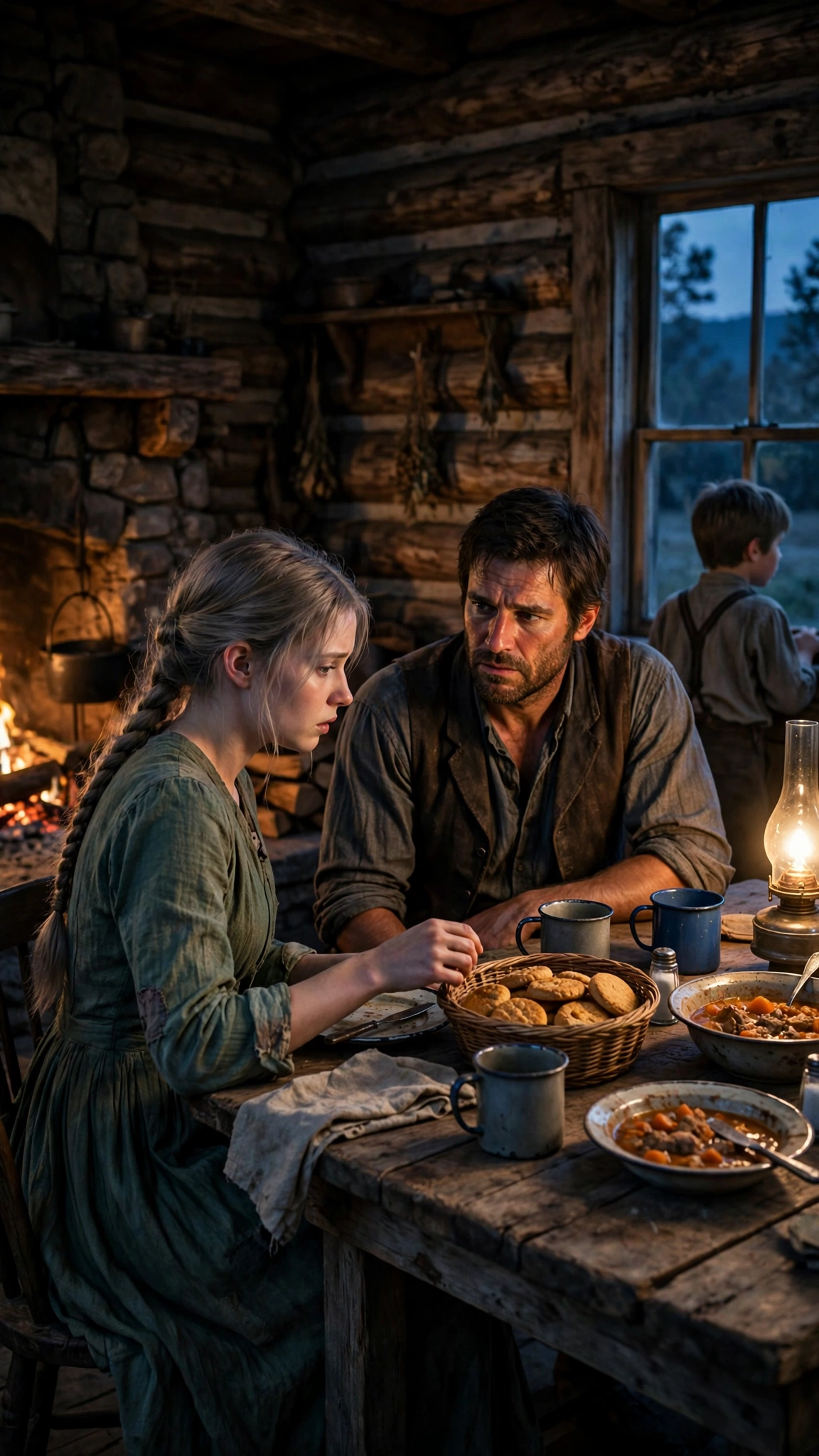
The horse stopped in the yard, and the rider swung down out of the saddle, and Cole was on his feet before the man had taken two steps toward the door.
"Stay inside," Cole said to Noah, without looking at the boy. And to Hannah, more gently, "Stay at the table."
He went out onto the porch with the lamp in his hand, and the rider came up through the blue dusk, and Cole saw that it was a man he knew — a neighbor from the next valley over, a man named Grant Mercer, who ran cattle on the far side of Red Creek and had known Cole since they were both young men breaking horses for other people's ranches.
Grant Mercer was not a man who rode out after dark without a reason. He was fifty, and gray, and careful, and he had a face that had seen too many winters to hurry. But he was hurrying now. He had ridden hard — Cole could see it in the horse, lathered at the neck, blowing — and he had something in his hand, a folded paper, and he held it the way a man holds a letter he wishes he did not have to deliver.
"Grant," Cole said. "What's wrong?"
"I came as fast as I could," Grant said. "I got this in the post yesterday, and I rode the moment I read it. Cole, I need to talk to you about your wife."
Cole's hand tightened on the lamp. Behind him, through the open door, the light fell across the supper table, and across the girl sitting at it, and across the half biscuit hidden under the folded cloth.
"Talk," Cole said.
Grant looked at the door. He lowered his voice. "Not in front of her. Not yet. Can we walk a little?"
They walked out to the corral fence, where the horses stood in the dark, and Grant Mercer unfolded the paper, and in the lamplight Cole read the words that had been written in a careful, clerkly hand, and signed at the bottom with a name he had never seen before: Elias Brooks.
It was a letter of demand. It said that Hannah Brooks, the writer's daughter, had run away from his house in Kansas with money that did not belong to her — four hundred dollars, taken from his strongbox — and that she had married under a false name, and that the marriage was therefore no marriage at all, and that she was to be returned to him at once, together with the money, or he would come with the law and take her, and he would see Cole Turner in court for harboring a thief.
Cole read it twice. Then he folded it, slowly, and put it in his vest pocket.
"Is it true?" he asked. "Any of it?"
"No," Grant said. "Not a word of it. I know Elias Brooks, Cole. I've known him for twenty years, since before he went east to Kansas. He is a liar and a drunk and a man who would sell his own mother's grave for a bottle. But that is not why I rode out here tonight. I rode because of what else I know."
"Tell me."
Grant leaned on the fence, and the horses shifted in the dark behind him, and he told Cole a story that he had carried for fifteen years and had never told anyone, because there had never been anyone to tell it to.
He had known Hannah's mother. Her name had been Willa Brooks, and she had been a good woman, and a clever one, and she had married Elias Brooks when she was young and did not yet know what kind of man he was. She had owned a small piece of land in Kansas, left to her by her own father, and she had saved money — a little at a time, sewn into the lining of a coat, hidden in a flour tin — because she knew, long before anyone else did, that her husband would take everything if he ever found it.
"She came to me once," Grant said. "It was before I moved west. She asked me to witness a paper for her. A will. She left everything to Hannah — the land, the money, all of it — to be Hannah's when she married, or when she turned twenty-one. She made me promise that if anything ever happened to her, I would see that Hannah got what was hers. And then she died, Cole. Of a fever, in the winter, when Hannah was seven. And Elias buried her, and he burned her papers, and he told the girl her mother had left her nothing."
Cole was very still. The lamp flame bent in the wind.
"How much?" he asked.
"Twelve hundred dollars," Grant said. "And forty acres of good bottom land. It is not a fortune, Cole, but it is enough for a girl to stand on. And Elias has been living on it for fifteen years, selling pieces of it, drinking the money, while his daughter went hungry in his own house."
"And the four hundred dollars he says she stole?"
"There is no four hundred dollars," Grant said. "There never was. He invented it so he could come after her with the law. He found out she married, Cole. He found out she married a man with a ranch, and he wants the money back — not the money she took, because she took nothing, but the money she is owed. He wants to frighten her into signing it away. He wants her back under his roof, where she cannot testify, where she cannot tell anyone what he did to her."
Cole looked back toward the house. The lamplight was warm in the windows. Inside, a girl sat at a table full of food, afraid to eat.
"What did he do to her?" Cole asked, quietly.
Grant was silent for a long time. When he spoke, his voice was low, and careful, the way a man speaks when the words themselves are heavy.
"I don't know all of it," he said. "I know what I saw, the one time I visited that house, years ago, when Hannah was still a child. There was a lock on the pantry door, Cole. A padlock. On a pantry in a house with a child in it. And the girl was thin — thin in a way no child should ever be thin. And when I asked Elias about it, he laughed, and he said a girl must learn that food is earned, and that a woman who takes what she has not earned is a thief. I have thought about that lock for fifteen years, Cole. I have thought about it every time I sat down to a full table."
Cole stood at the fence, and the night came down around them, and the creek ran somewhere in the dark, and he thought about the girl at his table, and the hand that had stopped above the biscuit, and the words — "May I have the pieces nobody wants?" — and he understood, at last, where those words had come from. They were not her words. They were her father's words, put into her mouth when she was small, and left there, like a lock on a pantry door.
"What do I do?" he asked.
"You keep her here," Grant said. "You keep her safe. And you let me help you. I have the will, Cole. Willa's will. I kept a copy of it all these years, because I promised her I would. Elias doesn't know I have it. He thinks he burned the only copy. And when he comes — and he will come, Cole, he is already on his way, he wrote that letter from the train — we take it to the courthouse, and we let a judge decide whose money it is."
"He's on his way here?"
"He was in Cheyenne three days ago," Grant said. "He'll be in Red Creek by the end of the week. And Cole — he won't come alone. He's hired a man. A man named Silas Creed, who does the kind of work a man like Elias can't do himself."
Cole nodded. He had heard of Silas Creed. Everyone in the territory had heard of Silas Creed.
"Thank you for riding out," he said.
"I made a promise to a dying woman," Grant said. "Fifteen years is a long time to carry a promise. I'm glad to finally be keeping it."
They walked back to the house together, and Grant took his leave at the porch, and Cole stood in the doorway for a moment, looking at the table, and at the boy, and at the girl who was his wife.
Hannah was still sitting where he had left her. She had not eaten. The half biscuit was still hidden under the folded cloth. Her hands were in her lap. She was looking at the door, and her face was white, and she was waiting — the way she always waited — to be told what would happen to her next.
Cole sat down across from her. He put the folded letter on the table between them. He did not open it. He looked at her, and he spoke quietly, the way a man speaks to a frightened animal he does not want to startle.
"Hannah," he said. "That was Grant Mercer, from the next valley. He's a friend. He rode out to warn me about something. A letter from your father."
She flinched at the word. Father. Her hands tightened in her lap.
"He says you stole money from him," Cole said. "Four hundred dollars. He says the marriage isn't real, and he wants you back."
She shook her head. It was a small shake, barely a movement, but it was the first time Cole had ever seen her disagree with anything.
"I didn't take anything," she whispered. "I never took anything. I never took anything in my life."
"I know," Cole said. "Grant told me the rest of it. About your mother. About the will."
At the word "will," something changed in her face. It was not hope. It was older than hope, and quieter. It was the look of a person hearing the name of something they thought was lost forever.
"My mother left me nothing," she said, and her voice was flat, the way a voice goes when a person has repeated a lie so many times they have forgotten it is a lie. "My father told me. She left me nothing. There was nothing."
"Your father lied," Cole said. "Grant was there. He witnessed the paper. Your mother left you twelve hundred dollars and forty acres of land. Your father has been living on it for fifteen years."
She stared at him. The lamp flame bent. The fire crackled. Noah, who had been pretending not to listen, had gone very still, his spoon in his hand, forgotten.
"Twelve hundred dollars," Hannah said, slowly, as if she were sounding out the words of a foreign language. "Forty acres."
"Yes."
"And my father has it."
"Yes."
She was quiet for a long time. And then she did something Cole had not expected. She reached out — slowly, carefully, the way she did everything — and she took the half biscuit from under the folded cloth, and she put it on her plate, in the open, where anyone could see it.
"I didn't steal it," she said. "The money. I didn't steal anything."
"I know," Cole said.
"He's coming, isn't he?" she said.
"Yes," Cole said. He would not lie to her. "Grant says he'll be here by the end of the week."
She nodded. She looked at the biscuit on her plate. She looked at the basket. She looked at Cole. And then, very slowly, she picked up the half biscuit, and she ate it — all of it, in small bites, in the lamplight, in front of him, without asking anyone's permission.
It was the bravest thing Cole Turner had ever seen.
He did not sleep that night. He lay awake in his room, listening to the wind in the cottonwoods, listening to the house settle around him, and he thought about the girl asleep down the hall, and about the lock on a pantry door in Kansas, and about the man who had ridden out of his yard with a letter in his hand. He thought about his first wife, Sarah, and about the fever that had taken her, and about the grave under the cottonwoods, and about the promise he had made to himself at that grave: that he would never marry again, that he would never put his heart where it could be broken again. And he thought about how a promise like that holds until the day a thin girl with ash-blonde hair steps off a train at Red Creek, and sits at your table, and is afraid to eat, and you realize that some promises are meant to be broken, because the person they were made for would not have wanted you to keep them alone forever.
In the morning, before the sun was up, he went out to the barn, and he saddled his horse, and he rode the fence line, checking the cattle, and he did it the way he always did it, slow and thorough, because work was the only thing that ever steadied him. But his mind was not on the cattle. It was on the letter in his vest pocket, and on the man who had written it, and on the question he had asked himself in the dark: what kind of man writes a letter like that, and calls himself a father?
He did not have an answer. But he had a rifle, and a ranch, and a sheriff who was on his side, and a neighbor who had carried a dead woman's will for fifteen years, and a wife who had eaten a whole half biscuit in front of him, without asking, without hiding, without apologizing. And that, he decided, was enough to start with. The rest would come when it came. On Saturday, or on Monday, or whenever Elias Brooks rode into his yard. He would be ready.