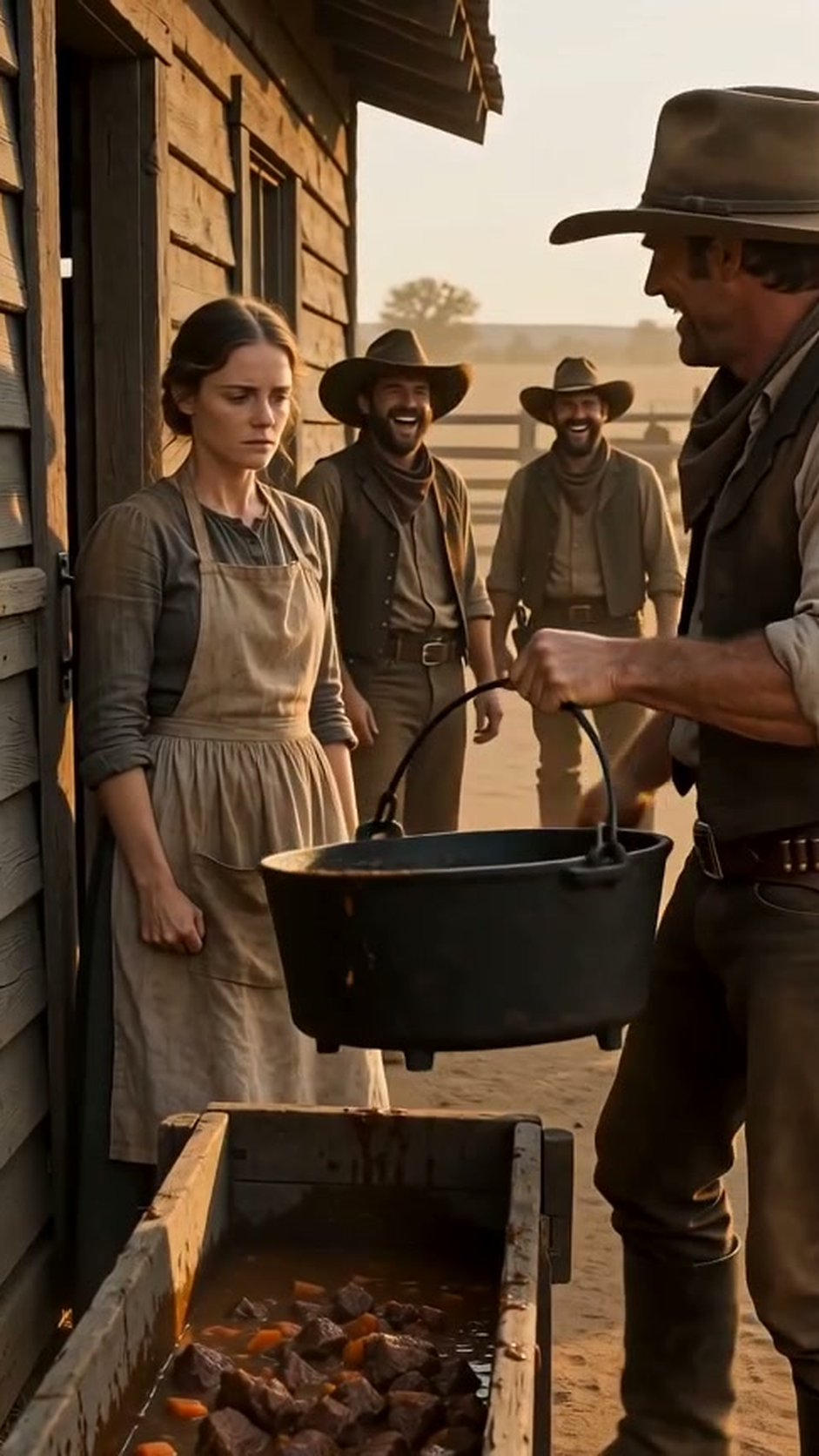
The first week, Bertha cooked and the men ate and the world was simple.
The second week, Buck began to educate her.
It started with the beef. A cook plans around what the ranch provides, and the Bar Seven provided its own beef — a steer butchered every Monday, hung in the spring house, and cut through the week. On the second Monday, Bertha went to the spring house at dawn and found the hanging side smaller than the week before, and the good cuts — the rounds she had been counting on for roasting — gone clean, trimmed away in the night with the cuts left neat as a tailor's work.
She took her problem to the only man whose problem it also was.
"Somebody's been at the beef," she said, standing in the barn door with her list in her hand.
Buck didn't look up from the hoof he was trimming. "Coyotes get in the spring house, now and again."
"Coyotes that use a knife and take the round and leave the shank?"
Now he looked up. His eyes were pale and unhurried. "You accusing somebody, Miss Platt?"
"I'm reporting a shortage, Mr. Thorp. It's my job to feed thirty men. I can't feed them on shank and good intentions past Thursday."
"Then I guess Thursday they'll eat light." He went back to the hoof. "Or in town."
She stood there a moment longer, learning. That was the first lesson: shortages were weather — you didn't argue with weather, you just got wet.
The lessons came regular after that, like a school term. A sack of flour split open on the cookhouse floor overnight, though she had left it tied and shelved; she found it at dawn with the flour drifted across the boards like first snow, and the hands tracked it through the yard all day in white footprints. A can of baking powder that had been half full at supper was empty by breakfast, so the biscuits went flat, and she served them anyway with her chin up, and heard one of the younger men say to another, not quite low enough, "Town biscuits don't do that." Her good knives walked off. Her coffee — bought at her own insistence in a full sack from the Merritt account at the Dryfork store — came back from the barn where it was stored two pounds light, then five.
And through it all, Buck was never angry at her. That was the thing she would remember later, when she understood: he was never angry. He was regretful. He was a man watching a nice girl struggle with a job that was too much for her, and he said so, in her hearing, in the hearing of the crew, in exactly the regretful tone a kind foreman would use. "Girl tries hard," he'd say, shaking his head over a short stew. "Ain't her mama, though. Nobody is. Town's got a cook at the hotel does beef proper, if a man's hungry enough to care."
It was beautifully done. Bertha stood in the middle of it with flour on her shoes and understood that she was fighting a man who fought like water — nothing to grab, everything soaked.
Not everyone soaked.
Andrew Coburn began staying behind.
He was twenty-six, a top hand, quiet in the way of men who listen more than they talk, and he had the habit — new, the other men noticed it and ribbed him for it — of coming to the cookhouse a few minutes before the others, and of carrying things: the water bucket filled without being asked, the wood box topped up, a split log replaced. He ate everything she put in front of him and thanked her for it by name. And on a Thursday evening, when the flour shortage had made the bread thin and Buck had made his little speech and gone, Andrew lingered at the table after the rest had drifted out, turning his coffee cup in his fingers.
"Bertha," he said, "I want to say a thing and I want you to hear the whole of it before you answer."
"Say it."
"Your cooking ain't the problem on this ranch." He looked at the door Buck had gone through. "Wasn't the last cook's cooking neither, and he was a drunk who'd burn water. Men ate in town when he was here because town was where — " He stopped.
"Where what?"
Andrew shook his head, frustrated at something in himself. "I don't know the shape of it. I know Buck rides to Dryfork more than a foreman needs to. I know he comes back easy in his mind, like a man who's been paid for something. And I know the men eat where Buck points. He's got them — wages, assignments, who's riding drag and who's riding point. A man who laughs at Buck's jokes eats in town where Buck says, and a man who don't…" He turned the cup once more. "I ride drag a lot, Bertha, and I don't even own a joke."
"Why are you telling me?"
"Because my mama raised me not to watch a thing happen quiet." He stood, set his cup down gentle. "And because that first chicken supper was the best meal I've had in four years of eating other men's dust, and I'd like the chance to eat a few more of 'em."
After he left, Bertha stood at the cookhouse door watching the light go, and the yard settle, and she filed away what he'd said the way her mother had taught her to file recipes — carefully, in order, where she'd find it when the pot came to a boil.
Payday Saturday proved him right in a way she hadn't expected, and it taught her the rest of Buck's machinery.
The men were paid at noon, in the barn, out of the strongbox, with Buck calling the names and Merritt's clerk making the marks. Bertha had cooked all morning against it — a payday supper, the kind her mother used to call a *keep-them-home supper*: roast beef with gravy, fried potatoes, creamed corn, biscuits, and two dried-apple pies, because a crew with money in its pockets and a good meal in front of it was a crew that might stay in the bunkhouse and play cards and be fit for Monday.
They ate it. Every man jack of them ate it, and praised it, and Gus Henley called the gravy a public service. And then — she watched it from the cookhouse door with her dish towel going still in her hands — they washed their faces, changed their shirts, and saddled up for town anyway, in a body, at Buck's whistle, like a remuda turning through a gate.
Only Gus stayed, and Gus stayed partly out of age and partly, she came to understand, out of a private war of his own with Buck Thorp that predated her by years.
"Ain't the food, girl," Gus said, settling at the table with the whole pie tin, shameless, in front of him. "Never was about food. Buck tells a man Saturday morning who's riding the far fence Monday, and who's riding the near pasture, and who's on night herd in the rain, and a man hears that schedule *in Buck's voice* while he's deciding where to eat his supper. You follow me? Town ain't a meal to this crew. Town's a tax they pay to sleep easy."
"Did they pay it in my mother's time?"
Gus's fork stopped. The old man's face did something complicated. "Your mama's last year, she was sick more than she was well, and Merritt was in Fort Worth half the time with the banks. Buck run this ranch that year, girl, lock and key and ledger. That's when the town habit set in. Before that?" He shook his head. "Before that, a man ate at Martha Platt's table because only a fool rides four miles to pay for worse." He ate a moment in silence. "I been waiting to see if it'd come back. The table, I mean. A ranch is its table, girl. Everything else is fences."
He scraped the pie tin clean and stood and put his nickel by his plate, same as always, and went out into a yard empty of everyone but the night herd rider and the cook.
Bertha stood at her door until the dust of the crew's leaving had settled for good, and she thought: *a tax they pay to sleep easy.* And then she thought about the beef rounds, and the coffee, and the split flour sack — and for the first time the two trails of thought lay down side by side in her mind like rails, and she could see a long way down them, further than she wanted to.
—
The shortages got worse, and worse in a pattern she only saw when she started keeping count.
Bertha had her mother's habit of the pantry-door pencil. Inside her own cottage door she began her own tally — every sack, every can, every side of beef, marked when it came in and marked when it went out. Within ten days the pencil had told her a story the spring house hadn't: the ranch was losing food steady as a leaking bucket, and it was losing it out of her kitchen's stores, at night, a little at a time — never enough to scream theft, always enough to make her table look thin and her management look sloppy.
Enough, in fact, to hang her with.
Because in the third week of May, Silas Merritt came home from Fort Worth with a letter in his coat from his bankers, and he called Bertha and Buck into the ranch house office, and the office had the dusty, unused smell of a room that waits for bad news.
Merritt was seventy, tall and bent like a tree that had grown around a fence, with his dead wife's photograph on the desk and ledgers stacked square as bricks. He was kind to Bertha in the absent way of a man whose kindness had been spent down to politeness, and he did not waste time.
"The Bar Seven spent eleven hundred dollars last year feeding this crew in town," he said. "Hotel meals. Saloon dinners." He took off his spectacles and polished them. "My bankers have Opinions. This ranch feeds its own men off its own beef at its own table, or it sells. I've hired a man out of Fort Worth — an auditor, name of Eakins — he'll be here the last week of June to go through the store accounts and the kitchen accounts and tell me where the money leaks out of this place."
He looked at Bertha then, really looked, over the spectacles.
"Miss Platt, the kitchen accounts are yours. I'd advise them to be in order."
"They will be, sir," Bertha said, and felt the flour and the missing coffee and the trimmed beef rounds rise up behind her eyes like a tide chart. "Mr. Merritt, there are shortages I should report—"
"She's had some trouble settling in," Buck said, smooth as poured cream, from his chair by the wall. "Supplies walking off. She's doing her best to get a grip on it. Aren't you, Miss Platt?"
All three of them looked at her: the old man waiting, the foreman smiling his regretful smile, and Bertha understood, with a clarity that iced her spine, the exact shape of the trap. If she cried theft now, she cried it against no one she could name, out of a kitchen that was hers, about stores that were in her keeping — and Buck would stand in this office being sorry for her. If the auditor came and found her pencil tally short against the store accounts, the leak had a name, and the name was Platt.
She folded her hands. "I'm getting a grip on it, sir," she said. "The accounts will be in order."
Walking back across the yard, she heard Buck fall into step beside her — not hurrying, not threatening, just present, the way weather is present.
"June's a hot month for an audit," he said conversationally. "Man'd want his house in order before then. Both his houses." He touched his hat brim to her, courteous as a church usher. "You sleep sound, Miss Platt."
That night she sat at her cottage table with her mother's pot on the stove and her pencil tally spread before her, and she did the arithmetic twice, and both times it said the same thing: by the last week of June, if the leaking went on at this rate, she would be short enough on paper to be fired for a thief — and Buck Thorp would stand in the office being sorry about it while she packed her carpetbag.