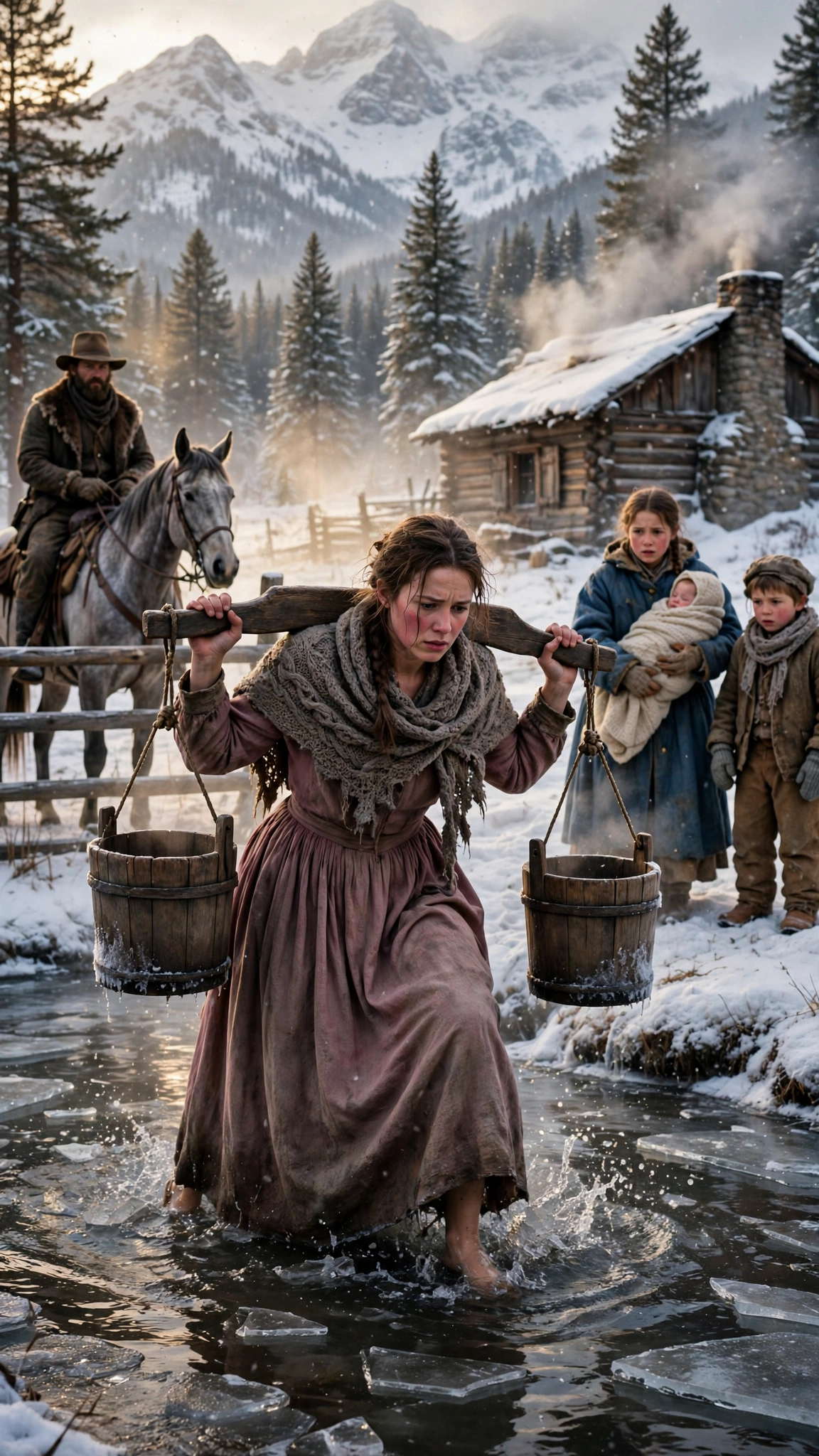
Friday, the nineteenth of January, dawned cold and clear, the sky washed clean by the blizzard, the mountains standing sharp and white against a blue so deep it hurt to look at. The snow in the yard glittered. The smoke from the chimney rose straight up. Anna was sitting up in her cradle for the first time in a week, reaching for the wooden spoon Clara dangled above her, and laughing — a small, rusty laugh, as if she had forgotten how and was remembering.
Addie dressed the children in their best clothes. Clara's blue coat, brushed clean. Peter's brown coat, the buttons done up to the throat, the gray scarf wound twice around his neck. Anna in the cream blanket, fresh-washed, smelling of soap and woodsmoke. She dressed herself in her second dress — the dark gray one, the one Henry had liked because it made her look, he said, like a lady from back East — and she braided her hair tight and pinned it up, and she put on Henry's boots, stuffed with rags, because she had no boots of her own, and she stood in the doorway and waited.
Jonas came at nine o'clock, riding Smoke, with the sack of gold in his saddlebag and the clerk's papers in his coat. He dismounted, and he did not go inside. He stood in the yard beside Addie, the way a man stands beside a woman when they are about to face something together, and they watched the road.
They did not have to wait long.
Bane came at ten, in a black wagon with iron-bound wheels, drawn by two bay horses, and beside him on the seat sat Deputy Hale — a big, slow man with a star on his coat and an unhappy expression on his face — and behind the wagon, on a bay mare, rode Dobbins, with his rifle in its scabbard and his thin smile already in place.
Bane climbed down from the wagon with the care of a man who does not wish to muddy his boots, and he took off his hat, and he bowed to Addie with the smooth politeness of a man conducting business, and he opened his ledger with a flourish.
"Mrs. Marsh," he said. "Friday. One hundred and forty-seven dollars and thirty-two cents. I trust you have it."
"I have one hundred and twenty-one dollars and forty cents," Addie said. Her voice was steady. She had practiced it, all morning, in front of the fire. "That is the lawful debt, Mr. Bane. The mortgage is ninety dollars. The store account is thirty-one dollars and forty cents. There is no collection fee. There is no second interest. The clerk's office has said so."
Bane's smile did not change. "The clerk's office, Mrs. Marsh, does not set my figures. My ledger—"
"Your ledger is a lie, Mr. Bane," Jonas said.
He stepped forward, and he took the papers from his coat — the certified copies, with the county seal in red wax — and he held them out to Deputy Hale, who took them with the slow reluctance of a man who does not want to be holding evidence against a powerful man in front of witnesses.
"Deputy," Jonas said, "those papers are from the clerk's office. The mortgage is ninety dollars. The store account is thirty-one forty. Mr. Bane added twenty-five dollars and ninety-two cents in fees that do not exist, and he counted the doctor's bill twice. The clerk has certified it, in writing. And here —" He took the sack from his saddlebag and held it up. "Here is one hundred and twenty-one dollars and forty cents, in gold, counted twice this morning, to pay the lawful debt in full."
Deputy Hale looked at the papers. He looked at the sack. He looked at Bane. He was a slow man, but he was not a dishonest man, and he had a wife and three children of his own, and he had not liked this errand from the moment Bane asked him to come.
"Mr. Bane," Hale said, slowly, "these papers appear to be in order. The county seal is on them. If the lawful debt is a hundred and twenty-one forty, and Mrs. Marsh can pay it, then the mortgage is satisfied, and the children stay with their mother."
"The children," Bane said, and his smooth voice cracked for the first time, "are the subject of a county board order. December twelfth. The mother abandoned them. The board voted."
"The board voted on your word, Mr. Bane," Jonas said. "And your word was false. Mrs. Marsh did not abandon her children. She walked to Helena on foot, carrying her baby, to buy medicine, and the clerk saw her do it. She has not left this cabin for a night since her husband died. Ask the deputy. Ask anyone in this valley. Ask the children standing in that doorway."
Hale turned to the doorway. Clara stood there with Anna in her arms and Peter beside her, and all three of them were watching him with wide, frightened eyes, and Hale looked at them for a long moment, and then he looked back at Bane, and his unhappy expression deepened into something harder.
"Mr. Bane," Hale said, "I have known Mrs. Marsh's husband since he came to this valley. He was an honest man. And I have known you for ten years, and I have never once seen you do a kind thing for any person who could not pay you for it. I am going to count this money. If it is a hundred and twenty-one forty, the debt is paid, and you will ride out of this yard, and you will not come back."
Bane's face went white, and then red, and then white again. "You cannot do this, Hale. I sit on the county board. I—"
"You sit on the board," Hale said, "and the board will hear about this. All of it. The false figures, the orphanage order, the cow you tried to take before the debt was due. I will see to it myself."
He counted the money, coin by coin, on the tailgate of the wagon, with Jonas and Addie and Dobbins watching, and the children watching from the doorway, and Bane watching with his hands clenched at his sides. The gold clinked softly in the cold air. Seventy dollars from Jonas's floorboards. Forty dollars from the steers. Eleven dollars and forty cents from the neighbor's favor.
"One hundred and twenty-one dollars and forty cents," Hale said, finally. "The debt is paid in full."
He wrote out a receipt, in his slow careful hand, on a page torn from his own notebook, and he signed it, and he gave it to Addie, and Addie held it in both hands, and she looked at it for a long time, and then she folded it, very carefully, and put it inside her dress, next to her heart.
Bane stood in the yard, and he looked at the receipt, and at the papers, and at the children in the doorway, and at Jonas Reed standing beside Addie with his arms folded, and something in his face changed — the smooth, reasonable mask slipping, just for a moment, to show the man underneath, who was smaller and meaner and more frightened than anyone had guessed.
"This is not over, Reed," he said, quietly, so that only Jonas could hear. "You have made an enemy today."
"I made an enemy the day I knelt in the snow beside a barefoot woman's footprint," Jonas said, just as quietly. "I can live with it."
Bane climbed into the wagon, and Dobbins mounted his mare, and they rode away down the road, and the sound of the wheels faded, and the yard was quiet, and the mountains stood white against the blue sky, and Addie Marsh stood in her doorway holding a receipt for one hundred and twenty-one dollars and forty cents, and her children were still hers.
Clara came out of the doorway first, still holding Anna, and Peter came after her, and they stood in the snow in their best clothes, and Addie went down on her knees in the snow — in Henry's boots, stuffed with rags — and she gathered all three of them into her arms, and she held them, and she did not cry, because she had used up her tears in November, and what she felt now was too big for tears.
It was Jonas who spoke first. He said, very quietly, "Friday is over, Mrs. Marsh."
"Friday is over," Addie repeated, and she looked at the road where Bane's wagon had gone, and at the pine cross on the rise, and at the cabin with the smoke rising straight from the chimney, and at the man standing beside her, and she thought: Friday is over. The children are mine. The cabin is mine. The debt is paid.
Deputy Hale did not leave at once. He stood beside his horse for a while, looking down the road after Bane's wagon, and then he turned to Jonas, and his slow face was serious.
"Mr. Reed," he said, "I want you to understand something. Bane will not forgive this. He is a proud man, and you have shamed him in front of witnesses, and men like Bane do not forget shame. He will go to the board. He will try to have the clerk dismissed. He will try to make trouble for you at the mercantile, and for Mrs. Marsh at every turn. I will do what I can — I have already told the board the truth about the figures, and they were not pleased — but I want you both to keep your eyes open, and to keep that receipt somewhere safe, and to remember that a paid debt is a paid debt, no matter what any man says about it."
"We will keep the receipt," Jonas said. "And we will keep our eyes open. Thank you, Deputy."
Hale nodded, and he looked at Addie, and he took off his hat, and for a moment the slow, unhappy man looked almost kind.
"Mrs. Marsh," he said, "your husband was my friend. He helped me raise my barn, back in seventy-nine, and he never asked for a cent for it. If you ever need a deputy, you send for me. That is a promise, and I keep my promises."
He mounted his horse and rode away, and Addie watched him go, and she thought about Henry raising a barn in seventy-nine, and about all the small kindnesses that made up a life in this valley, and about how a man could be gone for two months and still have friends riding out to stand beside his widow.
That evening, after the children were in bed, Addie and Jonas sat by the fire, and she made coffee — real coffee, from the tin Jonas had brought, the first real coffee she had tasted since November — and they drank it in silence for a while, listening to the fire and the wind, and then Jonas spoke.
"Bane will make trouble," he said. "Hale is right about that. But trouble is a thing a man can face, if he does not face it alone."
"We are not alone," Addie said. "We have Hale. We have Pritchard. We have Mrs. O'Rourke, and the Whitfields, and old Mr. Abernathy. We have a whole valley, Jonas. I did not know that until this week. I thought we were alone, because Henry was gone, and I could not see past the end of my own yard. But we were never alone. The valley was just waiting for someone to ask."
Jonas looked at her across the fire, and he nodded, slowly, and he said nothing, because there was nothing to add, and they sat together until the coffee was gone and the fire burned low, and then he rode home through the cold clear night, and Addie bolted the door, and she went to bed, and she slept — truly slept, deeply and without dreams — for the first time since the third of November.
She did not know, then, what would come next. She did not know about the county board's inquiry, or Bane's parting threat, or the spring that would change everything. She knew only that the wagon had come and gone, and her children were still in her arms, and the man who had knelt in the snow beside her footprint was still standing in her yard, watching the road, as if he intended to keep watching it for a long time.
That night she took the receipt from inside her dress and unfolded it by lamplight, and read Deputy Hale's slow careful handwriting one more time, and folded it again and tucked it into the coffee tin on the mantel, beside the three dollars and eleven cents that were still there, because a receipt was a kind of money too, and she intended to keep it where she could find it.