Eliza Moore had learned the price of milk the way you learn the price of anything in this world: by paying it.
She had not always been a woman alone with a carpetbag. Eighteen months before the morning she boarded the Fort Collins stage, she had been a wife on a small farm outside Julesburg, married to Thomas Moore, a gentle, broad-laughing man who had courted her for two years against the advice of his mother, who considered Eliza too big, too plain, and too old at twenty-eight to be a bargain. Thomas had not cared. Thomas had built her a kitchen with a window over the sink because she liked to watch the weather come in, and when the baby was on its way he had carved a cradle out of pine and sat up two nights sanding it smooth so that no splinter would ever touch his child.
He died of the fever in the spring, six months before the baby came, in three days, holding Eliza's hand and apologizing — actually apologizing, burning up with it — for leaving her to do the next part alone.
So Eliza did the next part alone. She kept the farm going with a hired boy and her own two hands. She grew enormous and unafraid. She talked to the child under her heart while she worked, the way her own mother had talked to her, and in the evenings she sat in the kitchen with the window and the weather and Thomas's cradle in the corner, and she made plans with the serene confidence of a woman who has already lost the worst thing and believes the world has finished with her.
The world had not finished with her.
Her daughter was born in the first week of the month, in a labor that lasted a day and a night, and she was small and perfect and furious, with a cap of dark hair and a cry that filled the house like weather. Eliza named her Clara, for her own mother. For two weeks — fourteen days exactly — Eliza Moore was happier than she had ever been in her life. Clara fed greedily, slept against her mother's heart, and grew. The milk came in like a river. The house had a purpose again. Eliza stood at the kitchen window with her daughter at her breast and watched the plains and thought: *We are going to be all right. We are going to be all right after all.*
On the fifteenth day, Clara was fussy and hot by evening. By midnight she would not feed. By morning, in the time it took the hired boy to ride to Julesburg and bring the doctor back through the mud, she was gone — a fever out of nowhere, the doctor said, the kind that takes newborns the way wind takes sparks, and there had never been anything anyone could have done, and he was sorry, and the burying needed to happen soon.
Eliza buried her daughter in the Julesburg cemetery on a bright, cold morning, in a pine box no bigger than a bread loaf, next to Thomas. She did not weep at the grave. She had noticed, the night before, that her body had not understood yet: the milk kept coming. It came that morning, soaking the front of her best dress while the minister prayed. It came that night, waking her, aching, in a house that echoed. The body goes on doing its faithful work in an empty room. She bound herself with cloth the way the doctor's wife advised and waited to dry up, and she did not dry up, and every day the ache in her chest was a clock that said: *there is a child somewhere who needs this, and she is not here.*
She could not stay in the house with the cradle. She could not stay in Julesburg, where the farm was mortgaged and the winter was coming and every woman at church looked at her with the kind, terrible pity that is worse than cruelty. Thomas's cousin in Fort Collins — a woman Eliza had met exactly once, at the wedding — kept a boarding house and had written, in answer to Eliza's desperate letter, that she could use a cook and a laundress, that there would be a small room, that she was sorry for Eliza's trouble.
So Eliza sold the farm for what the bank would give, paid the boy, packed one carpetbag, and kept out only two things from Clara's brief life: a small white cap she had knitted, and nothing else. She could not explain the cap even to herself. She put it in the bag and boarded the train, and then the stage at the junction depot, and settled her big body onto the bench with the care of a woman who has learned that the world is mostly narrow spaces not built for her, and arranged her dusty rose skirts, and tried not to cry at the sound the coach made settling on its springs.
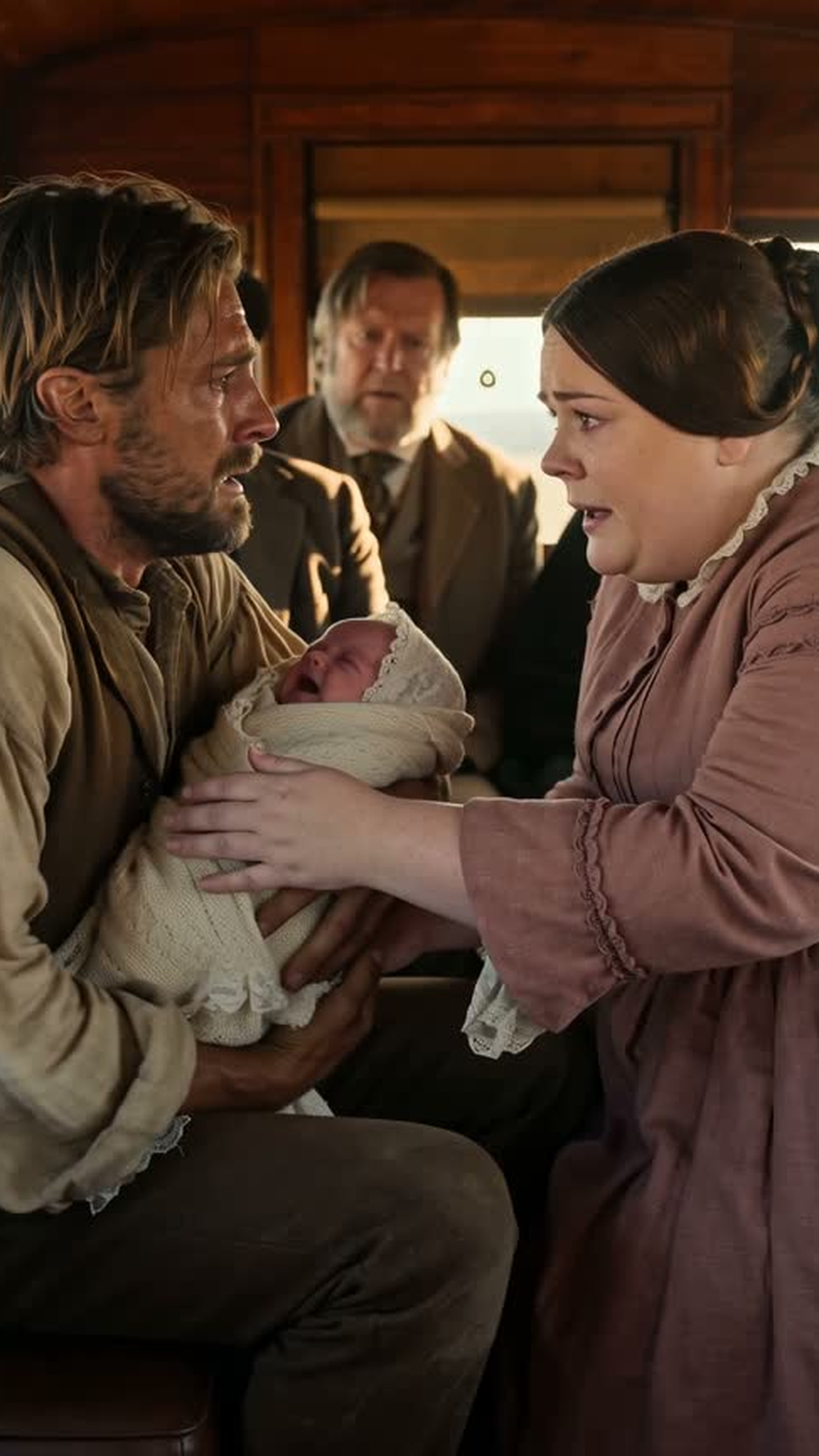
And then the man across from her shifted the bundle in his arms, and the baby in the ivory blanket cried.
Eliza Moore knew that cry. She had been hearing it in her sleep for fifteen days. It was not the cry of a wet baby or a cold baby or a baby who wanted holding. It was younger and older than that. It was the body's first language, asking for the one thing it cannot live without.
She looked at the father's hands — the trembling, the clumsiness, the desperate tenderness of them. She looked at the bottle he produced midway through the first hour, and the baby's brief, failing interest, and she understood more of that family's story in that one minute than the father could have told her in a day. A mother would have had the child to breast between one landmark and the next. A mother would not have needed the bottle. There was no mother. There was a man walking the oldest road a parent can walk, and he was walking it toward an empty house.
*He's three weeks old, if he's a day,* Eliza thought. *Maybe less. And that cry is changing.*
She had resolved, boarding, to keep herself to herself. Grief makes a person selfish the way cold makes a person huddle; she had meant to ride the whole way in silence inside her own loss, arrive in Fort Collins, take up the cooking and the laundry and the small room, and be nobody's burden and nobody's miracle. She had meant it sincerely.
But the coach rocked, and the morning wore on, and across from her the baby's fists opened and closed, slower and slower, like a man letting go of a rope one finger at a time — and every part of Eliza's body that had made milk for a daughter in the ground was wide awake and would not let her look away.
She counted his breaths. She did not know she was doing it.
She only knew that somewhere around the second hour, listening to that weakening cry, she had begun to be afraid in a way she had not been afraid even in the Julesburg cemetery — because this death, if it came, would not be God's arithmetic or a fever out of nowhere.
This one she could stop.
And the terrible question was forming in her, the question that would cost her every wall she had built in fifteen days: *What if I am on this coach for a reason?*
What she could not have said aloud, to anyone, was the other thing.
The doctor's wife in Julesburg had been brisk about it: bind tight, drink little, don't touch, it'll pass in a week. Eliza had bound and waited. A week passed. Then another. The milk did not pass. It ached through the train ride east with a dull, rising insistence that woke her before dawn in the depot hotel, and it ached now, in the swaying coach, worse than it had yet — because her body, stupid and faithful as a dog, had heard a hungry baby cry, and was answering.
She shifted against the ache and pressed her folded shawl to herself under cover of her carpetbag, and was ashamed — ashamed of the pain, ashamed of the leaking she had bound and padded against, ashamed most of all of the thought that had come into her head fully formed the moment the baby turned away from that bottle, a thought she had been fighting like a sin ever since:
*Mine is going to waste in the ground's shadow, and his is dying in front of me. What kind of arithmetic is that? What kind of God keeps those books?*
She knew what people would call it. She knew because old Mrs. Henderson, in the first hour of the ride, had already shown her. When the baby cried hard the first time — still strong then, still angry — the old lady had leaned to the salesman and observed, not quite under her breath, that a man had no business traveling alone with a newborn, that it wasn't decent and it wasn't safe, and that in her day a family had women for this. Pritchard had snorted his agreement and asked the driver, at the last stop, how long to Fort Collins, in the tone of a man calculating his suffering.
Eliza had said nothing. She was a widow in a strange coach; her one talent in this new life was silence. But she had watched Caleb Warren's face when the words reached him — he heard them; a man in his state hears everything — and she had seen him take it the way he took the rattling of the wheels and the baby's crying and the failure of the bottle: without defense, into himself, as one more weight stacked on a man already carrying more than a man can carry.
*You do not know one thing about him,* she had thought at the old woman, with a flash of anger that surprised her. *You do not know if he buried that child's mother last week or last year. You do not know what he has already tried. Look at his hands. Look at them. A father's hands know how to do everything except the one thing — and he is doing this instead of breaking, in front of strangers, at ten miles an hour.*
She thought of Thomas's hands on the cradle, sanding in lamplight. She thought of the pine box. She thought of the small white cap in her carpetbag, and of how she had told herself on the train that she would put it away in Fort Collins, in a drawer, and become a cook and a laundress and a woman whose story nobody asked about.
The baby cried again — weaker. Pritchard sighed loudly, an ugly sound, and Mrs. Henderson began, audibly, to pray for patience.
Eliza Moore took off her gloves, one finger at a time, and folded them, and laid them on the carpetbag.
She did not yet know what she was preparing to do. She only knew that her hands — empty for fifteen days, emptier than any hands she had ever heard of — were going to be needed before this ride was over, and that when the moment came, she did not want anything, not even a pair of gloves, between her and it.
Later she would try to remember the exact moment the decision stopped being a thought and became a certainty, and she never could find it, because it was not a moment. It was an accumulation — the bottle lifted and refused, the fists slowing, the father whispering *please, son, please* to a three-week-old boy as if the child could choose to stay. Somewhere in those small things the whole of Eliza's grief stood up inside her and turned around and faced the other direction. She had come onto this coach believing her life had narrowed to a point: a bag, a room, a stove, a grave behind her. Now there was a widening. It terrified her. It also — and this she would not admit for a long time — it also felt, terribly, like being handed back a piece of herself she had buried in Julesburg and would have sworn was gone forever.
She leaned forward a little in her seat.
"When did he last feed?" she asked.