The first morning in Gideon's cabin, Mave woke before dawn and lay still in the narrow bed, listening.
The cabin was quiet in a way Bitterroot had never been quiet. There was no clatter from the trading post yard, no shouting from the teamsters, no footsteps on the stairs above her head. There was only the wind moving over the roof, soft and steady, and the ticking of the iron stove as it cooled, and the faint crackle of the last embers in the stone fireplace. The air smelled of woodsmoke and pine resin and cold.
She lay there for a long time, afraid to move, afraid to make a sound, because in the back room of the trading post, a sound in the morning had meant Voss was awake, and Voss awake had meant she must be already working, already moving, already useful, or there would be consequences. Her body had learned that lesson so well that it woke her now before the sun, her heart beating fast, her hands already reaching for the dress she had folded over the chair.
Then she remembered where she was. She remembered the mountain, and the snow, and the man sleeping on the pallet by the fire. She remembered what he had said to her on the night of the wedding, standing in the firelight with his hands at his sides.
"You don't owe me anything. Not tonight. Not ever."
She lay back down, slowly, and she listened to the quiet, and after a while her heart slowed, and she slept again, and when she woke the second time, pale light was coming through the frost-covered window, and Gideon was already up, moving quietly around the cabin, banking the fire, putting the coffee pot on the stove.
He did not speak to her until she spoke to him. He did not look at her while she dressed behind the curtain he had hung across the corner for her privacy. He set a cup of coffee on the table for her, and a piece of bread, and he went about his work, and he left her alone with the morning, and that, Mave thought, was the kindest thing anyone had done for her in years.
The days fell into a rhythm, slow and plain and unhurried, like water finding its level.
Gideon rose before dawn and went out to check the traps, or to cut wood, or to hunt, and he came back at midday with his arms full of firewood or a rabbit or a brace of grouse, and Mave had the cabin warm and the stew on the stove, and they ate together at the wooden table in a silence that was not unfriendly, only new.
She learned the cabin the way a woman learns a new house — by touch, by habit, by small mistakes corrected gently. She learned where the cups were kept, on the shelf beside the door, and where the flour bin stood, under the window, and how the iron stove liked its wood — small pieces first, then larger, and never too much at once, or it would smoke. She learned that Gideon liked his coffee strong and black, and that he took his bread with butter when there was butter, and without complaint when there was not. She learned that he talked little in the mornings, and more in the evenings, when the fire was built up and the wind was loud outside, and that his stories, when they came, were short and plain and true.
He told her about the mountain, about the pass and the trails, about the marten that stole his bait and the bear that had come through the yard one spring and torn the door off its hinges. He told her about his father, who had built the cabin with his own hands when Gideon was a boy, and about the winter the snow had piled so high against the walls that they had to dig a tunnel to the woodpile. He told her about the iron stove, which his father had hauled up the mountain on a sled, a piece at a time, and about the stone fireplace, which his father had built from rocks gathered in the creek bed, one by one, over a whole summer.
He did not tell her about his brother. Not yet. But one evening, when the fire was low and the wind was quiet, she saw him looking at the pine on the ridge through the window, and she saw the way his face changed, and she understood that there was a grief in this house, too, a grief as old and as quiet as her own.
She learned, too, the shape of Gideon's patience. It was not a loud patience, or a patience that announced itself. It was in the way he waited for her to finish speaking before he answered. It was in the way he set things down gently, instead of dropping them. It was in the way he never came up behind her without speaking first, never reached past her without warning her, never moved quickly in the small space of the cabin, as if he understood — though she had told him nothing — that sudden movements frightened her.
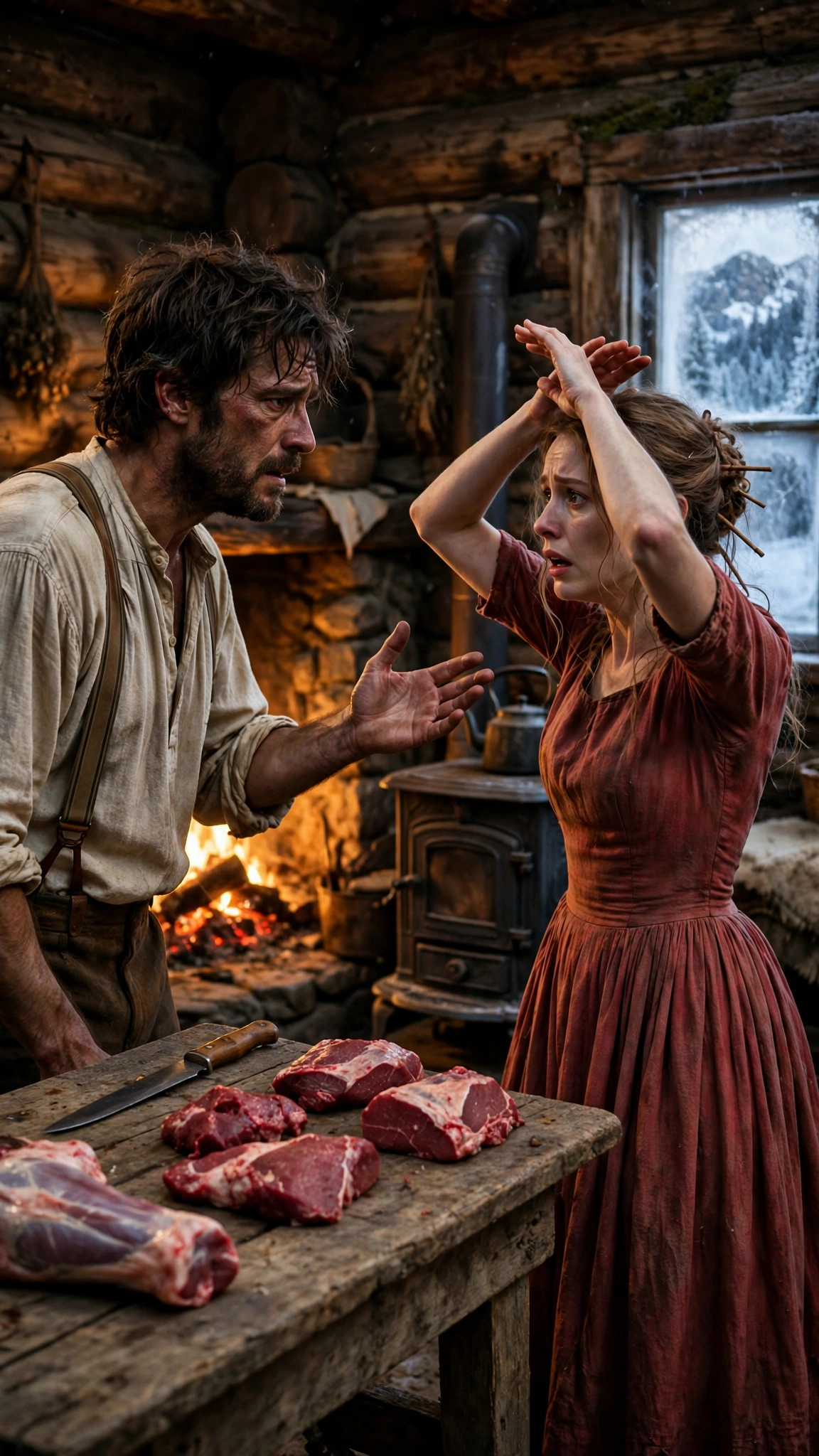
On the second day, she dropped a cup. It slipped from her wet hands as she was washing it, and it hit the floor and shattered, and she froze, her hands flying up, her breath stopping in her throat, waiting for the blow, waiting for the shouting, waiting for the hand on her side.
Nothing happened. Gideon, who had been mending a harness by the fire, looked up, saw the broken cup, saw her face, and set his work aside. He crossed the room slowly, and he knelt down, and he picked up the pieces himself, one by one, and he put them in the bucket by the door.
"It's only a cup," he said, and he said it the way a man states a fact, plain and unadorned. "We've got others."
Mave stood there with her hands still half raised, her heart hammering in her chest, and she did not know what to do with his kindness, because kindness had always been a trap before — a kind word in the morning, a blow in the evening, and the kind word only ever meant that the blow would come later, when she least expected it.
But Gideon did not strike her. He did not shout at her. He did not even look angry. He simply picked up the broken cup, and he went back to his harness, and the evening went on as if nothing had happened, and Mave sat down at the table with her hands folded in her lap and tried to understand a world in which a broken cup was only a broken cup.
It was the same on the third day, when she burned the bread. She had left it in the oven too long while she was mending Gideon's shirt, and when she opened the oven door, the smell of char came out in a black cloud, and the loaf was black on top and hard as a rock. She stood there holding it, waiting, her throat closing up, and Gideon came in from outside with an armload of wood, and he saw the bread, and he saw her face, and he set the wood down and took the loaf from her hands.
"Cut off the burnt part," he said. "The rest will do."
And that was all. He cut the loaf himself, and he ate the burnt edge himself, without a word, and he did not mention it again.
On the fourth day, she asked him about the traps. She had never asked a man a question before without first apologizing for it, and she caught herself mid-sentence, her voice faltering, her eyes dropping to the floor. Gideon waited until she had finished, and then he answered her, plainly and fully, as if her question were the most natural thing in the world, and he offered to show her the trap line the next day, if the weather held, and she said yes before she could stop herself, and then she spent the rest of the evening wondering why she had said it, and whether she had made a mistake.
She had not made a mistake. The next morning, the weather held — cold and clear, the snow firm underfoot — and Gideon took her out to the trap line, walking slowly so she could keep up, pointing out the tracks in the snow, the marten prints, the rabbit runs, the place where the creek bent and the ice was thin. He showed her how to set a trap, and how to bait it, and how to read the signs of an animal's passing, and he did it all with a patience that asked nothing of her, and when she slipped on the ice and fell, he caught her by the arm — gently, so gently — and steadied her, and let go at once, and asked if she was hurt, and when she said no, he nodded and walked on.
It was on the way back to the cabin, with the sun low and the snow turning pink on the ridge, that she realized something. She realized that she had not been afraid all day. Not once. Not when the trap snapped shut, not when she slipped on the ice, not when Gideon had reached for her arm. She had spent the whole day walking beside a man in the wilderness, and she had not once expected him to hurt her, and the realization was so strange, so new, that it frightened her almost as much as the fear itself had.
That night, she lay in the narrow bed and listened to Gideon breathing on the pallet by the fire, and she thought about the days that had passed — the broken cup, the burned bread, the trap line, the gentle hand on her arm — and she thought about the bruises on her ribs, hidden under her dress, and she thought about the sentence she had not been able to finish, the sentence that began "He told me…" and stopped, because she did not know how to say the rest of it, or to whom, or what would happen if she did.
She thought about telling him. She thought about sitting up in the dark and saying his name, and telling him everything — about Voss, and the ledger, and the paper, and the lie. But the words would not come. They were locked in her throat, behind five years of silence, and she did not know how to unlock them.
So she lay still, and she listened to the fire, and she waited for morning, and she told herself that six days was not enough time to learn to trust a man, even a good one, and that perhaps, given more time, the words would come on their own.
She did not know that the morning would bring the wash tub, and the loosened dress, and the moment when Gideon would see what she had been hiding, and the question she could not answer would be asked aloud at last.
On the fifth evening, after supper, Gideon did something he had not done before. He took his father's old rifle down from the pegs above the door, and he sat by the fire, and he cleaned it slowly, oiling the barrel, working the action, and he showed her how it was loaded, and how the safety worked, and where it was kept, and he told her, plainly, that the rifle was hers to use as much as his, if ever she needed it, and that no one in this cabin would ever take it up against her.
Then he told her about Silas. He told her about his younger brother, who had come up the mountain with him when they were both young men, full of plans for a trap line that would make them rich, and who had caught the fever in the tenth winter and died in the narrow bed in three days, coughing blood into a rag, asking for water, asking for their mother, who was ten years dead herself. Gideon had buried him under the pine on the ridge, with his own hands, in the frozen ground, and he had carved his brother's name into a flat stone with his hunting knife, and he had gone on living alone in the cabin for ten winters after, because the silence was easier than the company of people who asked questions he could not answer.
"He was nineteen," Gideon said, staring into the fire. "Younger than you are now. He used to laugh at everything. Even at the end, he was laughing, telling me the fever couldn't kill a Marsh, because Marshes were too stubborn to die. He was wrong."
Mave listened, and she thought about Jonah, and about the empty coffin in the Bitterroot churchyard, and about the way grief lived in a house long after the person was gone — in the chair no one sat in, in the name no one spoke, in the pine on the ridge. And she told Gideon, in return, about her mother, and the Bible, and the way her mother had taught her to read by firelight, tracing the letters with her finger, and about her father, and the beam at the barn raising, and about the house she had been born in, and the cottonwoods in the churchyard, and the cracked bell that had tolled for them all.
They sat by the fire until late, trading their dead, piece by piece, the way people trade small kindnesses, and when at last they banked the fire and lay down to sleep, Mave thought that perhaps this was what marriage was — not the ceremony, not the paper, not the words spoken before a preacher, but this: two people sitting by a fire in the dark, telling each other the names of the ones they had lost, and finding that the telling made the losing bearable.