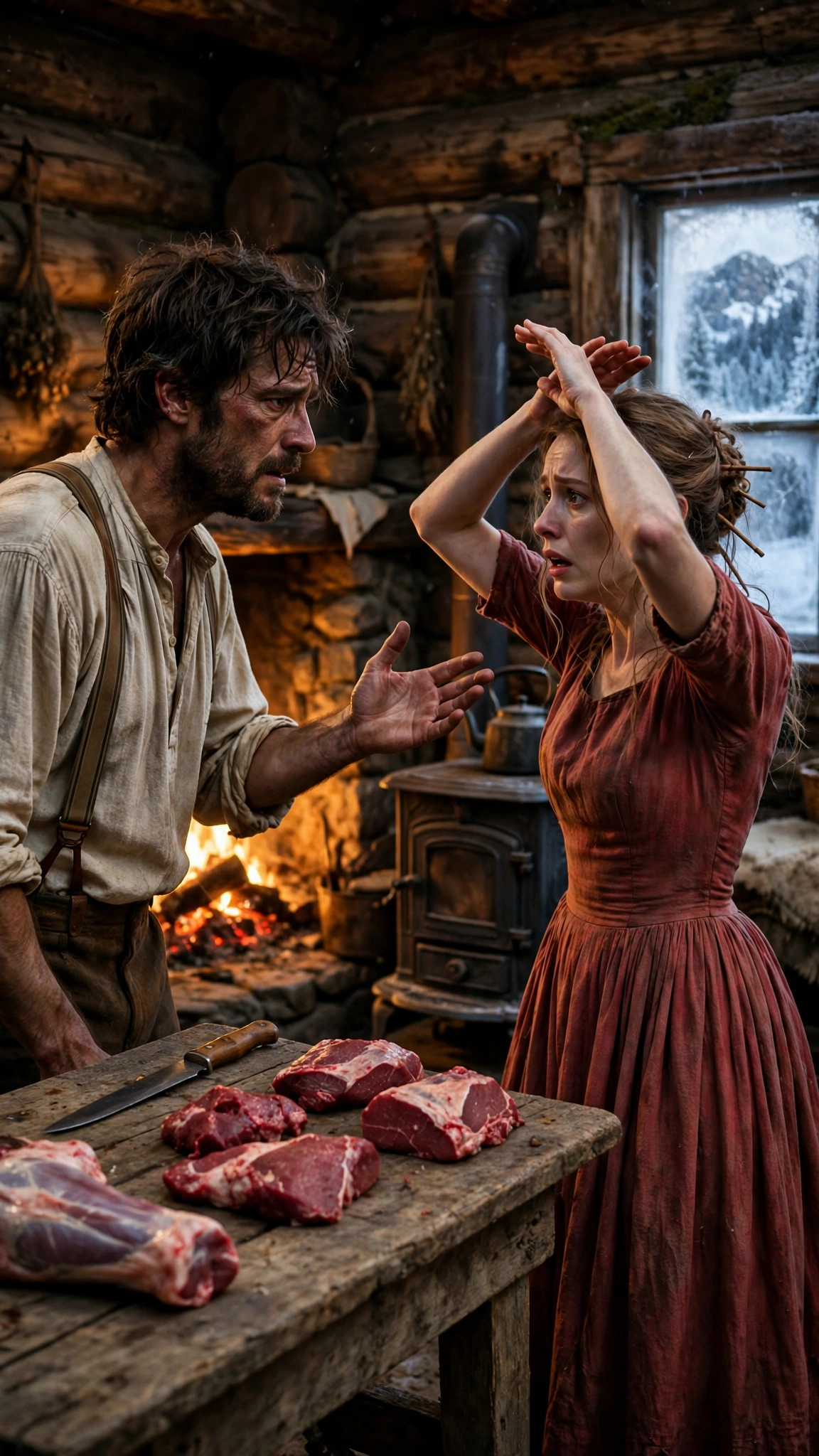
Spring came to the mountain the way it always came — not all at once, but in small surrenders.
First the icicles along the eaves began to drip in the afternoons, and the snow on the south-facing slope softened and sank, and the creek, which had been silent under its ice all winter, began to mutter and complain beneath the surface. Then the wind changed, losing its knife edge, and the air began to smell of wet earth instead of cold iron, and one morning Gideon came in from checking the traps and said, "The pass will open within the week."
Mave stood at the table kneading bread, her hands deep in the dough, and she felt something cold settle in her stomach at his words. The pass opening meant the world would come back up the mountain. It meant traders and trappers and travelers on the trail. It meant Bitterroot, and Bitterroot meant Merritt Voss.
She had not told Gideon the whole truth. She had told him, in pieces, over the long winter evenings — about Jonah, and the river, and the debt, and the bruises. She had told him enough that he understood, and he had never pressed her for more. But she had not told him about the paper, or the lie, or the words Voss had said to her on the night she left — You'll be back. They always come back. And she had not told him because she was afraid that if she said it aloud, it would become true.
Now, with the pass opening, the fear came back, sharper than it had been in months. She began to watch the trail. She began to listen for hoofbeats. She began to wake in the night, her heart pounding, certain she had heard a horse on the trail below, certain she had heard a voice calling her name.
Gideon noticed. He noticed everything about her now — the way she moved, the way she breathed, the way her hands shook when she thought he was not looking — and one evening, as they sat by the fire, he set down his whittling and looked at her across the flames.
"He's coming, isn't he?" he said, and it was not a question. "The man who did that to you. When the pass opens, he'll come."
Mave stared into the fire. The flames moved over the logs, orange and gold, and for a long moment she said nothing. Then, slowly, she nodded.
"His name is Merritt Voss," she said, and saying his name aloud in the firelight felt like opening a door she had kept locked for years. "He owns the trading post in Bitterroot. He told me Jonah sold me to him. He told me I belonged to him. He told me if I ran, he'd bring the law after me."
Gideon was silent for a long time. The fire crackled. The wind moved softly over the roof. When he spoke at last, his voice was low and steady, the voice of a man who has made up his mind about a thing and will not be moved from it.
"Then let him come," he said. "This is my cabin, and you're my wife, and no man takes what's mine from my own doorstep. Not Voss. Not any man. I'll stand in the doorway, Mave, and I'll tell him to go back down the mountain, and if he doesn't go, I'll stand there until he does."
Mave looked at him, and she saw the truth of it in his face — the same steady, unmovable look he had worn when he set the knife flat on the table, far from her, and said, It's only a knife. He was not a violent man. She knew that now, after a whole winter of living beside him. But he was not a man who stepped aside, either. He was a man who stood his ground, and the ground he stood on was this cabin, and her.
Three days later, Voss came.
Mave was at the wash tub in the yard, rinsing clothes in the cold spring water, when she heard the hoofbeats on the trail below — slow and deliberate, a single horse picking its way up the wet track. She straightened up, her hands dripping, and she looked down the trail, and there he was, riding up through the pines, tall and thin in his dark coat, his hat pulled low, his face pale as river water in winter.
Merritt Voss had come up the mountain.
She dropped the cloth she was holding. It fell into the wash water and sank. She stood frozen, her hands at her sides, her breath stopping in her throat, and she watched him ride closer, and closer, until he reined in his horse at the edge of the yard and looked down at her from the saddle.
"Mrs. Hale," he said, and his voice was smooth and reasonable, the voice he had used at the kitchen table in the trading post, the voice of a man discussing business. "I've come to take you home. The debt is still outstanding, and the paper is still valid, and you belong to me. Come along now. Don't make a scene."
Mave could not move. She could not speak. Her whole body had gone rigid, the way it had gone rigid on the day the knife fell, her hands half raised, her eyes fixed on the man before her, waiting for the blow.
And then the cabin door opened, and Gideon stepped out onto the porch.
He was not carrying his rifle. He was not carrying his knife. He wore his cream linen shirt and his brown suspenders, and his hands were empty and open at his sides, and he walked down the steps and across the yard, slow and deliberate, and he placed himself between Mave and the man on the horse, and he stood there, tall and broad in the spring sunlight, and he looked up at Voss with eyes as steady as stone.
"She's not going anywhere with you," Gideon said.
Voss looked down at him from the saddle, and his thin face tightened, and for a moment Mave thought she saw something flicker in his pale eyes — surprise, perhaps, or anger, or the first cold touch of fear.
"You must be Gideon Marsh," Voss said. "I've heard of you. A trapper. A mountain man. A man who lives alone because no decent woman would have him. Well, Mr. Marsh, I have a paper here — signed by her late husband — that says this woman belongs to me. She's my property, bought and paid for, and I have come to collect what is mine. Step aside."
Gideon did not step aside. He did not raise his voice. He did not reach for a weapon. He simply stood in the yard, his hands open at his sides, and he spoke in a voice so quiet and so certain that it carried across the yard like a bell.
"She's my wife," he said. "Married before God and the Reverend Amos Bell, in this cabin, in the sight of witnesses. She's not property. She's not yours. And she's not going down that mountain with you. Not today. Not ever."
Voss's face darkened. He swung down from the saddle, his boots hitting the wet ground, and he took a step toward Gideon, and Mave cried out, a small, strangled sound, because she had seen that step before, she had seen that look before, and she knew what came next.
But Gideon did not flinch. He did not back away. He stood his ground, and he kept his hands where Voss could see them — empty, open, still — and he said, very quietly, "Don't."
It was the same word he had spoken to her on the day of the knife, in a different tone, for a different reason, and it stopped Voss where he stood, because there was something in Gideon's voice, and in his stillness, that made it clear — without threat, without shouting, without a raised hand — that this man would not move, and that any man who tried to move him would find himself standing against a mountain.
Voss stared at him for a long moment. Then he laughed, a short, ugly laugh that held no humor in it at all.
"You think a piece of paper from a country preacher protects her?" he said. "I have the law on my side, Marsh. I have a signed paper, and I have the county court, and I will bring the marshal up this mountain, and when I do, we'll see whose paper holds. You have until the end of the week. Bring her down to Bitterroot yourself, and I'll consider the matter closed. If you don't, I'll come back with the law, and I'll take her anyway."
He turned and mounted his horse, and he rode back down the trail without looking back, and Mave stood in the yard with her hands pressed to her mouth, shaking so hard she could barely stand, and Gideon turned to her, and he put his arms around her — gently, so gently, asking with his eyes before he touched her — and he held her while she cried, for the first time since the day the knife fell, great shaking sobs that tore out of her like something breaking open.
"It's all right," he said, over and over, his voice low and steady against her hair. "It's all right. He's gone. You're safe. I'm here. I'm not going anywhere."
That night, Mave lay awake in the narrow bed and listened to the spring rain on the roof, and she thought about Voss's words — I have the law on my side — and she thought about the paper with the signature she could not read, and she thought about the end of the week, and she knew that Gideon could stand in the doorway forever, and it would not be enough, not against the law, not against a paper signed in Jonah's name.
Unless the paper was a lie. Unless someone could prove it was a lie.
And then she remembered something. She remembered her mother's Bible, the one she had carried up the mountain in her bundle, and the lining inside the back cover, where her mother had sewn a pocket, years ago, to hide a few coins from her father's drinking friends. Mave had never opened that pocket. She had forgotten it was there.
But Jonah had known about the pocket. Jonah had known everything about that Bible, because he had sat with her in the evenings while she read from it, and he had teased her about her mother's hiding place, and he had said, one night, "If I ever need to leave you something important, Mave, I'll put it where your mother put her coins. You'll know where to look."
She sat up in the dark. Her heart was beating so hard she could hear it in her ears. She slipped out of the bed, barefoot on the cold floorboards, and she crossed the cabin in the dark, and she took her mother's Bible from the shelf, and she carried it to the fire, and by the light of the embers, she opened the back cover, and she felt along the lining with her fingers, and there — sewn into the pocket her mother had made — was a folded piece of paper.
Before she opened it, she paused, and she thought about what Gideon had done that afternoon in the yard. He had not picked up his rifle. He had not picked up his knife. He had walked out onto the porch with empty hands, and he had stood between her and Voss, and he had said, "Don't," in a voice so quiet it had stopped a man in his tracks. She had seen men fight before — she had seen teamsters brawl in the yard of the trading post, and she had seen Voss raise his hand — but she had never seen a man win a fight by refusing to fight it, by standing still and letting the truth of his position do the work.
And she thought about the rifle above the door, and the way Gideon had shown her how it worked on the fifth evening, and how he had told her it was hers to use as much as his. He had given her a weapon, and then he had gone out to face Voss without one, because he understood something she was only beginning to understand: that a weapon was not what would save her. The truth was what would save her. And the truth, if Jonah had hidden it where he said he would, was in her hands now, folded small, waiting to be read.