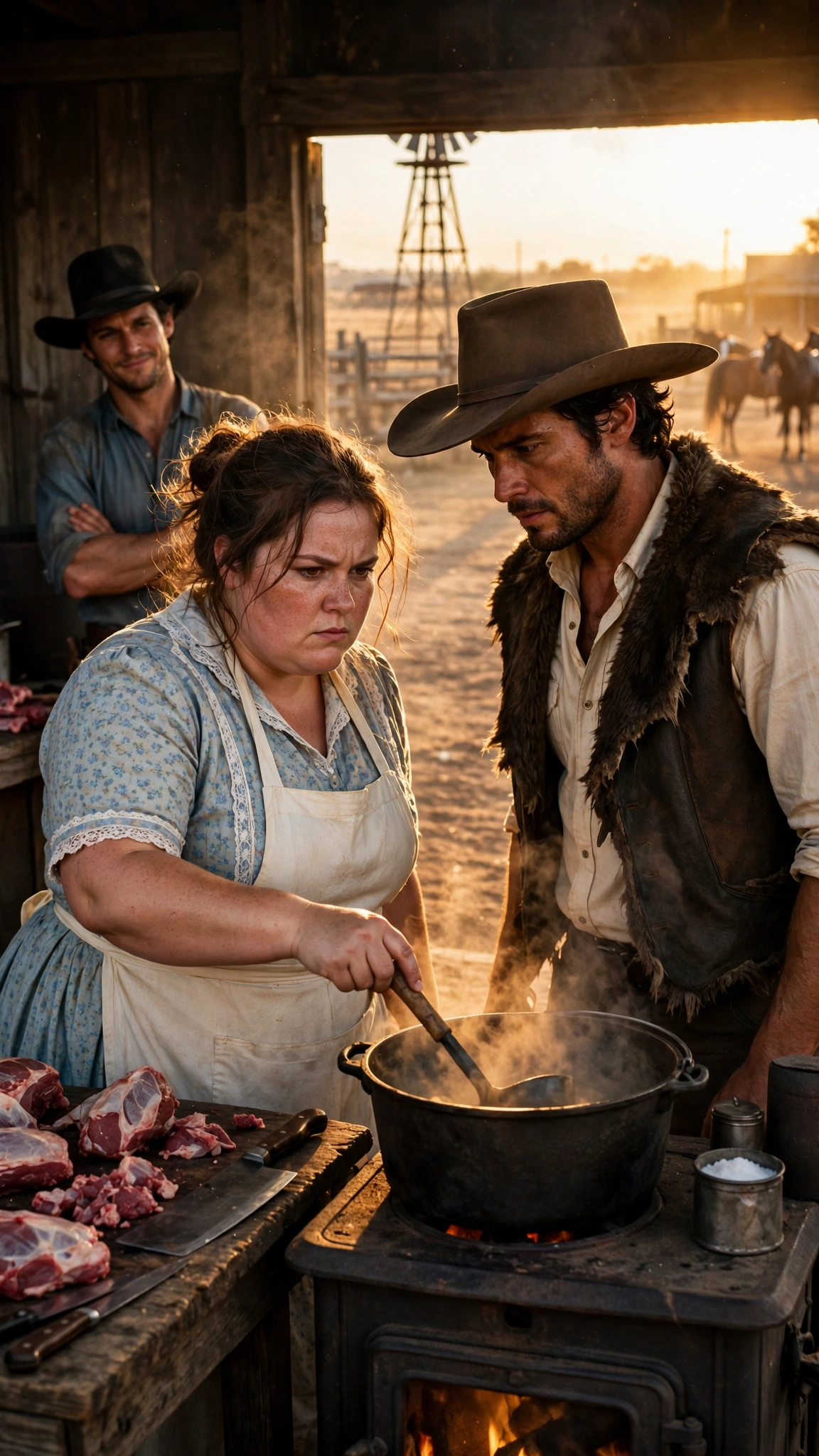
The cabin stood at the edge of the Bar R, where the ranch land ran out into open prairie, and it was small enough that a stranger might have mistaken it for a line shack. Two rooms, a lean-to kitchen, a garden fenced against rabbits, and a grave on the hill behind it. Abigail had lived in it for three years — first with Thomas, then alone, then with Martha, who had moved in two months after the funeral because her own knees had given out and her own cabin, ten miles off, had a roof that leaked in three places.
Thomas Thornton had been twenty-seven years old when he died, and he had been the best roper in the county, and everybody on the Bar R had a story about him. Eli said Thomas could rope a calf in a dust storm with his eyes shut. Sam said Thomas had once ridden a green colt through a hailstorm and come back laughing with ice in his hair. Dutch said Thomas was the only man he had ever known who could make Caleb Reynolds smile, and Dutch had known Caleb since they were both boys.
Abigail remembered a different Thomas. She remembered a man who came home smelling of horse and dust and who washed his hands at the pump before he touched anything in the kitchen, because his mother had raised him right. She remembered a man who was terrible at mending his own shirts and who pretended not to notice when she fixed them, and who left the mended shirts folded on the chair like a secret between them. She remembered a man who, on the last morning of his life, had kissed her goodbye at the door and said, "Stew tonight, Abby. Your mother's stew. I've been dreaming about it all week," and she had laughed at him, and she had said, "Then you'd better come home hungry," and he had.
He had not come home at all.
The stampede had started the way stampedes always start — with nothing. A steer had turned under a horse on a wet slope, and the horse had gone down, and the herd had gone over them both like a river going over a rock. The men had found Thomas under the trampled grass with his hat still on his head, which was the detail Abigail could not stop thinking about afterward, as if the hat mattered, as if the fact that his hat had stayed on meant something. Caleb Reynolds had carried the hat back to the cabin himself. He had stood in the doorway with his own hat in his hands, and he had said, "I'm sorry, Mrs. Thornton," and then he had gone, and Abigail had buried her husband on the hill behind the cabin, under a wooden cross she had carved herself with his name and the dates and the words "He came home hungry," because that was the last thing he had said to her that meant anything, and she wanted it to be true forever.
For a month after the funeral, she had not cooked at all. She had eaten cold bread and whatever Martha put in front of her, and the kitchen had gone quiet, and the stove had gone cold, and the house had smelled of nothing. Then one morning Martha had come into the kitchen and found Abigail sitting at the table with her hands empty, and Martha had said, "Girl, you are going to cook something today or I am going to die of your silence," and Abigail had laughed for the first time in a month, a sound that surprised them both, and she had gotten up and lit the stove and made a pot of beans, and the smell had filled the cabin, and it had felt like the first honest thing she had done since the funeral.
Cooking was the one thing nobody could take from her. Her mother had taught her in a kitchen in San Antonio, in a house with a dirt floor and a wood stove, and her mother had been the kind of cook who could make a meal out of nothing — a handful of beans, an onion, a bone — and make men ask for the recipe. "A cook feeds people," her mother used to say, standing Abigail on a stool so she could reach the stove. "That is the whole of it. You feed them, and you do not lie to them about what is in the pot, and you do not let anybody tell you that what you make is not enough. If it is made with care, it is enough."
Abigail had carried that with her across Texas, from San Antonio to the Bar R, and she had carried it through the year of her marriage, and she had carried it through the year of her widowhood, and now, in the spring of 1888, she was carrying it into a cookhouse full of thirty hungry men who had never once eaten her cooking and who had already decided, before she ever lifted a ladle, that she would fail.
The debt was the other thing she carried. Forty-seven dollars, owed to Hargrove's store. It had grown the way debts grow when you are a widow with a garden and a needle and no husband's wages — a little at a time, for flour, for salt, for coffee, for lamp oil, and then, last winter, for the medicine. Martha's cough had come on in November, and it had settled in her chest, and by January she could not walk to the well without stopping to catch her breath. The doctor in town had come out once — a long ride, and he had charged for it — and he had left a bitter brown bottle and the words, "Keep her warm, keep her fed, and pray for spring." The bottle had cost eleven dollars. Abigail had paid it without a word, because what else was she going to do, and the number in Hargrove's ledger had gone up to forty-seven, and it had stayed there, and every time she went into the store, Mr. Hargrove looked at her with the patient face of a man who was running out of patience.
She paid what she could. Eggs, when the hens laid. Mending, when the ranch wives brought her their torn shirts. Bread, when the bunkhouse asked for it, two loaves for a dollar, three for two. But the number would not go down fast enough, and the spring was coming, and Martha's cough was better but not gone, and Abigail had begun to lie awake at night doing sums in her head — flour, salt, coffee, medicine — and the sums always came out the same.
So when Caleb Reynolds rode up to the cabin on that April morning and offered to wipe the debt if she lasted the season, she had said yes before he had finished the sentence in her own head. She had said yes, and she had meant it, and she had been terrified of it, and she had not slept properly since.
Martha had opinions about the job, of course. Martha had opinions about everything.
"You are going to cook for thirty men," Martha said that first night, sitting by the fire with her mending in her lap, her needles clicking. "Thirty men who have not had a decent meal since Silas's hands gave out. They will eat what you give them, and then they will tell you it is not what they wanted, and then they will eat it again, because they are hungry. That is how men are."
"Thank you, Martha," Abigail said.
"And Wyatt Granger," Martha said, and her needles stopped clicking. "You watch that one. He has been sniffing around the cookhouse since Silas left, and he has a cousin who needs work, and he has decided that the cook's wages belong to his family. He will not say it outright. He will smile. He will be polite. And then he will do something quiet, when nobody is looking, and he will deny it with that same smile."
"How do you know all this?" Abigail asked.
Martha snorted. "I have lived on this ranch for forty years, girl. I know who steals the sugar and who steals the salt, and I know the difference between a man who is hungry and a man who is greedy. Wyatt Granger is greedy. His father was greedy. His grandfather was greedy, and he stole a whole herd of cattle in '62 and got away with it because nobody could prove it. It runs in the blood."
Abigail thought about that for a long time. She thought about the way Wyatt had looked at her in the yard that first Monday, when she had walked into the cookhouse at dawn — the way his eyes had gone over her, the way he had leaned against the doorframe with his arms folded, the way he had said, "Well. The widow cooks now," in a voice that was almost friendly and not friendly at all.
"I can stand my ground, Martha," she said.
"I know you can," Martha said, and she picked up her needles again. "Your mother could too. That is why I am not worried. I am only telling you what you are walking into, so that when it happens, you will not be surprised. A woman who is not surprised is a woman who is ready."
The next morning, Abigail rose before dawn, the way she had every morning since Monday, and she went to the cookhouse in the dark, and she lit the stove, and she put the coffee on. The yard was empty. The windmill turned slow. Somewhere in the pens, a horse stamped. She stood at the table and looked at the day's work — the beans to soak, the bread to bake, the meat to cut — and she thought about the grave on the hill behind the cabin, and about the wooden cross with the words "He came home hungry," and about the promise she had made to herself on the day she buried her husband: that she would not be driven off this ranch, not by grief, and not by debt, and not by any man.
She picked up her knife. She began.
And that was the morning she learned what the ranch had left to eat. She opened the meat store, and she counted, and she counted again, because she did not believe the first count. There was no beef. There was no pork. There was no mutton. There was a scrawny herd of goats in the far pen, bought cheap from a Mexican trader the previous autumn, and there was a bin of dried beans, and a sack of cornmeal, and a barrel of flour that was running low, and that was all. She stood in the doorway of the store with her hands on her hips and her mother's voice in her head — "A cook feeds people. That is the whole of it." — and she understood, for the first time, exactly what Caleb Reynolds had hired her to do.
He had not hired her to cook. He had hired her to make something out of nothing, in front of thirty men, and to do it with a smile.
Well. She had been making something out of nothing since she was a girl standing on a stool in a kitchen in San Antonio. And she was not going to stop now.
The first week taught her the shape of the work. She learned that Eli liked his coffee strong enough to stand a spoon in, and that Sam would eat anything put in front of him without a word, and that Dutch complained about every meal and then cleaned his plate twice, and that Pete, who was the youngest, saved the crust of his bread for the ranch dog. She learned that the men came to the cookhouse at the same hours every day, regular as the windmill, and that they judged a cook the way they judged a horse — not by how she looked standing still, but by how she held up under a load. She learned that the stove had a hot spot on the left side, and that the big iron skillet Silas had left behind was the best pan she had ever used, heavy and true, and that the dough rose faster in the warm corner by the stove than anywhere else in the room.
She learned, too, that the men were watching her. Not unkindly, not all of them — but watching, the way men watch a new thing, waiting to see if it holds. On the third morning, Eli came to the cookhouse door after breakfast and said, "Mrs. Thornton. That bread was good bread." He said it the way a man says a thing he has not planned to say, and then he nodded, and he went away, and Abigail stood at the table with the flour on her hands and felt something lift in her chest, something she had not felt in a long time. It was not happiness. It was not pride. It was the feeling of a door opening, just a crack, into a room she had not been invited into before.
By the end of the first week, the cookhouse had a rhythm, and the rhythm was hers. Coffee before dawn. Bread by seven. Beans by noon. Supper by dark. The men came and went, and the pots went on and off the stove, and the days passed, and Abigail Thornton began to believe — cautiously, the way a woman who has lost everything believes in anything — that she might last the season after all.