Spring came to Cutthroat Creek the way spring always comes to the high mountains — slowly, and then all at once.
In March, the snow began to soften. In April, the creek broke free of the ice and ran cold and clear and loud down the mountain, and the first green shoots pushed up through the mud in the yard. In May, the aspens put out small, bright leaves, and the air smelled of pine and wet earth and new grass, and the road to Leadville dried out, and the stage began to run again, and the world came back to the boarding house on the mountain.
The news from Fairplay came with the stage: Cornelius Vane had been found guilty of fraud by a judge, and fined, and ordered to repay every dollar he had taken from Abigail Thatcher, with interest. Mr. Pritchard had left Leadville and gone back east. The house on Cutthroat Creek was free and clear, and it belonged to Abigail Thatcher, and no one could take it from her ever again.
Abigail changed after that winter. Not all at once, and not completely — she was still a stern woman, and she still kept her ledger book down to the last penny, and she still pinned her hair back so tightly it pulled at the corners of her eyes. But she smiled now, sometimes, when the cowboys told stories at the table. She sat down to supper with the men, instead of standing in the doorway. And one morning in April, she came into the kitchen with a pot of paint and a brush, and she went out to the sign by the road — the old wooden sign that had read THATCHER BOARDING HOUSE for twenty years — and she painted, in careful, steady letters, underneath the old name:
THATCHER & HART BOARDING HOUSE.
Matilda stood on the porch and watched her do it, with her hand pressed to her chest, and tears in her eyes, and she did not trust herself to speak. Abigail climbed down from the ladder, and she wiped her hands on her apron, and she said, "A house needs two names, if two women keep it. You saved this house, Matilda. It is your house now, as much as mine. We will run it together, you and I — partners, equal and equal."
"Partners," Matilda whispered, and the word felt like sunlight on her face. "Yes, ma'am. Partners."
"Not ma'am," Abigail said, and for the first time, she smiled — a real smile, small and a little stiff, but real. "Abigail. My name is Abigail. We are partners now, Matilda. You may call me Abigail."
The cowboys cheered when they heard the news, and Tom Ellery fired his pistol into the air, and Silas McCready shook Matilda's hand as though she were a fellow foreman, and Wade Conroy baked — or tried to bake — a cake, which came out black on the outside and raw in the middle, and everyone ate it anyway, and laughed until their sides hurt.
And Jedodiah Boon — Jedodiah, who had stayed the winter, and who had mended the barn door and split the wood and stood between Matilda and the storm — Jedodiah stayed into the spring, too. He built a cabin of his own, a little way down the creek, with logs he cut himself and a stone chimney and a door that faced south, away from the wind. He built it slowly, and carefully, and he did not say why he was building it, and no one asked him.
Matilda watched him build it, day by day, from the kitchen window, and she carried him his lunch at noon — bread and stew in a tin pail, and coffee in a jug wrapped in cloth to keep it warm — and they ate together on a fallen log, looking out over the creek, and they talked, the way people talk when they are building something together, even if neither of them has said so yet. He told her about the mountain — about the beaver ponds in the high valleys, and the elk trails, and the place where the wild strawberries grew thickest in July. She told him about St. Louis, and about her mother's kitchen, and about Thomas, and about the long walk up the mountain road with a carpetbag and a recipe book. They did not hurry. Spring in the mountains does not hurry, and neither did they. But every day the cabin grew — a wall, and then another wall, and then the roof beams, and then the chimney, stone by stone — and every day Matilda understood a little more clearly what he was building, and for whom.
In June, when the wildflowers were out on the hillsides, and the creek ran full and clear, and the evenings were long and golden, Jedodiah came to the kitchen door in the evening, after supper, and he asked Matilda to walk with him down to the creek.
They walked in silence for a while, the way they always did — Jedodiah quiet, Matilda quiet beside him, the mountains all around them, the creek singing over the stones — and the wildflowers brushed against her skirt, yellow and purple and white, and the air smelled of pine and new grass, and a hawk circled high above the meadow, crying once, far away.
At the big flat rock where the creek bent around the meadow, Jedodiah stopped, and he turned to face her, and he took her hands in his — his great, rough hands, gentle as they had been that night by the fire — and he said, "Matilda. I built that cabin for us. I have been building it for us since the first warm day of spring, and I did not ask you first, because I was afraid of what you would say, and because a man who has lived alone for seven years does not know how to ask for the things he wants. But I am asking now." He took a breath, and his icy-blue eyes held hers, steady and clear. "I am not a young man, and I am not a rich man, and I am not an easy man. But I have a cabin, and I have two strong hands, and I have a heart that has been empty for a long time. Will you marry me, Matilda? Will you be my wife, and let me be your husband, and let us build a life together on this mountain?"
Matilda looked at him — at his long dark hair, and his thick beard, and his quiet eyes, and his great frame, silhouetted against the evening sky — and she thought about Thomas, who had loved her, and who had died, and who had told her, once, on a cold night on the trail, "If anything happens to me, Matty, do not stop living. Promise me. Do not stop living."
"I promise," she had said, and she had kept that promise, through the fever and the wagon and the pine tree beside the creek, and through the long walk up the mountain road, and through the storm, and through the week when she had almost lost everything.
"Yes," she said, and her voice shook, and her eyes filled, and she laughed through her tears, the way she had not laughed in years. "Yes, Jedodiah Boon. Yes, I will marry you."
He kissed her hands, one and then the other, and then he put his arms around her — gently, as though she were made of glass — and she leaned against his great chest, and she listened to his heartbeat, steady and strong, and the creek sang over the stones, and the mountains stood all around them, gold in the evening light.
They were married in August, in the yard of the boarding house, under the aspens, with the whole house standing witness — Abigail in her best dark blue dress, crying openly and not caring who saw; Silas McCready standing as best man, his grey moustache trembling; Tom Ellery firing his pistol into the air again; Wade and Ephraim singing a hymn in rough, heartfelt voices; and a preacher from Fairplay, who had ridden up the mountain specially, reading the words over them while the sun shone down and the creek sang below.
Matilda wore her best dress — a new one, made of soft blue calico, with a cream apron, because a cook is a cook even on her wedding day — and her brown hair was in its messy bun, and her face was round and rosy, and she had never looked more beautiful, because she had never been happier. Jedodiah wore a clean shirt and his best coat — not the grizzly coat, which was too heavy for August, but a plain brown one, brushed and mended — and he stood so straight and so still that Silas whispered to Tom, "He looks like a mountain that has decided to get married," and Tom had to bite his lip to keep from laughing out loud.
Afterward, there was a feast — venison stew, of course, with the chokecherry jam, and bread still warm from the oven, and apple cake, and coffee, and the whole house ate together at a long table set out under the aspens, laughing and talking until the stars came out, and Abigail herself served the cake, and Silas made a speech that made everyone cry, and Tom danced a jig on the porch, and the preacher, who had stayed for supper, declared it the finest wedding he had ever performed in the territory, and the finest stew he had ever eaten in his life.
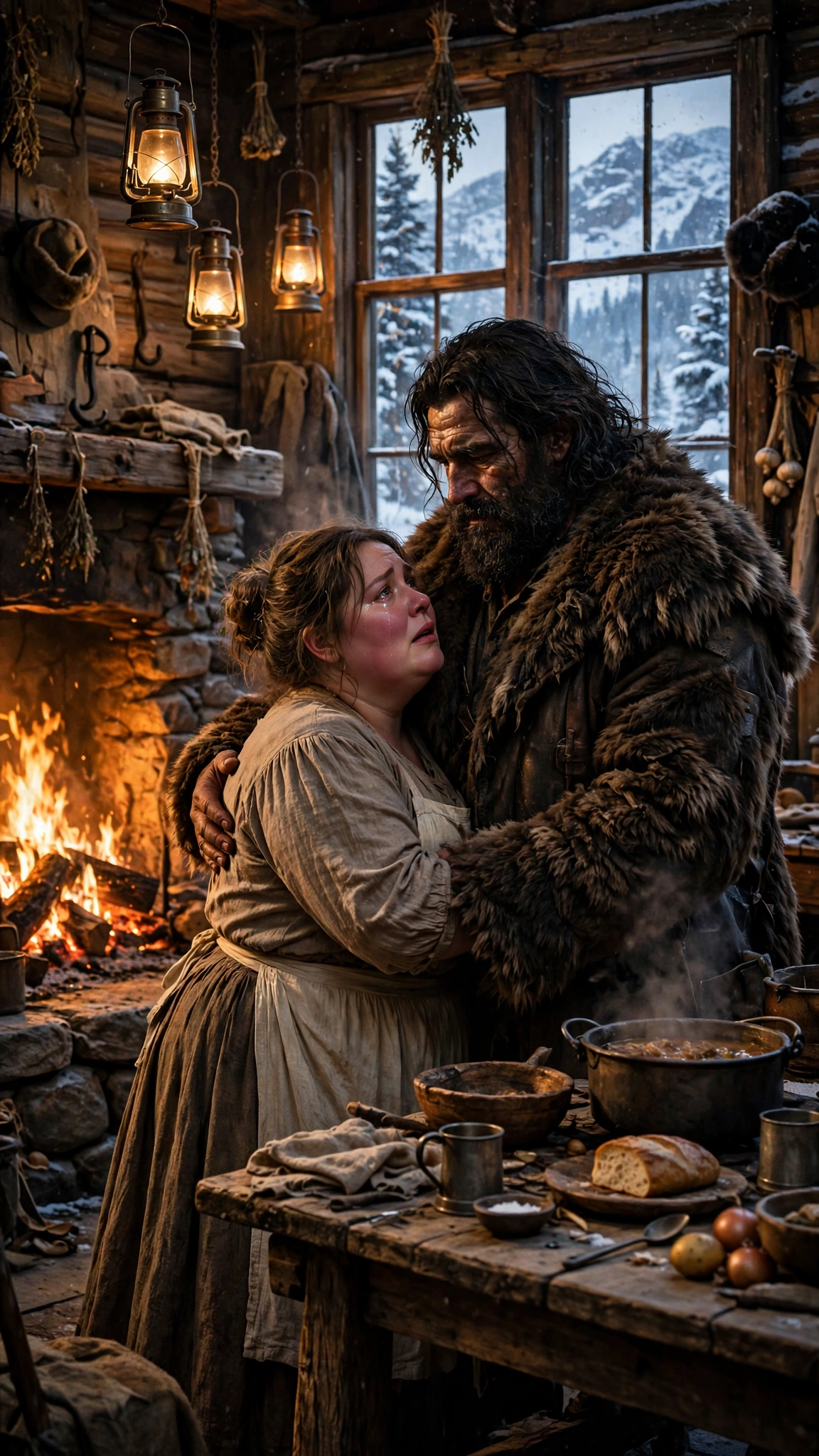
And that night, when the guests had gone and the house was quiet, Matilda stood in her kitchen — her kitchen, in her house, on her mountain — and she looked around at the stove and the work table and the window that looked out on the barn and the mountains beyond, and Jedodiah came up behind her and put his arms around her waist, and he rested his chin on the top of her head, and he said, "Are you happy, Mrs. Boon?"
"Yes," she said, and she leaned back against him, and she closed her eyes. "Yes, I am happy. I am happier than I ever thought I would be again."
On the hook by the kitchen door hung the grizzly-fur coat — the coat he had worn through every storm, the coat he had laid around her shoulders on the night the blizzard tried to take her, the coat that had kept her warm when the whole world was cold. It hung there still, heavy and dark and smelling faintly of pine sap and snow, and every morning Matilda touched it as she passed, the way one touches something sacred, and every morning it reminded her of the same thing:
That a good stew can hold a family together. That a coat can be a promise. And that sometimes, in the middle of the worst storm of the winter, a seven-foot trapper will rise from his chair, and block the wind with his own body, and say two words that change everything.
She stays.
And she did. She stayed, and she was loved, and she was safe, and the house on Cutthroat Creek stood warm and bright against the mountain for the rest of her days, and the stew was always on the stove, and the bread was always in the oven, and the fire never went out.
A year later, the boarding house was fuller than it had ever been. Word had spread down the mountain — about the cook whose stew could bring a dead man back to the table, and about the house where a traveler would always find a warm bed and an honest price — and new boarders came up the road every week: miners and teamsters and a schoolteacher from Denver, and even a young couple on their way to California, who stayed a month and then stayed another. Tom Ellery began courting a girl from Fairplay, and he asked Matilda's advice about it, solemnly, as though she were his own mother, and she gave it, solemnly, as though she were. Abigail kept her ledger book, down to the last penny, but now the columns added up to something more than survival — they added up to a future. And in the cabin down the creek, where the chimney smoked every morning and the door faced south, away from the wind, Matilda and Jedodiah built their life together, one day at a time, the way you build anything that lasts: slowly, and carefully, and with your whole heart.
And every winter, when the first snow came down from the peaks and the wind began to rise, Matilda would set the stew on the stove, and Jedodiah would hang the grizzly coat by the door, and the house would fill with the smell of bread and chokecherries, and the fire would burn warm in the hearth, and the woman who had once walked up a mountain road alone, carrying everything she owned in a carpetbag, would stand in her own kitchen and know, with all her heart, that she was home.