In the morning, the storm had broken.
The sky was a hard, clear blue, and the snow lay deep and white and glittering across the whole mountain, and the sun came up over the peaks like a blessing. Matilda got up before dawn, as she always did, and she lit the stove, and she set the coffee on, and she took her mother's recipe book from the drawer, and she opened it to the page for venison stew, and she took out the folded paper, and she held it in her hand for a long moment, looking at it, before she put it in her apron pocket, where it would be close to her heart.
She did not know if it would be enough. She knew only that it was the truth, and that the truth was the only weapon she had.
At breakfast, when the men were at the table and Abigail had come out of her parlor with her face pale and her eyes red from a sleepless night, Matilda stood up, and she took the paper from her apron pocket, and she unfolded it, and she laid it on the table in front of Silas McCready.
"Mr. McCready," she said, "you can read. Will you read this aloud, please? So that everyone can hear it."
Silas picked up the paper, and he held it close to his face, squinting, and he read it, slowly, in his deep, careful voice:
"'Received, this fifteenth day of October, in the year of our Lord eighteen hundred and seventy-five, from Mr. Edmund Thatcher, the sum of four hundred dollars, in full payment of the mortgage on the Thatcher Boarding House, Cutthroat Creek, Colorado Territory. Signed, Cornelius Vane.'"
The silence that followed was so complete that Matilda could hear the clock ticking in the parlor, and the fire crackling in the hearth, and her own heart beating in her chest.
"Four hundred dollars," Silas said again, wonderingly. "In full payment. Dated three weeks before Mr. Edmund died."
Tom Ellery let out a whoop that made the lanterns swing. "Did you hear that? The house is ours! I mean — the house is Mrs. Thatcher's! It was never his at all!" Wade Conroy pounded the table with his fist, hard enough to make the mugs jump, and Ephraim Doyle bowed his head and murmured, "Thank the Lord. Thank the Lord for the truth, and for this woman who found it."
Abigail stared at the paper, and her face went white, and her hands flew to her mouth, and she whispered, "Where did you get that?"
"I found it in the attic," Matilda said. "In Mr. Edmund's Bible. He folded it inside the front cover, and no one ever looked. He paid the mortgage, ma'am. He paid it before he died. The house is yours. It has always been yours. Mr. Vane has been collecting money on a debt that was already paid."
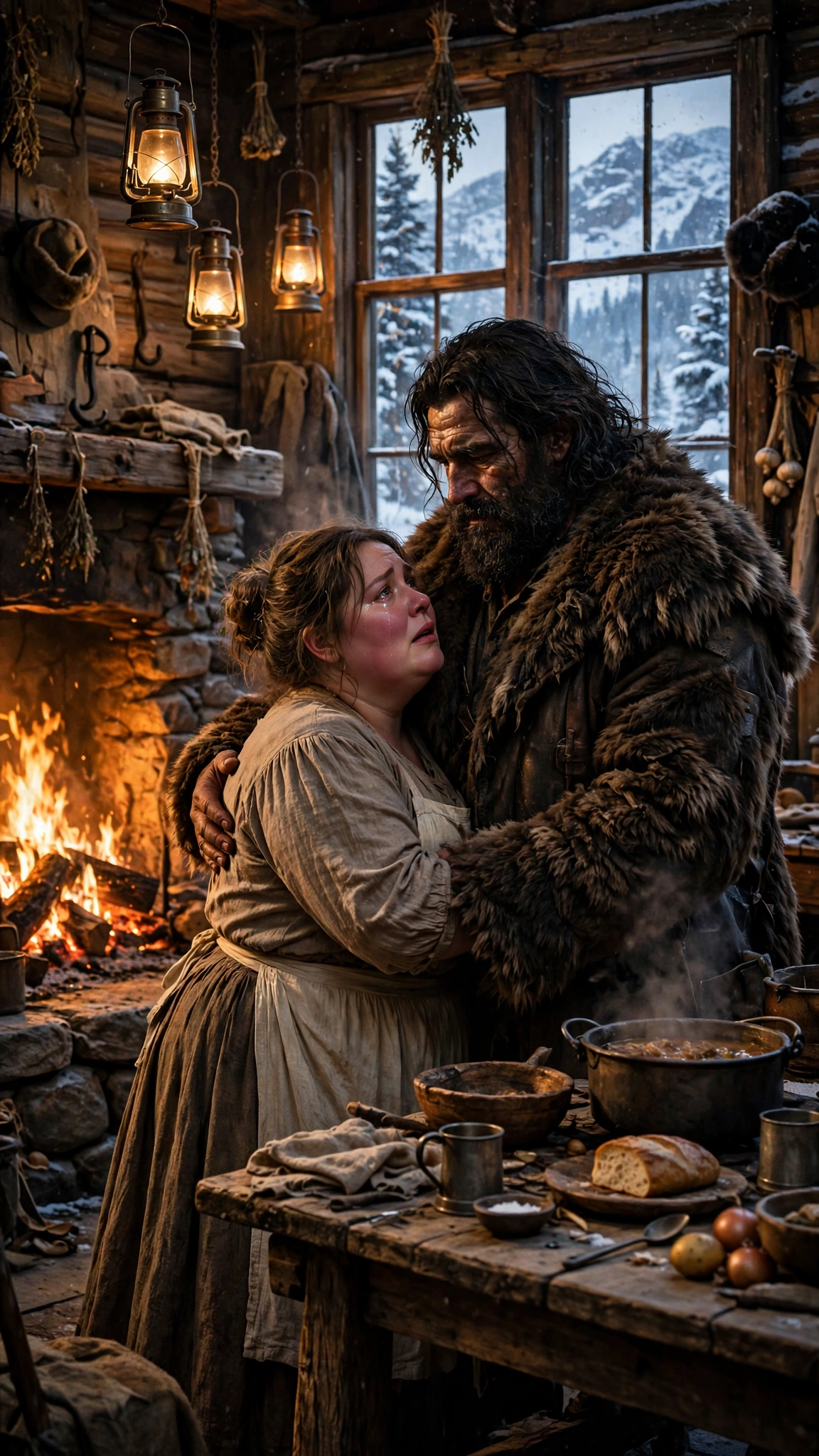
Abigail sank into a chair, and her shoulders shook, and for the first time since Matilda had known her, Abigail Thatcher wept — not the cold, controlled tears of a woman holding herself together, but great, shaking sobs, the sobs of a woman who has carried a weight for three years and has just set it down.
"Edmund," she whispered. "Oh, Edmund. You paid it. You paid it, and you never told me. You let me believe —" She covered her face with her hands, and her voice broke. "He was a careless man, my Edmund, always borrowing, always dreaming of silver. But he was not a dishonest man. He would never have left me in debt if he could help it. And all this time — all this time I thought he had left me nothing but a mortgage and a house I could not keep. I thought —" She looked up at Matilda, her eyes streaming. "I thought I had to clear this house to survive. I thought I had to send you away. And all the time, the house was mine. All the time, I was free, and I did not know it."
Matilda knelt beside her chair — awkwardly, heavily, the way she did everything — and she took Abigail's cold hands in her own warm ones, and she said, "You know it now, ma'am. That is what matters. You know it now."
Jedodiah stood up from the table, and he walked to the window, and he looked out at the white mountain, and he said, without turning around, "Then Mr. Vane is a thief. He has been taking money from a widow for a debt that does not exist. That is a crime, in any territory, and the law will want to hear about it."
And as if the words had summoned him, the sleigh bells sounded outside again, and Cornelius Vane came up the porch steps, stamping snow from his boots, with Mr. Pritchard behind him and a third man — a broad, red-faced fellow with a sheriff's star pinned to his coat.
Vane came into the dining room with his leather case under his arm, and he saw the paper on the table, and he saw Abigail's tear-streaked face, and he saw Jedodiah standing by the window, and he stopped in the doorway, and his face went the color of old paper.
"Mr. Vane," Silas McCready said, standing up, and his voice was very calm, and very dangerous, "we have been reading a receipt. A receipt for four hundred dollars, paid in full, signed by you, dated October of 1875. Would you like to explain to the sheriff why you have been collecting payments on a mortgage that was paid off three years ago?"
The sheriff — a man named Holt, from Fairplay, who had known Silas for twenty years — picked up the paper, and read it, and read it again, and then he looked at Vane, and he said, "Mr. Vane, is this your signature?"
Vane's mouth opened and closed. "That — that paper is a forgery. That woman stole it. She is a thief. She stole my —"
"She stole nothing," Jedodiah said, and he stepped forward, and his shadow fell across the table, and Vane went very still. "The receipt was in Edmund Thatcher's Bible, in the attic of this house, where it has been for three years. The cook found it. And the only thief in this room is you."
The sheriff folded the paper, and he put it in his coat pocket, and he said, "Mr. Vane, I think you had better come down the mountain with me. We will sort this out in Fairplay, in front of a judge. And Mr. Pritchard, you will come too."
Vane's face twisted. "You cannot do this. I own the mines of Leadville. I own —"
"You own nothing here," the sheriff said. "Not anymore. And I will tell you something else, Mr. Vane. I have known Silas McCready for twenty years, and I have known Mrs. Thatcher for ten, and I have never known either of them to lie. But you —" He looked Vane up and down, slowly. "You I have heard of. And what I have heard is not good."
Pritchard, who had stood silent through all of it, with his shoulders hunched and his eyes on the floor, finally spoke, in a small, miserable voice. "I told him, Sheriff. I told Mr. Vane, two years ago, that the mortgage was paid. I found the entry in the books myself. He told me to forget I had seen it. He said —" Pritchard swallowed. "He said a widow would never know the difference."
"Well," the sheriff said, "now she knows. And now a judge will know, too."
Vane opened his mouth once more, and then closed it, and the fight went out of him all at once, like air out of a punctured bellows, and he allowed the sheriff to take his arm and lead him out into the snow, Pritchard trailing behind, and the sleigh bells jingled away down the mountain road, and the house was quiet.
And then, in the quiet, Abigail Thatcher did a thing no one expected.
She stood up from her chair, and she walked across the kitchen to where Matilda stood by the stove, and she took Matilda's hands in her own — her hands, thin and cold and shaking — and she said, "I accused you of stealing my husband's watch. I had men search your room. I tried to throw you out into a blizzard. And all the time, you were the one who saved my house."
Matilda shook her head. "Ma'am —"
"No," Abigail said. "Let me finish. I was afraid. I have been afraid for three years — afraid of losing the house, afraid of being alone, afraid of growing old with nothing. And fear made me cruel. It made me cruel to the one person in this house who never did me any harm." She took a breath, and her voice steadied. "I am sorry, Matilda. I am sorry for all of it. Will you forgive me?"
Matilda looked at her — at this tall, stiff, proud woman, standing in her own kitchen with tears on her face, asking forgiveness from a cook — and she thought about her mother, who had always said that forgiveness is the one thing a person can give that costs nothing and means everything. And she squeezed Abigail's hands, and she said, "Yes, ma'am. I forgive you."
And then — because the morning had already held more miracles than any morning had a right to hold — Matilda went to mend Abigail's dress, the dark blue dress with the torn hem, and she picked up the sewing basket to find a needle, and she lifted the folded cloth at the bottom of the basket, and there, underneath it, winking in the lamplight, was Edmund Thatcher's silver pocket watch.
She held it up, and the whole room went still, and Abigail stared at it, and then she laughed — a short, startled laugh, the first laugh Matilda had ever heard from her — and she said, "It was in my own basket. All this time. I accused you, and it was in my own basket."
She took the watch, and she wound it, out of habit, and to everyone's astonishment, it began to tick — a small, steady ticking, like a heart starting to beat again after a long silence.
"It kept time all along," Abigail said softly, holding the watch to her ear. "I only had to look in the right place."
That night, the house ate supper together — Abigail at the table, not standing in the doorway; the cowboys telling stories; Jedodiah by the fire — and Matilda served the stew, and the stew was good, and the fire burned warm, and outside, the snow lay white and clean over the whole mountain, and the house on Cutthroat Creek stood firm, and free, for the first time in three years.
The next morning, Abigail rose before dawn for the first time in weeks — not to add columns in her ledger, but to wind the silver watch and set it on the mantel where the whole room could see it ticking. She came into the kitchen while Matilda was kneading bread, and without a word she took an apron from its hook and tied it on, and began setting the table herself, plate by plate, the way a woman sets a table in a house that is finally, truly hers. Matilda watched her for a moment, and then she went back to the bread, and neither of them said anything, because there was nothing that needed saying: the house was free, the watch was ticking, and the kitchen belonged to both of them now.
Before supper, Abigail had come into the kitchen while Matilda was stirring the pot, and she had stood there for a moment, watching, and then she had said, very quietly, "Edmund would have liked you, Matilda. He liked people who worked hard and complained little. He used to say that a house is not made of logs and stone, but of the people who keep it warm. I forgot that, for a while. You reminded me."
Matilda had not known what to say to that, so she had ladled stew into a bowl and set it in front of Abigail, and Abigail had eaten it, sitting at the work table in the kitchen, like a boarder, like a friend, and they had talked — about Edmund, and about the house, and about the spring, when the road would open and new boarders would come — and for the first time, the kitchen had felt like a room where two women could simply be together, without fear between them.
Silas McCready raised his mug at supper, and he said, "To the Thatcher Boarding House — and to the woman who saved it." And every man at the table raised his mug, and every man drank, and Tom Ellery, his eyes shining, said, "And to the cook. To the best cook in the territory." And Matilda, who had never been toasted in her life, pressed her hand to her chest, and laughed, and cried, a little, all at once, and the fire burned warm, and the house stood firm, and free, for the first time in three years.
=== STEP 7 — APPEND Chapter 7 ===