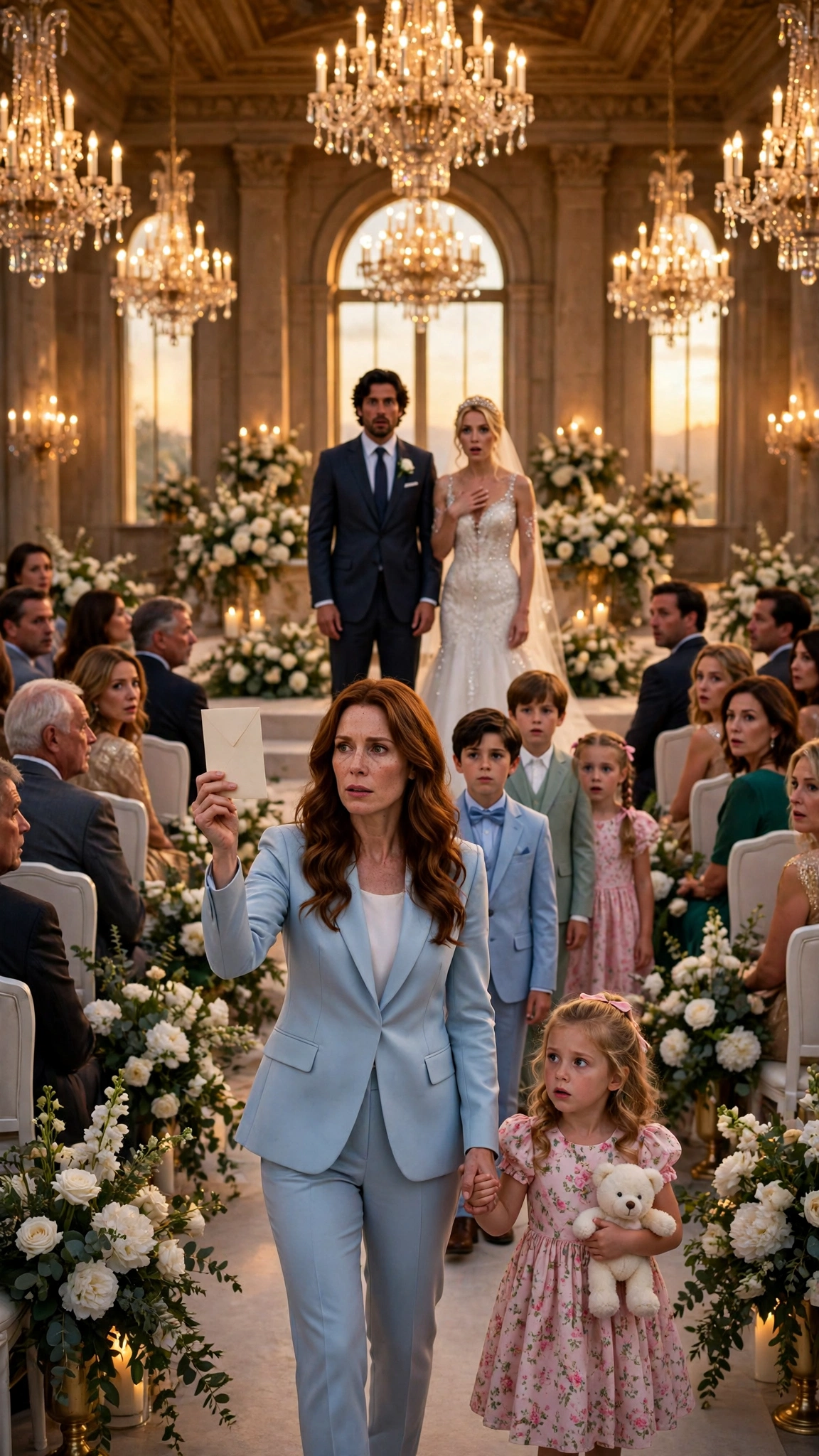
The hall emptied slowly, the way a theater empties after a play that no one knows how to applaud. Guests filed out in murmuring clusters, glancing back over their shoulders at the woman in the light blue suit and the four small children and the old man holding a photograph. The florist began quietly removing the white roses. A waiter folded the chairs. By six o'clock, the grand hall was empty except for the people who could not leave, because the story was not finished.
Dominic sat in the front row with his head in his hands. Evelyn sat three rows behind him, with the children around her, Layla asleep against her shoulder, Noah watching everything with his watchful eyes. Ambrose sat beside Dominic, his silver pocket watch in his hand, looking older than Evelyn had ever seen him. And Gabriel stood by the altar, alone, in his dark navy suit, his silver hair gleaming in the fading light, smiling — because Gabriel Castellano, even now, was smiling.
"Well," Gabriel said, "that was quite a performance."
Dominic looked up. His eyes were red. "Get out, Gabriel."
"Dominic, listen to me." Gabriel walked toward him, his hands open, his voice smooth as oil. "That photograph proves nothing. An old man takes a picture of a woman and a young man in a hospital. It could be anyone. It could be any night. And this DNA test —" He gestured at the papers in Dominic's hand. "Who paid for it? Her. Who chose the laboratory? Her. Do you really believe a woman who lied to you for two years would not lie to you now?"
Evelyn stood up. Layla stirred against her shoulder and woke, blinking. "Don't talk about my mother that way," Layla said, very clearly, in her small brave voice. She was four years old, and she had never spoken to a room full of adults before. But she had watched her mother walk down an aisle in front of two hundred people, and she had learned something about courage.
Gabriel looked at the little girl, and for a fraction of a second, something flickered in his cold eyes. Then it was gone. "Children should be seen and not heard," he said.
"Don't speak to my daughter," Evelyn said. Her voice was low and dangerous. "Don't ever speak to my children again."
"Your children," Gabriel repeated, and he laughed — a short, ugly sound. "Your children, who are not your husband's. Your children, who you conceived with another man before you married into this family. You want me to be the villain, Evelyn. But you were the one who lied. You were the one who let Dominic believe those children were his. You were the one who took his money and his name and his love, and gave him nothing in return."
Dominic stood up. He was a big man, tall and muscular, and when he stood, the room seemed to get smaller. "Gabriel," he said, "I want you to be very careful about what you say next."
But Gabriel was not careful. Gabriel had spent his whole life being careful, and it had brought him to this moment — standing in an empty hall, watching everything he had built crumble — and he was done being careful.
"You want the truth, cousin?" he said. "Here is the truth. Yes, I paid the laboratory. Yes, I had the report written. But the report was not a lie — it was a kindness. Dominic, you were married to a woman who had another man's children in her belly on your wedding day. She deceived you. She deceived all of us. I gave you the information you needed to free yourself. I gave you your life back. And this —" He pointed at Evelyn. "This is how she repays you. By coming to your wedding and making a spectacle of herself in front of the whole city."
Ambrose rose slowly from his chair. He was an old man, and his heart was failing, and his hands shook — but his voice, when he spoke, was steady and terrible.
"Gabriel," he said, "you paid a laboratory to write that the children were conceived during the marriage. That was a lie. You knew the dates. You knew she was pregnant before the wedding. You knew, because I told you — the night the babies were born, I told you, and you smiled and said you would take care of it. Do you remember?"
Gabriel's face went white. "I don't know what you're talking about."
"You do," Ambrose said. "And I have the proof. Not just the photograph. Not just the hospital record." He reached into his coat and pulled out a folded paper. "A bank record. A payment of fifty thousand dollars from your personal account to a laboratory in New Jersey, dated three weeks before you gave Dominic the report. The laboratory's owner has already spoken to my lawyer. He has confessed. He has signed a statement. It is all here."
He held out the paper. Dominic took it with shaking hands. He read it. He read it again. And then he looked at his cousin — at the man he had trusted with his business, with his family, with his life — and he saw, at last, what Evelyn had seen all along: a man who would do anything to take what was not his.
"Why?" Dominic asked. His voice was barely a whisper. "Why, Gabriel? I gave you everything. I made you my right hand. I trusted you with my company, with my family. Why?"
Gabriel looked at him, and for a moment, the mask fell away entirely, and Dominic saw the truth that had been hiding behind it for thirty years: envy, pure and simple. The second son of a second branch, standing forever in the shadow of a cousin who had everything — the looks, the money, the name, the father who loved him best.
"Because it should have been mine," Gabriel said quietly. "The company. The name. All of it. My father was the elder brother, Dominic. The company should have gone to him. It should have gone to me. But Ambrose chose you. He always chose you. And when you married her —" He looked at Evelyn. "When you married a girl with nothing, and you had four children, and the old man was ready to give them everything — I knew I had to stop it. If you had no heir, the company would come to me. If you married Vanessa, I would control the merger. It was all arranged. It was all so close."
The silence that followed was worse than shouting. Dominic stood very still, looking at his cousin, and Evelyn saw the moment his grief turned into something harder and colder — not rage, but resolve. The resolve of a man who has finally seen clearly.
"Get out," Dominic said. "Get out of this hall. Get out of my company. Get out of my family. If I ever see your face again, Gabriel, I will have you arrested for fraud. Do you understand me?"
Gabriel looked at him for a long moment. Then he straightened his tie, smoothed his silver hair, and walked toward the doors. At the threshold, he stopped and turned back.
"You'll regret this, Dominic," he said. "She'll leave you again. Women like her always do."
"No," Dominic said. "She won't. Because I'm not going to give her a reason to."
Gabriel left. The doors closed behind him with a sound like a book slamming shut.
For a long moment, no one spoke. The hall was empty now except for the four of them and the children, and the fading light fell across the red rose petals in long golden bars.
"She was used too," Dominic said at last, looking toward the doors where Vanessa had gone. "Gabriel used her the way he used all of us. Her father's company, her future — he spent them the way he spent everything that wasn't his."
"She knew," Evelyn said quietly. "And knowing and doing nothing is its own kind of guilt. But she told the truth in the end, Dominic. When it mattered. When it cost her the most. That counts for something."
Ambrose nodded slowly, his silver pocket watch in his hand. "It counts for a great deal," he said. "Most people, given the choice between a comfortable lie and a costly truth, choose the lie. Your Vanessa chose the truth. Remember that about her, son. Whatever else you remember about today, remember that."
Dominic looked at his father, and then at Evelyn, and he nodded. "I will," he said.
Then he turned to Evelyn, and to the four small children, and to his father, and he said the words he should have said four years ago.
"Will you come home?" he asked. "All of you. Just for tonight. Just to talk. Please."
Evelyn looked at him for a long time. She looked at the man who had thrown her out in the rain. She looked at the man who had believed a liar and broken her heart. And she looked at her children — at Layla, who was watching her with enormous eyes, waiting to see what her mother would do.
"No," Evelyn said gently. "Not tonight. Tonight, we go home to Queens. But tomorrow — tomorrow, you can come to us. You can come to our apartment, and you can sit on our floor, and you can build towers out of wooden blocks with four children who barely remember you. And we will see. We will see what can be built from the truth."
Dominic nodded. He understood. Forgiveness, like a house, had to be built one brick at a time.
"Tomorrow," he agreed.
And as they walked out of the hall together — Evelyn and her children, Ambrose leaning on his cane, Dominic following a few steps behind like a man who had lost everything and found it again — the last golden light of the afternoon fell through the tall windows and across the red rose petals, and for the first time in five years, Evelyn Hart felt something she had almost forgotten how to feel.
Hope.
That night, in the small apartment above the bakery, Evelyn sat on the mattress with her four children and told them a story — not the story about the princess and the tower, but a true story, about a mother who had walked into a great hall full of strangers and told the truth, and about a grandfather who had stood up and held a photograph in the air, and about how being brave did not mean not being afraid. It meant being afraid and doing it anyway. Layla listened with her eyes wide, and Noah nodded solemnly, and Mia fell asleep halfway through with her thumb in her mouth, and Leo asked, "Will the bad man come back?" And Evelyn said, "No, baby. The bad man is gone. And even if he came back, your mother would be here. And your father. And your grandfather. And Dominic. You have so many people now. You are safe."
Across the city, in the great silent house in the Hudson Valley, Dominic sat in his study until midnight, making telephone calls. He called his lawyer and told him to freeze Gabriel's access to every company account, effective immediately. He called the head of security and told him that Gabriel Castellano was no longer permitted on any company property. He called the laboratory in New Jersey, and the owner — a frightened man with a family of his own — told him everything, and agreed to sign a statement, and to testify if it came to that. Dominic wrote it all down, carefully, in his own hand, the way his father had taught him: dates, amounts, names. Evidence. Not revenge — evidence. There was a difference, and he intended to honor it.
The next morning, a letter arrived at Evelyn's gallery, delivered by hand. It was from Vanessa Laurent. It was short, and it was kind. "Dear Mrs. Hart," it read, "I wanted you to know that I have told my father everything. He has ended all business with Gabriel Castellano. I am leaving for Florence next week, to study art, which is what I always wanted to do before my father decided I should marry. I wish you and your children every happiness. You were the bravest woman I have ever seen. With admiration, Vanessa."
Evelyn read the letter twice, and then she folded it and put it in the drawer with Ambrose's photograph and the DNA report — the drawer where she kept the things that mattered. Then she went back to work, and the day was ordinary, and the children were ordinary, and the bread smelled like bread at five in the morning, and for the first time in five years, ordinary felt like enough.