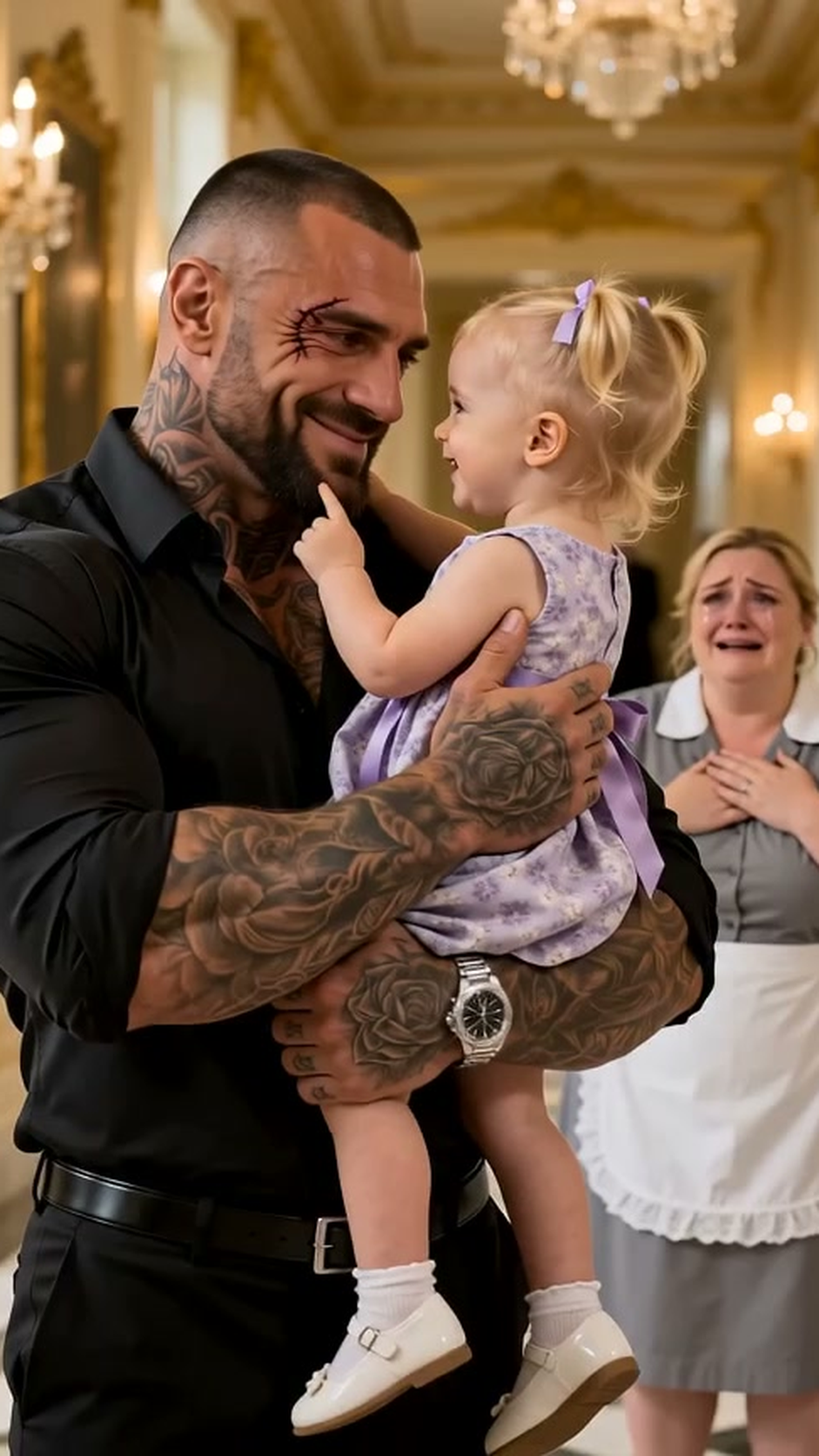
Here is what the house knew about Isabella Falcone, and said only in the kitchen, in pieces, the way people handle broken glass.
She had been a pediatric nurse who became a hospital board director, which meant she had spent her life being the calmest person in rooms full of frightened people. She had met Dante at a fundraiser she was running and he was enduring, and she had looked at the most dangerous young man in the Falcone family — the tattoos, the reputation, the silence like a locked door — and said, in front of forty donors: "You have the face of a man who hasn't been fed. Sit down." He sat down. He had been sitting down, in one way or another, ever since.
The night they met, he had been standing at the back of her fundraiser with a glass of wine he hadn't touched, radiating the particular menace of a man being auctioned at for charity, and Isabella — who had run the hospital's pediatric wing through two flu seasons and one flood — had crossed the room with a plate of food and no fear whatsoever. She told the story against herself for years afterward: "He looked like a bear at a wedding. All shoulders and grievance. So I fed him. It is my professional opinion that ninety percent of dangerous men are simply hungry and have been lied to about it by other men."
He courted her with a formality that made the family's old guard weep into their grappa — flowers with the stems cut the way she liked, a driver dismissed for driving her too fast, church on Sundays because her mother would hear of nothing else. At the wedding, in a chapel in the village his grandfather had built, Enzo — nineteen then, and genuinely happy — had been the one to make the toast: "To Isabella, who looked at the scariest man in three counties and saw a seating problem." The coffee ritual began on their honeymoon and never missed a day of their marriage: four o'clock, the sitting room, her account of the hospital, his account of nothing at all — he had never once brought the business to that table, and she had never once asked him to leave it outside; it simply had never occurred to either of them that the door could be used any other way.
She was the only living person who could make him laugh. She called him her bear. She insisted on the white flowers and the music and the sitting room full of books and afternoon coffee, and when the family business put blood on the floor of his world — and it did, twice in their marriage, despite everything — she never once flinched from him. She washed his hands in the kitchen sink herself, in silence, and then she made him eat something, and then she made him tell her, and he did. Every time. She was the one room in Dante Falcone's life with the door open.
The headache started at lunch on a Thursday. She told Marco it was nothing. She told the board meeting it was nothing. At three o'clock she called her husband in Chicago, between his meetings, and the call lasted four minutes, and she laughed twice in it — Marco heard the second laugh through the doorway and remembered it, later, the way you remember the last time you saw the sun before an eclipse.
Dante's last words to her, on that call, were: "Bella. The Meridian contracts. I'll call you tonight."
He never got to call her that night. At four-forty, in the kitchen of the house she had filled with music, Isabella Falcone put one hand to the counter, said "Oh—" to no one, and was gone before she reached the floor. A blood vessel in her brain, a flaw written into her before she was born, a debt collected without warning. Thirty-four years old. The doctors would use the word instant. They would use the word painless. Dante, who arrived seven hours later through the worst storm of that winter, who had shouted at pilots and offered a fortune to any man who could fly faster, would spend eighteen months discovering that instant and painless were words for other people's comfort. He had not been there. He had been talking about docks.
He buried her on a Monday. On the Tuesday, at four o'clock — the hour she had always come home, the hour they had always met at the sitting-room door for coffee while she told him about the hospital and he pretended the rest of the world didn't exist — Dante Falcone walked the length of the marble hallway to the sitting-room door.
He stopped. He stood there for eleven minutes; Marco counted, and then never counted again. Then he walked back.
He has done it every day since. Through flu, through a winter storm that took the power out for two days, through a summit of the five families in a snowbound hotel in the mountains — where he left the table at three-forty-five without a word of explanation, walked the hotel's marble lobby end to end at four o'clock, and returned to his seat among men who decided, privately and forever, that the Falcone boss was either insane or holy. The staff learned not to speak of it. The family learned not to joke about it. Enzo, alone, learned to use it.
"Grief has made him useless," Enzo told the family council that spring, in a restaurant private room, with his uncle Salvatore's tired eyes on him from the head of the table. "A boss who walks in circles for a dead woman while Castellano counts our harbors. I love my cousin. That is exactly why I'm saying it. Sunday, he gives Vincent an answer. If the answer is no — or worse, if the answer is nothing — then this family needs to talk about what comes next. About who comes next."
Salvatore had let the silence sit until it hurt, and then the old man had spoken with the terrible mildness of his generation of the family. "When my brother — your grandfather, Dante's grandfather — buried his wife in 1962, he did not speak for a year. Not a word. He ran three counties by pointing, and the pointing was obeyed, because the families understood a thing your generation has forgotten: a man's grief is not a vacancy in him. It is a room with the door shut, and the wise do not bang on it. The Castellanos are not at our gates because Dante mourns his wife, boy. They are at our gates because they have been told — by someone — that mourning is the same as weakness." The old eyes had moved, slowly, to Enzo's face, and stayed there. "When I find out who told them, I will be very interested in his reasons. Sunday, nephew. Let us see what Sunday shows us."
In the house, in those same days, something small and strange had begun to happen, the way spring begins: not with flowers, but with one green decision underground.
Dante started eating breakfast.
Not in the dining room — in the kitchen, twice in one week, standing at the counter where the staff ate, with a plate Marco silently set in front of him, saying nothing, listening to the radio Addie played and the ordinary clatter of a working house, while the maids died quietly of shock in the pantry doorway. He asked the gardener about his wife's surgery, by name, and the gardener nearly dropped the shears, because the boss had not asked any of them anything in eighteen months, and the answer — she is well, Mr. Falcone, thank you — seemed to land on him like a gift he had forgotten people were allowed to give.
And once, at four o'clock — Rosa heard about this from Marco, in the garden, in the low voice of a man reporting a change in the weather — his walk stopped, as always, at the sitting-room door. But this time, Marco said, the boss's hand had risen. Had hovered, an inch from the handle. For a long moment. And then had fallen back, and clasped itself behind his back, and the walk had resumed.
And on the Thursday of that week, Sophia's treasures escalated. Rosa, dusting the grand hallway in the safe hours of the morning, found it at the base of Isabella's portrait, placed with the ceremonial precision of a votive offering: one smooth white stone, still faintly warm from a small fist, and beside it — weighted under the stone like a treaty — a fresh crayon drawing, this one of the portrait lady herself, dark scribble hair, enormous smile, holding the hand of a tall black stick man on one side and a small purple girl on the other. Everyone, in Sophia's theology, holding hands. Everyone, at last, in the same picture.
Rosa's hands shook gathering them up. She should have taken both away. She knew she should have taken both away. Instead — God forgive her, she told Danny's photograph that night — she left the stone exactly where it was, and hid only the drawing in her apron, and did not examine her reasons too closely.
The stone was gone by Friday. Not swept away — Marco had asked the morning staff, with terrible casualness, and no one had touched the hallway before four. Gone the way things vanish in that house: upward. Somewhere in the boss's black trousers, in a pocket over a fortune in dangerous knowledge, rode one smooth white stone, carried four o'clock after four o'clock, past the portrait and back, like a pilgrim's pebble. Rosa only ever learned this much later. At the time, all she knew was that the stone had been taken, and that whatever had taken it had not thrown it away.
On Friday night, Enzo came to the house when he knew Dante was out. He found Rosa — he arranged to find her, the way a cat arranges to find a mouse — in the laundry corridor, with a basket of the boss's shirts against her hip.
"A word, Mrs. Bennett." He smiled like a man who had practiced on mirrors. "You've settled in. The child too, I hear. Sweet thing. Addie speaks well of you." He let the kindness hang for exactly one beat, then took it apart, piece by piece. "Sunday, my cousin answers the Castellanos. If he answers the way a boss answers — the way this family needs — then there will be changes after. A new wife. A new household. New staff, chosen by the bride. People with… distractions… will be wished well and let go. If he answers like a widower—" Enzo shrugged, pleasantly, "—then there will be different changes, and the people who stood too close to his grief will be remembered as part of the problem. Either way, Mrs. Bennett, women in your position do well to have a bag packed and a sister somewhere. You understand me."
Rosa understood him perfectly. She had heard that exact music before, in landlords' offices and hospital billing departments: the sound of a door being held politely open onto the street.
"I understand you, Mr. Falcone," she said. "Will that be all?"
"That's all." He was already turning away, bored. "Give my love to the little artist."
That night, after Sophia was asleep, Rosa got down the small suitcase from the top of the wardrobe. She packed it the way she had packed it for the hospital twice, for evictions once, for Danny's funeral home viewing with a change of clothes for the baby: efficiently, without tears, in the dark. Two dresses. Sophia's good shoes. The photographs. The forty-dollar envelope money, in the lining, where it always lived.
She set the suitcase under her bed, where small hands could not find it, and she sat on the floor beside her sleeping daughter's crib, and she did the arithmetic of her whole life once more, the way she did every time the ground moved: one woman, one child, one suitcase, no one coming.
"Whatever happens, baby," she whispered, "Mommy walks with you. Okay? You will never walk alone."
Sophia slept on, fists up beside her ears like a tiny boxer, undefeated.
Two floors above them, in a study lit by one lamp, Dante Falcone sat alone at two in the morning with his sleeves rolled to the elbow and the tattoos like dark water on his forearms — and in front of him, smoothed flat under his hand for perhaps the hundredth time, was a crayon drawing of a very large smiling man, holding the hand of a very small smiling girl.
He was trying, with the whole ruined machinery of his heart, to remember how the man in the drawing had ever been him.