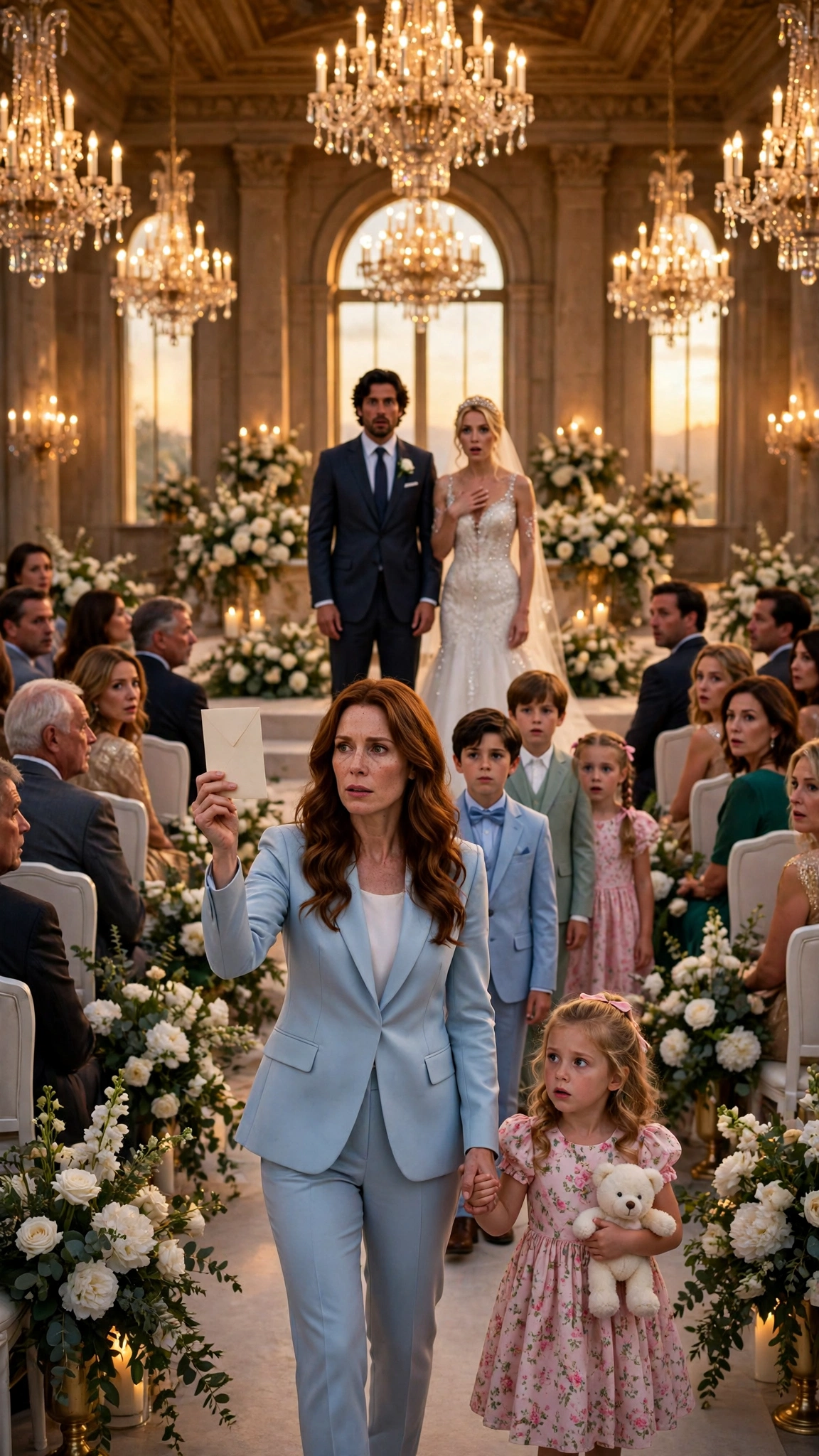
The wedding was nothing like the first one.
There was no grand hall, no crystal chandelier, no two hundred guests in white chairs. There was a garden behind the house in the Hudson Valley — the house that Dominic had given back to Evelyn, not as a settlement or a gift, but as a home, because it had always been the children's home, and he had no right to keep it from them. There were white chairs, but only thirty of them, set out on the grass beneath the old oak tree. There were flowers, but they were wildflowers, picked that morning by four small children with dirty hands and enormous pride. And there were red rose petals — because Layla had insisted on red rose petals, scattered down the grass like drops of blood on snow, the way they had been in the hall that day, only this time, they meant something different. This time, they meant joy.
Evelyn stood in the doorway of the house, looking out at the garden, and she could hardly believe it was real. She wore a simple white dress — not a gown, not a costume, just a dress, soft and light, that moved when she moved. Her long auburn wavy hair fell over her shoulders. Her soft brown eyes were bright. She carried no envelope. She carried no handbag. She carried only a small bouquet of wildflowers, tied with a pink ribbon.
"Mommy," Layla whispered, tugging at her dress, "are you ready?"
Layla wore her pink floral dress again — the same dress she had worn to the wedding hall, only now it was a little shorter, because she had grown, and a little dirtier at the hem, because she had been picking flowers all morning. Her light-brown wavy hair fell loose around her shoulders. Her small pearl earrings caught the light. Her white sandals were dusty, and her white teddy bear was tucked under one arm. She looked, Evelyn thought, like the bravest person in the world.
"I'm ready, baby," Evelyn said. "Are you?"
Layla nodded. She took her mother's hand. Behind them, Noah and Mia and Leo lined up in their best clothes, each one holding a basket of red rose petals. They had practiced this for a week — walking slowly, scattering petals, smiling — and they were very serious about it, the way only four-year-olds can be serious about something important.
The music started. It was not an organ. It was a violin, played by a woman from the village, sitting under the oak tree. And Evelyn walked out of the house and down the grassy aisle, with her daughter's hand in hers and her three other children scattering petals ahead of her, and the thirty guests stood up, and every one of them was smiling.
At the end of the aisle, beneath the oak tree, Lucas waited. He wore a camel-colored suit and a white shirt, and his short black hair was shining in the sunlight, and his warm brown eyes were fixed on her, and he was crying — not hiding it, not ashamed of it, just standing there with tears running down his face, because he had waited five years for this moment, and he had written a hundred letters about it, and now it was happening.
Beside him stood Dominic. He wore a dark navy suit, a crisp white shirt, a navy tie — the same suit he had worn on the day his wedding had fallen apart, only now it fit differently, because the man inside it was different. He was not the groom. He was not the father of the bride. He was the godfather of four small children, and the friend of the woman he had once loved, and the man who had come to give his blessing. When Evelyn reached the oak tree, Dominic stepped forward, and he took her hand, and he placed it in Lucas's hand, and he said, very quietly, so that only the three of them could hear, "Take care of her. Take care of all of them. And if you ever need anything — anything at all — you know where to find me."
Lucas nodded. He could not speak. He held Evelyn's hand, and he looked at her, and the violin played, and the sun shone through the leaves of the oak tree, and the whole world seemed to hold its breath.
The ceremony was short. There were no long speeches. There were no lawyers, no contracts, no prenuptial agreements. There was a woman from the village who had known Evelyn since she was a girl, and she said the words, and Evelyn and Lucas said "I do," and they kissed, and the four children cheered so loudly that the birds flew out of the oak tree in a startled cloud.
And then the party began. There was food — simple food, bread and cheese and fruit and cake, made by the women of the village, laid out on long tables under the trees. There was music. There was dancing. And there were four small children, running wild through the garden, scattering red rose petals everywhere, laughing until they could not breathe.
Ambrose sat in a chair beneath the oak tree, watching it all. He was thinner than he had been, and paler, and his hands shook when he lifted his glass — but his eyes were bright, and his face was peaceful. Evelyn came to sit beside him, and she took his hand, and she said, "Thank you, Ambrose. For the photograph. For the truth. For standing up when no one else would."
The old man smiled. "I should have stood up four years ago," he said. "But I stood up when it mattered. And that is enough. That has to be enough."
"It is enough," Evelyn said. "You gave me my life back."
"No," Ambrose said. "You took it back yourself. I only held the door open."
He looked out at the garden, at Lucas dancing with Layla on his feet, at Noah and Leo wrestling in the grass, at Mia sitting on Dominic's lap while he read her a story — the one about the princess and the tower, doing all the voices. And he thought about the watch in Layla's pocket, ticking quietly, measuring the time that was left. He did not know how much time he had. The doctors had been honest with him. But sitting there, in the sun, watching his family — his real family, the one he had almost lost — he understood something he had not understood in sixty-five years: that time was not the enemy. Time was the gift. And he had spent it, at last, on the right thing.
Later, as the sun began to set and the garden turned gold, Evelyn found Dominic sitting alone on the steps of the house, watching the children play. She sat down beside him.
"Are you all right?" she asked.
He nodded. "I am," he said. "I really am. For the first time in a long time, I am." He looked at her. "I want you to know something, Evelyn. I don't regret loving you. I don't regret loving them. The only thing I regret is believing a lie instead of believing you. And I will spend the rest of my life making sure I never do that again — to anyone."
"I know," she said. "I know you will."
They sat in silence for a while, watching the sun go down, watching Lucas chase four laughing children across the grass, watching Ambrose doze in his chair beneath the oak tree with a smile on his face.
"Will you come to Sunday dinner?" Evelyn asked. "Every Sunday. You and Ambrose. It's a standing invitation."
Dominic smiled. "Every Sunday," he said. "For the rest of my life."
As the last light faded from the garden, Layla came running up the steps, her white dress dusty, her ivory ribbon coming loose, her face flushed with happiness. She climbed into her mother's lap, and she held up the silver pocket watch.
"Mommy," she said, "listen. It's still ticking."
Evelyn held the watch to her ear. Tick, tick, tick. Steady and strong and alive.
"Yes, baby," she said, holding her daughter close. "It's still ticking. And so are we."
Above them, the first stars came out over the Hudson Valley. In the garden, the music played on. And in the house that had once been a place of shouting and rain and goodbyes, a family — a real family, broken and mended and whole again — sat down to dinner together, and stayed, and stayed, and stayed.
The wedding had started in a hall full of strangers, with a woman walking down an aisle carrying a cream envelope.
It had ended here, in a garden full of love, with four children scattering red rose petals, and a silver watch ticking in a little girl's hand, and a mother who had fought for five years to get her family back — and won.
And they lived, all of them, happily ever after.
A year later, the house in the Hudson Valley was full of noise again. The nursery that Dominic had built five years ago — the one the size of a ballroom — was a playroom now, with wooden blocks scattered across the floor and drawings taped to every wall. The four children started school in the autumn, walking down the lane in a neat line, Layla's teddy bear tucked under her arm, and Layla, who was five now and very serious about being the eldest, held the silver pocket watch in her hand every morning and checked the time, the way her grandfather had taught her.
Lucas's library opened in the spring — a small, beautiful building on the Upper West Side, with tall windows and a reading room where children could sit on cushions and listen to stories. On the opening day, Evelyn stood beside him in the doorway, and she thought about the girl she had been at twenty-nine, poor and heartbroken and certain that the world had forgotten her. The world had not forgotten her. It had only been waiting for her to come back and claim what was hers.
Dominic kept his promise. Every Sunday, without fail, he came to dinner — he and Ambrose, in the old car, up the lane to the house in the Hudson Valley, where four children ran out to meet them shouting, and Evelyn stood in the doorway with her hands on her hips, pretending to be cross and failing completely. He read to them after dinner, doing all the voices, the way he always had. He taught Noah to play chess. He taught Leo to swim in the river in the summer. He took Mia to the ballet, and he sat in the dark theater with tears in his eyes, because she danced like a small, fierce flame, and he was proud of her in a way he had never been proud of anything he had bought or built.
He started a foundation, too — in the children's names, though he never told them that. It helped single mothers pay their rent and buy winter coats and hire lawyers when they needed them. The first woman it helped was a girl of twenty-three with a baby and no family, and when Dominic met her, he looked at her for a long time, and he said, "I once knew a woman like you. She was the bravest person I ever met." He did not say her name. He did not have to.
And Gabriel? Gabriel went abroad, to a city where no one knew his name, and he lived quietly, and he never came back. Dominic did not press charges — not because Gabriel deserved mercy, but because Evelyn asked him not to. "He has lost everything already," she said. "His family. His name. His place. Let that be enough." Dominic agreed, though it cost him. And once a year, at Christmas, a card arrived from abroad, with no return address, and only three words written inside: "I am sorry." Evelyn read it, and folded it, and put it in the drawer with the photograph and the DNA report and Vanessa's letter. She did not answer it. But she did not throw it away, either. Forgiveness, she had learned, was not a single act. It was a practice. And some practices took a lifetime.
Ambrose lived to see his grandchildren start school. He lived to see Layla read her first book aloud, stumbling over the long words, holding the silver watch in her lap for luck. He lived to see the library open, and the foundation begin, and the house in the Hudson Valley full of noise again. He grew weaker, slowly, the way old trees grow weaker — not all at once, but branch by branch, in the autumn of a long life. And when the time came, it came gently, on a Sunday evening after dinner, with his family around him and his son's hand in his. He was not afraid. He had made his peace. He had told the truth. He had given the watch to the bravest girl he knew. And he had watched time begin to tick again.
They buried him on the hill above the house, beside his wife, under the oak tree where Evelyn and Lucas had been married. Layla put a red rose petal on the grave. And that night, she wound the silver pocket watch, and she held it to her ear, and she heard it — tick, tick, tick — steady and strong and alive.
And in the house below, the lights burned warm in the windows, and the smell of bread rose from the kitchen, and four children slept in a row in the nursery, and their mother and father sat at the table with the man who had once been their enemy and was now their friend, and they talked about ordinary things — about school, and about the library, and about Sunday dinner, and about the future, which stretched out before them like a road in the morning light, long and bright and full of promise.
The wedding had started in a hall full of strangers, with a woman walking down an aisle carrying a cream envelope.
It had ended here — in a house full of love, with a family that had been broken and mended and made whole again, with a silver watch ticking in a little girl's hand, and with the simplest and truest words in the world, spoken every night before bed, in four small voices, one after another:
"We are home. We are safe. We are loved."