Sunday arrived like a held breath finally let go.
The answer was due by dark. Enzo had called twice by noon. Uncle Salvatore had come in person in the morning, and had left after twenty minutes with his nephew, wearing the face of a man who has heard a decision he cannot move and does not entirely mourn. Vincent Castellano's reply, when it came, would come in person or in fire, and Marco doubled the gate detail with the air of a man laying out good silver.
That morning, Rosa burned three drafts of a resignation letter in the kitchen stove, one after another, while Addie shelled peas at the table and watched her out of the corner of one all-seeing eye.
"Dear Mr. Falcone, I regret—" Burned. "Dear Mr. Falcone, family circumstances—" Burned. "Dear Mr. Falcone—" Burned with the rest of the sentence still unwritten, because there was no version of the thing that did not sound, to Rosa's own ears, like leaving a man alone in a burning building because the rent was due elsewhere.
"You're a fool, Rosa Bennett," Addie said at last, mildly, tipping peas into the bowl.
"I know, ma'am."
"A house does not ask a woman to burn three letters unless the woman has put down roots she's frightened of." Addie's hands never stopped. "I put the advertisement in the village paper myself, thirty years of habit. I interviewed nine women for your position. Nine sensible women with no children and no complications, any one of whom Giulia's agency would still send tomorrow." She shelled a pod with surgical precision. "I hired the widow with the baby and the debts. The old know things, child. We know them in our knees before the weather changes. Whatever you've decided about five o'clock—" the old woman's eyes came up, and they were not mild at all, "—decide it about the house, and the man, and the girl. Not about Enzo Falcone. No woman in my house makes her life smaller because a little man in a good suit leaned on her in a laundry corridor. I won't have it. It's untidy."
Rosa's suitcase was under the bed. Her resignation — three drafts of it, each more cowardly than the last — was folded inside her apron pocket, and she had made up her mind with the calm of a woman stepping off a curb: at five o'clock, when the walk was done and the house was distracted by whatever was coming, she would ask Addie for her final wages, take Sophia, and go quietly out the service door she had come in by, two months and a lifetime ago. It was the sensible thing. It was the safe thing. Safe had kept them alive this long.
She only had to survive one more afternoon, and keep Sophia in the staff wing until it was over.
Sophia, however, had other plans, and a three-year-old's plans have the structural integrity of weather.
The connecting door had a fault in it that Rosa did not know about: the latch, old and worn, did not always catch. Addie knew. Marco knew. By four o'clock on Sunday afternoon, one more person knew — a small person in a lavender dress, who had been listening to a sad man's footsteps for two months through wood and keyholes, who had drawn him smiling because somebody clearly had to, and who pushed the door at exactly the wrong moment, or the exactly right one, depending on which member of that household you asked for the rest of their lives.
She went through it like light through a curtain.
Her journey down the service corridor took four minutes, because she was three, and because a person has obligations. She stopped to pat the laundry basket. She stopped to inform the cat — an orange tyrant named Console who ruled the back stairs — of her intentions, in a whisper, with a finger to her lips, because Console was sworn to secrecy. She passed exactly one adult: Paolo, the youngest of the gate guards, rotated indoors that week and posted by the corridor junction with instructions to be furniture. Paolo saw a small girl in a lavender dress marching past him with her hands clasped behind her back and the expression of a tiny admiral, and Paolo — who had been trained for armed men, for breached gates, for everything except this — made the executive decision that he was, in fact, furniture, and studied the opposite wall with the fixed intensity of a man being paid by the hour to not have seen that.
At the end of the corridor, the grand hallway opened out in marble and gold and afternoon light. And there, right on time, right on schedule, came the footsteps — slow, measured, enormous — and Sophia Bennett stepped out into the middle of the most feared daily ritual on the coast, took up her position precisely six small feet behind the grief of the Falcone family, folded her hands behind her back, puffed out her chest, and began, with all her heart, to walk.
Rosa discovered the open door at three minutes past four. The staff wing corridor was empty. The nursery was empty. And from the main house — from the marble hallway, down the length of the grand corridor where the boss walked alone, every day, rain or shine or funeral — came nothing at all. No footsteps. No voices. A silence so complete that Rosa was running before she had decided to run, apron flying, heart in her throat, praying every prayer she knew in no particular order.
She came through the doorway into the hallway and saw them.
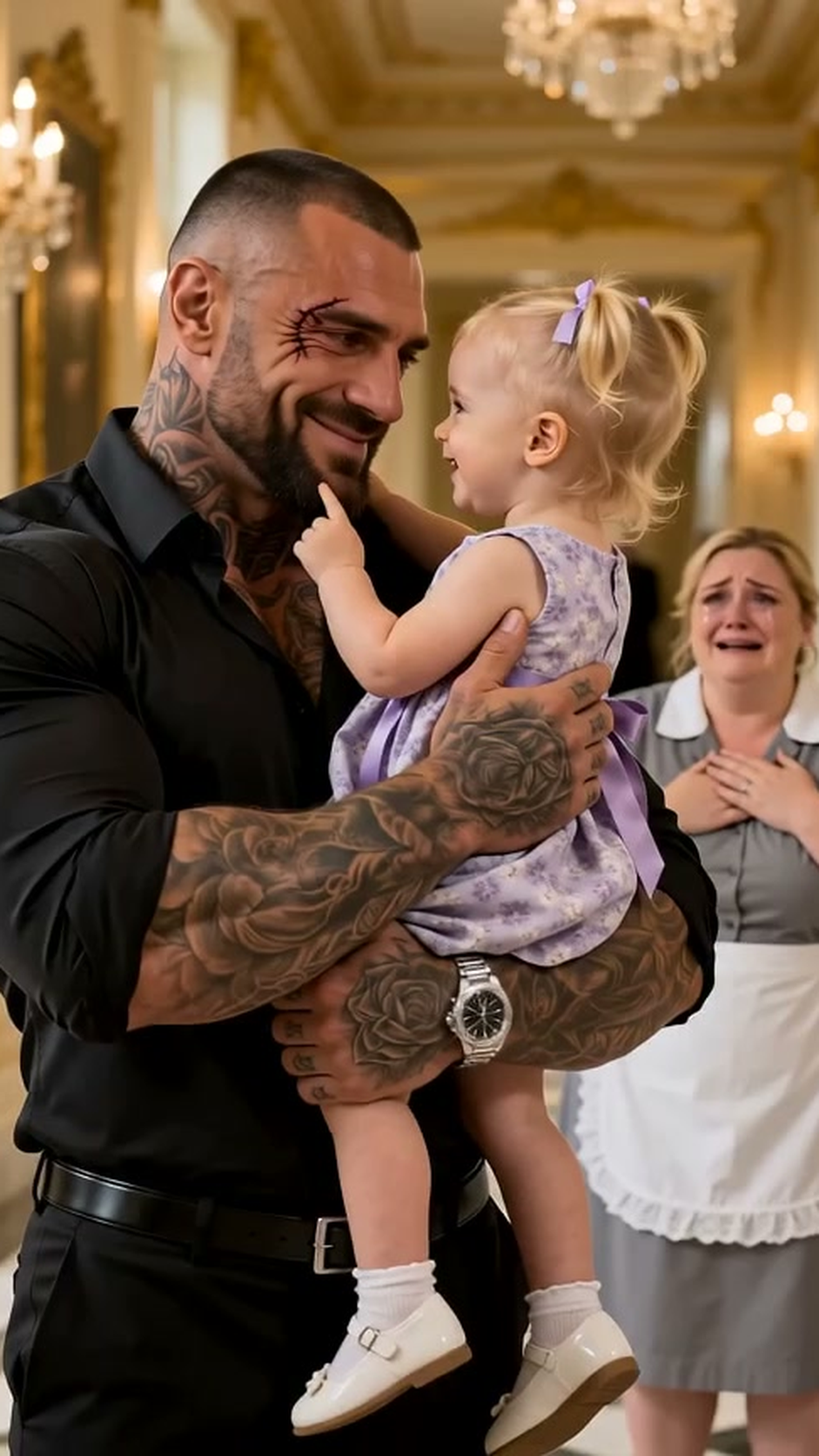
Dante Falcone stood in the middle of the black-and-white marble with his hands clasped behind his back, frozen mid-stride, staring down. And behind him — six small feet behind him, in perfect formation — stood Sophia. Hands folded behind her back. Chest puffed out under the lavender dress. Face arranged into the most ferocious scowl in the history of organized crime. She was taking the walk with him. She had, Rosa understood in one flooding instant, probably been rehearsing it in the nursery for weeks. The serious steps. The grave little nods at the portraits. She had taught herself the whole solemn ceremony of his grief, the way other children learn a dance, because in her whole three years of life she had arrived at one unshakable conclusion: nobody should have to do the sad thing by themselves.
"Sophia," Rosa breathed, and then, with her heart slamming her ribs, "Sophia, sweetheart, come back!"
Dante turned.
He turned slowly — head first, then the great tattooed shoulders — and found his mourner. His prisoner of war. His mirror, three feet tall, in white shoes. For a moment his face was the face Rosa had feared in a hundred half-sleeps: the storm, the mountain, the loaded gun of Addie's warning. The guards at the far end of the hall had gone absolutely still.
Dante looked at Sophia. Sophia looked at Dante. She did not drop the posture. She did not run. If anything, Rosa thought wildly, she stood a little straighter, the way you do when the teacher finally looks at you and you want, more than anything in the world, for your work to be right.
"Why are you walking like me?" the boss of the Falcone family asked her, very quietly.
Sophia tilted her head.
"Because you look lonely."
If a pin had dropped on that marble in that moment, it would have sounded like a gunshot. Rosa watched Dante Falcone's face — the face that had faced down five families, two funerals' worth of rivals and a winter of his own despair — watched it be dismantled, quietly and completely, by five words in a three-year-old's voice. His jaw loosened. His eyes flickered. And his hands — clasped behind his back for eighteen months of afternoons, locked like the doors of the sitting room — slowly came undone.
Sophia stepped toward him and took hold of his finger.
"So I walk with you," she said.
"You…" Dante's voice did something it had no practice at; it roughened. "You have been practicing."
Sophia considered the accusation with judicial care. "Every day," she admitted. "In the mirror. Mommy said don't. I did it quiet." A pause, and then the confession widened, as three-year-old confessions do, to take in the whole conspiracy. "I left you a stone. For the picture lady. So she wouldn't be lonely in the picture. Did you find it? It was a good stone. It was my best one."
Somewhere at the far end of the hall, one of the guards — Paolo, the youngest, who had been furniture once and knew a co-conspirator when he saw one — made a sound that he converted, with great presence of mind, into a cough.
"I found it," Dante said. He said it the way a man speaks in church. "I've kept it."
"Good," said Sophia, with the deep satisfaction of a professional whose work has been properly valued. "Now you don't have to be the only one. Walking is better with two people. Mommy says nobody should do the sad things alone. Mommy does the sad things alone all the time, but she says that's different because she's a mommy." She reported this without malice, the way weather is reported. "I think that's silly. I think mommies get lonely too."
Rosa, frozen in the doorway with her hands over her mouth, felt the words go through her like light through a window. Dante's eyes lifted — slowly, over the child's pigtails — and found Rosa's, and held them, and in his face was the dawning, devastating understanding of the whole arrangement: that the small general in the lavender dress had not wandered into his ritual by accident at all. She had assessed the entire house, located its two loneliest people with the unerring instinct of her kind, and deployed herself — daily, in secret, at personal risk of early bedtime — exactly where she was needed most. Like her mother. Exactly like her mother, who had done the same thing in a kitchen at midnight and called it nothing.
He looked at the portrait then. Eighteen months he had looked at that portrait like a man looking at weather through glass. Now Rosa watched him look at it like a man saying goodbye at a train window — and she watched him go down, slowly, onto one knee on the cold marble, until his scarred face was level with a pair of blue eyes that had never once been afraid of him.
Sophia touched his cheek, right beside the scar.
"See? You can smile!"
The laugh, when it came, was worth every mile of the eighteen months before it. It startled the guards. It startled the chandeliers. It startled Dante Falcone most of all — a great, rude, wonderful laugh, Addie's words made flesh, rolling down the marble hallway like weather changing, while he gathered a giggling three-year-old into arms that could have stopped a door off its hinges and held her like she was made of spun glass and dynamite, both.
Rosa was crying. She did not care anymore. Her hands were pressed to her heart and her daughter was laughing against the chest of the most dangerous man in three counties, and his eyes — when he found Rosa's, over Sophia's blonde head — were not a storm at all. They were a man's eyes. Wet, and warm, and asking her a question she had no name for.
"Then don't let me walk alone," he said softly.
And that was the moment — the exact moment, timed by a universe with a flair for cruelty — when the great doors at the end of the hallway opened, and Enzo Falcone walked in with two members of the family council at his back, and stopped dead at the sight of his cousin: the boss of the Falcone family, on his knees on the marble, laughing, with a maid's child in his arms and a hundred years of the family's iron dignity in pieces around him like confetti.
"Dante," Enzo said at last, into a silence you could have built a church in. "Vincent Castellano's cars are at the gate. He's come for his answer." His eyes went to Sophia, and his smile arrived, thin and delighted and poisonous. "Shall I tell him you've been busy playing house?"
Dante rose to his feet. He did not put the child down. He settled Sophia against his shoulder — where she immediately, with immense satisfaction, laid her head down like a small queen taking a throne — and he looked at his cousin the way a mountain looks at weather.
"No," he said. "Tell him I'll give it myself."
He carried Sophia down the hallway toward the doors, and the council, and the Castellanos, and every armed consequence of the last eighteen months — and behind him, shaking in her shoes, with her resignation letter burning a hole in her apron pocket, Rosa did the only thing left in the world to do.
She followed her daughter.