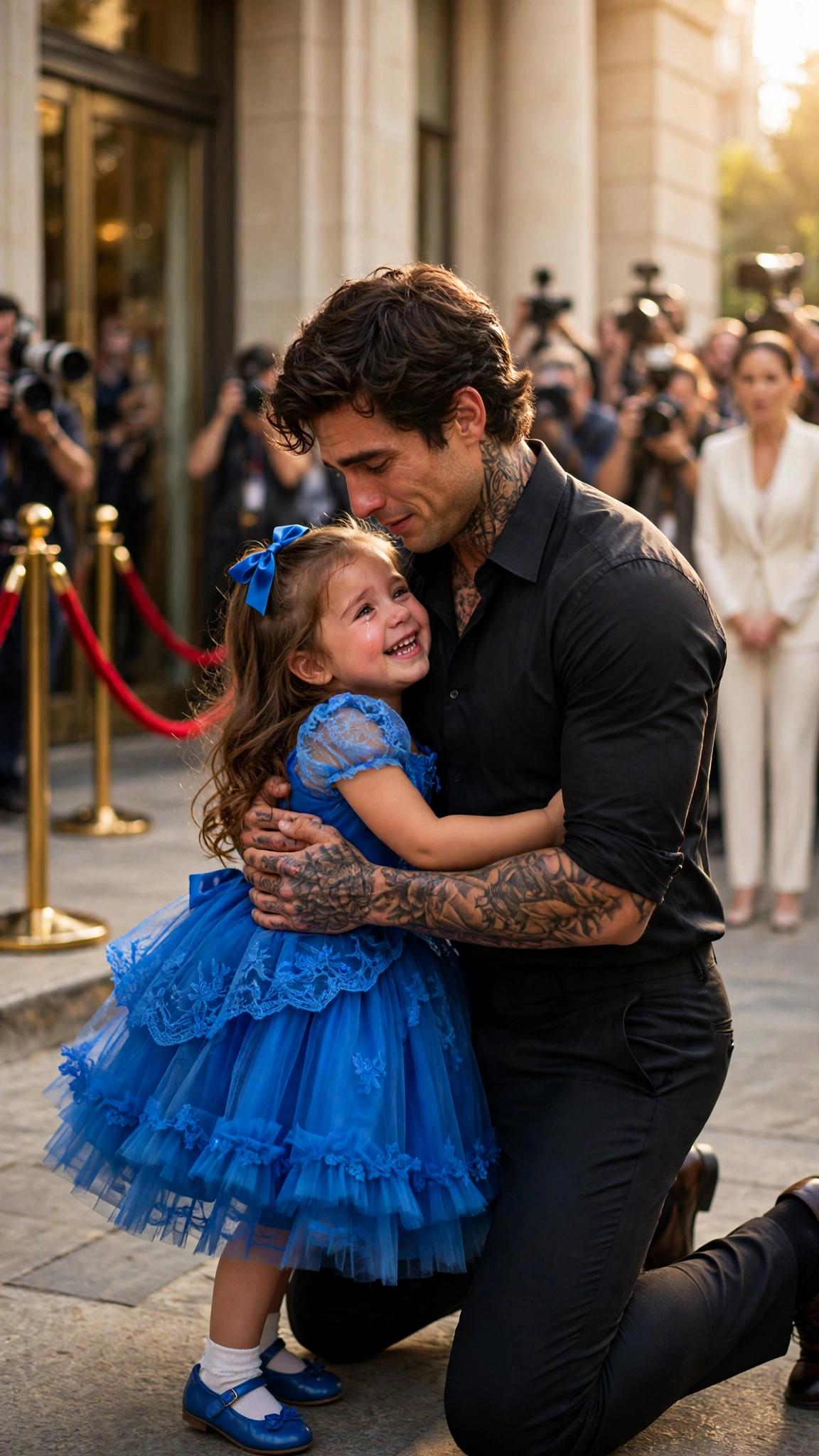
One year later, on a bright afternoon in late spring, Sunrise Children's Home held a birthday party.
It was Emma's sixth birthday. She wore a new dress — royal blue, like the first one, but this one had been chosen by Emma herself, with lace at the collar and a full skirt that spun when she twirled, which she did often, to everyone's delight. The blue bow was still there, pinned to the right side of her hair, a little faded now, but Emma had refused a new one. "This one is lucky," she had said. "This is the bow I wore the day Daddy came."
The garden behind the home was full of people. Children from the home ran between the tables with balloons. Helen Marsh, in a soft yellow dress, directed the proceedings with the calm authority of a woman who had seen a hundred parties and loved every one of them. A small band played in the corner. There was a cake — three layers, white frosting, blue roses — and a pile of presents that Emma had not yet been allowed to open.
Michael stood near the garden wall with a glass of lemonade he was not drinking, watching his daughter, and he thought about how much had changed in a year.
Claire was healthy. Her heart was strong. She had gone back to work at the clinic, two days a week, because she loved it and because she refused to be anyone's kept woman — "I am your partner, Michael Rivers, not your project," she had told him, and he had laughed and agreed, because she was right. They had moved, all three of them, into a brownstone in Brooklyn with a garden of their own and a blue front door that Emma had chosen. It was not a penthouse. It was a home.
Rivers Capital was doing better than ever. Michael had started a foundation — the Bennett Foundation, named for Claire and Emma — that paid for heart surgery for children whose families could not afford it. In its first year it had paid for forty-one operations. Michael kept a photograph of every child on his office wall. He visited the hospital every Tuesday, in comfortable shoes, the way Claire had taught him.
And Emma — Emma was thriving. She had started school. She could read simple books on her own. She had a best friend named Lily, and a goldfish named Captain, and a collection of rocks she insisted were treasure. She called Michael "Daddy" a hundred times a day, and every single time, it still stopped his heart for half a beat.
"Mr. Rivers?" Helen Marsh appeared beside him, smiling. "It's time."
Michael nodded. He set down his lemonade. He walked to the centre of the garden, where the cake stood waiting, and he raised his hand for quiet. The band stopped playing. The children gathered around. Emma stood beside the cake with her hands clasped, her eyes shining.
"Thank you all for coming," Michael said. His voice carried easily across the garden — he had given a hundred speeches in his life, but this was the first one that mattered. "A year ago, in front of this building, a little girl ran through a crowd of reporters and changed my life. I had everything a man could want — money, a company, a name. And I had nothing. Because I had walked away from the two people who mattered most. Emma found me. Claire forgave me. And this place — Sunrise — kept my daughter safe until I was ready to be her father."
He paused, and he looked at Claire, standing at the edge of the crowd in a simple white dress, her light-brown hair loose around her shoulders, her eyes bright with tears.
"Today is Emma's birthday," he said. "But I have something to say before the cake. Claire Bennett —" He turned to her, and the whole garden went silent. "Five years ago, I failed to ask you the most important question of my life. I'm asking it now, in front of our daughter and everyone we love. Will you marry me?"
Claire put her hands over her mouth. The garden held its breath. Emma, who had been watching with wide eyes, tugged at Michael's sleeve and whispered, loudly enough for everyone to hear, "Say yes, Mama! Say yes!"
Claire laughed, and she cried, and she walked across the garden to him, and she took his face in her hands, and she said, "Yes. Yes, Michael. A thousand times, yes."
Michael slipped the ring onto her finger — a simple band, with a single small diamond, because Claire had always hated ostentation — and the garden erupted. The children cheered. The band started playing again. Helen Marsh wiped her eyes with a handkerchief. And Emma threw her arms around both of them at once, her blue dress swirling, her bow slightly crooked, her face radiant.
"We're a family now," she announced to the garden at large. "A real family. Forever and ever."
One month later, on a warm Saturday morning, they were married in the garden of Sunrise Children's Home.
It was a small wedding. Claire wore a simple white dress — not a grand gown, but the kind of dress she had always loved, soft and plain and beautiful. Michael wore a dark suit, and for once he had not rolled up his sleeves. Emma was the flower girl, in a new blue dress with a basket of blue petals, and she took her job very seriously indeed, scattering petals in careful handfuls all the way down the garden path, and then running back to scatter them again.
Helen Marsh gave a toast. She stood up with a glass of sparkling water — she never drank at work, she said — and she said, "A year ago, a little girl in a blue dress ran through a crowd and found her father. Today, that father married her mother, in the garden of the home that kept her safe. If that isn't a happy ending, I don't know what is." There was not a dry eye in the garden.
Michael's vows were short. He looked at Claire, and he said, "I walked away from you once. I will never walk away again. Not from you. Not from Emma. Not from this family. I promise you that, in front of everyone we love, for the rest of my life." Claire's vows were shorter still. She took his hands and said, "You came. That's all I ever asked. You came."
After the ceremony, Emma presented her wedding gift: a drawing, framed in blue, of the three of them in front of the house with the blue door — only this time, she explained with great seriousness, the house had a garden, and there was a dog, and the sun was bigger than before. "Because we're happier now," she said. "The sun has to be bigger when you're happier. That's the rule." Claire hugged her so tightly that Emma laughed and said, "Mama, you're squashing the artist," and the whole garden laughed with them.
Mrs. Bennett, Claire's mother, took Michael aside during the reception and looked at him with the same sharp eyes she had fixed on him in her kitchen doorway all those years ago. "You show up, Mr. Rivers," she said. "That's what I asked you, all those years ago. Do you show up? And you do. You showed up when it mattered most. So —" She paused, and her stern face softened into a smile. "Welcome to the family, son." Michael, who had faced down boardrooms full of hostile men without flinching, found that his eyes were suddenly wet, and he said, "Thank you, ma'am. I won't let you down."
The first dance was Emma's idea. "Daddy has to dance with me first," she announced, "and then with Mama, and then with both of us." So Michael danced with his daughter in the garden, spinning her carefully in her blue dress while the band played something slow and sweet, and then he danced with Claire, holding her close, and then — as Emma demanded — he danced with both of them at once, one on each arm, turning slowly in the sunlight while the children cheered and Helen Marsh wiped her eyes with her handkerchief for the third time that day.
That autumn, the Bennett Foundation paid for its first surgery — a little boy named Daniel, seven years old, with a faulty valve very much like Claire's. Michael and Claire visited him in the hospital the day after his operation, and his mother — a young woman from the Bronx who worked two jobs — took Claire's hands and cried, and said, "Thank you. Thank you for giving my boy a chance." Claire held her, and said, "That's what it's for. That's what all of it is for." On the way home, Michael said, "Forty-one children this year. Forty-one, Claire." And Claire said, "Good. Next year, let's make it a hundred."
In the summer, they took their first family holiday — a weekend at the beach, at a small rented cottage with a view of the sea. Emma had never seen the ocean before. She ran straight into the waves in her clothes, shrieking with delight, and Michael ran in after her, and Claire stood on the sand with her arms around herself, laughing, and then she kicked off her shoes and ran in too. They built a sandcastle with a blue flag on top, and Emma declared it the finest castle in the world, and a seagull stole their sandwiches, and nobody minded at all. That evening, as the sun went down, Michael took a photograph of Claire and Emma standing at the water's edge, holding hands, the light turning their hair to gold. He printed it when they got home, and he framed it, and he put it on the shelf in the living room, next to the old photograph from the beach — the one Claire had shown Emma every Sunday for five years. "Now we have two," Emma said, looking at them side by side. "The old Daddy and the new Daddy." Michael knelt down beside her and said, "They're the same Daddy, sweetheart. He's just finally home."
In September, Emma started school. On her first morning, Michael walked her to the gate in her new uniform, holding her hand, and she was nervous — he could feel it in the tightness of her grip — but she did not cry. At the gate she turned and said, "You'll be here when I come out, won't you, Daddy?" And Michael said, "I'll be right here. I promise." He waited on the pavement for six hours, because he could not bring himself to leave, and when the bell rang and Emma came running out with her friend Lily, she threw herself into his arms and said, "Daddy! I made a friend! Her name is Lily and she likes my bow!" And Michael thought: this is what it is to be a father. Not the grand gestures. Not the money. Just this — standing at a school gate, waiting, and being there when she runs out.
Later, after the cake had been cut and the presents opened and the sun had begun to go down behind the cream limestone walls, Michael found Emma sitting on the garden wall with her legs swinging, looking out at the street where, a year ago, she had run to him through the crowd.
"What are you thinking about, sweetheart?" he asked, sitting beside her.
"I'm thinking about the photograph," Emma said. "Mama used to show me your picture every Sunday, and I used to kiss it goodnight. And I used to think — what if he doesn't come? What if he never comes?"
Michael put his arm around her. "And now?"
"Now I don't have to kiss the picture anymore," Emma said, leaning her head against his shoulder. "Because you're here. You're really here, Daddy. And you're never going away again."
"I'm never going away again," Michael promised. "I'm here, sweetheart. I'm here, and I'm staying. Forever and ever."
Emma smiled, and she took his hand, and together they watched the sunlight fade over Sunrise Children's Home — the place where a little girl in a blue dress had run to her father, and where a family had finally, at long last, come home.
The End.
THE END