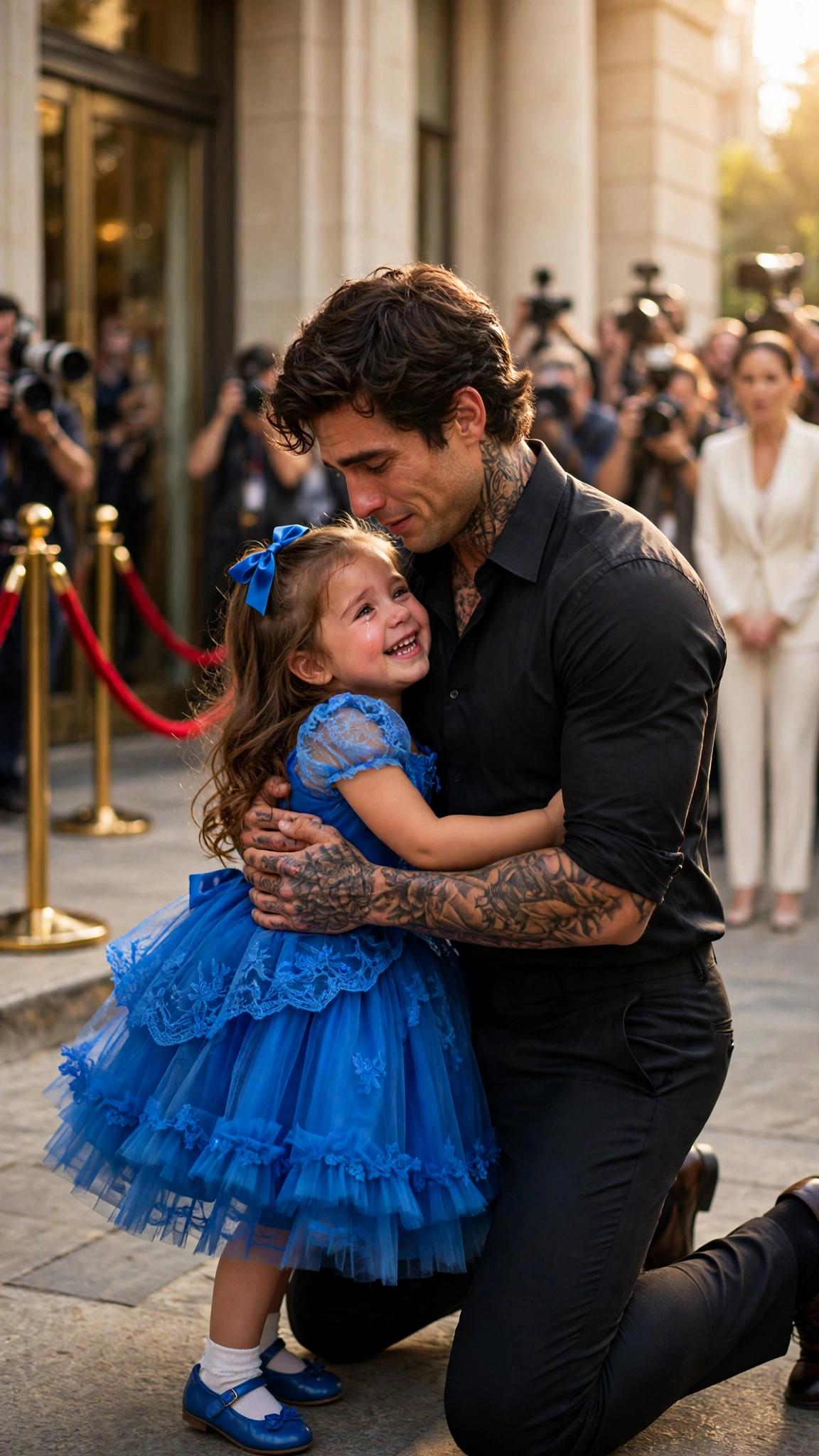
Claire came home from the hospital three weeks later, on a bright morning in early autumn, with a scar down the centre of her chest that she wore like a medal and a heart that beat strong and steady for the first time in years.
Michael had spent those three weeks learning how to be a father.
It was harder than any deal he had ever closed. Emma did not want his money. She did not care about his penthouse, or his cars, or the toys he bought her in a panic on the second day — a mountain of them, dolls and books and a bicycle she was too small for — which she had looked at politely and then ignored in favour of a cardboard box. What she wanted was his time, and his attention, and his presence. She wanted him to read to her. She wanted him to sit on the floor and play. She wanted him to be there when she woke up, and there when she went to sleep, and there in between.
So he was there. He cancelled meetings. He worked from the small kitchen table in Claire's Queens apartment, with Emma's drawings spread around his laptop and her questions interrupting his calls. He learned to braid hair — badly, at first, and then, with practice, almost well. He learned that Emma liked her sandwiches cut into triangles, that she was afraid of thunderstorms, that she talked to her dolls when she thought no one was listening, and that she had a laugh that sounded exactly like her mother's.
Slowly, day by day, she began to trust him.
It did not happen all at once. There were moments when she would go quiet and watch him with her mother's watchful eyes, and he knew she was thinking: Will you leave again? There were nights when she woke up crying and called for her mother, and Michael would sit outside her bedroom door until she fell asleep again, because he did not want to frighten her by coming in uninvited. There was one afternoon when she asked him, very casually, while they were drawing together, "Daddy, did you leave because I was bad?"
Michael put down his pencil. He turned to face her, and he took both her small hands in his, and he said, "No, sweetheart. Never. You were never bad. You were perfect. I left because I was afraid, and because I believed a lie, and because I was a coward. It was my fault. All of it was my fault. And I am so sorry."
Emma considered this for a long time. Then she nodded, and she picked up her pencil, and she said, "Okay. But you have to stay now."
"I will stay," Michael said. "Forever."
Meanwhile, the world outside was not standing still.
The afternoon at Sunrise Children's Home had been filmed by a dozen cameras, and the footage — a billionaire brought to his knees by a five-year-old girl in a blue dress — had gone everywhere. The newspapers called it the story of the year. The business press called it a scandal. The board of Rivers Capital called an emergency meeting and asked Michael, in very polite language, whether he intended to let a personal embarrassment destroy the company.
Michael went to the meeting. He stood at the head of the long table, in front of men who had known him since he was a boy, and he told them the truth. All of it. The pregnancy. The abandonment. His father's lie. The five years. The little girl. The letter.
"I did a terrible thing," he said. "I walked away from the woman I loved and the child I didn't know I had, because I was afraid and because I believed a lie. I am not proud of it. I will never be proud of it. But I am going to spend the rest of my life making it right. And if this company can't stand behind a man who is trying to do the right thing, then it doesn't deserve to stand at all."
There was a long silence. Then the oldest board member — a man who had worked with Michael's father for forty years — cleared his throat and said, "Your father was a hard man, Michael. Harder than he needed to be. But he loved you, in his way. And I think —" He paused. "I think he would have been proud of you today."
The board voted, unanimously, to stand behind him.
The next day, Michael did something he had never done before: he called a press conference, and he told the public the truth.
The room was full — reporters, cameras, microphones, the same press that had filmed him kneeling on the pavement at Sunrise. He stood at the podium in his black shirt, sleeves rolled up, tattoos visible, and he did not read from a statement. He spoke plainly, the way Claire had spoken at the gala seven years ago.
"Five years ago, I abandoned the woman I loved when she told me she was pregnant," he said. "I believed a lie about her, and I was too proud and too afraid to find out the truth. Yesterday, my five-year-old daughter ran through a crowd and called me Daddy, and I learned that her mother had raised her alone, and loved her, and taught her to believe I would come. I am here to tell you that I am going to spend the rest of my life earning the right to be called that. Her name is Emma. Her mother is Claire Bennett. And I am proud to be their family."
The room was silent for a moment. Then a reporter in the front row stood up and said, "Mr. Rivers, do you have anything to say to your daughter?" Michael looked straight into the camera and said, "Yes. Emma, sweetheart — Daddy's here. And Daddy's staying."
The story ran everywhere. But this time, it ran as a story of a man trying to make things right, and the public — to Michael's lasting surprise — responded with something he had not expected: forgiveness. Letters arrived at his office. Donations to Sunrise tripled. A nurse from the cardiac ward told a reporter that Mr. Rivers had quietly paid the medical bills of every family on the ward, and the reporter printed it, and Michael was embarrassed, and Claire, when she heard, smiled and said, "That's the man I fell in love with."
There was one more thing Michael had to do. He went to his father's old lawyer, a careful man named Mr. Hartley, who kept Richard Rivers' papers in a locked room, and he asked him a single question: "Did my father pay Claire Bennett?"
Mr. Hartley opened a file and showed him the truth: a letter, in Richard's handwriting, instructing that a payment be prepared — and, clipped to it, a second note, also in Richard's hand, written a week later: "She refused. Close the matter. The girl has more pride than all of us."
Michael read those words twice. Then he folded the letter and put it in his pocket, next to Claire's letter, and he understood, finally, that his father had known the truth too. Richard had known Claire refused the money. He had lied to his son anyway, on his deathbed, because he believed the company mattered more than the truth.
Michael forgave him, in the end — not because the lie was forgivable, but because carrying the anger would have poisoned everything he was trying to build. He went to his father's grave on a quiet Sunday morning, and he stood there for a long time, and he said, "She refused the money, Dad. She was better than both of us. I hope you know that now."
He never told the newspapers about the lie. He told them only the truth that mattered: that he had a daughter, that her name was Emma, that her mother was the bravest woman he had ever known, and that he intended to spend his life deserving them both.
The newspapers, to everyone's surprise, loved it. The story of the billionaire and the little girl in the blue dress became, not a scandal, but a story of redemption. Donations to Sunrise Children's Home tripled. Michael quietly paid off the medical debts of every family on the cardiac ward. He did not tell anyone. Claire found out anyway — a nurse told her — and she smiled and said, "That's the man I fell in love with. I always knew he was in there."
One afternoon, Michael brought Emma to his office for the first time. His assistant Sarah had cleared the big conference table and laid out paper and coloured pencils, and Emma — in a yellow dress this time, the blue one being saved for special occasions — set to work immediately, drawing the three of them in front of the house with the blue door, while Michael took his calls in a low voice so as not to disturb her. Between calls, she would hold up a drawing for his approval, and he would nod solemnly, as if he were approving a merger. At the end of the day, she taped her best drawing to the glass wall of his office, right where everyone could see it, and she said, "Now your office is nice, Daddy. Now it has a family in it." Michael looked at the drawing — three stick figures, a blue door, a yellow sun — and he thought that in all his years in that office, with all its deals and all its money, nothing on those walls had ever mattered as much as that one piece of paper.
By the time Claire came home from the hospital, the three of them had settled into a rhythm. Mornings in the Queens apartment, sunlight through the kitchen window, Emma eating cereal and telling them both her dreams. Afternoons in the park. Evenings with books and baths and bedtime stories — Michael reading, Claire listening from the doorway with her hand over her heart, which was strong now, and steady, and hers.
The move to the brownstone came in the spring. Michael had found it almost by accident — a narrow, three-storey house in Brooklyn with a garden at the back and a front door that needed painting. Emma had taken one look at the door and announced, "It should be blue. Like my dress." So they painted it blue together, all three of them, on a Saturday afternoon, with Emma in charge of the bottom half and Michael in charge of not getting paint on Claire, which he failed at, twice. When it was done, Emma stood back and said, with great satisfaction, "Now it's our house. The house with the blue door. Just like in my drawings."
Claire went back to the clinic two days a week, and the first morning she left for work, Emma stood at the blue door and waved until the taxi turned the corner, and then she turned to Michael and said, "Now it's just us, Daddy. What shall we do?" What they did was make pancakes — badly — and then go to the park, and then come home and make more pancakes, slightly less badly. When Claire came home that evening, she found them both covered in flour, and she laughed until her new heart ached, and then she laughed some more.
One evening, after Emma was asleep, Claire sat beside Michael on the small sofa and said, "You know what she asked me today? She asked me if you were going to live with us now. If we were a real family."
Michael took her hand. "What did you tell her?"
"I told her," Claire said, "that families aren't about living in the same house. They're about showing up. And you've shown up, Michael. Every day. That's what makes you her father. Not the birth certificate. Not the photograph. You. Showing up."
Michael looked at her — at her warm brown eyes, at the scar hidden beneath her shirt, at the woman who had raised his daughter alone and never once stopped believing he would come — and he knew, with a certainty he had never felt about anything in his life, what he wanted to do next.
But he did not say it yet. Some things, he had learned, were worth waiting for. Some things had to be asked properly, on the right day, in the right way.
He waited for the right day. It was not far off.