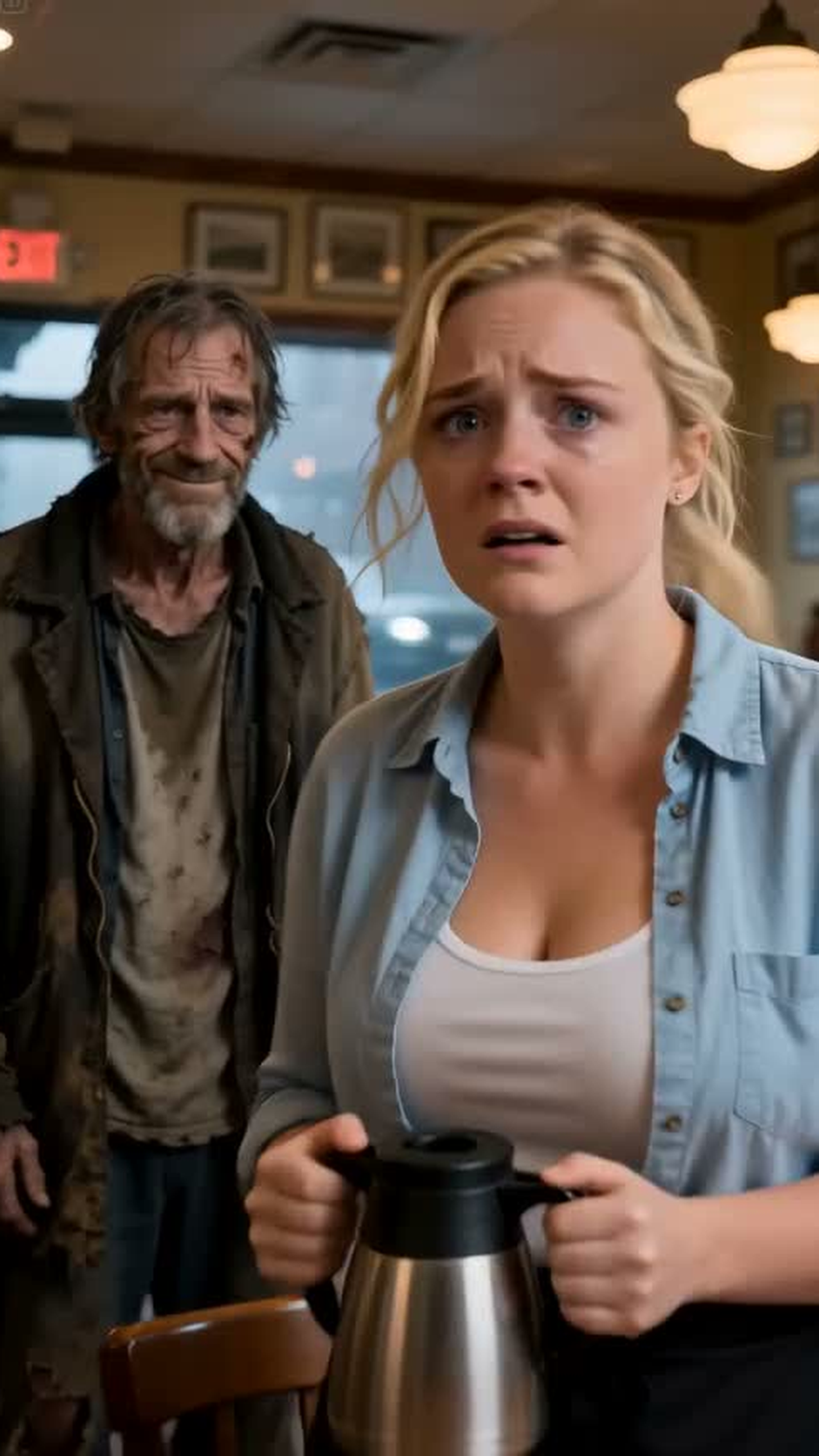
By the end of the first week, the old man had become part of the avenue's furniture, which is to say he had become invisible in the particular way that only people can become invisible — deliberately, and with effort.
Emma kept a private census. Monday: a woman in a red coat slowed, actually slowed, hand going to her purse — and then her phone lit up and the moment passed through her like light through glass. Tuesday: one of the counter regulars, a retired teacher named Walter who tipped in exact change and opinions, came in shaking his head. "Fellow out front's got a system, mark my words. They make more than you do, some of them. Tax free." Wednesday: rain in the morning, and the awning dripped on him for four hours, and no one inside so much as moved a chair.
Emma moved through those days with a glass of water in her hand more often than the job required. Then coffee, in a real mug, because paper felt like an insult she couldn't explain. On the fourth day she brought out half a sandwich on a saucer — her own break, halved without a thought — and he took it with that same grave nod and one word, the first he had given her.
"Name?"
She blinked. "Emma. Emma Lawson."
Something happened in his face then — small, and gone fast, like a fish turning under dark water. "Lawson," he repeated, as if tasting it for a lie. "Huh."
"Huh, what?"
But he only shook his head and ate his sandwich half with the manners of a man at a wedding, and when Gus came out with the trash and saw the saucer, the storm that had been gathering behind the counter all week finally broke.
"Inside," Gus said. "Now. Both feet. Inside."
The office at the Kettle was a broom closet with ambitions — mop, ledgers, a calendar from a food-service supplier stuck forever on March. Gus closed the door with care, which was worse than slamming it.
"You feed one," he said, "you feed them all. This is not me being a monster, Emma. This is arithmetic. I got a landlord doing market potential on my roof, I got Sysco raising me eleven percent, I got a health inspector who thinks my walk-in is a confession booth—"
"He's not them all, Gus. He's one man. An old man."
"He is a line item I cannot see the end of." Gus rubbed his face with both hands, and when he lowered them he looked every one of his sixty-four years. "Your grandmother—" He stopped.
"My grandmother what?"
"Your grandmother," he said, with the air of a man laying down a card he has held for decades, "would have fed him too. That's the problem with you Lawsons. It's genetic. It's a defect." He pointed at her with a wooden spoon, which somewhat undermined the boardroom tone. "The water, fine. The coffee — fine, I'm a Christian country. But plates, Emma? Meals? That's the business. That's my chicken walking out my door on your conscience."
"It was my break, Gus. My sandwich."
"Half your break." A beat. "I counted." He let out a breath that was almost a laugh and waved her out of the closet. "Go. Your eggs are philosophical. And Emma — when the city or the rain moves him on, don't take it personal. They always move on."
But the old man did not move on. He arrived before the lunch rush and left after it, unhurried as a tide, and the notebook Emma did not know about filled a page a day in copperplate handwriting.
What no one on Candler Street knew — what precisely three people in the city knew, and two of them were paid to forget it — was that the man under the awning had walked out of the Moretti estate nineteen days earlier with nothing but the coat he was wearing and a point to prove.
Salvatore Moretti had built an empire the way his father had taught him: with his hands, then with his name, then with the kind of silence that other men filled with obedience. Forty years of it. Ports and warehouses, restaurants and real estate, a foundation with his late wife's name on the brass plate that fed eleven thousand people a month. He had buried his wife, raised his son, buried two brothers and most of his enemies, and arrived at fifty-nine with everything he had ever wanted and one question he could not put down:
When the name stopped working — when he was only a man, cold and hungry on a sidewalk — what was left?
The fight with Adrian had been the match, not the fire. The foundation's audit, postponed three times. The new director, Marcus Webb, all cufflinks and reassurance, who spoke about hunger the way weather anchors speak about rain — as something that happened on a map. Carlo Russo, Sal's right hand of thirty years, counseling patience in a voice like warm oil: Let the boy run his side, Sal. You're retired. Retired. A word for furniture.
So one night Salvatore Moretti put on the coat of a man who had nothing, walked out through the service gate his own security never watched, and went to find out what his city actually was.
He had chosen the Copper Kettle for the oldest reason there is. In the spring of 1986 he had been twenty-six years old, broke in a way that has a smell, sleeping in a doorway two streets over with his whole future folded into a duffel bag — and a waitress at this diner, a Lawson, a girl with tired blue eyes and no reason on earth, had fed him for nine days straight out of her own staff meals and told him, the morning he finally landed work, pay it forward when you're rich, handsome.
He had been paying it forward, or telling himself he had, for forty years. Eleven thousand meals a month. It had taken him until fifty-nine to wonder whether the machinery had eaten the mercy — whether anyone in his gleaming foundation still fed a man because he was hungry, or only because he was counted.
Nineteen days under awnings and overpasses had given him a stomachful of answers. The notebook was a ledger of doors. Churches that cited policy. Cafés that cited liability. A bistro whose manager had called the police with the fluency of long practice. And one diner on Candler Street where the waitress had his dead benefactor's eyes and brought water without being asked, and coffee in a real mug, because paper felt like an insult she couldn't explain.
Two streets away, the search for him was entering its third week and growing teeth.
Adrian Moretti did not raise his voice. It was the thing the men who worked for him feared most about him — that flat, courteous calm, like deep water. He stood at the window of his office above the harbor with Carlo at his back and a private investigator's report in his hand that said, in professional language, nothing at all.
"Nineteen days," he said. "A man of fifty-nine, with a heart condition he hides from his own doctor, vanishes from a house with eleven cameras. And your conclusion is that he's sightseeing."
"My conclusion," Carlo said, "is that your father is the slipperiest son of a—" He caught himself, smiled, recalibrated. "—of his generation. If Salvatore Moretti doesn't want to be found, Adrian, he is not found. The Kovacs don't have him. If the Kovacs had him, we'd have heard terms by now. Terms are their love language."
"And if it's not the Kovacs?"
"Then it's a hospital with a John Doe, or it's him teaching us all a lesson at our expense, and either way" — Carlo spread his hands — "shouting at detectives won't shorten it. Patience."
Adrian turned from the window. "My father used to say patience is what the trap tells the rabbit."
Carlo's smile did not move, but something behind it did — a fraction, like the fish under dark water in the old man's face, gone before it could be named.
The second week brought the city itself out to the ledge, in the form of a two-man outreach team with clipboards and the exhausted kindness of men who have been given a map instead of a budget. Emma watched from the pass as they crouched by the old man with the practiced choreography of concern — shelter beds, intake hours, a card with a number on it — and she watched him receive them the way he received weather: courteously, immovably, with those clear eyes taking notes of his own. When they left, the senior of the two came in for coffee and stood at the counter shaking his head.
"He's not confused," the outreach worker said. "That's the thing. Usually there's a — you know. A fog. This one quoted the shelter's own funding statute at me. Correctly. Then he asked if I was eating enough." He turned his cup in his hands. "Nineteen years I've done this route. First time a client's ever made me feel like the intake."
That same week, at the estate above the harbor, Adrian Moretti stood in a hospital corridor at two in the morning looking through a curtain at a John Doe who was not his father — sixtyish, gray, pulled from the river side with no name on him — while Carlo, at his shoulder, murmured the word patience like a man turning a key in a lock he owned. Adrian paid the stranger's bill on his way out. He did not examine why. He told himself it was procedure. He had begun, in the small hours, to understand that he would stand in any corridor in the city, any number of times, rather than say the thing Carlo kept almost saying — that a man of fifty-nine with enemies does not vanish by accident, and that the family should begin, quietly, to plan for the shape of the world after Salvatore.
He went home and stood in his father's bedroom doorway and did not plan for it. He made the housekeeper cry by asking her, with great courtesy, to keep making the bed.
On Candler Street the rain gauge of the days was the awning, and the old man beneath it had begun, without anyone voting on it, to be greeted — not by the customers, not yet, but by the street itself. The florist two doors down started leaving the ledge swept. Somebody's grandfather, passing with a cane, took to nodding at him, one veteran of the sidewalk to another. And Emma, refilling his coffee on the eleventh day, got her second sentence out of him, offered without prompting while he watched a crew repaint the crosswalk:
"You're Rose Lawson's granddaughter."
It wasn't a question. Her hand stopped with the pot in the air.
"You knew my grandmother?"
"I knew a waitress in this room," he said, "when this room had different paint." The clear eyes came up to hers and something in them was almost gentle. "You're the first person on this street who hasn't asked me my name, Emma Lawson. Did you ever notice that? Everyone wants the name. The name tells them what a man is worth. You brought water first." He folded his hands around the mug. "Ask later. Isn't that the law?"
She went back inside with her heart slamming and told absolutely no one, because some things are too large for a shift, and because a part of her — the part that counted tips at a kitchen table and knew the weight of every envelope — already understood that the man under the awning was an exam she had not applied to sit, and that she had been taking it, question by question, for eleven days.
That night it rained for the first time in a week, a rehearsal for Thursday. Emma, locking up, found the old man still under the awning at half past nine, an hour past his usual tide, and understood from the set of his shoulders that he was sleeping there — that the ledge was not a post but a bed.
She stood in the doorway with the keys in her hand and her grandmother's first law standing in her throat like a supervisor.
Feed people first. Ask later.
She went back inside and made up the storeroom cot the night cook used on doubles — blanket, the good pillow from the office, no fuss — and held the door for him. He looked at the cot. He looked at her, and those spring-water eyes did something she would think about for a long time afterward.
"You'll lose your job for this one day, Emma Lawson."
"Then I'll lose it fed," she said. "In you go. Bathroom's through the kitchen. Don't touch the pies."
He slept at the Copper Kettle for three nights, and was gone by five each morning like a rumor, and neither of them ever mentioned it again — not the next day, when Gus found the pillow and said nothing either, in a voice that fooled no one, about mice getting ideas.
And on Wednesday night, in a black sedan parked across from the diner with its lights off and its engine ticking as it cooled, a man who did not work for Adrian Moretti lowered a camera with a long lens, and looked at the photograph he had taken of the old man asleep in the storeroom window, and made a telephone call.
"I found him," he said. "You are not going to believe where Salvatore Moretti is sleeping."