At two o'clock in the morning, the knocking came again.
Knock. Knock. Knock.
Lorenzo was ready.
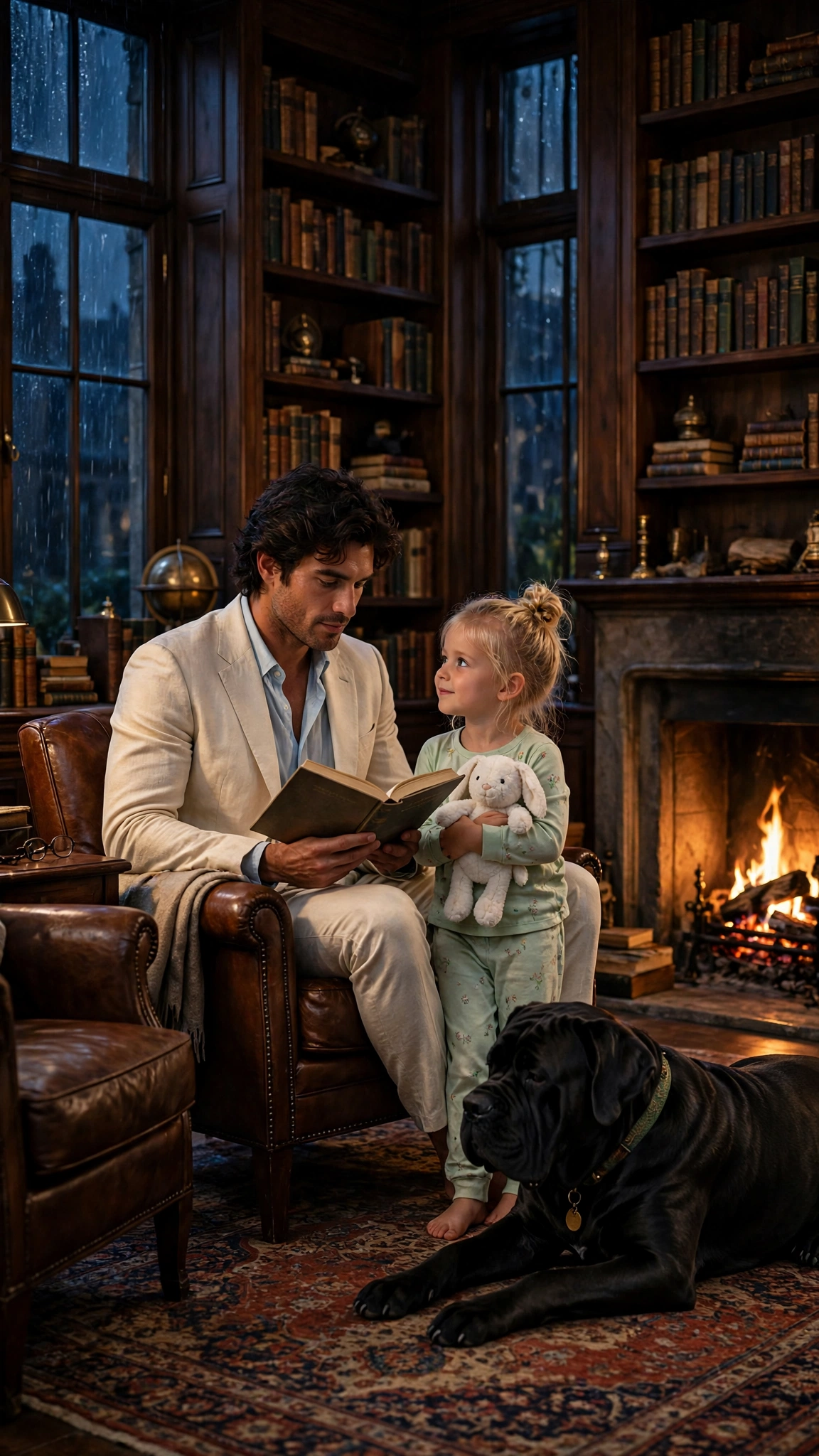
He had been sitting in his leather armchair since eleven o'clock, in his cream suit, with no book in his hands, listening to the house. He had heard the clock strike twelve, and one, and two. He had heard the rain stop. He had heard the silence settle over the house like a blanket. And when the knocking came — three knocks, slow and deliberate, against the tall glass terrace doors at the far end of the library — he was on his feet before the third knock had faded, moving silently across the Persian rug, his hand already on the latch.
King was on his feet too. The great black dog had risen from the fireplace without a sound, his ears flat, his body low, and he moved to Lorenzo's side, and stood there, staring at the terrace doors, and a low, deep growl began in his chest.
"Stay, King," Lorenzo said quietly. "Stay with me."
He opened the terrace doors.
The night air came in, cold and wet, smelling of rain and earth and night. The garden was dark. The cypress trees stood black against the sky. The fountain was a pale shape in the dark. And on the terrace, standing in the shadows by the stone step, was a man.
He was not a large man. He was thin, and pale, and he wore a dark coat that was too big for him, and his hands were shaking. He had been reaching for the door when Lorenzo opened it, and now he stood frozen, his hand still raised, his eyes wide, like a rabbit caught in a torch beam.
For a moment, no one moved. The man looked at Lorenzo. Lorenzo looked at the man. King looked at the man, and his growl grew deeper, and the man took one step back, and then another, and his foot slipped on the wet stone, and he fell to his knees on the terrace.
"Don't," the man said, his voice shaking. "Please. Don't let the dog — please."
Lorenzo looked down at him. He had faced down killers and judges and rivals without ever once flinching, and this — this thin, frightened man in a coat that was too big for him — was the thing that had been keeping his five-year-old daughter awake for a month. It was almost funny. It would have been funny, if it had not been so terrible.
"Get up," Lorenzo said, very quietly.
The man got up, slowly, his hands raised, his eyes on King.
"Who sent you?" Lorenzo asked.
The man swallowed. "I — I don't know what you mean, sir. I was just — I was walking —"
"Do not lie to me," Lorenzo said, and his voice was very soft now, the way it always was when he was most dangerous. "You have been coming here for a month. You smoke three cigarettes on my terrace. You knock three times on my doors. You watch my house. Who sent you?"
The man looked at the garden, and at the gates, and at the two of Enzo's men who had appeared silently on the terrace behind him, and he understood, suddenly and completely, that there was nowhere to run. He sagged, like a man who had been holding his breath for a month and had finally been allowed to let it out.
"The Ferraros, sir," he said, very quietly. "A man named Ferraro. He paid me. Fifty euros a night, to come here, and to knock, and to see if anyone answered. He wanted to know if the house was guarded. If the dog slept inside or outside. If the girl was — if the girl was alone at night."
Lorenzo was silent for a long moment. Then he said, "And what did you tell him?"
The man looked down at his shoes. "I told him the house was quiet, sir. I told him no one ever answered. I told him the dog slept in the library, and the girl slept upstairs, alone. I told him — I told him it would be easy, sir. I told him the house was not watching."
"How many nights?" Lorenzo asked.
The man swallowed. "A month, sir. Maybe more. I lost count after the first two weeks. Every night, the same. I came through the hedge, I smoked three cigarettes, I knocked three times, and I left before half past two. That was the arrangement."
"Who paid you?" Lorenzo asked.
"I never met him, sir. A driver left an envelope under the bench by the harbor, every Friday. Fifty euros a night. The note in the envelope said the address, and the instructions: three cigarettes, three knocks, leave before half past two. That was all. I never saw Ferraro. I never saw anyone. I only ever saw the house."
King stepped forward then, silently, and lowered his great head, and sniffed the man's coat, once, deeply, and the man went rigid, his eyes fixed on the huge black dog, his breath coming short and fast. Lorenzo laid one hand on King's broad head, and the dog stopped, but he did not step back. He stood there, staring at the man, and the man stared back at him, and Lorenzo understood, suddenly, that the man was not afraid of him. He was afraid of the dog. And the dog, who had never harmed anyone in his life, was the most frightening thing in the garden.
"He is not going to hurt you," Lorenzo said quietly. "Not unless I tell him to. And I am not going to tell him to. You are not a killer. You are a hungry man who was paid to frighten a child. That is a small, mean thing to do for money — but it is not a thing worth killing a man over."
The man stared at him. "You — you are letting me go, sir?"
"I am letting you go with a message," Lorenzo said. "That is different. Enzo's men will walk you to the gate. They will watch you go. And if you ever come back to this house, for any reason, at any hour, you will not find me standing in the doorway asking questions. Do you understand?"
"Yes, sir," the man whispered. "I understand, sir. Thank you, sir."
Enzo's men searched the terrace while they waited, their torches low, looking for anything the man might have left behind. One of them found a dropped cigarette packet, crushed flat, in the wet grass by the wall. Another found a fresh footprint, deeper than the others, where the man had stood for a long time, watching the library windows. Enzo bagged the packet in a handkerchief, the way policemen do in films, and Lorenzo, watching him, thought about how strange it was that a man could spend a month standing in his garden, night after night, and leave behind nothing but cigarette ends and footprints — and a little girl who could not sleep.
Lorenzo looked at him for a long time. And then, slowly, he smiled — not the smile he wore for photographs, but a small, cold smile, the smile of a man who has just understood something important.
"You were wrong," Lorenzo said. "The house was watching. My daughter was watching. My dog was watching. You were the only one in this garden who was not watching, because if you had been watching, you would have seen that this house has never once been unguarded — not for a single night, not for a single hour. You saw a quiet house, and you thought it was an empty house. That was your mistake."
The man nodded, miserably. "Yes, sir. I see that now, sir."
"Then you will carry a message back to Ferraro," Lorenzo said. "You will tell him that the Moretti house is guarded. You will tell him that the girl is protected. You will tell him that if anyone comes here again — anyone at all, for any reason, at any hour — I will not be standing in the doorway asking questions. Do you understand?"
"Yes, sir," the man said quickly. "I understand, sir. I will tell him. I swear it."
"And you will tell him one more thing," Lorenzo said. "You will tell him that his scout knocked three times on my daughter's door, and that my daughter was afraid, and that she came downstairs in the middle of the night to ask me for my dog, and that I gave him to her. And you will tell him that a house where a five-year-old girl is braver than his whole family is not a house he should ever come near again."
The man nodded, and Enzo's men took him by the arms, gently but firmly, and led him away across the terrace, toward the gates, and Lorenzo stood in the doorway, watching them go, and he felt a strange, quiet feeling in his chest — not anger, not triumph, but something else. Relief. And beneath the relief, something else: a deep, tired sadness, because he understood, suddenly and completely, that the man on his terrace had not been the enemy. The enemy had been his own blindness. The enemy had been three years of building walls and never looking at them. The enemy had been a father who sat in his library every night, reading his book, while his daughter lay awake upstairs, listening to a stranger knock on her house.
King pressed his great head against Lorenzo's leg, and Lorenzo laid his hand on the dog's broad head, and they stood together in the doorway, looking out at the dark garden, and Lorenzo thought about his daughter, and about the dog, and about the man who had just been led away, and about the three years he had spent believing that strength meant never bending, never yielding, never admitting he was wrong.
And then, from the stairs behind him, came a small, sleepy voice.
"Papa?"
Lorenzo turned.
Millie stood on the bottom step of the staircase, in her green pyjamas, barefoot, with the white bunny in one arm and her eyes wide in the dark. She had heard the voices. She had heard the dog. She had come downstairs, the way she always did when she was afraid, to find her father.
"Millie," Lorenzo said, and he went to her, and he knelt down, and he put his hands gently on her small shoulders. "What are you doing down here, tesoro? It is the middle of the night."
"I heard voices, Papa," Millie said. "I heard King growling. Is everything all right?"
Lorenzo looked at his daughter for a long moment. And then, slowly, he told her the truth — not all of it, because she was five years old, and some truths are too heavy for small shoulders — but enough of it. Enough for her to understand that she had been right, and that she had been brave, and that the knocking was over.
"There was a man, Millie," he said quietly. "A bad man, who was paid to watch our house and to frighten us. He knocked on our doors to see if anyone was watching. But we were watching, tesoro. You were watching. King was watching. And now he is gone, and he will not come back. No one will knock on your door again. I promise you."
Millie looked at him for a long moment, searching his face the way children search faces for the truth. And then, slowly, she nodded.
"Good," she said. "Because I was tired of being afraid, Papa."
Lorenzo felt something break open inside his chest — something he had kept locked away for three years, since the night of the rain and the red light and the telephone call. He pulled his daughter into his arms, and he held her tight, and he felt her small heart beating against his chest, fast and strong, and he thought about how small she was, and how brave she was, and how close he had come to losing the most important thing in the world, all because he had been too proud to listen.
"I know, tesoro," he whispered. "I know. And I am sorry. Papa is sorry. From now on, I will listen. I promise you."
King came and pressed his great head against Millie's side, and Millie put one small arm around the dog's neck, and the three of them stood together in the dark hallway — a mafia boss, a little girl, and a great black dog — and for the first time in three years, Lorenzo Moretti felt like he was exactly where he was supposed to be.
"Come," he said, and he picked Millie up, and he carried her back upstairs, with King following behind them like a shadow, and he laid her down in her bed, and he pulled the blankets up over her shoulders, and he sat on the edge of the bed for a while, watching her breathe, the way he had done the night before, and the night before that, and every night since she was born.
"Papa?" Millie murmured, half asleep. "Will King stay? Forever?"
"Forever," Lorenzo said. "I promise."
"And the knocking won't come back?"
"It won't come back," Lorenzo said. "I promise you that too."
Millie smiled in her sleep, and her small hand tightened around the bunny, and Lorenzo bent down and kissed her forehead, and whispered, so softly that only the sleeping child and the dark room could hear him, "Goodnight, my little bird. Papa loves you. Mama loves you. And we will always, always stay."
He stood up, and he went to the door, and he looked back one more time at the small, peaceful scene: his daughter asleep in her green pyjamas, the bunny under her chin, and the great black dog lying across the foot of the bed like a guardian, his eyes half open, watching over them both.
Downstairs, the library was dark, and the fire was low, and the rain had stopped, and the house on the hill stood quiet in the night, like a ship that had finally found its way home.
And in the garden, beyond the gates, the Ferraro family's scout walked away into the dark, carrying a message he would never forget, and behind him, the Moretti house glowed warm in the night, guarded by a dog, and a little girl, and a father who had finally learned how to listen.