Three weeks later, the house on the hill had changed in small ways that everyone noticed and no one could quite explain.
The study door stayed open now, instead of closed. The telephone rang less at night. Lorenzo came home for dinner every evening, and on Sundays he took Millie and King down to the garden, where King taught Millie how to throw a ball properly, and Millie taught King how to play hide and seek behind the hedges, and Rosa watched them from the kitchen window and smiled.
King's bed had moved. It was no longer by the fireplace in the library. It was in Millie's room now, by the foot of her bed, a great soft cushion that Lorenzo had bought himself, in the town, from a shop that sold things for dogs the size of small bears. Every night, King lay down on it, and every morning, he was still there, his great head on his paws, his eyes open, watching the door.
The terrace doors had a new lock. The gap in the hedge had been repaired. The old service door at the back of the house had a new lock too. And every night, two of Enzo's men walked the terrace, quiet and watchful, the way good guards walk — not stomping, not shouting, just there, like the walls themselves.
The Ferraro family had gone quiet again. Their men had not been seen in the town for weeks. The message had been delivered, and it had been understood: the Moretti house was guarded, and the girl was protected, and anyone who came near it again would find not a quiet house, but a house that was watching.
But the biggest change was not in the locks, or the guards, or the garden. The biggest change was in the library.
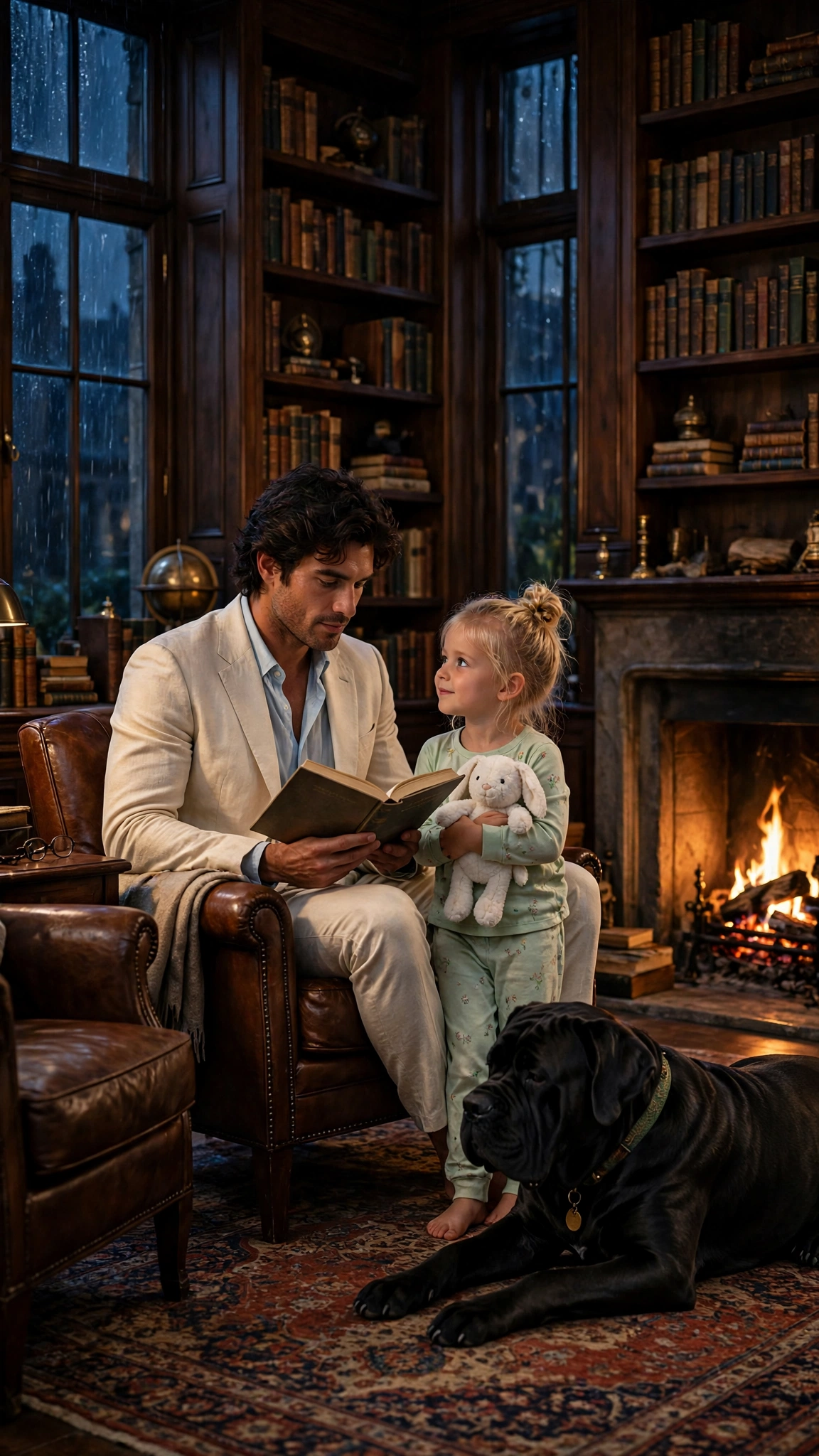
Every evening, after supper, Lorenzo would go to the library with Millie on his lap and King at their feet, and he would read to her until she fell asleep. He read her fairy tales, and stories about dragons, and stories about brave little girls who outsmarted giants, and Millie would listen with her head against his chest, and King would listen with his chin on his paws, and the fire would burn low, and the rain would drum softly on the windows, and the house would go quiet around them, the way a house goes quiet when everyone in it is exactly where they are supposed to be.
It was Rosa who had started it, in a way. One evening, about a week after the night of the knocking, Rosa had come to the library door with a tray of tea, and she had found Lorenzo sitting alone in his armchair, staring at the fire, and she had said, very gently, "Mr. Moretti, the little one is asking for you. She wants a story."
Lorenzo had looked up, surprised, and Rosa had smiled, and she had said, "She has been asking every night, sir. She just never told you before, because she thought you were too busy."
Lorenzo had gone upstairs, and he had found Millie sitting up in bed with her bunny in her arms, waiting, and he had sat down on the edge of the bed, and he had read her a story — the first story he had read aloud in years, his voice rusty and uncertain at first, and then smoother, and then warm — and Millie had fallen asleep halfway through, with her head on his arm, and Lorenzo had sat there for a long time after she was asleep, watching her breathe, and thinking about how much he had missed.
From that night on, it became a ritual. Every evening, after supper, the library, the armchair, the book, the little girl, and the dog. And every night, when Millie fell asleep, Lorenzo would carry her upstairs to bed, and King would follow behind them like a shadow, and Rosa would come up later with a cup of warm milk, and the house would go quiet, and the rain would fall on the windows, and the family would sleep in peace.
On a Friday evening, three weeks after the night of the knocking, Lorenzo was reading to Millie in the library when she interrupted him, in the middle of a sentence about a dragon, and said, "Papa?"
"Yes, tesoro?" Lorenzo said, looking down at her.
"Are you still afraid?" Millie asked. "Of the knocking man?"
Lorenzo thought about this for a moment. He thought about the man on the terrace, thin and frightened in his coat that was too big for him. He thought about the Ferraro family, quiet again in the town. He thought about the new locks, and the guards on the terrace, and the dog lying at his feet. And he thought about the three years he had spent being afraid — afraid of losing his daughter, afraid of losing his wife's memory, afraid of being soft, afraid of being wrong — and about how the fear had never once kept anyone safe.
"No, tesoro," he said, very quietly. "I am not afraid anymore. Because I understand something now that I did not understand before. I thought that being strong meant building walls, and never letting anyone in, and never admitting I was wrong. But you taught me something different, Millie. You taught me that being strong means telling the truth, and asking for help, and staying. That is what you did. You came downstairs in the dark, and you told me the truth, and you asked me for my dog, and because you did that, our house is safe. Do you understand?"
Millie nodded slowly. "I think so, Papa. I think being brave means asking for help."
"Yes," Lorenzo said. "That is exactly what it means. And you are the bravest person I know."
Millie smiled, and she leaned her head against his chest, and Lorenzo went back to reading, and King sighed, a deep, contented sigh, and closed his eyes, and the fire burned low, and the rain drummed softly on the windows, and the library was warm, and quiet, and safe.
Later that night, when Millie had fallen asleep and Lorenzo had carried her upstairs to bed, he stood in the doorway of her room for a long time, looking at the small, peaceful scene: his daughter asleep in her green pyjamas, the bunny under her chin, and the great black dog lying across the foot of the bed like a guardian, his eyes half open, watching over them both.
He thought about Renata. He thought about the way she used to sit in the library, in the evenings, with her feet tucked under her, reading, while he worked. He thought about the way she had laughed at him when he tried to be stern. He thought about the last thing she had ever said to him, on the night she died: "Don't forget to be soft with her, Lorenzo. She is going to need you to be soft."
He had not been soft. He had been hard, and fast, and certain, and he had been wrong. But now, at last, he was learning. He was learning to sit in a library with his daughter on his lap, and to read her stories, and to listen when she spoke, and to let a dog sleep in her room, and to let a housekeeper make him tea, and to let his walls come down, one by one, until the house was not a fortress anymore, but a home.
He went downstairs, and Rosa was in the kitchen, making tea, and he sat down at the table with her, and they talked — really talked, for the first time in twenty years — about Renata, and about Millie, and about the bunny, and about the nights when Rosa had sat up with the child when she was sick, and about the mornings she had braided her hair, and about all the small, invisible things that make a childhood, and Lorenzo listened, the way he had learned to listen, and he understood, at last, how much he owed this quiet woman who had never once asked him for anything.
"Thank you, Rosa," he said, when she had finished. "For staying. For everything. For twenty years. I should have said it years ago."
Rosa looked at him, and her eyes glistened, and she nodded once, slowly, the way she had nodded a hundred times before — at the top of a staircase, at the edge of a garden, at the beginning of something brave.
"You are welcome, Lorenzo," she said. "That is what family is for."
And Lorenzo Moretti, who had not cried in three years, felt his own eyes sting, and he did not try to stop it, because for the first time in three years, he was not the most feared man in the city. He was just a father, sitting in his kitchen at midnight, drinking tea with a woman who had loved his daughter in silence for years, and learning, at thirty-six years old, how to be a family.
The next morning, Millie woke up early, and the first thing she did was check that King was still there, lying across the foot of her bed, warm and breathing. The second thing she did was run to the window and look out at the garden, where the sun was coming up over the cypress trees, and where her papa was standing by the fountain with a cup of coffee, looking up at her window and smiling.
She waved. He waved back. And Millie Moretti, who was five years old, and who had a dog, and a bunny, and a papa who was learning to listen, and a housekeeper who had loved her since she was a baby, and a mama who watched over her from a little white bunny, thought that the world was, after all, a very good place to be.
She got dressed, and she put on her green dress — the one that matched her pyjamas, the one Rosa had bought her in the spring — and she tied her blonde hair up in a little top bun, the way she always did, and she went downstairs to start her day, with King beside her and the bunny in her arms, and the house on the hill glowed warm in the morning light, like a ship that had finally found its way home.
In the weeks that followed, the house changed in small ways that everyone noticed and no one could quite explain. The study door stayed open. The telephone rang less. Lorenzo came home for dinner every evening. And every night, in the library, by the fire, with the rain on the windows, a father read to his daughter, and a great black dog lay at their feet, and a little white bunny sat on the arm of the chair, watching over them all.
Some nights, when the rain came back, Millie would ask her papa to read the story of the dog who stayed, and Lorenzo would open the book and begin, and she would correct him if he skipped a single word, the way only a five-year-old can. King would lift his great head at the sound of her voice, and then settle again with a sigh, and Rosa would bring in a tray with two cups of tea and one small glass of warm milk, and she would sit in the chair by the fire for a while, mending a sock or shelling peas, until the house grew quiet and the only sound left was the rain and the turning of pages. Lorenzo learned the names of all the dogs in Millie's picture books, and he learned that a library is not a room for being alone, but a room for being together, and he learned that the walls he had built to keep the world out had also kept his own daughter out, and that taking them down, brick by brick, was the hardest and the best work he had ever done. And every night, before she fell asleep, Millie would whisper the same question into the dark, and her papa would answer it the same way, every time.
That is how the story ends: not with a grand gesture, and not with a fortune, but with a little girl, and a dog, and a bunny, and a library at night, and a family that finally learned the bravest thing of all — how to stay.
And if you ever pass the Moretti house on a rainy night, and you look up at the tall windows of the library, you will see them there: a man in a cream suit, reading aloud; a little girl in green pyjamas, asleep on his lap; and a great black dog, lying by the fire, with his eyes half open, watching over them both. And you will understand, the way Millie understood on the night she walked downstairs in the dark to ask her father for his dog, that the bravest thing in the world is not to fight, or to win, or to never be afraid.
The bravest thing in the world is to ask for help — and to stay.
THE END