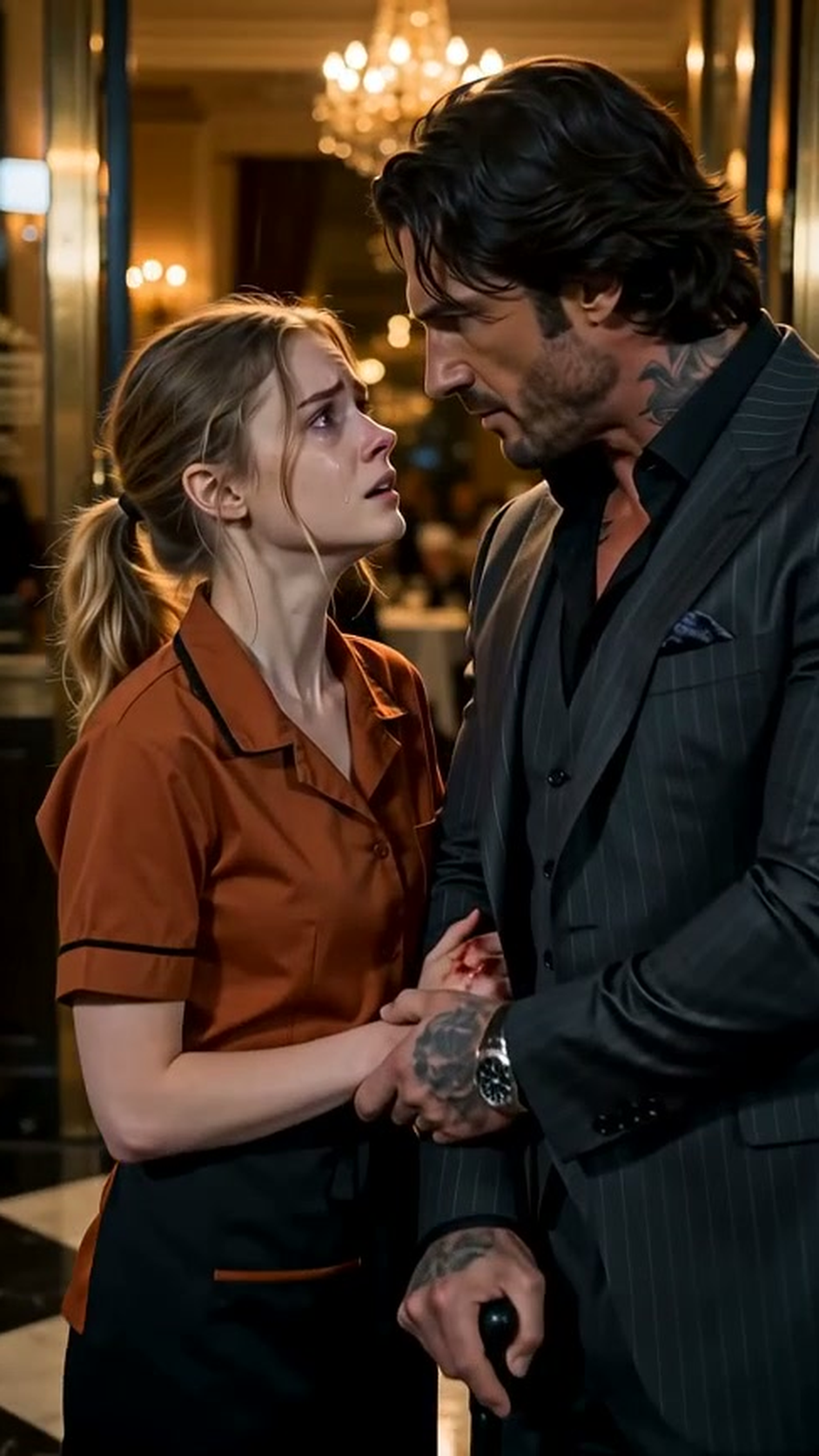
Every head in Laura turned as David Kesler marched her through the dining room.
That was the worst of it — worse than the rain waiting outside, worse than the word fired already forming in his mouth like a bullet being chambered. Forty tables of people in evening clothes, people she'd served birthdays and anniversaries and one actual proposal to (table nine, the ring in the crème brûlée, she'd cried a little bringing it out) — forty tables watched her pass with her apron in her hands, and nobody said a word, because wealth is very brave about other people's emergencies.
"Out," David said, at the top of his voice, for the room. "Out, out — don't slow down, Walker, you've slowed this restaurant down enough for one career—"
He threw the brass doors wide. The rain came in sideways on a gust of wet November air, and there, under the awning, at the top of the marble steps, framed in the golden doorway like a man the evening had been arranged around, stood Roman Castellano.
Naen saw him and didn't recognize him. That was the strange, true thing. She had seen this man at the edge of death, gray as ash, and she had never seen him standing — six foot three of him in a charcoal pinstripe suit, a black cane planted on the marble, one leg bound white under the trouser's break, tattoos climbing out of his collar like something alive. He looked like the storm had dressed up for dinner.
She had no idea why her heart was slamming. She thought it was fear. It was not fear.
David, with the instincts of a man who has survived thirty years of service by smelling power the way dogs smell weather, changed tone so fast it squeaked. "Sir! Welcome to Laura, sir, if you'll just give us one moment, we're— dealing with a staff matter—" And then, because cruelty was his native language and he couldn't leave it alone even now, he took Naen by the elbow to move her aside like furniture, and shoved her termination out into the rainy air for the stranger's benefit and the whole doorway's:
"You're fired. Get out!"
The words cracked across the marble entrance like a gunshot.
Naen stood in the golden spill of the doorway with her eyes lowered and her whole body trembling. The rain spotted her shoulders. Behind David, through the brass doors, the staff froze — a waiter mid-step, two chefs exchanging one look and then finding the floor fascinating. Her hands, twisting together, found the only solid thing in reach: the edge of a dark pinstripe sleeve. She gripped it like a rail in a flood.
"Please," she whispered, to David, to God, to the empty pharmacy bag on her kitchen counter. "Please… my little boy needs medicine."
And the stranger turned his head.
She felt it before she saw it — the shift of him, the weight of the arm that came around her shoulders with the solidity of a fortress wall, the cane replanting with a crack on the marble as a man with a ruined leg put himself, deliberately and entirely, between her and David Kesler.
"Don't speak to her like that."
The voice. Low, and flat, and certain — and her blood knew it before her mind did. In. Out. In. A drowning man's rope of a voice, turned now into something with edges.
David laughed — his ugly, barking laugh — and pointed, actually pointed, at the owner of everything he stood on, though of course he didn't know that yet. "And who exactly are you?"
The push-in, if God was filming, lasted a year. Roman adjusted his grip on the cane. His jaw tightened. His eyes went the color of a winter sea, and he looked at David Kesler the way a man looks at something already dead.
"The man who owns this restaurant."
The silence afterward had its own weather. David's pointing hand fell as though the bones had been removed from it. The color didn't drain from his face so much as desert — all at once, an army leaving a city. "Mr. Roman," he managed, in a voice she had never heard out of him, a voice from the bottom of a well. "Mr. Roman… I didn't know."
"No," Roman agreed, pleasantly, and it was the most frightening sound Naen had ever heard. "You didn't know her name when you read her file to the kitchen, either. You didn't know a private phone call when you listened to one. You didn't know—" the cane shifted, and David flinched as if it were a rifle coming up, "—that the woman you chose, tonight, out of everyone in my restaurant, treats a bleeding stranger better than her own manager treats her. There's a great deal, Kesler, that you don't know. Shall I tell you the one that matters?"
He turned then. Gently — with a gentleness that contradicted everything about him, the size of him, the tattoos, the cane, the whole dark architecture of the man — he turned to her, and his face softened, and Naen Walker finally, fully, recognized him. The alley. The rain. The blood coming warm and unstoppable through her fingers, and those pale eyes holding hers like a promise being made at gunpoint by the universe.
"You—" Her voice broke. "You're alive. You're standing. You shouldn't be standing—"
"Neither should you," he said quietly, "be standing out here." His hand came over hers where it still clutched his sleeve — covered it, warm and steady and enormous — and his gray eyes held hers and did not let go. "You saved my life. Now let me save yours."
What happened next happened the way things happen in his world: completely, and in order, and without anyone raising their voice. Marco was simply there, the way furniture is there, with an umbrella and a phone. David Kesler was informed — in the doorway, in the hearing of the forty tables, because Roman understood about audiences too — that his employment ended that minute, that his personal effects would be couriered, that his industry references would reflect seventeen documented complaints from staff, eleven of them women he'd reduced to tears in dry storage rooms over nine years, all of which had been sitting in a file Roman's people had compiled in the last forty minutes.
"Wait— you can't— I have a contract, I have— Mr. Roman, please, the girl was late, she was nineteen minutes—"
"She was nineteen minutes late," Roman said, "spending those minutes with her hands inside my leg." The cane came up — just an inch, just the ferrule leaving the marble — and David's mouth snapped shut. "You'll leave through the kitchen, Kesler. The front is for people with dignity."
They took him through the kitchen. It was Marco's one flourish of the evening, and Naen, safe in the circle of Roman's arm, watched it happen because some small, unhealed part of her needed to: David Kesler, who had ruled that kitchen like a border checkpoint for nine years, walked its length in silence between two quiet men, past the line where the chefs stood with their arms folded — hats off now, all of them, a row of white suddenly bareheaded like mourners — past the pass where his own voice had lived at full volume for a decade, saying nothing, because there was no one left in the building whose fear he owned. At the service door, Tomas the busser's replacement — Tomas, who had just resigned in the middle of service, Tomas who was nineteen — was holding the door open into the alley. The alley where, eleven hours before, a waitress had chosen a stranger's life over her own son's medicine money. David stopped there a moment, looking out at the wet brick and the dumpsters, and whatever he saw there, it went through him like weather. "I didn't—" he began, to no one, to the alley, to himself. Then he went out into it, and the door closed, and the kitchen let out its breath all at once, like a room that had been underwater for nine years and had just remembered the way to the surface."
Somewhere in the dining room, a glass was set down very carefully on a table, the way people set things down at funerals. Then old Mrs. Ashworth of table twelve — eighty-one years old, a widow of the old school, who had had her coat taken by three generations of Castellanos — stood up, slowly, in her black silk, and began, with hands like birds, to applaud. One person. Then the Ashworths' driver, standing at the bar. Then a waiter — a boy of nineteen named Tomas, whom David had docked a week's tips in September for a spilled sauce boat — put his tray down on the marble with a crack like a judge's gavel, and took off his apron, and folded it, and laid it on the tray, and said, clearly, in the silence: "I quit too, sir. If it's him or her, I quit too."
It went through the staff the way fire goes through a field. Jenna, at the hostess stand, was crying openly and making no attempt to stop. Two more aprons came off. The floor captain — a man with thirty years in and a pension in David's keeping — looked at the doorway, at the owner, at the girl, and said, "The staff of Laura requests, sir, that the lady keeps her job. If it matters what we request."
"It matters," Roman said. He raised his voice then — the only time that night — and it reached the back of the dining room the way it was built to, rolling off the marble like weather. "Ladies and gentlemen. Laura apologizes for the interruption to your evening. Dinner, tonight, is the house's." A murmur, delighted and scandalized. "You came to the best restaurant in New York. You were very nearly served by its worst." His gray eyes tracked, once, the empty space where David Kesler had been, and came back to the room, and softened not at all. "That is corrected. Permanently." And then, quieter, to the staff, in a tone that rearranged every spine in the building: "Walker keeps her job. Walker keeps her section. And there will be no more storage-room conversations in my restaurant, about anyone, ever. Am I understood?"
"Yes, Mr. Roman," said forty people, in something close to harmony.
Naen stood in the middle of it with tears running down her face and Roman's hand still over hers, and thought, in a distant, scientific part of her mind: this is what it's like when the weather changes. This is what money can't buy and power can, and God forgive me, it's wonderful, and I'm terrified of how wonderful it is.
And that might have been the end of it — the fairy tale, complete, the boss and the waitress in the golden doorway — if Naen had not looked past Marco at that moment, out into the rain, and seen the car.
It was parked across the street with its lights off. It had been there, she realized with a drop of her stomach, the whole time. And as she watched, a man in the passenger seat lowered a phone from his ear, and the car pulled away into the wet dark — slowly. Not fleeing. Reporting.
She knew, with the perfect clarity of a woman who has lived four years one emergency from the edge, exactly what she had become in the last eleven minutes of the alley and the last five of this doorway. Not a witness, exactly. Not yet.
Something worse. A loose end. A name the Sorin family now had.
"Roman," she said, and her hand tightened in his — and his eyes went to the street, and hardened, and she understood that he had seen it too, and had already finished doing the arithmetic that she was just beginning.
"Inside," he said. "Now. Marco — the car, the alley, all of it, I want names by midnight." And as he guided her through the golden doors with his hand still over hers, as forty tables of rich people turned back to their dinners and pretended they had not witnessed the exact moment a waitress's life split into before and after, Roman Castellano leaned down and said the thing that would keep her awake for a week:
"They came for me once today, Naen. They missed. Men who miss—" the doors closed behind them on the rain, "—always come back to check their work. And now they've seen your face."