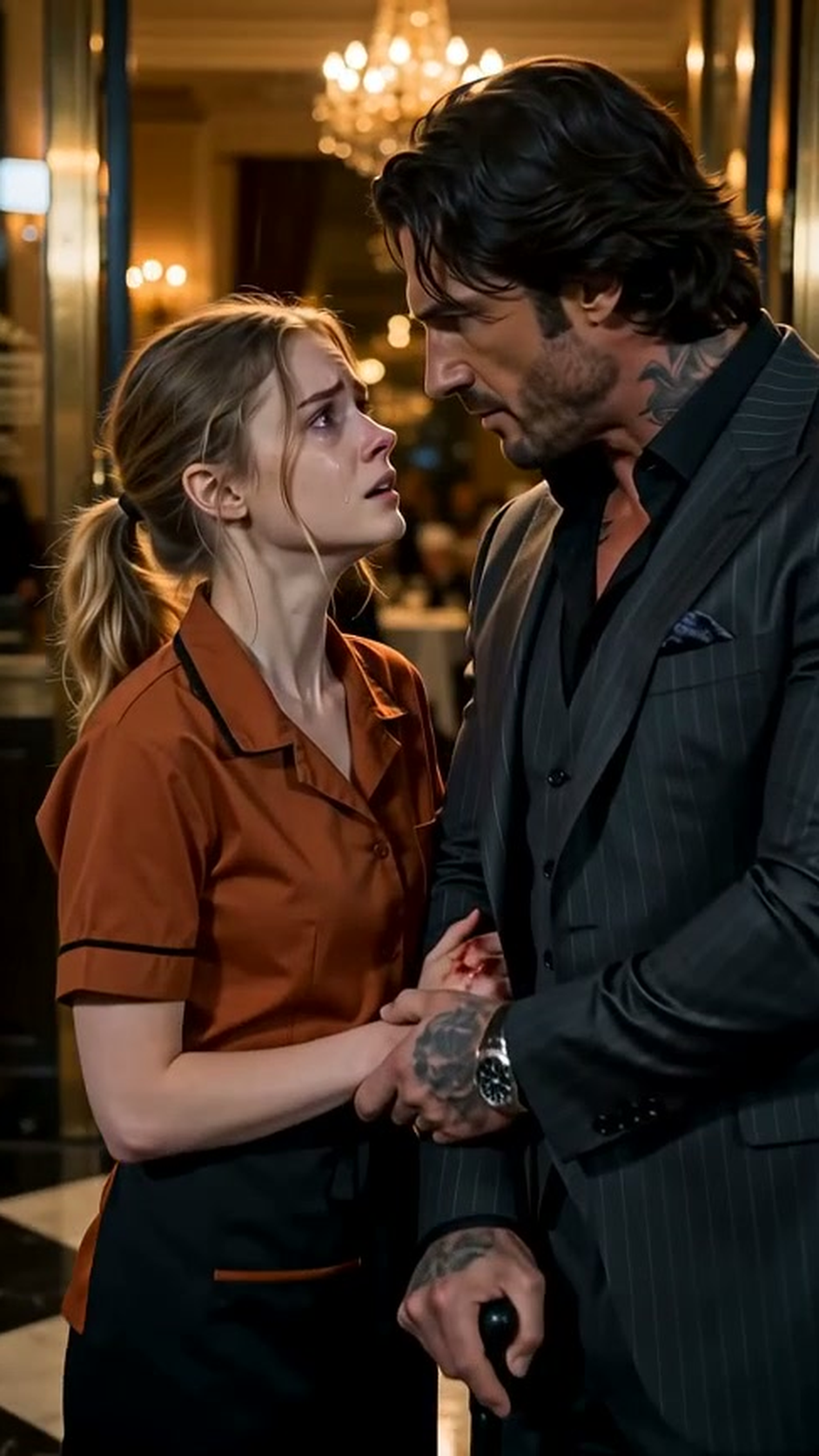
"Name it," Roman said, in the car, with the rain drumming the roof and his ruined leg stretched across the leather and his eyes on her hands, which would not stop shaking in her lap. "Whatever the boy needs. Name it."
Naen stared at him. The car smelled of rain and money. Marco drove like the flooded streets were a personal insult.
"You don't understand," she said. "It's not— I don't need a— it's ninety-four dollars, Roman. That's it. That's the whole catastrophe. Antibiotics, and an inhaler refill, and the fever medicine that works. Ninety-four dollars and change. I was going to earn it tonight. I wasn't asking for—"
"You held my life in your hands for eleven minutes," Roman said, "and you are sitting there apologizing for ninety-four dollars." He leaned his head back against the seat and closed his eyes, briefly, and she saw the pain move across his face like weather over a mountain — and understood that he had been hiding it, every second since the doorway, and was only now, in the dark, in the car, letting himself have it. "Naen. Let me be very clear, because I think nobody has ever been clear with you. I am not offering you charity. I am paying a debt. There is a difference, and the difference is everything. Marco."
"Boss."
"The pharmacy in Astoria. The one on Ditmars. Now."
The pharmacist on Ditmars Boulevard was a tired man named Okafor who knew Naen by name, knew the prescription by heart, and had been quietly keeping it behind the counter for three days past the point his own rules allowed, because he had once watched her count out a copay in nickels without complaining. He saw her come in out of the rain at 8:45 on a Friday night with her apron still on and a six-foot-three man on a cane behind her filling his doorway like a bank vault door, and to his credit he only said, "Walker. You made it."
"She made it," Roman said, and set a black card on the counter with two fingers. "The full prescription. And a spare inhaler. And whatever else a five-year-old with bad ears and a worse chest should have in the house. Spare me the total, just do it."
It came, in the end, to two hundred and eleven dollars. Roman didn't blink. Naen stood there holding the warm white bag — antibiotics, fever reducer, two inhalers, the good cough syrup, a thermometer because Roman had heard Leo's was broken, electrolyte drinks because Roman had apparently decided she was also a patient — and she cried, quietly, in the pharmacy, under the fluorescent lights, over a bag of medicine, which was not a thing she had ever once, in four years of widowhood and poverty, allowed herself to do in public.
"Hey." His voice, gentled down to almost nothing. The cane's handle found, somehow, the job of lifting her chin — no. His hand. His hand, enormous and tattooed, cupping her jaw with a care that broke her worse than the medicine had. "None of that. He's going to have it tonight. That was the promise, wasn't it? You make him a promise every day. Tonight you keep it."
"You remembered that?" she whispered. "I said that in the alley?"
"You said a lot of things in the alley." The gray eyes held hers. "I heard every word. It was the only thing worth listening to."
The doctor met them at the apartment — that was the part that finally convinced Naen she had fallen through the floor of her real life into another one. Not an ER, not an urgent care queue: a soft-spoken pediatrician with a gray braid, Dr. Ives, who arrived at the fourth-floor walk-up ten minutes after they did, summoned by Marco's phone like weather, and who examined Leo on his own bed, in his own dinosaur pajamas, while his mother held the flashlight. Ear infection, both ears, yes. Chest: congested, watch it, not pneumonia, not yet. Medicine measured into a syringe right there. Fever would break by morning.
"And you," Dr. Ives said, packing her bag and fixing Naen with a look over her glasses, "will eat something and sleep, or I'll be treating two of you. He's fine now, Mrs. Walker. He's been fine all along in the way that matters — he's loved like a job." She nodded once at the enormous man standing silent in the doorway of the tiny apartment, cane and all, having his first sight of the whole of Naen Walker's empire: one room and a half, a couch with a Leo-shaped dent, a wall of crayon drawings held up by magnets shaped like fruit. "Whoever you are — make sure she sleeps."
Leo, already floating on the fever medicine, focused with enormous effort on the stranger in the doorway. "Are you a giant?" he asked, with great seriousness.
Roman Castellano, who had made forty diners and one manager forget how to breathe an hour before, considered the question with equal seriousness. "I'm a friend of your mom's," he said. "She helped me today when I got hurt. See?" He shifted the cane. "I have an owie on my leg. Like your ears."
"You gots a stick."
"I gots a stick," Roman agreed gravely, and Leo nodded like a judge and was asleep inside a minute, one small hand still fisted around two of his mother's fingers.
Naen walked the doctor out, and came back, and found Roman Castellano standing motionless in front of Leo's wall.
The drawings covered the patch of wall beside the couch in no order and total order at once: Leo's entire cosmology, in crayon, held up by fruit magnets. A dinosaur of magnificent inaccuracy. The apartment building, recognizable by its being taller than the sun. A stick man with an enormous smile labeled DADA in heaven, with wings, which Leo added to every drawing as other children add clouds. And, in the place of honor at the center, slightly crooked under a strawberry magnet: a woman with a vast orange scribble for a blouse and hair like a scribbled sun, holding the hand of a small boy with a cape, captioned in the wobbling capitals of the recently five: MOMY IS THE HERO.
"Did he—" Roman's voice was strange, roughened in a way that had nothing to do with his wounds. "He drew this recently?"
"Last month. His class did 'heroes in our families.' The teacher called me. She said—" Naen had to stop and manage her face, a skill the day had worn thin. "She said all the other kids drew firefighters and Spider-Man, and Leo stood up and said his mom was the hero because she fights the fevers. He didn't— I didn't know he thought about it like that. He's five. He's supposed to think I'm the lady who makes the nuggets."
"You are the hero," Roman said quietly, still looking at the wall. "The boy's evidence is better than most I've acted on."
Later she would remember that he asked about Thomas before he asked about anything else — not the way men in his position ask, collecting a person's weak places, but standing at her stove with the kettle beginning to knock, saying only: "The ring. On the chain. Tell me about him — only if it doesn't cost you. I'm learning what things cost you."
So she told him, in pieces, the way you hand someone something breakable: Thomas the paramedic, Thomas of the terrible jokes and the huge soft hands, the ice on the BQE, the two state troopers at the door at 2 a.m. with their hats in their hands, so kind, so rehearsed. Leo had been eleven months old. He had learned to walk, that winter, holding the leg of the couch in the spot where the drawing wall was now. "I used to think the worst thing was that he wouldn't remember him," she said. "Now I think — maybe it's a mercy. He only knows him from the wings on the drawings. He thinks heaven is a place his dad works. Like shifts." She turned the ring on its chain, once, an old gesture. "I keep the pressure on things, Roman. That's my whole — that's what I'm for. Since I was twenty-two. Somebody bleeds, I hold it. Somebody's feverish, I hold it. The rent, the job, the — I just hold everything and don't let go and don't—" She stopped, appalled at herself; she had never said any of this aloud to anyone, not even Mrs. Delgado, not even at the funeral to the priest.
"And who," Roman said, very gently, into the sound of the kettle coming up to the boil, "holds you?"
Naen walked the rest of the way into her kitchen — six feet of counter and a stove — and looked at the most dangerous man in New York making tea, and did not have an answer, and the silence where the answer should have been said everything to both of them. He had found the kettle. He had found, God help her, the good mugs, the ones without chips. He moved around her poverty with his cane and his bandaged leg and a strange, absolute care, as though it were a place that mattered.
"Roman." She folded her arms to hold herself together. "The car across the street. The men who did that to you. Marco. The file your people built on David in forty minutes. A doctor who comes because you phone." She made herself say it. "I need you to tell me who you are. All of it. Not the restaurant part."
He set the tea down. He didn't insult her by pretending not to understand, and he didn't insult her by lying — which, she understood later, was the moment, the true moment, before all the others, that she began to be lost.
"My name is Roman Castellano," he said. "My family has owned businesses in this city for sixty years. Some of them are restaurants." His eyes didn't leave hers. "Some of them are not. The men in the alley today work for a family called Sorin, who want the docks my grandfather built, and thought putting me in the ground would be a shortcut. They were wrong. I keep what is mine, Naen. I protect what is mine." A pause, in which the kettle ticked and Leo breathed, small and steady, in the other half of the room. "And as of today, whether you like it or not — you and that boy are standing inside the fence of what is mine. Because of eleven minutes. Because you didn't run."
"I don't want to be inside anyone's fence," she said, but her voice had no force in it, because her son was asleep with medicine in him, and there was tea, and nobody had been kind to her in the doorway of the world in a very long time.
"I know," Roman said. "That's why nobody else gets to decide about you. Not anymore."
At that same hour, in a rented room in Bayonne with his personal effects in two courier boxes and nine years of humiliation fermenting into something chemical, David Kesler made a phone call. He had spent the evening inventorying what he knew, the way a drowning man inventories the furniture: a waitress. An alley. A name — Walker. A sick kid, in Astoria, in a building he could find, because hadn't she once begged him for an advance against a rent check, with the address right there on the form?
"A woman answered the floor phone once," he told the man who finally picked up, on the fourth ring, in a voice like gravel in a bucket. "Kesler. Formerly of Laura. I have something the Sorin family wants. I have the girl who saved Castellano — where she lives, and what's sleeping in the next room. It'll cost you. And when it's done—" his hand tightened on the phone until it creaked, "—I want to watch."