Christmas Eve came in with snow and church bells.
Sophia woke before anyone else in the house, the way she always did on Christmas Eve, and she lay in her bed for a while listening to the bells from the church at the end of the street, and then she got up and went to the window, and the whole world was white, and the garden was white, and the oak tree was white, and the stone paths had vanished under a smooth white skin, and somewhere in the distance a dog was barking at the snow.
She dressed quickly, because today was the day, and she had a plan, and plans do not wait for anyone. She put on her warmest dress, and her thickest tights, and her red mittens, and she went downstairs to the kitchen, where Rosa was already at work and Macy was already washing dishes, and the whole kitchen smelled of cinnamon and oranges and fresh bread.
"Good morning, little one," Rosa said, without looking up from the dough she was kneading. "Happy Christmas Eve. Now go and wash your hands, and then you can help Macy with the pies."
Sophia washed her hands, and she helped Macy with the pies, and she was very good at helping, because she had been helping for three weeks now, ever since the day she had cut the star, and she knew exactly how to roll the pastry and exactly how much filling to put in and exactly where to put the little pastry stars on top. Macy watched her with a smile, and Rosa watched them both with a smile, and for a little while the kitchen felt like the warmest room in the whole world.
But the warmth did not last. At noon, Rosa came into the kitchen with her coat on and her basket on her arm, and she said, "I am going to the market for the last of the shopping. Macy, you are in charge of Sophia until I get back. Keep her in the nursery until bedtime, and do not let her near the study wing. Her father has given his orders, and I do not want any trouble today."
Macy nodded, and she stood up a little straighter, because being in charge was a big responsibility, and she wanted to do it well. "Yes, Rosa. I will keep her in the nursery. I promise."
Rosa looked at her for a moment, and then she looked at Sophia, who was sitting on the counter with flour on her nose, swinging her legs, and looking as innocent as a child possibly can, and Rosa said, in the voice she used when she was giving an order that was not to be questioned, "Sophia. You will stay in the nursery with Macy. You will not go to the study. You will not disturb your father. Do you understand me?"
Sophia nodded, and her blue eyes were wide and solemn, and she said, in the clearest voice she had, "Yes, Rosa. I understand."
Rosa did not believe her. Rosa had been raising this child for five years, and she knew that look, and she knew that voice, and she knew that when Sophia said "I understand" in that particular way, it meant that Sophia understood perfectly well and was going to do exactly what she had planned to do anyway. But Rosa was late for the market, and the shopping would not wait, and so she put on her coat and she went out into the snow, and she left Macy in charge, and she hoped, with all her heart, that she was wrong.
She was not wrong.
After lunch, when the pies were in the oven and the kitchen was warm and quiet, Macy took Sophia up to the nursery, as she had been told to do, and she sat her down with her dolls and her picture books, and she said, "Now, little one, you stay here and play, and I will be just downstairs in the kitchen, and if you need anything, you call me, all right?"
Sophia nodded, and she picked up her favorite doll, and she began to play with it, very quietly, very obediently, and Macy, who was relieved that the little girl was being so good, went back downstairs to the kitchen, where the Christmas puddings needed to be carried in from the pantry and the table needed to be set for the staff supper.
But Sophia was not playing with her doll. She was waiting. She waited until she heard Macy's footsteps go down the stairs and into the kitchen, and then she waited a little longer, until she heard the clatter of the pudding basins and Macy's voice humming a Christmas carol, very softly, to herself. And then she put down her doll, and she stood up, and she walked, very quietly, to her wardrobe.
She had hidden the box at the back of the wardrobe, behind her winter coats, where nobody would ever think to look, and she took it out now, carefully, with both hands, and she looked at it for a moment — the brown paper, the gold ribbon, the bow that leaned to one side — and she smiled, because it was the most beautiful present in the whole world, and because today, at last, she was going to give it to her father.
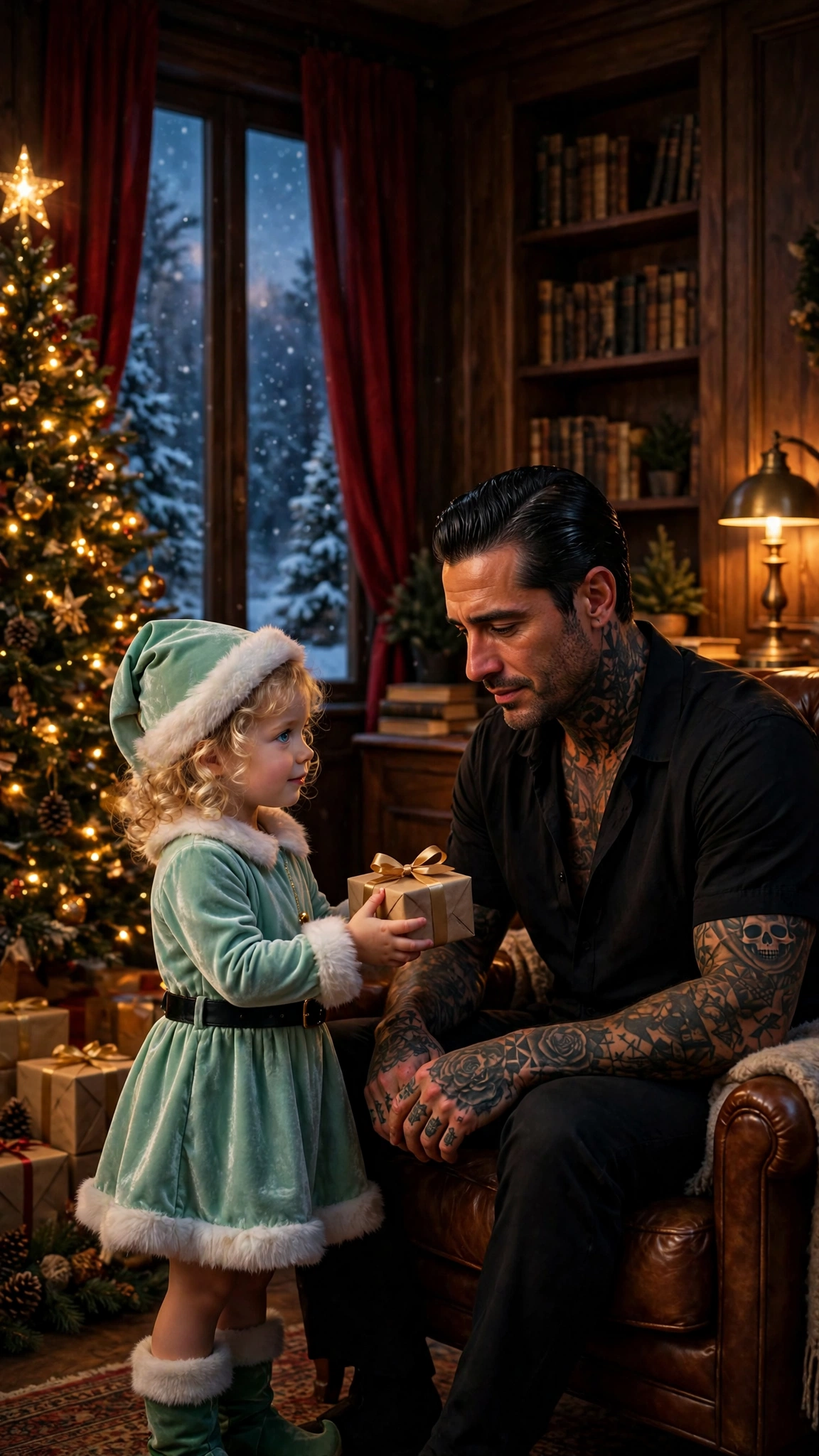
But she could not go to the study in her dress. Her father had given his orders, and Rosa had given her orders, and the whole house knew that the study wing was forbidden. So Sophia did the cleverest thing she could think of. She went to the nursery cupboard, where the costumes for the staff's little nativity play were kept, and she took out the elf costume that Macy had helped her try on the week before — the mint-green velvet dress with the white fur trim, and the black belt with the gold buckle, and the green elf hat with the white fur trim, and the green boots with the white fur trim — and she put it on, quickly, over her dress, because an elf, she reasoned, was exactly the kind of person who was allowed to go into a study on Christmas Eve and give a sad man a present.
She looked at herself in the nursery mirror. The hat sat crooked on her blonde curls, and the dress was a little too long, and the boots were a little too big, but she looked, to her own eyes, exactly like Christmas itself, and she nodded at her reflection, and she picked up the box, and she slipped out of the nursery, and she went down the hallway on tiptoe, past the doors that led to the main staircase, and around the corner to the back stairs.
The back stairs were narrow and dark, and they smelled of polish and old wood, and they went down the back of the house in a steep, winding flight, past the linen cupboard and past the pantry and past the little window that looked out over the garden. Sophia knew them well. She had discovered them when she was three years old, chasing a cat that had gotten into the house, and she had used them ever since, whenever she wanted to go somewhere without being seen. They were her secret, and they were the reason she had told her father, with such confidence, that the stairs did not squeak — because she had tested every single one of them, a hundred times, and she knew exactly which ones to step on and which ones to skip.
She went down the back stairs now, one careful step at a time, with the box held tight against her chest, and she came out at the bottom, in the little hallway that led to the study wing, and she stopped, and she listened.
The house was quiet. The kitchen was far away, at the other end of the house, and Macy was still in there, humming her carol, and Rosa was still at the market, and her father was in his study, alone, with the door closed, and nobody in the whole world knew where Sophia was.
She walked down the hallway, past the portraits of men she did not know, past the tall clock that ticked in the corner, past the door of the music room, which had been closed for two years, and she stopped outside the study door.
The study door was tall and dark, and it was closed, and from behind it came no sound at all — no telephone, no papers, no footsteps, nothing. Just silence, and the faint smell of wood smoke from the fire inside.
Sophia stood there for a long time, with her small hand on the door handle, and she thought about her father's face, and Macy's frightened face, and the tree in the study that nobody was allowed to celebrate, and the star in the box, and the words she had written on the back of it in green crayon, and she felt her heart beating very fast in her chest, the way it beats when you are about to do the bravest thing you have ever done in your life.
And then, in the kitchen at the other end of the house, Macy came back from the pantry with the Christmas puddings in her hands, and she looked up at the clock, and she realized how long she had been gone, and she ran up the stairs to the nursery, two at a time, to check on Sophia.
The nursery was empty.
The doll lay on the floor where Sophia had dropped it. The picture books were scattered on the rug. The wardrobe door stood open, and the winter coats had been pushed aside, and the elf costume was gone from the cupboard, and Macy, standing in the middle of the empty room with the Christmas puddings still in her hands, understood, all at once, exactly what had happened.
"Oh no," she whispered. "Oh no, oh no, oh no."
She put down the puddings, and she ran out of the nursery, and down the stairs, and through the house, looking in every room, calling Sophia's name in a voice that got higher and more frightened with every room she checked. She looked in the kitchen, and the sitting room, and the dining room, and the ballroom, and the little room where the Christmas decorations were kept, and Sophia was not in any of them.
And then Macy stopped, in the middle of the great hallway, with her heart pounding in her chest, and she looked toward the far end of the house, toward the dark corridor that led to the study wing, and she understood, with a cold, sick feeling in her stomach, exactly where the little girl had gone.
Her father had given his orders. Rosa had given her orders. And Macy had been put in charge, and she had failed, and the little girl she was supposed to be watching was walking, at that very moment, toward the one room in the whole house she had been forbidden to enter, carrying a present for the most feared man in Chicago.
Macy did not think. She ran. She ran down the hallway, past the portraits and past the tall clock, toward the study wing, her apron flying behind her, her shoes loud on the polished floor, and she prayed, with every step, that she would get there in time.
But she was too late. By the time she reached the end of the corridor, Sophia Moretti had already put her small hand on the study door handle, and the door was already opening, an inch at a time, and the little girl in the elf costume was already stepping into the room where her father sat alone in his leather armchair, with the Christmas tree burning gold behind him and the snow falling past the windows and a glass of whiskey in his hand that he had not touched.