"911, what's your emergency?"
I knew the voice. Of all the shifts, of all the consoles — I knew the voice the way you know a song from your wedding.
"Dana," I said. "Dana, it's Laura. Log this like a call, baby, please. Log it exactly like a call."
There was a half-second — I heard her whole body change on the other end of the line — and then Dana Whitfield, who had held my bouquet and taught my daughter to whistle, went flat and professional and perfect. "Go ahead, Laura. I'm recording. Give me your location."
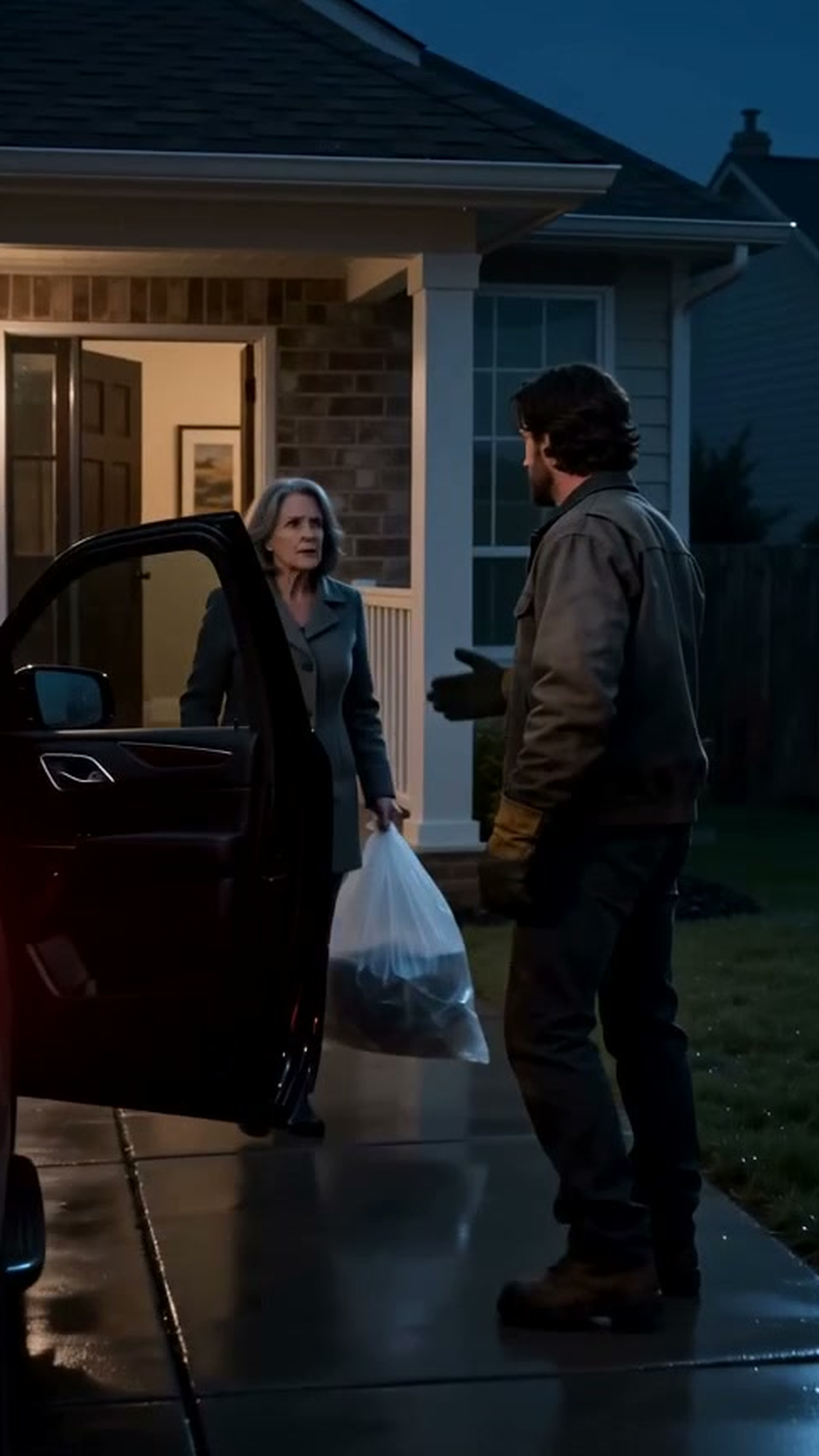
"Fourteen-twelve Sycamore Bend, Katy. My address. My husband is on my back patio with a gasoline can and a crowbar. He's forced the back door once. The house has a tampered gas line — do not let fire stage inside, tell them the structure is charged with gas—" Rain spotted the windshield. Two houses down, in the white spill of our security light, Mark had raised his gloved hand to his mother like a man greeting a colleague at a job site, and Evelyn stood by her open car door with that heavy bag swinging against her leg, and I heard my own voice drop to a whisper I couldn't stop: "His mother just arrived. Dana. They're doing this together."
"Units are rolling, Laura. Harris County sheriff, two minutes out, fire behind them. "Stay in the vehicle. Do not approach. Laura — do not approach the house."
"Stay on with me," I said. "Dana. Stay on the line till they're on scene. Whatever happens — stay on, so it's all on the recording."
"I'm not going anywhere." I heard the shift change in her voice, the sound of a woman settling in at a console like a pilot at a stick. "You're on the big board, Laura. I've got your location sharing up on my second screen and it is the steadiest thing in this county. You just keep talking to me. Tell me what you see, in order, like you taught me. Facts, partner. Give me facts and I'll give you sirens.""
"I hear you."
"Say it back."
"I stay in the vehicle," I said. What I didn't tell Dana — what she would have heard in my voice anyway, because we were trained by the same woman — was that with my other hand I was wedging my phone upright against the windshield, camera open, recording. The rain, the light, the red can on the walkway, my husband's work gloves: whatever happened on that patio was going to exist somewhere besides my memory. A dispatcher learns it in her bones. Calls get recorded because people, afterward, remember what they can survive remembering. Machines remember the rest. I pointed my phone at my own front yard like a woman planting a flag, and then I reached for Lily and gathered her against me, because through the rain I'd seen Mark cross the wet grass toward his mother, seen him extend his gloved hand toward the bag, seen his fingers open—
And that was when Lily, who had been silent since the airport, who had done everything right, saw her grandmother's face in the headlights and forgot — or remembered — everything at once.
"GRANDMA!" The car window beside her was cracked two inches for air, and her voice went through it like a bell through fog. "GRANDMA, NO! DON'T HELP HIM! GRANDMA!"
Evelyn's head came around so fast the bag swung wide on her wrist.
What I saw on my mother-in-law's face in that second is the hinge my whole life turned on. Not guilt. Not fear of being seen. Recognition — the face of a woman who had been telling herself for six weeks that this was paperwork, that it was a fire in an empty house, that it was insurance, that no one — no one — was actually going to be inside it. And now here, in the rain, in the flesh, was the actual child. Screaming her name. Through a car window. Two houses from the furnace her son had opened like a throat.
Evelyn pulled the bag back against her body with both arms, the way you'd shield a child, and stepped — I watched her decide it with her whole body — between Mark and the back door of my house.
"Mom." Mark's voice carried in the wet air, reasonable as weather. "Mom. Give me the bag."
"No."
It was the smallest word of my whole life and it landed like a door slamming. I had heard Evelyn Bennett say no to waiters, to pastors, to the church roof fund, in the bright social register of a woman denying nothing of consequence. This no came from somewhere under the ribs. Mark heard the difference too — I watched his shoulders change. What crossed the wet lawn between them in that moment was thirty years of a shared secret doing the work it had always done: he didn't raise his voice. He lowered it, the way you lower a weapon.
"You remember the stairs, Mom." Soft. Almost kind. "You remember what you told the deputy. You remember who cleaned the railing. Now — you want Laura to know that? You want Lily to know that? Give me the bag, and nobody ever has to know anything. That's still the deal. It's always been the deal."
I did not understand the words then. I understood the shape of them — a leash, pulled — and I understood Evelyn's answer better: she clutched the bag tighter and took one step backward, toward the street, toward my daughter's voice, away from her son, in the rain, in front of witnesses, for the first time in three decades.
"Evelyn—" He stepped closer. The crowbar was still in his left hand. "We talked about this. All of it. You know what happens if we stop now. You know what he does to both of us."
"I know what you're doing now," Evelyn said, and her voice rose out of her, huge and cracking, sixty-two years of swallowing arriving all at once. "Get away from that door, Mark. GET AWAY FROM THAT DOOR. LAURA — RUN! LAURA, HE'S GOING TO—"
Mark wrenched at the bag. It tore out of her hands and hit the wet concrete with a sound I felt in my teeth — glass, metal, weight — and Evelyn stumbled back against the door of her car and caught herself on the mirror, and her son turned on her with the crowbar coming up—
—and I screamed his name. I don't remember choosing to. It tore out of me the way Lily's had torn out of her, one word, the first word of our whole marriage: "MARK!"
He stopped. In the white glare of the security light, with the crowbar arrested in mid-air and the rain striping through the light like wire, my husband turned his head and found me — found the SUV he hadn't counted, found the phone at the windshield with its red recording eye, found his wife, alive, upright, unwitnessed by no one, at the end of the street he had arranged like a stage set for an audience of insurance adjusters. I have been asked since, by Ruiz, by Dana, by my own 3 a.m. self, what his face did in that second. It did the plainest thing a face can do. It recalculated. I watched the arithmetic fail in real time: the wife who was supposed to be a body in a burned house, reclassified before his eyes into the one category his paperwork had no form for — a witness. "Laura," he said — I read it more than heard it, across the wet grass, his mouth shaping my name like a man who has just found a load-bearing error in a structure he built himself — and whatever he would have done next, to his mother, to the door, to me, the morning took out of his hands entirely—
—and the street filled with light.
They came from both ends, the way Dana would have sent them: two Harris County units silent through the rain and then suddenly all siren and floodlight, and a deputy's voice over the loudspeaker flattening the whole street: "SHERIFF'S OFFICE. DROP THE TOOL. DROP IT NOW."
Mark Bennett stood in my flooded driveway in his work jacket with a crowbar in his hand and a red gasoline can at his feet and his mother's bag burst open on the concrete — and I watched him do the arithmetic of his whole life one last time, and lay the crowbar down in the wet grass like a man setting a table.
Lily and I were out of the SUV before I knew I'd moved. A deputy with a rain-slick poncho took her from my shaking arms — gently, so gently — and another one wrapped a blanket around shoulders I hadn't known were cold, and behind us the fire crews came up the street at a run with meters in their hands, and stopped at my front walk, and read the air of my home, and did not go in.
The captain found me twenty minutes later under the Abernathys' porch, where half the street had gathered in robes and rain boots. He was young, with a soot-smudged jaw, and he took his helmet off before he spoke to me, which is how I knew.
"Ma'am. The flex line on your furnace was backed off two full turns. Gas has been pooling in the attic space since sometime last night. Your husband texted you at 08:13 — my lieutenant showed me." He glanced at Lily, asleep at last against Dana — Dana, who had left the console the second her shift supervisor heard the address, who had driven through the rain to hold my daughter so I could watch. "If you'd gone home this morning, ma'am. If you'd walked in there and turned on that heat the way he asked— the thermostat's an ignition source. The whole structure—"
"I know," I said. "I know what it was."
A paramedic checked Lily under the porch light — pupils, pulse, the soft questions they ask children about their names and their foxes — and pronounced her unhurt, which I already knew and needed to hear from a stranger in uniform anyway. A deputy took my first statement standing in the Abernathys' garage with a body camera blinking red on his chest, and I gave it the way I'd been taught to receive them: times, directions, facts in order, no adjectives. 08:04, terminal. 08:13, the text. 08:41, the can. When I got to the words turn on the heat my voice did something it had not done all morning, and the deputy, who was maybe twenty-five, said "Take your time, ma'am" with a gentleness that told me he was somebody's good son, and I finished the statement, and signed it, and it is still the most orderly thing I have ever produced while coming apart.
Mark went past us then, between two deputies, on his way to the second cruiser. His work jacket was dark with rain. His gloves were gone, bagged. He looked at me — not at Lily, never again at Lily, I would have come off that porch if he had — he looked at me with the expression of a man whose arithmetic had been interrupted by weather, and he said, quite calmly, "You were supposed to go home, Laura," as if the whole morning were a scheduling error I had made. The deputies put him in the car before I could decide what my hands wanted to do, and Dana — who had arrived in her own car with her headset still around her neck and her console abandoned mid-shift, who had taken my daughter out of the rain and into her arms like a transfer of sacred property — Dana said, from behind me, at exactly the right volume: "Let the record show he said that." And the closest deputy, without smiling, said, "Ma'am, the record shows everything on this street."
From the far end of the street, handcuffed in the rain beside her own car, her gray-brown hair plastered flat and her charcoal coat black with water, Evelyn Bennett was watching me. And as they turned her toward the cruiser she spoke — not to the deputies, not to her son in the other car. To me. Across forty feet of wet pavement and the ruin of everything:
"Laura. The bag. Don't let them just—" Her voice broke. "There's something in the bag. You make them open the bag."