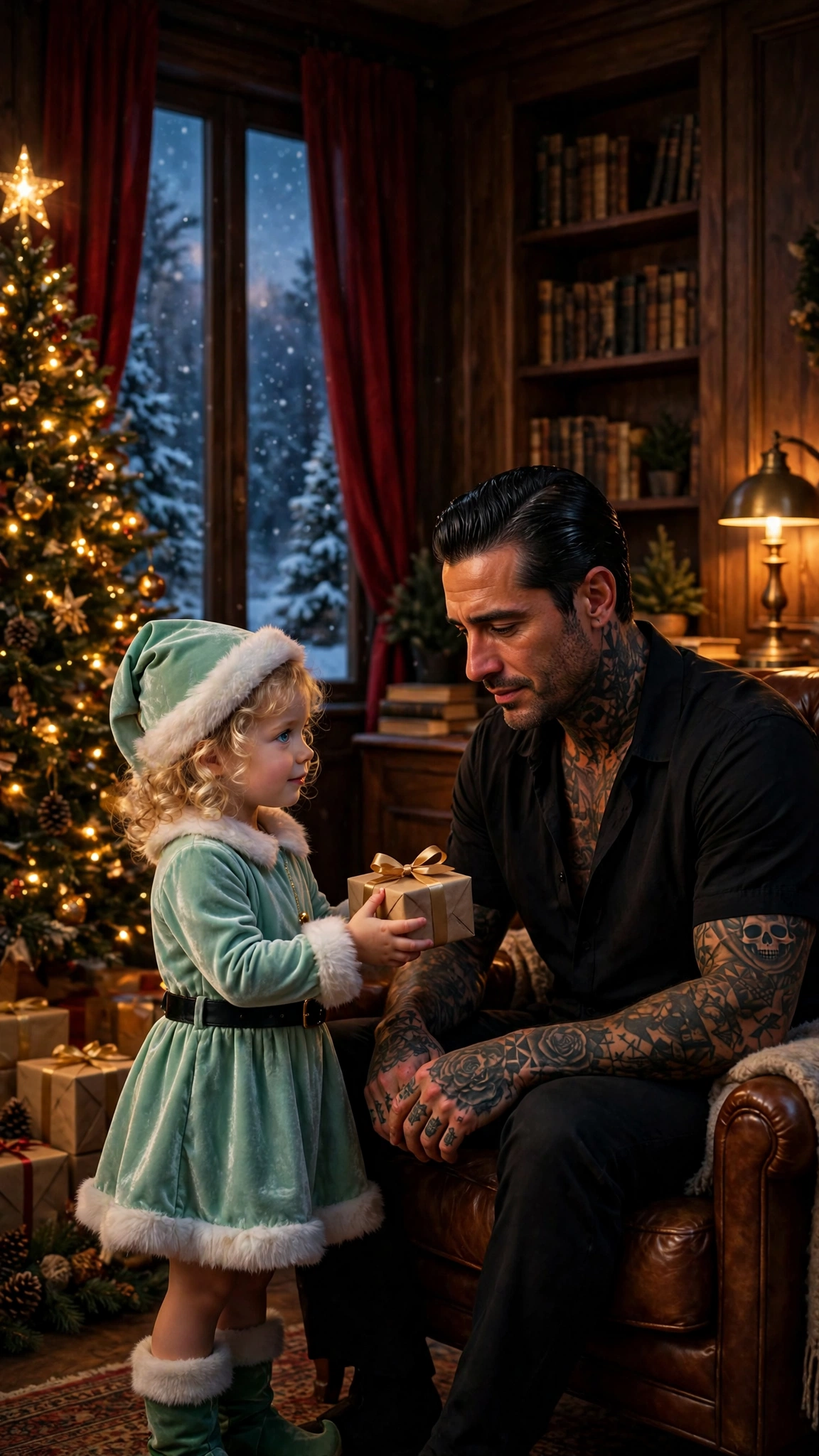
The study was warm, and it was dark, and it smelled of wood smoke and old books and the pine of the Christmas tree, and for a moment Sophia stood in the doorway and did not move at all, because the room was so beautiful, and so quiet, and so full of her father's sadness that she could feel it in the air, like the cold coming off the windows.
Her father sat in the brown leather armchair by the fire, with a glass of whiskey in his hand that he had not touched, and he was staring at nothing at all, and the Christmas tree in the corner burned with small golden lights, and beneath it the presents lay in their paper and ribbon, untouched, and the snow fell past the tall windows in slow, fat flakes, and the red curtains hung still on either side of the glass.
Sophia took one small step into the room, and then another, her green boots silent on the thick rug, and she stopped in front of his armchair and held the box out toward him with both hands.
"Please don't be sad anymore," she said.
Lorenzo looked up.
He had been sitting alone in the dark for hours, and he had told the whole house not to disturb him, and he had meant it, and now his five-year-old daughter was standing in front of him in an elf costume, holding out a present, and telling him not to be sad anymore, as if sadness were a coat he could simply take off and hang up by the door.
For a moment he could not speak at all. He set his whiskey glass down on the small table beside the chair with great care, the way a man might set down something that could break, and he leaned forward, his tattooed hands resting on his knees, and he looked at her — really looked at her, the way he had not looked at anyone in a very long time.
"Who let you in?" he asked, and his voice was quiet, but it was the voice of a man who is used to being obeyed, and the room seemed to get a little smaller around the sound of it.
Sophia looked at the door behind her, and then back at her father, and she said, in the clear, matter-of-fact voice of a child who has decided to tell the truth and be done with it, "The stairs."
"The stairs," Lorenzo repeated.
Sophia nodded. "The back stairs. The ones that don't squeak."
Lorenzo almost smiled. He did not know the back stairs did not squeak. He had never used the back stairs in his life. But his daughter, it seemed, knew his house better than he did, and she had used that knowledge to do the one thing he had forbidden anyone to do, which was to come into his study on Christmas Eve and disturb him while he sat alone with his sadness.
He looked at the box in her hands.
"What is that?" he asked.
Sophia held it out a little further, and her blue eyes were earnest, and there was nothing in them but honesty and hope.
"I made this just for you," she said.
Lorenzo took the box from her. It was light in his hands, lighter than he had expected, and the gold ribbon was tied in a bow that leaned to one side, and the brown paper was creased at the corners where small fingers had folded it too many times. He turned it over once, slowly, and he looked at his daughter, and he saw that she was watching his face the way a child watches a candle, waiting to see if it will catch.
Behind her, in the doorway, someone cleared their throat.
Rosa stood there, the housekeeper, her dark hair pulled back in its neat bun, her black-and-white maid uniform crisp, her white apron bright against the dark wood of the hallway. She had come back from the market to find the house in an uproar, and Macy running through the hallways calling Sophia's name, and she had followed the sound of the running feet to the study wing, and now she stood in the doorway with one hand pressed flat against her chest, and her face was pale, and behind her, half-hidden in the shadows of the corridor, stood Macy, the young kitchen maid, nineteen years old and new to the house, her hands twisted together in front of her apron, her eyes wide with terror.
Lorenzo looked from Rosa to Macy, and his face went still in the way it went still when he was deciding something, and Macy, who had been afraid of him since the first day she had come to work in this house, took one small step backward, as if the floor itself might open up beneath her.
"Macy!" Lorenzo said.
Macy flinched. She came forward one step, and then another, her knees shaking so hard that Rosa put a steadying hand on her shoulder, and she stopped in the doorway of the study with her head bowed, waiting for the words she was certain were coming, the words that would send her out of this house and back to the cold streets with no wages and no reference and no hope at all.
Lorenzo looked at her for a long moment. Then he looked down at the small box in his hands, and at his daughter in her elf costume, and at the Christmas tree burning gold in the corner of the room, and something in his face changed — not much, and not all at once, but enough that Rosa, who had worked in this house for twenty-two years and had seen every face her employer owned, drew in a sharp breath and held it.
"You're not fired," Lorenzo said.
Macy stared at him. Rosa stared at him. Sophia, who did not understand what fired meant but understood perfectly well that something good had just happened, smiled for the first time since she had come into the room.
"Thank you, sir," Macy whispered, and her voice shook, and her eyes filled with tears, and she pressed her hands together in front of her apron as if she were praying. "Thank you. I will never let her out of my sight again, I promise, I swear it on my mother's life."
Lorenzo did not answer her. He was looking at the box again, turning it over in his tattooed hands, and Rosa, who knew him better than anyone alive, saw something in his face that she had not seen in two years, and she quietly took Macy by the arm and led her back out into the hallway, and she closed the study door behind them, very gently, leaving the father and the daughter alone in the firelight with the Christmas tree and the snow and the small brown box with the leaning gold bow.
"Sit with me, little one," Lorenzo said, and he lifted Sophia up onto his lap, into the big leather armchair, the way he had done when she was very small, before her mother died, before everything went quiet. She settled against his chest, small and warm, her elf hat crooked on her blonde curls, her green boots swinging above the rug, and she watched his face as he untied the gold ribbon, slowly, carefully, as if the ribbon itself were precious.
He lifted the lid. And then he stopped.
Inside the box, nestled on a bed of white tissue paper, lay a star.
It was a small star, cut from paper, painted gold on both sides, with five points, one of them a little shorter than the others, one edge a little crooked. It was not perfect. It was not the kind of star you could buy in a shop. But it shone in the firelight like a small piece of the sun, and Lorenzo Moretti, the most feared man in Chicago, looked at it the way a man looks at a ghost.
He turned it over. And on the back, in big, careful, wobbly letters, written in green crayon, were the words:
FOR DADDY
Lorenzo stared at the words for a long time. Then he turned the star over again, and he looked at the gold paint, and he saw, beneath the gold, the faint dark lines of the notes showing through, and he saw the shape of the page it had been cut from, and all at once he understood, and his breath caught in his chest, and his hands began to shake.
"Sophia," he said, very quietly. "Where did you get this? Where did you get the paper?"
Sophia looked up at him, and her blue eyes were wide and earnest, and there was nothing in them but honesty.
"Mummy's music box," she said. "It was inside, under the velvet. The song is called 'Silent Night.' Mummy used to play it. I cut the star out of the song, Daddy. I painted it gold. I made it just for you."
Lorenzo closed his eyes.
He could see her. Elena, sitting at the grand piano in the music room, her blonde hair falling forward over her shoulders, her hands moving over the keys like birds over water, playing "Silent Night" on Christmas Eve while the snow fell past the windows and the whole house went quiet to listen. He could see the pencil marks in the margins of the sheet music, the little circles and stars she had drawn, the marks of a woman who had played this song a hundred times and loved it more every time. He could see her laughing, and turning the page, and looking up at him in the doorway with her arms crossed and her eyes closed, listening to the last notes die away.
And he could see, too, the morning she had died, and the silence that had come after, and the two long years of silence that had followed, and the closed door of the music room, and the tree nobody celebrated, and the glass of whiskey he had not drunk, and the sadness he had carried around like a stone in his chest, everywhere he went, every day, for two years.
His daughter had cut a star out of his dead wife's favorite song, and painted it gold, and written "For Daddy" on the back in green crayon, and brought it to him in the dark, on Christmas Eve, because she wanted him not to be sad anymore.
Lorenzo Moretti opened his eyes, and he looked down at the small blonde girl in the elf costume sitting on his lap in his leather armchair, and he did something he had not done in two years.
He wept.
He did not weep loudly. He did not sob, or shake, or make a sound at all. The tears simply came, silently, down his face, and fell onto the gold star in his hands, and Sophia, who had never seen her father cry before, reached up with one small hand and wiped a tear away with her thumb, the way Rosa wiped away her tears when she was sad, and she said, in a very small, very brave voice, "Don't cry, Daddy. It's all right. Mummy is in the music. Rosa says so. Whenever you hear the piano, that is her, singing to you."
Lorenzo held her then, properly held her, both arms around her small warm body, his face pressed against her blonde curls, breathing in the smell of her hair, which smelled of cinnamon and soap and cold air, and he held her for a long time, while the fire burned low in the grate and the Christmas tree burned gold in the corner and the snow fell past the windows, soft and steady, covering the whole white world outside.
"I am not sad anymore," he said, at last, and his voice was rough, and it shook a little, but it was true, or as true as anything had been in two years. "Not tonight, little one. Not tonight."
Sophia smiled, and she snuggled closer against his chest, and she closed her eyes, and within minutes she was asleep, her elf hat slipping sideways over one ear, her small hand still curled around the edge of his black shirt, and Lorenzo sat there in his leather armchair with his daughter asleep on his lap and the gold star in his hand, and he looked at the Christmas tree, and at the snow, and at the fire, and he thought about the woman he had lost, and the child he had kept, and the song that had brought them both back to him, and he knew, with a certainty that settled in his chest like warmth after a long cold, that something in this house had changed tonight, and that it was never going to go back to the way it was before.