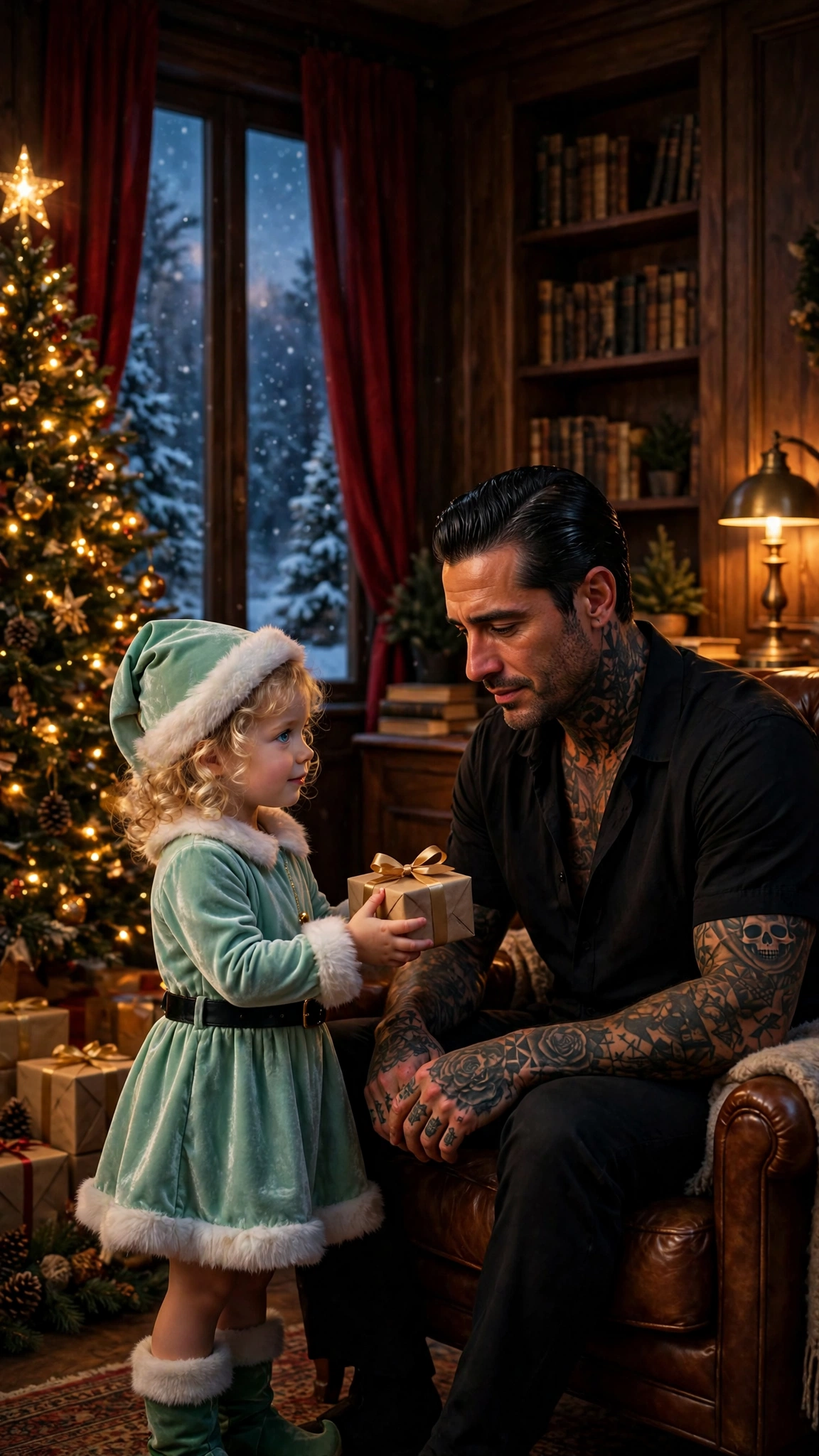
Rosa came for Sophia just before midnight.
She came quietly, the way she did everything, and she stood in the doorway of the study for a moment, looking at the two of them — the big man in the black shirt asleep in his leather armchair with his daughter curled against his chest like a small warm animal, the gold star still in his hand, the fire burned down to embers, the Christmas tree burning gold behind them — and she felt something in her own chest loosen, something that had been tight there for two years, and she smiled, and she wiped her eyes with the corner of her apron, and she went to wake the child as gently as she could.
"Come along, little one," she whispered, lifting Sophia into her arms. "Time for bed. Your father needs his sleep, and so do you."
Sophia murmured in her sleep, and her small hand tightened for a moment on Lorenzo's shirt, and then it loosened, and Rosa carried her out of the study and up the stairs to her room, and Lorenzo sat alone in his armchair for a long time, with the gold star in his hand, looking at the fire and the tree and the snow, and thinking about the woman he had lost and the child he had kept and the song that had brought them both back to him.
And then he stood up, and he put the gold star carefully on the small table beside the chair, and he walked out of the study, down the dark hallway, past the portraits of men he did not know, past the tall clock that ticked in the corner, and he stopped outside the door of the music room.
The music room door had been closed for two years.
Lorenzo had closed it himself, on the day Elena died, and he had not opened it since, and the staff had learned, very quickly, never to go near it, never to dust it, never to speak of it. It was the one room in the house that belonged to the past, and Lorenzo had kept it that way on purpose, because opening it would have meant remembering, and remembering hurt too much, and he had decided, a long time ago, that it was easier not to remember at all.
But tonight was different. Tonight his daughter had cut a star out of his dead wife's favorite song and brought it to him in the dark, and tonight he had wept for the first time in two years, and tonight something in his chest had loosened, the way something in Rosa's chest had loosened, and he stood outside the music room door with his hand on the handle, and he thought about the last time he had been in that room, and he opened the door.
The music room smelled of dust and old wood and something else, something faint and sweet that he could not name at first, and then he knew what it was: Elena's perfume, still in the curtains after two years, still in the air, as if she had only just left the room.
The grand piano stood in the middle of the floor, black and shining, its lid closed, its keys covered, exactly as it had been on the day she died. Lorenzo walked to it slowly, his footsteps loud in the silent room, and he lifted the cover from the keys, and he ran one tattooed hand over them, very lightly, and the keys were cold under his fingers, and he thought about her hands on those same keys, moving like birds over water, and he closed his eyes, and for a moment he could hear her playing, as clearly as if she were sitting beside him.
He opened the piano bench.
He did not know why he did it. He only knew that Elena had always kept her music in the bench, in neat stacks, tied with ribbon, and that he wanted to see it again, to touch something she had touched, to be close to her in the only way he still could.
The music was there, just as she had left it — the Chopin, and the Bach, and the little book of Christmas carols with the red cover, worn soft at the edges from a hundred years of hands. And on top of the pile, where it had not been before — or where he had never noticed it before, because he had never looked — lay a single white envelope, sealed with wax, with his name written across the front in Elena's looping handwriting.
LORENZO
Beneath his name, in smaller letters, were the words:
To be opened on a Christmas when you are ready.
Lorenzo stared at the envelope for a long time. Then he picked it up with both hands, and he broke the wax seal, very carefully, and he took out the letter inside, and he sat down on the piano bench, in the dark music room, with the snow falling past the windows, and he read it.
My dearest Lorenzo,
If you are reading this, then it is Christmas, and you are ready, and I am so glad, because I have been waiting for you to be ready for a very long time.
I know you. I know how you grieve. You go quiet, and you go hard, and you close doors, and you tell yourself that feeling nothing is better than feeling everything, and you are wrong, my love. You have always been wrong about that. Feeling nothing is not strength. Feeling nothing is just another kind of dying, and you are not dead, Lorenzo. You are alive. And our daughter is alive. And the house is alive. And Christmas is alive, if you will only let it be.
I am not asking you to forget me. I would never ask you that. I am asking you to remember me properly — not with sadness, but with joy. Remember the way I laughed. Remember the way I played. Remember the way I loved you, and the way you loved me, and the way we made a beautiful, brave, wonderful little girl together, who has my eyes and your stubbornness and a heart bigger than this whole house.
Let the house have Christmas again, Lorenzo. Let them put up the tree. Let them sing the carols. Let Sophia be a child, and let yourself be a father, and let the music room be open, and let the piano be played, because a piano that is never played is just furniture, and a house that is never happy is just a building, and you are worth more than that, and so is she.
I made a star once, when I was a little girl, out of gold paper, and I kept it in my music box all my life, because it reminded me that light comes back, even in the darkest winter. If Sophia ever finds it, tell her it was mine, and tell her I loved her, and tell her that the star was my promise: that no matter how dark it gets, the light always comes back.
Be happy, my love. Not for me. For you. And for her.
All my love, always,
Elena
Lorenzo read the letter twice. Then he folded it, very carefully, and he put it back in the envelope, and he put the envelope in the inside pocket of his black shirt, close to his heart, and he sat on the piano bench for a long time, with his head in his hands, and he wept, and he laughed, and he wept again, and the music room, which had been silent for two years, was silent no longer, because it was full of the sound of a man coming back to life.
When he came out of the music room, it was past midnight, and the house was dark and quiet, and the snow was still falling, and Lorenzo Moretti walked through his house like a man waking up from a long sleep.
He went to the kitchen first, where Macy was sitting at the table with a cup of tea gone cold in front of her, because she had been too frightened to go to bed, and he stood in the doorway, and he said, in a voice that was not the voice he used for his men, but the voice he used for his daughter, "Macy. Look at me."
Macy looked up, and her face went white, and her hands began to shake, and Lorenzo said, "You have a job in this house for as long as you want one. Do you understand me? For as long as you want one. You looked after my daughter today, and you helped her make me a present, and you did not tell anyone, and that is loyalty, and loyalty is the one thing in this world I will never forget."
Macy stared at him. Then she burst into tears, and she put her face in her hands, and she sobbed, with relief and gratitude and exhaustion, and Lorenzo, who had never comforted a crying kitchen maid in his life, stood there awkwardly for a moment, and then he patted her shoulder, once, firmly, the way a man pats a soldier, and he said, "There now. That's enough. Go to bed, child. Tomorrow is Christmas."
Then he went to the garden door, and he called John Barone in from the cold, and he gave him a bottle of wine from his own cellar, and he said, "John. Tomorrow morning, you will come in for Christmas breakfast, and you will sit at my table, and you will eat with my family, and if anyone has anything to say about it, they can say it to me."
John looked at him for a long moment, and then he smiled, a slow, weathered smile, and he said, "It is good to have you back, sir."
And then Lorenzo went to find Rosa, who was sitting in the sitting room by the kitchen, mending a stocking by the light of a single lamp, and he stood in the doorway, and he said, "Rosa. The staff party is on tomorrow. All of it. The tree, the carols, the supper, everything. And I want the big tree in the hall this year, not just the one in the study. Do you understand me?"
Rosa looked up at him, and her hands went still on the stocking, and she looked at his face for a long time, and then she smiled, and her eyes filled with tears, and she said, "Yes, Lorenzo. I understand you perfectly."
And then, last of all, Lorenzo went back to his study, and he took the gold star from the small table beside the chair, and he carried it to the Christmas tree in the corner, and he hung it on the highest branch he could reach, right beside the glowing star at the top, where it caught the light and shone like a small piece of the sun.
He stood there for a long time, looking at the two stars side by side — the one from the shop, bright and perfect, and the one his daughter had made, crooked and gold and shining — and he thought about the letter in his pocket, and the woman who had written it, and the little girl asleep upstairs with a photograph and a star on the table beside her bed. And then he went to his desk, and he took out a sheet of paper and a pen, and he wrote, in his own hand, a letter back.
He did not write very much. He was not a man of many words, and he had never been one for letters. But he wrote that he had read her letter, and that he had opened the music room, and that he had played the piano, and that their daughter had made him a star out of her favorite song, and that he was going to let the house have Christmas again, and that he was going to try, every day, to be the man she had believed he could be. And then he folded the letter, and he put it in the music box, beside the sheet music, where it would wait for Sophia to find it one day, when she was old enough to understand.
"For the one who is brave enough to look," he whispered, to the empty room, to the snow, to the woman he had lost and the child he had kept. "I am looking now, Elena. I am looking."
And he went to bed, and he slept, for the first time in two years, without dreaming of silence.