"You are not resigning."
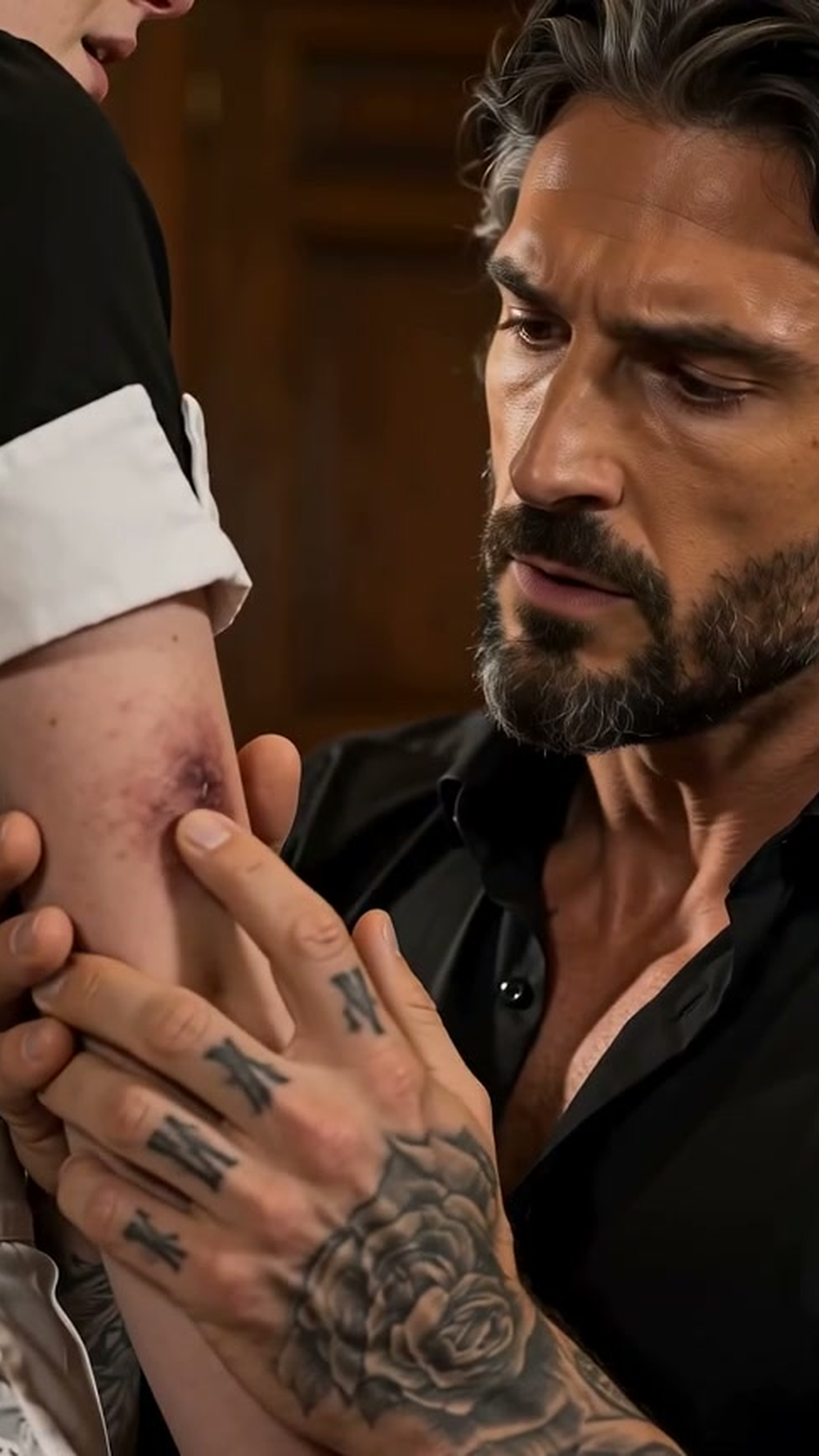
Kate had rehearsed the speech in the dark for two hours — gratitude first, then the facts, then the door. She had not rehearsed for him to simply take the whole speech away with five words, standing in her doorway in the gray dawn light with last night still on him like weather: the shirtsleeves, the bare tattooed forearms, a tiredness around the eyes she had never been permitted to see before.
"Mr. Blackwell—"
"Damon. It is six in the morning and you are standing in your coat, Kate. We are past 'Mr. Blackwell.'"
"Then — Damon." His name felt illegal in her mouth. "You have to let me go. Not because I'm not grateful. Because I am. But I cost you — Rosa told me, the whole house is talking — I cost you the merger. The announcement. Your partner, your ships, a senator standing in your ballroom watching it burn. Whatever I am, I am not worth an empire. And every day I stay here, every person in this house will look at me and see the maid who—" her voice cracked, traitorously, on the word — "who broke the house. I can't. I won't live as that story. I'll find other work. The deposit— I'll find a way for the deposit."
"The deposit," Damon said, "was paid on Friday."
The room went very quiet. The suitcase on the bed sat between them like a small, packed accusation.
"What?"
"St. Aurelia's received the full amount on Friday afternoon. Surgery, specialist, aftercare — the complete schedule, paid in full, from an endowment that does not have a name. Your mother was moved to the surgical list while you were laying out champagne glasses." He said it the way he said everything, flat and factual, as if he were reporting weather in another country. "She is operated on Tuesday. The surgeon is the one you chose — I asked. He is, apparently, the best. He had better be."
Kate sat down on the bed beside the suitcase, because her legs had stopped consulting her.
"You paid for my mother's heart," she said slowly, "on Friday. Before the gala. Before you knew. Before I ever told you his name."
"Yes."
"Why? On Friday you knew nothing. On Friday I was a maid who flinched at lunch service. Why would you—"
He crossed the little room — two steps, it was a servant's room, it had never been meant to hold a man his size and a moment this size at once — and he did the thing she had seen exactly once before, in a lamplit sitting room that now felt like another lifetime: he lowered himself, deliberately, until he was not towering. This time there was no chair to draw close. This time he simply knelt on the bare boards of her room, in the dawn, in the wreckage of his own coronation night, and put himself at the level of her eyes.
"On Friday I knew a girl on my staff was favoring an arm she would not stop working on," he said. "I knew she sent every dollar she earned out of this house within a day of receiving it — the agency mentions it; girls who do that are either gamblers or saints, and you dust like a saint. I knew there was a hospital. I did not know the rest. I did not need the rest. In my house, Kate, people are not furniture. That is not a sentiment; it is the entire difference between my organization and the animal you mistook it for. Preston Caldwell believed the staff were part of the building. That is why he is driving into the sunrise with one bag, and you are having this conversation."
"But the money—"
"Is not a debt." His voice hardened — not at her, at the idea. "Hear me, because I will only build this road once. It is not a debt, it is not a purchase, and it buys no one in this room anything. Your mother will have her surgery whether you stay, go, marry a lighthouse keeper, or burn this house down out of general principle. It was owed. Not to you — by the house, to itself, for Thursday. For a corridor I failed to keep safe. I pay my house's debts. It is the whole of my religion."
Kate looked at him — at the gray in his temples, the ink on his arms, the exhaustion and the absolute, immovable steadiness underneath it — and what rose in her then was not gratitude, though there was gratitude; it was not awe, though there was awe. It was the terrifying, clarifying realization that she had spent three days believing silence was her only armor, in a house whose master had been quietly moving the whole world an inch at a time so that she would never have to be silent again.
"Then why are you kneeling in my room, Damon Blackwell," she whispered, "if you don't want anything?"
"Oh," he said, "I want something."
He reached out — slowly, telegraphing every inch of it, exactly as he had in the sitting room, a man who had learned in one night how to ask permission with his hands — and he took her braced forearm in both of his, and held it the way you hold a bird you are about to release and are not sure will fly.
"I want the girl who said no to Preston Caldwell twice — once with a candlestick in her hand and once in front of three hundred witnesses — to stop believing she is small enough to disappear. I want her to run this house's charitable foundation, which Matteo has been failing to staff for a year because everyone qualified is afraid of me. The salary is eight times what you earn with that tray, the office has a window, and the work is moving money to hospitals, which I am told you have some talent for." A breath. The ghost of something almost like nerves, in the most dangerous man in the city. "And when the brace comes off, and your mother is dancing at whatever wedding she's already planning in that hospital bed — I want to take you to dinner. Not as your employer. Not in this house. Dinner, Kate. Where I have to be charming, and you are allowed to leave whenever you wish, and nothing — nothing — is owed."
On Tuesday, Kate sat in a hospital corridor at St. Aurelia's in her one good dress, with her arm in its brace and a paper cup of coffee going cold in her good hand, and watched the doors through which they had taken her mother. She had been there an hour. She expected to be there six more, alone, in the manner to which her whole life had trained her.
At the second hour, the elevator opened, and Damon Blackwell stepped out of it into the fluorescent corridor — out of place as a wolf in a chapel, in a dark coat over an open collar, carrying, with an air of faint bewilderment at himself, two coffees and a paper bag of pastries — and sat down beside her on the plastic chairs without asking whether she wanted company, because by then they both understood that asking was a language he was still learning and presence was the one he spoke.
"You have an empire," Kate said at last, to the doors.
"I have brothers, cousins, and a brother. Matteo is being an empire today. He sends his respects and a threat about your eating, which—" he nudged the paper bag an inch toward her — "I am apparently delivering."
He stayed the whole six hours. He read contracts in the chair beside her and did not once check the time where she could see it, and when the surgeon came out at last, gray-faced and triumphant, and said the words "textbook" and "strong" and "she asked for tea before she was fully under, which we take as a good sign," it was Damon who caught Kate's elbow — the good one — as the corridor briefly rearranged itself under her feet, and Damon who said, to the surgeon, with the absolute gravity of a man discussing shipping routes: "Whatever she needs. Whatever it costs. You have a number to call." And on the drive back to the estate, in the dark, with her mother's heart ticking repaired and steady behind them, Kate slept — actually slept, undefended, for the first time since Thursday — with her head against the window of his car, and woke to find his coat over her and the driver taking the long way home, slowly, under instructions nobody admitted to giving.
The brace came off six weeks later, on a bright morning in a clinic whose bills, Kate noted with a glare that made him laugh — actually laugh, a sound the staff would dine out on for a year — he had itemized, separated, and left entirely to her new salary to pay. The arm had healed straight. The bruises were a memory her skin kept only in certain lights.
Her first morning at the foundation, Kate arrived at the office with the window — a bright room over the garden that had been a store-room for spare chairs since before she was born — wearing her own clothes and carrying, out of pure reflex, a tray. Rosa met her at the office door with her arms folded and confiscated it.
"Directors do not carry trays," Rosa said. "Directors have opinions about trays. Sit down. Your nine o'clock is a children's hospital with a boiler from the last century, your ten is the hospice in the county, and at eleven you are expected to argue with Mr. Matteo about a roof. He is already afraid. I can tell. It improves him."
"Rosa. I'm the same person I was in April."
"No," Rosa said, with enormous satisfaction, setting down tea she had made as an excuse and drinking Kate's, as an older sacrament. "In April you were the house's best-kept secret. Now you are its loudest one. Drink your tea, Director. And when the boss comes by at noon pretending he has paperwork in this wing — and he will, hermana, he has invented entire corridors of paperwork in this wing — try to look like a woman whose time is valuable. He respects it. It drives him pleasantly insane."
He came at noon. He had paperwork. It was, on inspection, one sheet, already signed.
"You'll want to check that," Kate said gravely, from behind her new desk, with her healed arm resting on a children's hospital's boiler estimate. "Foundations require oversight."
"I live in terror of it," said Damon Blackwell, and stayed for lunch. The surgeon at St. Aurelia's performed, by all accounts, like a man inspired; Eleanor Bennett came out of surgery with a repaired heart and immediately started matchmaking the cardiologist, because some forces of nature cannot be operated on.
Preston Caldwell was never seen on the coast again. The harbor police received an anonymous file in the spring — manifests, names, dates — thorough as scripture. What became of the fifteenth name, in whatever port his one bag finally stopped moving, the house never learned, and Kate, who had once done arithmetic in the dark to survive him, found she could no longer remember his face without effort. It remains the single finest gift the night gave her.
And on the first anniversary of the gala — a smaller affair this time, a better one, three hundred guests and not a single contract in a leather folder — the staff of the Blackwell estate watched their foundation director come down the great staircase in a dress the color of deep water, with her right arm bare and unbroken, and watched the boss of all the Blackwells meet her at the bottom of the stairs and offer her his hand with the particular care of a man who knows exactly what hands can do, and what they are for.
She took it. In front of everyone. She had finished with hiding.
"Dance with me," Damon said.
"In front of the whole house?" Kate said. "People will talk."
"Let them." He led her out onto the floor where, a year ago, an empire had failed to be announced and something better had been founded instead. "I have it on good authority the account is settled."
And above them the chandeliers burned gold, and the orchestra played, and every door in the house stood open.
THE END