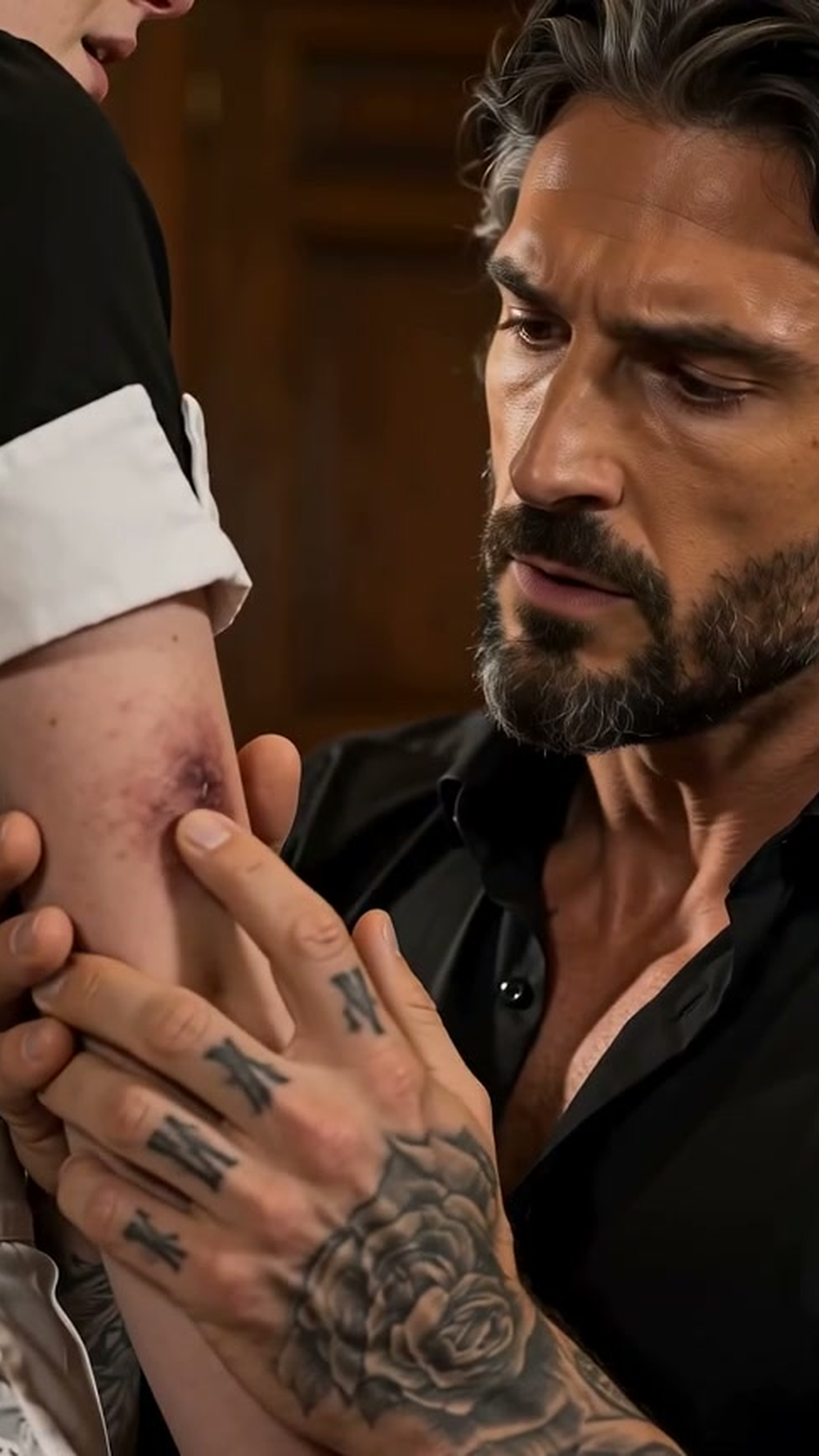
Kate did not go to him.
It was the second refusal of her life, and it was harder than the first, because the first had been made in a locked corridor with no witnesses and nothing left to lose, and this one she made in a burning garden in front of three hundred people, with everything to lose and a broken arm throbbing in time with the fireworks. Her feet, trained by eleven weeks of service and three days of terror, wanted to obey. Obedience was her whole profession. Obedience was the deposit, the surgery, her mother's heart.
She set her tray down on the terrace balustrade with exaggerated care, the way a bomb technician sets down a device, and she walked — not toward the garden doors, not toward the folly, not toward the man crooking his finger like a hook — but backward, into the ballroom, into the light, into the crowd, threading herself between dancing couples and champagne and laughter until there were a hundred witnesses between her body and Preston Caldwell's smile.
His smile went away then. She saw it go, across the room, in the flash of the second firework — and she understood that she had just done the most dangerous thing available to her: she had refused him in public, where he could not pretend it was a negotiation, and a man like Preston Caldwell could survive anything except being seen to be refused by a maid.
"Miss Bennett."
The quiet man was back at her elbow, white-faced, with his hand actually out — not touching, hovering — as if she were something that had nearly fallen off a shelf. "My apologies. There was a—" He stopped. Reassessed her face. "You did well," he said, with deep disapproval of the entire situation. "That was extremely dangerous and you did it exactly right. Come with me. Now. Mr. Blackwell wants you where the walls are stone."
She went with him through the service corridor — the other corridor, the west one, lit and populated, nothing like Thursday — and all the way she could feel the night moving around her like water around a stone in a river, and she had no way of knowing that she had just lit the last fuse of the evening. Because Preston Caldwell, watching the maid vanish into the protection of his partner's house, had done his arithmetic to its final line, and the answer it gave him was the answer such men always reach when the alternative is ruin:
The girl was the only witness who mattered. The girl, therefore, was the only problem left.
* * *
The count, afterward, became a kind of legend in the house — the way the staff tell it still, in the kitchens, on slow mornings, with the presses hissing and somebody's cousin listening with her mouth open. Matteo Blackwell kept it on a folded list in his breast pocket, and he crossed the names out one at a time, in pencil, as the night gave them up.
One: Gerald Vance, head of security, twenty years, who had sold eleven minutes of static for twenty thousand dollars and a promise. Taken before the announcement, in the room beneath the kitchens, weeping with relief by the end, because being taken by Matteo was survivable and he knew the alternatives by reputation.
Two, three, four: the steward, the freight clerk, and the receiving-door porter — Preston's little loyalties, bought over months of envelope diplomacy and hints about a new arrangement. They were found, respectively, at their stations, in the freight office, and halfway across the south lawn with a bag, and they were all of them astonished to learn how completely the house knew their names.
Five: the driver, who had waited in a car outside a locked corridor on Thursday and heard a glass break through a wall and driven on anyway.
Six and seven: two deck officers of Caldwell Shipping, flown in for the gala, whose real cargo — the cargo that never appeared on any manifest — had moved on Preston's orders and Damon's water for six years. The audit found them before the police ever could have, which was, in the end, a kind of mercy they had not earned.
Eight: the lawyer with the kind face who had drawn up, in advance and in secret, a certain maid's letter of resignation and a settlement with a silence clause, dated for the Monday after the gala. He had the documents in his briefcase at the hotel. He had never met Kate. He had charged Preston four hundred dollars an hour to erase her.
Nine, ten, eleven, twelve: the crew of the garden — the two men who had held the east corridor doors on Thursday and called it a cigarette break, the folly's "electrician," who had disconnected a lamp that had worked for a decade, and the quiet professional from out of state whose presence at a shipping gala no one could quite explain, and whose luggage contained, among other things, a syringe.
Thirteen: Preston's own nephew and aide, who carried the leather folder, and the envelopes, and had chosen the corridor on Thursday out of a directory of the house's blind spots, helpfully provided by name number one.
Fourteen: the banker. The respectable, white-haired, church-going banker who had agreed to freeze a certain organization's accounts the morning after the merger — Preston's coup, prepared in silk — and to unfreeze them only for the new arrangement. He took Matteo's midnight visit in his dressing gown, in his own hallway, and discovered that he had opinions about loyalty he had never suspected.
In the housekeeper's parlor, Kate sat with her back to the warm wall and listened to the night dismantle a man. There is no sound for it, exactly — that was the Blackwell way — only the sounds of absence arriving one at a time: a car starting in the mews and not returning; the service bell that rang and rang for a steward who no longer existed; footsteps in the passage, two pairs, unhurried; a long quiet; then two pairs again, lighter by one man's dignity. Rosa sat against the door with her rosary moving through her fingers at the speed of a woman saying it for other people's souls, and at one point, around one in the morning, she said, without looking up: "Stop counting, Kate. I can hear you counting."
"I'm not—"
"You are. It's in your breathing. Whatever the number is when it stops — it isn't yours. You hear me? You carried a tray for eleven weeks and a man used a corridor wrong. The count belongs to the corridor, and to him, and to the house that let its cameras sleep. Not to you."
And fifteen —
But the fifteenth name is not a name on a list, and it did not wait politely to be crossed out. At two in the morning, with the fireworks long finished and the ballroom emptying into cars and laughter and the last of the champagne, with Kate locked — at her own insistence, with Rosa on a chair against the door like a small, furious dragon — in the housekeeper's parlor off the kitchens, the fifteenth name came looking for her.
Preston Caldwell had not run. Running was for men who believed the world outside the house belonged to them. Instead he had done the last thing a cornered prince can do: he had gone to take the throne room. He walked into Damon Blackwell's study at two in the morning with the leather folder in his hand and the merger contract inside it, signed — he had signed it himself, alone, both lines, in the car — and he laid it on the desk between them like a shield.
"It's done," he said. "Whatever tantrum tonight was, Damon, it's paper now. We're partners. The ships, the water, the bank, the senator — it's all in motion, and you cannot unpick it without unpicking yourself." He was still handsome. He was still calm. Only his eyes had aged. "Your brother has been collecting my people all night like a bailiff. Call him off. We'll discuss your — episode — like gentlemen, and I'll overlook the insult to the announcement, and the girl—" his mouth shaped the word like a flavor he disliked — "the girl will be compensated. Generously. A clinic for the arm. A pension for the mother. She'll sign the lawyer's letter, and this house will never hear her name again."
Damon Blackwell sat behind his desk in his shirtsleeves, with his tattoos bared to the elbow and a glass of water untouched at his hand, and listened the way a cliff listens to the sea.
"You broke her arm on a Thursday," he said at last. "In my house. In a corridor you paid my own man to blind. Then you sat at my table and ate my food and put your hand on the evening's roster, and you ordered her to a garden building in the dark, the way a man orders wine." He rose, slowly, and Preston — to his credit, or his shame — did not step back. "You keep saying the word 'partner,' Preston. I have been turning it over all evening, and I have concluded that you mispronounce it. The word you want is 'tenant.' You have been a tenant in my empire for six years, and tonight your lease came up."
"The contract—"
"Your ships are impounded in four ports as of midnight — my audit, my harbors, my paperwork; the harbormasters send their regards. Your accounts are frozen; your banker had a change of heart in his hallway. Your crew is in my basement explaining your manifests to my brother, who is taking notes for the harbor police in the morning — anonymously, of course; we are all legitimate men here." Damon came around the desk. "You have no money, no hulls, no crew, no partner, and no name that any door on this coast will open to after sunrise. What you have, Preston, is one asset left. You have the six hours between now and dawn, and a car I am lending you, and my word — which, unlike yours, has never once been broken in twenty years — that no one will follow it as long as it keeps driving."
"And if I stay?" Preston whispered. "If I go to the police? The press? I know where the bodies—"
"You know where some of them were," Damon said gently, "and a ruined, exiled, document-forging attempted rapist's word against the house of Blackwell is a currency I am willing to let you try to spend. Stay, and you spend it from a cell, on charges written by your own lawyer's briefcase. Drive, and you are a ghost with a head start." He leaned close, and his voice went down to the register Kate had heard in the sitting room, the register of schedules, not threats. "But understand the terms of your haunting. If you ever say her name again — if you ever come within a hundred miles of her, or her mother, or anyone she loves — the count my brother finished tonight will turn out to have been missing its last name after all. Go."
The car left the estate at twenty minutes to three, with one bag, no driver, and the whole of the staff — awake, all of them, somehow, in doorways and at windows along the drive — watching it go in a silence so complete that the gravel sounded like applause played backward.
At sunrise, Matteo knocked once on his brother's study door and laid a folded list on the desk. Fifteen names. Fifteen pencil lines through them, neat as stitches.
"It is done," Matteo said. "Every name before sunrise."
Damon looked at the list for a long moment. Then he opened the desk drawer, and put it away with the photograph he kept there, and said: "Now I go and tell the girl."
But the girl — exhausted, unbroken, with her arm aching in its new brace and Rosa snoring in the chair against the housekeeper's door — had slept two hours, woken before dawn to the sound of the estate holding its breath, and made a decision all her own.
By the time Damon Blackwell reached the staff wing, Kate Bennett was standing in her narrow room in her traveling clothes, with her borrowed suitcase packed on the bed.
And the look on her face stopped the most dangerous man in the city in his own doorway like a hand on his chest.