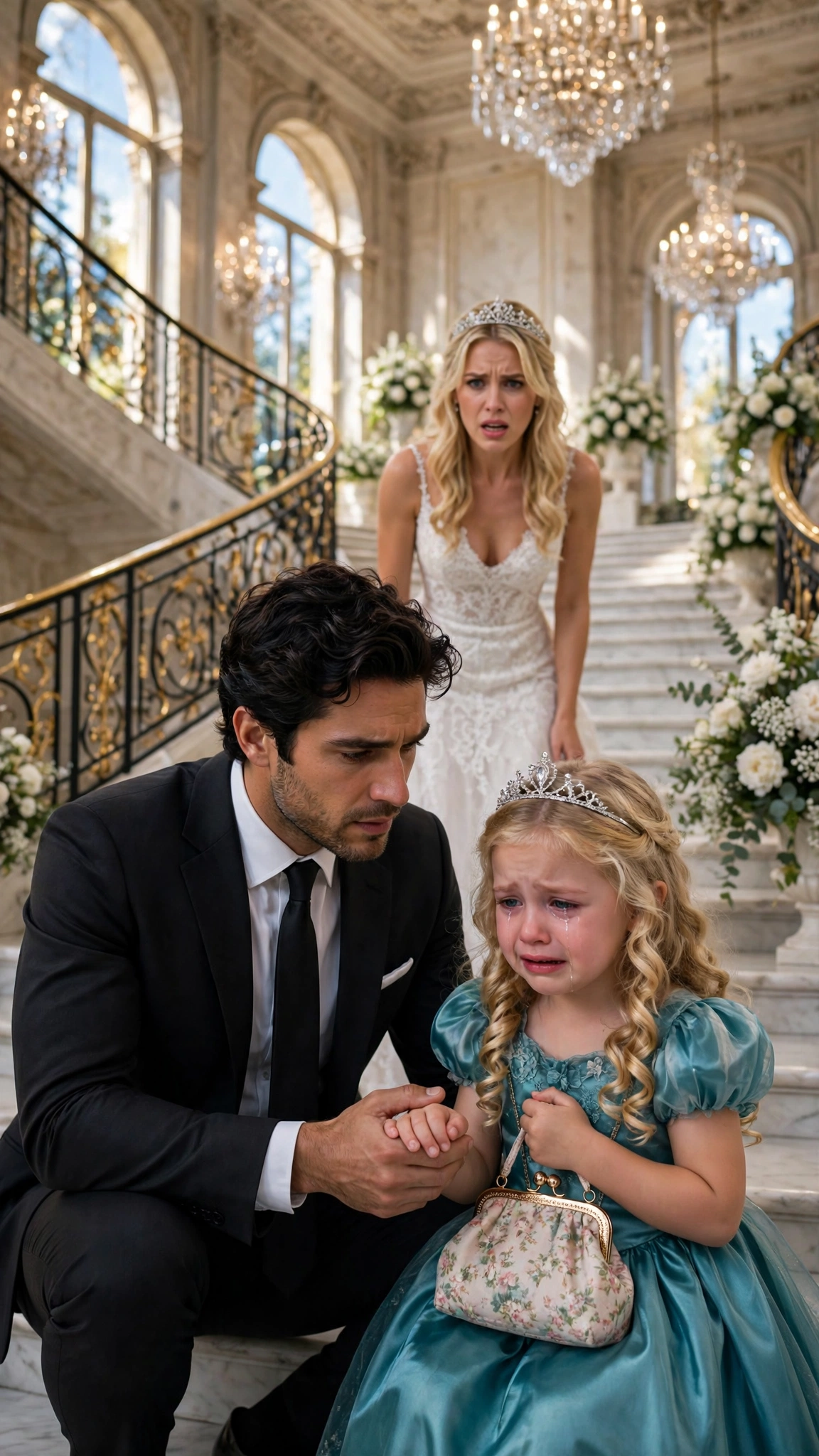
Daniel Moretti was a man who noticed things. It was his profession to notice things — a hesitation before an answer, a glance that lingered too long, a hand that trembled when it should have been steady. He had built an empire on noticing things other men missed. And so, in the week before his wedding, he began to notice his own house.
He noticed it first at breakfast. Lily sat at the long table in the morning room, her small legs swinging under her chair, her spoon moving slowly through her oatmeal. She was quiet, as always. But there was something different about her quiet. It was not the peaceful quiet of a child lost in thought. It was the held-breath quiet of a child who is listening for footsteps.
"Lily," Daniel said. "Are you all right?"
She looked up. Her blue eyes were wide. "Yes, Daddy."
"Are you excited about the wedding?"
"Yes, Daddy."
She went back to her oatmeal. Daniel watched her for a moment, and then he looked at Victoria, who was reading the newspaper at the other end of the table, her coffee cup held delicately between her fingers, her diamond ring catching the morning light.
"Isn't she excited?" Victoria said, smiling. "She's been talking about it for days."
Daniel nodded. But he had not heard Lily talk about the wedding for days. He had not heard Lily talk about anything, really, for days. And he realized, with a slow, sinking feeling, that he had not had a real conversation with his daughter in weeks — that he had been so busy with the wedding, with the business, with Victoria, that Lily had become a small, quiet presence at the edge of his life, like a photograph on a wall that you pass every day without truly seeing.
He noticed it again that afternoon, in the garden. Lily was playing with her stuffed rabbit, sitting under the old oak tree, her mother's floral handbag on her lap, and when Victoria came out onto the terrace, Lily went very still. She did not run to Victoria. She did not wave. She simply went still, the way a small animal goes still when a shadow passes overhead.
Daniel watched from the study window. He saw Victoria walk toward Lily, saw her say something, saw Lily nod, saw Victoria reach out and touch Lily's shoulder — and saw Lily flinch. It was a small flinch. A tiny, involuntary pull away. But Daniel saw it, and his hands tightened on the windowsill, because his daughter did not flinch. His daughter had never flinched from anyone. She was a brave little girl. She had been brave when her mother died. She had been brave every day since.
Why would she flinch from the woman who was about to become her stepmother?
That evening, he went to the nursery. Lily was already in bed, her eyes closed, her breathing slow and even. He stood in the doorway for a long time, watching her sleep, and he thought about Isabella, and about the rocking chair, and about the way the house had gone cold, and about the way it had stayed cold even after Victoria arrived — because, he realized now, Victoria had not warmed the house. Victoria had only lit candles in it. And candles, however beautiful, do not warm a house. They only make the shadows deeper.
He noticed the bag. It was on the pillow beside her, the little floral purse with the pink roses, its gold clasp glinting in the light from the hallway. Lily slept with one hand on it, even in her sleep, her small fingers curled around the clasp as if someone might try to take it from her in the night.
Daniel frowned. He had seen the bag a hundred times. But he had never asked himself why a five-year-old girl held on to a handbag as if her life depended on it. He asked himself now, standing in the dark doorway, and he did not like the question, and he liked the possible answers even less.
The next day, Daniel did something he had not done in months. He left his office at noon, and he drove to Lily's school, and he stood by the gate at pickup time, watching the children come out in twos and threes, shouting and laughing, their backpacks bouncing. Lily came out last, alone, her teal coat buttoned to the chin, her mother's floral handbag on her arm, her small face serious in a way that made his chest ache. Her teacher, a kind woman named Mrs. Alvarez, walked her to the gate, and when she saw Daniel, she said, very quietly, "Mr. Moretti. I'm glad you're here. Lily has been very quiet lately. Quieter than usual. And she won't let go of that little bag. Not for painting, not for lunch, not for anything. The other day, another little girl tried to look inside it, and Lily cried. She never cries, Mr. Moretti. Not at school. Not ever." Daniel thanked her, and he took Lily's hand, and they walked to the car in silence, and he thought: My daughter is afraid at school, too. She is afraid everywhere. And I did not know. I did not know, because I was too busy to come to the gate.
He noticed the tiara, too. The small silver tiara — Isabella's wedding tiara — sat in its velvet box on the nursery dresser, polished and bright, waiting. Lily took it out only on special days, on days when she needed to feel brave. Daniel had not known that. He had not known that his daughter had a ritual, a small private courage, that she practiced without him. He stood there, looking at the velvet box, and he thought: How much of my daughter's life have I missed? How much have I not seen, because I was too busy being happy to look?
He went to find Carlo. Carlo was in his office downtown, working late, as always, and Daniel called him, and said, "I need you to look into Victoria."
Carlo was quiet for a moment. Then he said, "What do you want me to find?"
"Everything," Daniel said. "Where she came from. Who she talks to. What she wants. I need to know what she was planning. I need to know if there is anything — anything at all — that I should have seen."
"It will take a day," Carlo said.
"Take an hour," Daniel said. "Take whatever you need. Just find it."
It took less than a day. It took four hours.
Carlo called back at midnight. "The school is real," he said. "Switzerland. A strict boarding school in the Alps. I called them. They have a file. A girl named Moretti. A start date in September. A deposit paid — with your household account money, by the way. Victoria wrote to them three months ago."
Daniel closed his eyes. "What else?"
"She's been talking to the Rossis," Carlo said. The Rossis were a rival family, smaller than the Morettis, hungrier, always looking for a weakness. "Nothing solid yet. But she's angry, Daniel. Or she will be, if she finds out you're looking. And a woman with information is dangerous."
"What information?"
"She knows things," Carlo said. "She lived in your house for a year. She knows your schedule. She knows your men. She knows where the safe is. She knows about the shipment coming in on Thursday."
Daniel was silent. He thought about the shipment — a legitimate shipment, wine from Italy, but routed through channels that would not survive close inspection — and he thought about Victoria, standing in his bedroom, and he understood that the danger was not over. The rehearsal had not happened yet. The wedding had not happened yet. And the woman he was about to marry had already made plans that did not include his daughter.
"Watch her," Daniel said. "And watch the Rossis. And Carlo — thank you."
He hung up. He sat in his study, in the dark, and he thought about what to do. He was a man who had spent his life solving problems with leverage and fear, and for the first time, he understood that the problem in front of him could not be solved that way. Victoria was not a rival boss. She was a woman he had loved, who had tried to hurt his daughter, and who was now angry and dangerous. He could not threaten her. He could not frighten her. He had to be smarter than that.
He went to the nursery. He stood in the doorway, watching Lily sleep. Her blonde curls were spread across the pillow. Her small hand was curled around the gold clasp of her mother's handbag. Her breathing was slow and even. And on the wall above her bed, taped carefully in a row, were her drawings — the tall man, the small girl, the woman with yellow wings.
Daniel felt something in his chest — not break, but open — and he made a promise, there in the dark doorway, to his sleeping daughter and to the wife he had buried and to the mother whose tiara sat in a velvet box on the dresser.
I will not fail you again, he thought. Not you, Lily. Not ever again.
Then he went back to his study, and he sat down, and he waited for morning, and for the rehearsal, and for the moment when his daughter would finally find her voice — and he would finally find his.
He did not sleep that night. He sat in his study long after the house had gone quiet, the untouched drink on the desk beside him, Isabella's photograph in his hands. He looked at her face — the smile, the dark hair, the eyes that had seen straight through him from the very first night — and he thought about the day Lily was born, about the way Isabella had held their daughter and whispered, "She is going to be brave, Daniel. Braver than both of us."
He had not been brave. He had been busy. He had hidden from his grief in work, and he had hidden from his daughter in silence, and he had let a stranger walk into the house his wife had made warm and turn it cold again, one small cruelty at a time.
He thought about the tiara. Isabella's tiara. He had given it to her on their wedding day, and she had worn it once, and then she had kept it in its velvet box, and she had told him, laughing, "For our daughter, one day. For when she needs to feel like a princess." And Lily had found it, and she had worn it, and she had made it her own small courage, and Daniel had not even known.
He stood up. He walked to the nursery, and he stood in the doorway, watching Lily sleep, and he thought about the rocking chair, and about the way she had read to Lily in that chair, her voice low and unhurried, one hand resting on the small curve of her daughter's back.
And he thought: I have failed them both. I failed Isabella, because I let a stranger into the house she built. And I failed Lily, because I was too busy being happy to see that my daughter was afraid.
He did not confront Victoria that night. He was too angry, and anger, he knew, made a man stupid. He needed to be smart. He needed to be sure. He needed to hear it from Lily herself, and he needed to see Victoria's face when she knew that he knew.
So he waited. He waited for the rehearsal, which was the next morning, and he told himself that he would watch, and that he would listen, and that when the moment came, he would know what to do.
He did not know that the moment would come in the form of his five-year-old daughter, standing at the foot of the grand staircase in her teal princess dress, her silver tiara bright in her blonde curls, her mother's floral handbag clutched to her chest, saying the words she had practiced a hundred times in her bedroom mirror.
He did not know that she would be braver than he had ever been.
But she was. And when she spoke, the whole house stopped, and the whole world changed, and Daniel Moretti — the most feared man in Chicago, the man who had buried his wife and raised his daughter alone and let a beautiful stranger into his house because he was tired of being cold — looked down at his little girl, and for the first time in two years, he truly saw her. And he knew, in that moment, exactly what he had to do.