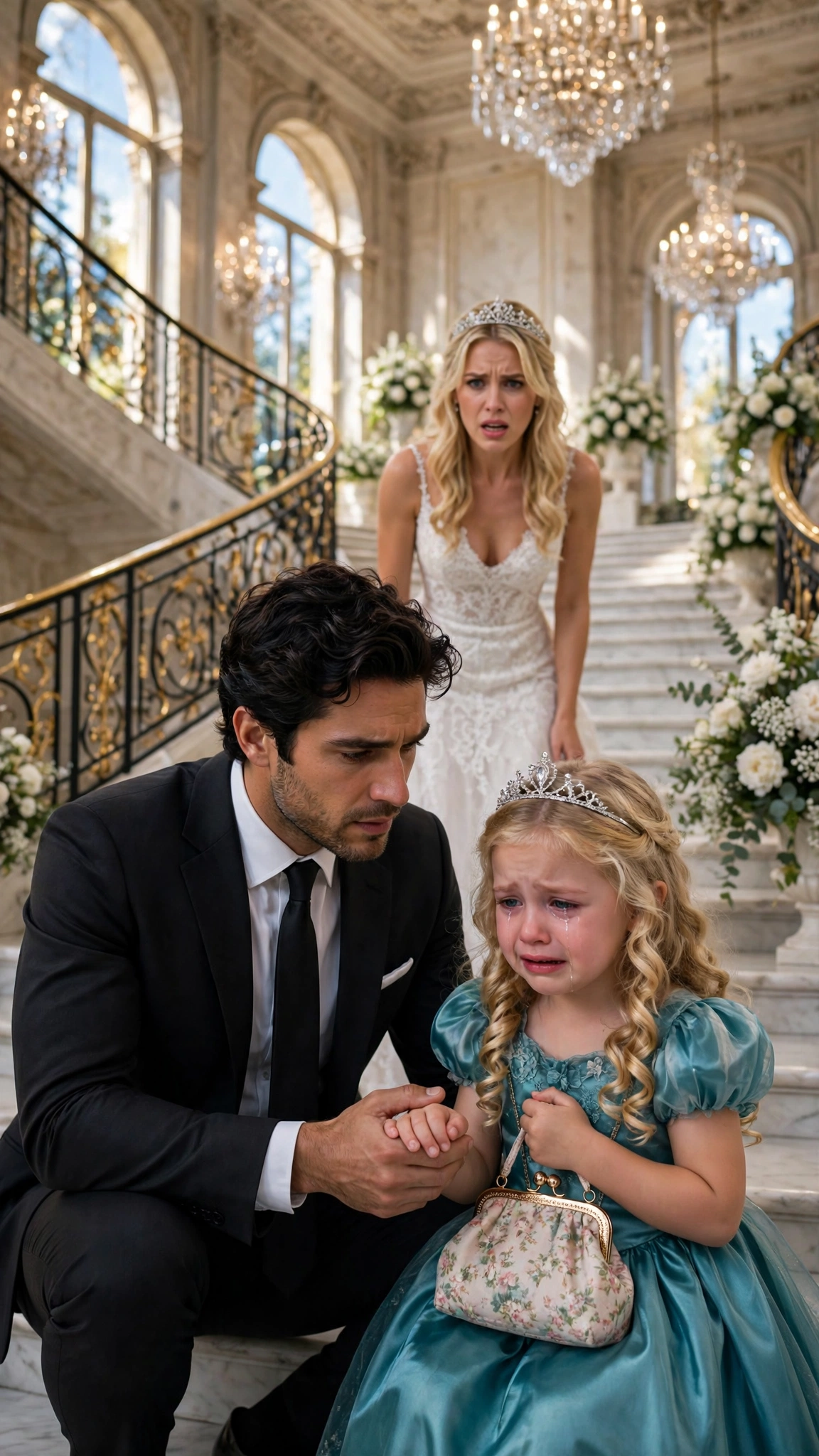
The wedding was called off on a Friday, in the same week it was supposed to happen, and the house — the cold, quiet house that had forgotten how to be warm — began, very slowly, to remember.
It did not happen all at once. Healing never happens all at once. It happens in small moments, in quiet rooms, in the spaces between words. It happens when a man sits on the floor of a nursery and draws with his daughter. It happens when a friend ties a silver tiara in a little girl's hair and the little girl smiles. It happens when the sun comes through the windows in the morning and the house does not feel empty anymore.
Daniel cancelled the wedding himself. He called the venue. He called the florist. He called the guests, one by one, and he told them, in a voice that was calm and final, that the wedding would not be taking place. He did not explain. He did not need to explain. He was Daniel Moretti, and when Daniel Moretti said a thing was over, it was over.
The white roses were taken away. The chandeliers were dimmed. The grand staircase hall — the hall where Lily had stood at the foot of the stairs in her teal princess dress and said the bravest words of her life — was quiet again. But it was a different kind of quiet now. Not the held-breath quiet of a child listening for footsteps. The peaceful quiet of a house at rest.
Lily asked about Victoria once. Just once.
"Daddy," she said, one morning at breakfast, her spoon moving slowly through her oatmeal, "where did Miss Victoria go?"
"She went away," Daniel said. "She won't be coming back."
"Is she mad at me?"
"No, sweetheart," Daniel said, and he reached across the table and took her small hand in his. "She is not mad at you. She made a mistake. And sometimes, when grown-ups make a mistake, they have to go away so that everyone can be safe."
Lily thought about that. Then she said, "I am glad she went away."
"I am glad too," Daniel said, and he meant it, and he was surprised by how much he meant it.
That was the last time they spoke about Victoria. Lily did not ask again. She did not need to. She was five, and she had already learned the hardest lesson a child can learn — that sometimes the people who smile at you are not safe, and that the people who love you are the ones who stay. And she had learned the best lesson, too — that her father would choose her. That he had chosen her. That he would always choose her.
The changes came slowly, and they came from Daniel himself.
He started coming home earlier. He started eating dinner with Lily, sitting across from her at the table, asking her about her day, listening — really listening — when she told him about school, and about her friends, and about the butterflies in the garden. He started reading to her at night, sitting in the nursery, his deep voice low and unhurried, one hand resting on the small curve of her back, the way Isabella had. He was not good at it, at first. He stumbled over the words. He read too fast. But Lily did not mind. She leaned against him, and she listened, and she fell asleep with her head on his shoulder, and Daniel sat there long after she was asleep, looking at the ceiling, thinking about how much time he had wasted, and how much time he still had.
He brought the rocking chair back. He found it in the storage room, where Victoria had had it taken, and he carried it up to the nursery himself, and he set it in the corner, in the exact spot where it had always been, and he sat in it, and he rocked, slowly, and he thought about Isabella, and about the way she had read to Lily in that chair, and he felt — not grief, not the sharp, terrible grief of the first year, but something softer. Something like gratitude. Gratitude that he had loved her. Gratitude that she had left him Lily. Gratitude that he had been given a second chance to be the father his daughter deserved.
One evening, a month after the rehearsal, Daniel went to the nursery with the little floral handbag in his hands. Lily was already in bed, her eyes closed, her breathing slow and even, her silver tiara in its velvet box on the dresser. He sat on the edge of the bed, and he opened the handbag, and he took out the folded note — Isabella's note, the one he had read on the stairs, the one that said, "For my brave girl. When you miss me, hold this and know I am with you. Be brave, my little girl. Be brave, and hold on tight."
"Lily," he whispered. "Sweetheart. Wake up. I have something for you."
She opened her eyes. She blinked at him, sleepy and confused, and then she saw the note in his hands, and her eyes went wide.
"Is that —" she whispered. "Is that Mommy's note?"
"It is your mommy's note," Daniel said. "And I want to read it to you. Properly. The way she would have read it."
He read it aloud, his deep voice low and unhurried, and Lily listened, her eyes wide, her small hand curled around the gold clasp of her mother's handbag, and when he was finished, she threw her arms around his neck, and she held him tight, and she whispered, "Thank you, Daddy. I love you, Daddy."
"I love you too, sweetheart," Daniel said, and his voice was thick, and his eyes were wet, and he held her, and he did not let go, because he had learned — finally, truly learned — that this was what mattered. Not the business. Not the money. Not the fear. This. A little girl, in a nursery, wearing her mother's tiara in its velvet box beside her, safe in her father's arms.
The house healed. It healed the way houses heal when the people in them decide to be kind to each other — slowly, and then all at once, and then it was simply the way things were.
Lily grew louder. She laughed more. She drew pictures — her family, the tall man, the small girl, the woman with yellow wings, and now, beside them, a small house with a red door, and a garden full of flowers, and a sun in the corner, shining down on all of them — and she taped them to the nursery wall, where everyone could see them. She played in the garden, chasing butterflies in her teal dress, her silver tiara catching the sun, her mother's floral handbag bouncing on her arm, and she did not flinch when anyone came near her, because there was no one left in the house to flinch from.
One Saturday morning, Daniel took her into the garden with a packet of sunflower seeds and a small silver trowel, and together they dug a row of holes along the fence, and Lily dropped a seed into each one, very carefully, her tongue caught between her teeth in concentration, and Daniel covered them with earth, and Lily watered them with a small green can, and she said, very seriously, "They will grow big, Daddy. As big as the house. And Mommy will see them from heaven."
"She will," Daniel said. "And she will be proud."
Lily wore her silver tiara that morning, bright in her blonde curls, and her mother's handbag sat on the garden bench beside them, the pink roses faded by the sun but still beautiful, and Daniel looked at his daughter — at her small fierce face, and her dirty hands, and her fearless laugh — and he thought: This is what I almost lost. This is what matters. Not the business. Not the money. Not the fear. This. A little girl, planting sunflowers, in a garden, in a house that was finally warm again.
Daniel grew softer. He still ran his business. He still made decisions that other men were afraid to make. But he came home earlier, and he ate dinner with his daughter, and he read to her at night, and he sat in the rocking chair, and he rocked, and he thought about Isabella, and he was grateful. He was grateful for the life he had, and for the daughter he had almost lost, and for the second chance he had been given.
Carlo stayed. He stayed in Daniel's life the way he had always stayed — at the edge of the table, at the end of the phone, in the doorway of the nursery with a smile and a story. He tied Lily's tiara on the mornings when Daniel was running late, and he taught her how to make hot chocolate, and he read to her on the nights when Daniel was away, and he never once asked for thanks, because he was Carlo, and that was what Carlo did.
And Lily — Lily Moretti, five years old, with her blonde curls and her silver tiara and her blue eyes and her mother's floral handbag on her arm — grew up safe, and loved, and unafraid. She grew up knowing that her father had chosen her. She grew up knowing that her mother's wings were the biggest wings of all. She grew up knowing that she was, and always would be, her daddy's little girl.
One afternoon, a year later, Lily stood in the staircase hall — the same hall, the same white marble stairs, the same black-and-gold railings, but the white roses were gone, replaced by a vase of sunflowers on the newel post, bright and yellow and cheerful — and she looked up at her father, and she smiled, and she said, "Daddy?"
"Yes, sweetheart?"
"Thank you for not letting her throw me out."
Daniel crouched beside her. He was a tall man, a broad man, and he folded himself down to her height, and his hand rested on her shoulder, and his gray-brown eyes searched her face, and he said, very quietly, "I will never let anyone throw you out, Lily. Not ever. This is your home. You are my daughter. And that will never, ever change."
Lily smiled. It was a real smile, the kind of smile that lights up a whole room, and she threw her arms around her father's neck, and he picked her up, and he held her, and the sun came through the tall arched windows in wide white bars across the marble stairs, and the house — the house that had been cold for so long — was warm.
And it stayed warm. For a very long time. For always.
On Lily's sixth birthday, a year after the rehearsal, the garden was full of sunflowers and balloons, and the house was full of laughter. There were children from her school, and Carlo, and a cake with six candles that Lily blew out in one breath, her eyes squeezed shut, wishing with all her might.
"What did you wish for?" Daniel asked, kneeling beside her.
Lily grinned, chocolate frosting on her cheek. "I can't tell you, Daddy. If I tell you, it won't come true."
"Then I hope," Daniel said, "that it already has."
She threw her arms around his neck, and he picked her up, and he spun her around, and she laughed — a loud, fearless, impossible laugh, the kind of laugh a little girl should have — and Carlo, watching from the terrace, wiped his eyes with his sleeve and smiled.
Later, as the sun went down and the guests went home, Lily sat on her father's lap in the garden, her head against his chest, her mother's floral handbag in her lap, her silver tiara still neat in her curls.
"Daddy?" she said sleepily.
"Yes, sweetheart?"
"I love our house."
"I love our house too," Daniel said.
"And I love you," Lily said. "And I love Carlo. And I love Mommy, even though she is in heaven. And I love the sunflowers."
Daniel held her a little tighter. "I love all of those things too," he said. "Especially you."
Lily yawned. Her eyes closed. And as she drifted off to sleep in her father's arms, under a sky full of early stars, Daniel Moretti — the most feared man in Chicago, the man who had lost everything and found it again in the arms of a five-year-old girl — looked up at the sky and thought of Isabella, and of all the women with wings who watched over his daughter, and he whispered, very quietly, "Thank you. She's safe. She's happy. I promise you — she will always be safe."
THE END