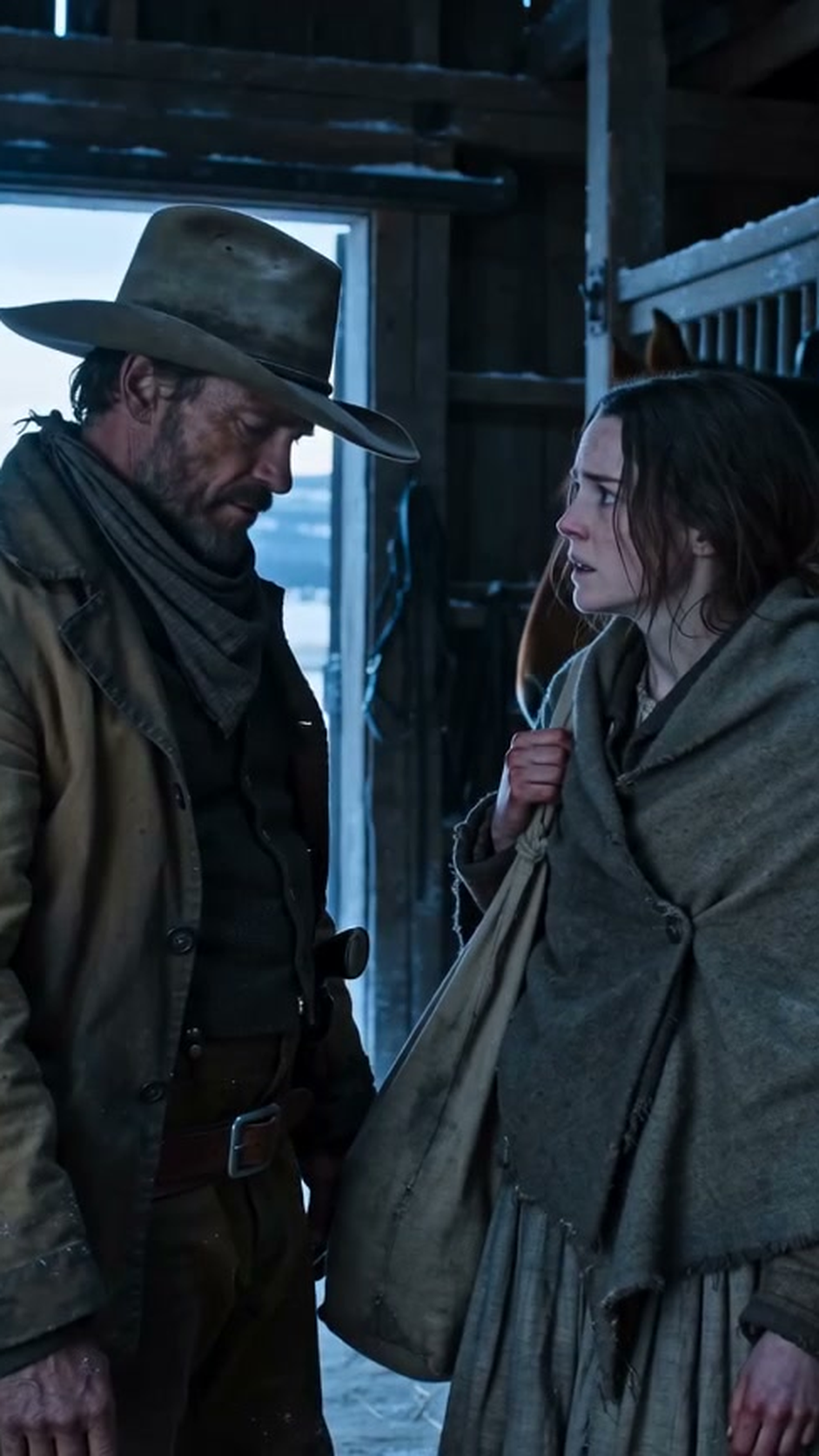
The ladder creaked.
Tessa Ren woke the way she had learned to wake in the last three weeks of her life — all at once, silently, with her hand already closing around the strap of her canvas bag.
She was lying in the hay loft of a stranger's barn, wrapped in a gray horse blanket that smelled of dust and animal sweat, and below her, in the blue dark before dawn, a man's boot had just settled on the first rung of the ladder.
Cold poured through the gaps between the barn boards in thin bright blades. Her breath smoked. Beneath the loft, in their stalls, three stallions stood quiet — too quiet, as if they, too, were listening.
The boot rose to the second rung. The ladder groaned again under a man's weight.
Tessa sat up slowly, the blanket sliding from her shoulders, her heart hammering so hard she was certain he could hear it. She looked down the length of the loft's edge and saw the rifle first — and then the man holding it, half in shadow, his face turned up toward her.
He stopped climbing.
For one long second neither of them moved.
"I didn't take anything," Tessa said. Her voice came out quiet and steady, which surprised her. It was the first thing she had said to another living soul in two days, and she had decided, sometime in the freezing dark of the second night, that if she was caught she would say it plainly and first. "Not feed, not tack. Nothing."
The man did not answer at once. He studied her the way men in this country studied weather — carefully, without hurry, watching for what it meant to do. Then, deliberately, he lowered the rifle until its barrel pointed at the floorboards, and something in Tessa's chest unclenched a fraction.
"How long?" he asked.
She hesitated. Lying had never bought her anything but worse trouble, and she was too cold and too hungry to spend herself on it now.
"Two nights," she said.
His expression changed — not into anger. That was the strange thing, the thing she would turn over in her mind for weeks afterward. Not anger, and not pity either. Something quieter moved behind his eyes, like a man recognizing a road he had once walked himself.
He nodded once, toward the ladder. "Come down."
She climbed down with her bag over her shoulder, her patched skirt gathered in one fist, her cold-reddened hands gripping the rungs. Halfway, the whole barn seemed to tilt toward her broken boot — the left one, split open at the toe and tied together with cord, the leather gone stiff as iron in the cold. She set it on each rung as carefully as a cat crossing ice.
On the floor, she shouldered her bag properly and faced the door. Beyond it lay the yard, the fence, and twelve miles of snow-covered nothing between this ranch and the town that had finished with her.
"I'll leave now," she said.
She took two steps toward the light. Her knees, traitors after two nights of freezing hay and no food worth the name, nearly folded under her — she caught herself on the edge of a stall with one hand, hard, before he could move to help her. She would not be caught falling. Not by him. Not by anyone.
"Come to the house," he said behind her.
Tessa stopped. She turned slowly and looked at him — really looked at him, this weathered man in a worn ranch coat with frost on his hat brim and a rifle he had already lowered.
"I don't take charity," she said. Her voice was firm, even if nothing else about her was.
He glanced — only glanced — at her broken boot, at her reddened hands, at the hollow places hunger had carved under her cheekbones. There was no pity in it. That was the second strange thing. Only recognition.
"I offered breakfast," he said.
A horse shifted softly in its stall. Wind worried at the barn boards.
"And afterward?" she asked.
He did not answer with words. He turned, walked to the wall beside the stall, and leaned the rifle against it — set it down, out of his hands, out of the conversation entirely, the way a man sets down a threat he has decided not to make. Then he stepped past her toward the open doorway and the pale snow beyond it, leaving the whole width of the barn between her and the door, leaving her completely free to walk out into the cold and be done with him.
"Afterward," he said, "you decide."
He stood near the doorway against the dawn, half turned toward her, and she understood that he was waiting — not for gratitude, not for pleading. For an answer, as if her answer were a thing that mattered, as if she were a person whose choosing counted for something.
"What kind of work can you do?" he asked.
Tessa stared at him. Her grip loosened, slowly, around the strap of her bag.
She opened her mouth to answer —
* * *
TWO DAYS EARLIER
— but to understand what that question cost her, you have to go back to the morning she still had a name in the town of Elkhorn, and watch her lose it.
Three weeks before the morning in the barn, Tessa Ren had been the cook and housekeeper at the Brandt Hotel, the only hotel in Elkhorn, and by every account but one she had been good at it. She rose at four. She baked bread that miners' wives crossed the town to buy. She kept Silas Brandt's books in a hand so clean that the county auditor had once complimented it in front of witnesses — a fact that would matter later, though nobody knew it yet.
Silas Brandt owned the hotel. He also sat on the board of the bank, held the notes on half the ranches in the valley, and had a wife, Clara, who wore a silver brooch shaped like a wheat sheaf and a smile that never once reached her eyes.
On a Tuesday, in the pantry, with the dinner service clattering on the other side of the door, Silas Brandt put his hand on Tessa's waist and told her that a girl alone in the world ought to be kinder to the man who fed her.
Tessa picked up the cast-iron skillet from the shelf — not to strike him. She was not a fool. She set it down on the counter between them like a fence going up, and she said, "I am kind to the man who pays my wages, Mr. Brandt. That is the whole of it."
His face went the color of old brick. "You'll be sorry for your pride, girl."
Two days later, Clara Brandt's silver brooch was missing from her dressing table, and by sundown it was known all over Elkhorn — known the way a thing is known when a rich man says it loudly in three different rooms — that the Ren girl had sticky fingers. The marshal, Avery, a decent man made uncomfortable, searched Tessa's little room over the hotel kitchen while half the town watched from the street. He found nothing. He found less than nothing: a mended dress, a Bible with her mother's name in it, four dollars and sixty cents in a tin.
It made no difference. A search that finds nothing proves nothing to people who have already decided, and Silas Brandt did not need proof. He needed her gone, and he needed her ruined loudly enough that no one would ever believe a word she said about anything — about a pantry, say. Or about what she had seen, one October afternoon, dusting his office, when the county ledger lay open and the column of figures for the school fund did not match the column she herself had copied out fair the week before.
She had understood what she was looking at for exactly four seconds before she closed the book and went back to her dusting. Four seconds. Brandt had come in as she was leaving, and something in her face — she had never learned to hide her face — told him she had seen.
That was the real theft, though no one ever charged her with it: she had seen, and he knew she had seen.
For three weeks she knocked on doors. The dressmaker. The laundry. The ranch wives who came to town on Saturdays. Every door opened a crack, showed her a face she knew, and closed. Word travels faster than a woman on foot, and Brandt's word had money behind it. Her four dollars and sixty cents became two dollars, became sixty cents, became a heel of bread she made last two days because there was no work and no credit for a girl with a name like hers.
On the second day of November, with the first real snow coming down and nowhere left in Elkhorn to be turned away from, Tessa Ren put everything she owned in the world into a patched canvas bag — the Bible, the mended dress, a needle and thread, her father's old clasp knife, and a tin that was empty — and walked out of town on the west road with her head up, so that anyone watching would have to say she left like a person, not like a dog.
Twelve miles. She had walked that road before, in another life. North of it, two miles off the valley floor, stood the coulee country where her father's homestead claim had been — one hundred and sixty acres of grass and a one-room cabin, lost the winter he died to fees and interest at Brandt's bank, fees she had never been able to make add up no matter how many times she did the sum. The cabin had burned the spring after. There was nothing there now but a chimney and a memory.
She was not going back to the chimney. She was walking west because west was the only direction that wasn't Elkhorn.
By the time the light began to fail, her left boot had split at the toe — a mile of snow had worked into it, and her foot was a cold, distant thing she could no longer quite feel. The temperature was dropping with the sun. She knew what a Montana night in November did to a person caught in the open with a split boot and no fire. She had buried a neighbor's boy in her father's time who had been caught exactly so.
The barn found her as much as she found it.
It stood below a rise, long and weathered, with smoke rising from a ranch house chimney two hundred yards off — the Silver Crown Ranch, though she did not know its name then. She watched from the tree line until full dark. No dogs came out. A man — she would know him later by his walk — crossed from the house to the barn with a lantern, fed and watered in the stalls, spoke once, low, to one of the horses, and went back to the house. The lantern in the house window burned another hour and went out.
The loft ladder was where it should be. The hay was deep and dry and smelled like June. Tessa climbed up in the dark with her bag, burrowed down into the hay the way she had as a girl in her father's barn, and pulled an old gray horse blanket over herself from a nail by the loft edge, and cried — once, silently, for about a minute — not from sorrow, exactly, but from the warmth of hay against her back after twelve miles of snow.
Then she slept the sleep of the utterly spent, and the stallions below, who might have raised the roof at a stranger's scent, stood quiet over her all night long, as if they had decided something among themselves.
She woke before dawn and lay listening to the ranch come alive beneath her — the man again, and an older voice, and a boy's. She heard the day's shape: feeding, a wagon, riders out. She stayed in the loft all that day, motionless, hungry past hunger, watching through a gap in the boards as the rancher worked his horses in the corral with a patience she had rarely seen in any man — watched him spend twenty minutes gentling a half-broke gray to a touch, watched him favor his left knee, watched him stand a long time at the fence looking north at nothing, the way a man looks at a grave he cannot visit.
The second night was colder. She tied cord around her split boot. She rationed the last of the bread into two halves and ate one. She told herself she would be gone before first light, west again, anywhere.
She very nearly was.
But the cold that night went through the hay and through the blanket and into her bones like water through a sieve, and by the hour before dawn she was sleeping the deep, dangerous sleep that comes before freezing — and so she did not hear the house door, or the lantern, or the man's boots crossing the yard.
She heard only the ladder, when it creaked.