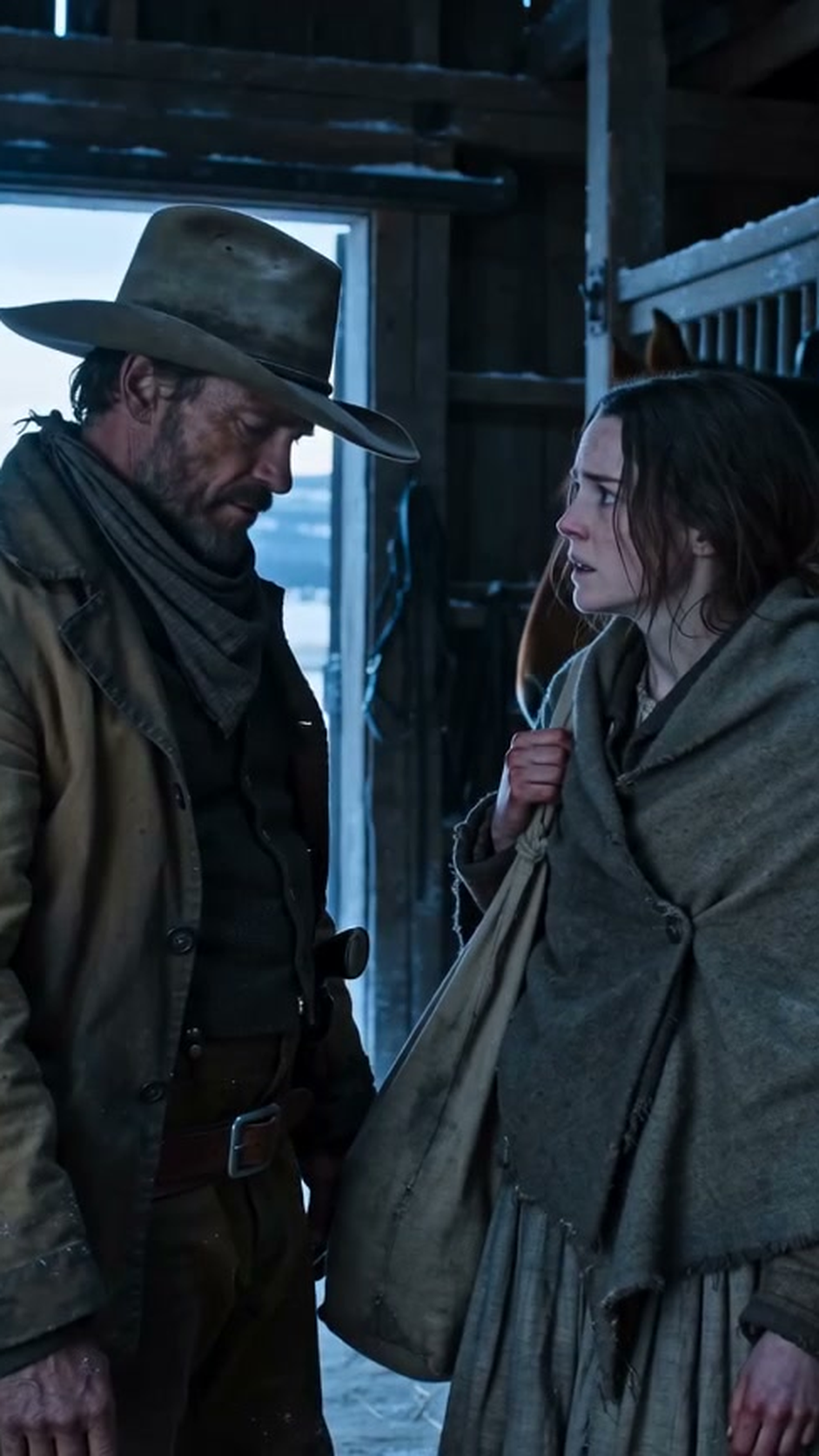
To know why Ransom Calder lowered that rifle, you would have to know what the two days before it looked like from the house — and what the three winters before that had done to the man who lived in it alone.
Silver Crown was not the biggest ranch in the valley, but it was the one other men measured theirs against: nine hundred acres of deeded grass, water that ran even in dry years, and a string of stallions — a black, a bay, and a gray — that men rode in from two counties away to breed their mares to. Ransom had built it out of a relinquished claim and twenty years of work that started before sunup and ended after dark, and there was a time when he would have told you, if you could get him to talk at all, that he had built it for somebody.
Her name was Eleanor. She had laughed at him the first time he asked to walk her home from a church social — laughed not unkindly, but at the solemn way he asked, as if he were proposing a cattle contract — and she had married him anyway, in the spring of his twenty-second year, and for fourteen years the big house on the rise had been the warmest-lit window in the valley.
She died in the hard winter three years back, in the small bedroom at the back of the house, along with the son she was trying to bring into the world. The doctor rode out from Elkhorn through a storm and rode home again through worse, and there was nothing in his bag for what took her. Ransom buried them both on the hill above the house, under a cottonwood, in ground so frozen it took him and Gus Pruitt the whole of a day to open it.
Men who knew him said Ransom Calder did not grieve the way other men grieved. He did not drink himself blind or sell off or run. He worked. He worked in a way that frightened his hands a little — out in the dark with a lantern before any sane man was awake, fostering other men's orphaned calves at two in the morning, mending fence in weather that split rails — because work was the only room in his life where the quiet couldn't get at him.
Gus Pruitt, his foreman, had been with him nineteen years and was the only man alive who could say certain things to him. It was Gus who said, that October, standing in the kitchen doorway watching Ransom stare at a plate of Gus's own cooking — beans burned on one side and raw in the middle, bread like a paving stone — "Boss, I'm a fair hand at most things God made, but I ain't a cook, and you're wastin' away to a fence post. Mrs. Sweeney's gone to Miles City for good. We got to hire a woman for this house before the crew mutinies or starves, and I ain't particular which order."
Mrs. Sweeney had cooked for Silver Crown for six years, a widow of fifty with a rolling pin she used for emphasis, and she had gone east in October to nurse a sister through a lying-in and written, in November, that she was staying. Since then the house had slid into the particular squalor of men living without women: meals at odd hours, shirts mended with twine, a film of dust on Eleanor's piano that Ransom saw every morning and could not bring himself to touch, because her hands had been the last to close its lid.
The house did not merely miss a woman's hand; it was coming apart at the seams in a dozen small masculine ways that no one had the grammar for. Shirts were mended with baling twine and worn anyway. The good cups had retreated to the back of the cupboard, and the men drank coffee out of tin like a trail crew, in a house with a piano. The lamp chimneys were smoked black. A mouse had taken up residence in the flour bin and been granted, by common consent of exhausted men, something approaching squatter's rights. Ransom saw all of it the way he'd see a fence line sagging on a neighbor's place — as evidence of a standard quietly surrendered — and every morning he ate Gus's burnt beans in the middle of it and told himself, with a straight face, that spring would fix what winter had broken.
He had advertised nothing. He had told himself the crew could manage until spring. The truth, which Gus knew and Ransom knew Gus knew, was that hiring a woman into the house meant a woman in Eleanor's kitchen, at Eleanor's stove, and some part of him that had not consulted the rest had decided to starve first.
There were other pressures, of the kind that come with paper. The ranch owed the bank in Elkhorn a note — feed money and a loan against the spring drive — and Silas Brandt, who sat on that bank's board like a spider at the center of a web, had taken to writing letters in a tone so courteous it raised the hair on Ransom's neck. The note was not due until April. But Brandt had begun, in those letters, to wonder aloud about the ranch's "management," and a railroad beef buyer who bought for the Northern Pacific — a cousin of Brandt's wife — had let it be known that his spring contract would go to a ranch whose affairs were "settled and respectable." August Keller, whose land bordered Silver Crown's north pasture and who had wanted Calder water for a decade, had ridden over twice that fall with offers to "help" by buying the north coulee grazing, and had smiled, both times, like a man who could smell smoke from a fire he intended to set later.
Ransom understood all of it. He was not a fool about money; he was only a man about grief, and the two had not yet had their reckoning.
There was a reason, older than Eleanor, older than the ranch itself, that Ransom Calder's table had never in twenty years turned away a hungry person, and it lived in a winter he did not talk about.
He had been nineteen, green as grass, riding for a outfit up on the Musselshell when his horse stepped in a prairie-dog hole in the dark and broke its leg, and he had shot it with his own hands and walked out of that country in the first week of a hard November with a bedroll, a rifle, and nothing in his stomach but snow. Three days he walked. On the third day, half out of his head with hunger and cold, he came down a draw at dusk onto a little ranch he had never seen — a lamp in the window, smoke in the chimney — and the man who owned it, an old widower named Halloway who kept thirty head and a dog and no company at all, found him standing in the yard too proud to knock.
Halloway did not ask his name. He did not ask his business, or whether he was running from something, or what he was good for. He said, "You'll eat first. A man can't answer questions on an empty stomach, and I can't abide interrogating a guest." He fed him at the table — at it, not at the door — like a person. And in the morning, washing his own plate without being told, the boy Ransom had asked what he owed, and the old man had looked at him the way you look at weather coming and said the thing Ransom would carry the rest of his life:
"You don't owe me. But I'll tell you the rule of this house, since you'll have a house someday. A man who turns a hungry stranger from his door in winter has to live with the sound it makes. It's a small sound. It'll follow him the rest of his life."
Halloway hired him that morning — for wages, offered plainly, not as charity — and Ransom worked two years for him and learned cattle and learned men, and when he rode away at twenty-one with a stake and a string of horses, the old man shook his hand and said, "Keep a plate for the road, son," and Ransom had. Through everything. Through Eleanor, who had laughed when she first heard the story and then quietly adopted the rule as her own and improved on it: in the years of their marriage there was always, at the Silver Crown table, what she called the strangers' plate — a setting laid at the end, empty, every single night, so that no one who came to that door in need would ever have to watch a place being made for them as if they were an interruption. Cowboys drifting, a peddler with a broken wagon, a Crow family caught by weather in the bad winter of '81 — all of them had eaten at the end of Eleanor Calder's table off the strangers' plate, and none of them had been asked a single question first.
The setting had not been laid since she died. Gus had asked about it once, the first month, and Ransom had said, "We don't get strangers," and Gus, who understood more than he said, had put the plate back in the cupboard and never raised it again. The cupboard was still there. So was the plate.
And then, in the last days of October, small things began to be wrong around the barn.
The first was nothing: the gray stallion, Smoke, standing loose in his stall one morning with his head up and his ears pricked toward the loft, not frightened — interested, the way a horse is interested in a gentle hand. Ransom had followed the horse's gaze up into the shadows of the loft and seen nothing but hay and dark.
The second was the pitchfork. He kept it hung on the second peg, always, the way a man keeps things who lives by habit, and on the last morning of the month it was on the third peg, and the gray horse blanket that hung by the loft ladder was gone from its nail.
Gus, consulted, squinted up at the loft and delivered the considered opinion of nineteen years: "Raccoon, most like. Or you're gettin' old, boss, and hangin' your own fork wrong."
Ransom had let it go. A man who has been alone with his thoughts for three winters learns to distrust the evidence of his own loneliness; he had half convinced himself he had imagined a presence in the barn because some starved part of him wanted the ranch to contain one more living soul than it did.
But on the second night of November, lying awake in the cold house in the hour when the grief came visiting — it had an hour, the way creditors do — he heard, or dreamed he heard, from the direction of the barn, a sound so small it might have been the wind: a cough, smothered instantly, like a person who had learned to cough the way thieves and the hunted learn, into a sleeve, apologizing to the dark.
He lay there a long time. Then he got up, dressed without a lamp, took his rifle from beside the door — more from habit than intent — and carried a lantern he did not light across the frozen yard under a sky pricked with stars.
His knee ached on the cold. The barn door gave its familiar groan, softened because he knew exactly how to lift it. Inside: the warm animal smell, the stallions breathing, the black stallion Comet shifting a hoof. Everything ordinary. Everything in its place.
Except that Smoke, the gray, was looking up at the loft again, ears pricked, interested — and the ladder, in the dark, seemed to Ransom's tired eyes to be the only road in the world that led anywhere he still needed to go.
He set his boot on the first rung, testing his weight the way a man tests ice.
The ladder creaked.
And above him, in the hay, something that had been sleeping the sleep of the nearly frozen woke all at once — and sat up.