Winter came down off Blackstone Mountain that year like something with a grudge.
Martha counted their stores the first week of November, standing in the cabin's cold pantry with a stub of pencil, and did the arithmetic that widows do at night so their children won't see it in the morning. Flour for six weeks, if she stretched it with cornmeal. Salt pork for four. The beans from her own garden, dried on the vine. Coffee she would not touch, because coffee was coin if it came to that. Isaac's winter wages were spent before he earned them — owed to Hendricks at the general store for the new stove pipe, the seed loan, the glass for the window Samuel had broken in September with a sling stone and a clear conscience.
Hendricks came in person on a gray Tuesday, which frightened her more than any letter could have. Men sent paper when they meant business. Men came in person when someone had asked them to.
"Miz Sullivan." He turned his hat in his hands at her door and would not meet Samuel's eye where the boy watched from the table, whittling a stick into something that wanted to be a horse. "I hate like poison to say this. You know I do. But there's paper come due, and there's parties that've bought up paper on half the valley this fall, and I don't hold yours anymore, not really. I sold it on. I had to. A man's got his own—"
"Who bought it, Mr. Hendricks?"
He studied the grain of her door. "Pike's land company, missus. Same as bought the Alvarado note, and the Whitts'. I'm sorry. I truly am."
Everybody in the valley was sorry that winter. They were sorry at church, sorry at the well, sorry with their eyes sliding away. The minister's wife brought a pie and stayed eleven minutes. Old Mrs. Abernathy, who had nursed half the county through the measles year, came with dried apples and the truth, which was more valuable: "Harlan Pike's telling it at the saloon that you'll sign by Christmas, Martha. Telling it like it's decided. Like the mountain decided." She took Martha's cracked hands in hers. "Your Isaac was no fool and no liar, whatever they say at that bar. You remember that I said it."
Martha remembered. She also understood, standing at her window watching the snow come down over the north face — their north face, whatever the paper said — that sorrow was a currency Pike was spending on purpose. A lone woman, a dead husband whose name was being gently ruined, debts gathering like crows, a hard winter, a small boy. The valley would not have to be conquered. It would only have to be persuaded that Martha Sullivan could not last, and it would do the rest itself, kindly, with pies, and be relieved when she signed.
The third week of November, she rode into Pinewood for lamp oil and salt with the last of the coffee money, and found Harlan Pike's land agent waiting in Hendricks' store with his hat already off, like a man at a funeral he is enjoying.
His name was Fenn, and he had the soft, sorrowful manner of an undertaker. "Mrs. Sullivan. A hard season. A hard season for everyone, but for a lady alone—" He watched her count out her coins on the counter, coin by coin, and let the silence do his talking for a moment, the way a man lets a dog do his barking. "The company is prepared to be generous, ma'am. Generous past the paper's worth, purely out of respect for your husband's memory. Four hundred dollars has been mentioned, I believe. In gold. There are men in this valley who have farmed thirty years and never held four hundred dollars in their hands at one time."
"There are men in this valley," Martha said, "who have held the same forty acres for thirty years, Mr. Fenn, and if I held their deeds the way your company holds my note, they'd be counting coins on this counter too. It isn't the hand that shakes. It's whose pocket the harvest goes into."
Hendricks, behind the counter, became extremely interested in his own scales.
Fenn smiled the smile of a man who is paid by the visit and not by the result. "The boy's schooling, ma'am. His future. A signature is a small thing. It's only ink."
"So is a deed, Mr. Fenn. So is a survey. So is a gravestone, in the end." She took up her parcel. "You may tell Mr. Pike that the Sullivan ink is not dry this season, and he may not wait for it to be. Good day."
She walked out with her head up and her parcel under her arm and her heart slamming like a loose door, and she did not see, until she was nearly home, that her hands had stopped shaking somewhere on the road — that being frightened and being finished were different countries, and she had crossed, sometime in Hendricks' store with the coffee money counted out coin by coin, from the one into the other.
The quitclaim deed arrived on the first of December, brought by a rider who would not give his name. It lay on her table for two days under the flour tin, unsigned. It offered four hundred dollars — a fortune, a fortune — for her mark releasing "all Sullivan interest, claim, and inheritance" in the Blackstone grant, forever, for herself and her heirs.
Four hundred dollars. Samuel's whole mountain, at roughly the price of a good team of mules.
She burned it in the stove on the third day, and the boy, watching the paper catch, asked if it had been a bad letter, and she said, "It was an offer, Samuel. Your papa taught me the difference between an offer and a price."
That was the week the fever came visiting the valley.
It was not the killing kind, the doctor said — the doctor who rode out from Pinewood and took her last silver dollar and most of another — only a hard lung fever that was working its way through the county's children like a slow fire through dry grass. Rest. Broth. Cool cloths. Time. He left a paper of powders and the instructions every frontier mother already knew by heart, and rode away into the snow, and two days later Samuel was burning so hot the cloths steamed on his forehead and his breathing came in shallow, frightening rasps, each one shallower than the last.
Martha did not sleep for two nights. She burned the coffee for broth steam and held him upright against her shoulder so the fluid in his chest would settle low, the way her mother had held her brothers. She sang everything she knew, hymns and nonsense songs and the surveyor's ditty Isaac used to sing to the chain — sixty-six feet, another sixty-six, God and Caleb keep the line — and on the second night, somewhere near the blackest hour before dawn, the boy's skin broke into a drenching sweat and his breathing eased, and he slept like a stone dropped into deep water.
She changed the cloths until the basin water went cloudy and cool, and laid the back of her hand to his forehead the way her mother had done, and then her cheek, not trusting her hands anymore. The cabin ticked around her as it warmed — frost sighing in the logs, the stove settling, the wind worrying the loose shutter Isaac had meant to mend in October and now never would, a small sound she could not bring herself to fix.
She was sitting in the wreckage of that relief, laughing silently with her face in her hands, when she heard the horses.
Not passing horses. Arriving horses. In the yard. Before dawn.
She had Isaac's rifle off the pegs and the door barred before the knock came — three raps, patient, almost courteous.
"Mrs. Sullivan." Harlan Pike's voice, muffled by good oak. He had never once come himself in daylight. "I won't keep you. I heard in Pinewood the boy's poorly, and it sits wrong with me, a child sick in a cold house on a rich man's mountain."
"Say your piece through the door, Mr. Pike. The boy's asleep."
"The company can't carry paper past the new year. You know that. It's not malice, it's arithmetic. Come January, there's a legal question of occupancy on a lapsed claim, and I'd have to— well. Men would have to come. I'd rather it was a signature in a warm office, with the boy looked after. There's a doctor in the capital, Martha. For his chest. Think of the boy."
His voice through the door was reasonable, regretful, kind. It was the most frightening thing she had heard all winter, because she could hear, under the kindness, the machinery: come January. Men would have to come. And Samuel's chest still clicked faintly with every breath, and the flour would be gone by February, and the whole valley arranged, kindly, with pies, to watch her sign.
She stood in her cold kitchen with the rifle across her body like a crutch and made the decision that Isaac had made before her, the decision of every Sullivan who had ever been cornered on that mountain.
She would not be in the house when they came.
By full light she had packed the sled: blankets, the salt pork, flour in a stout sack, the axe, Isaac's satchel with his field books, and the boy wrapped like a parcel of precious glass. She left a note on the table for whoever entered first, in her clear schoolteacher's hand: Gone to family in Pinewood. Do not trouble yourself to follow. It was a lie, and it pointed south, and she drove the mule north, up into the teeth of the rising storm, toward a cairn of black stones above the tree line and a cave her husband had marked in his book with two words she had never understood until the night he died, showing her the figures by lamplight.
Caleb's cache.
The climb took four hours that would have taken Isaac ninety minutes, and Martha would remember every yard of it for the rest of her life: the mule blowing and plunging in the drifts, the sled runners shrieking on the buried rock, the wind coming off the north face with a sound like tearing canvas and taking the breath out of her mouth before she could use it. Twice she lost the trail entirely and found it again the surveyor's way — by the cairns, Isaac's cairns, black stones piled at intervals up the white slope like a sentence she could read with her eyes half shut against the snow: here, and here, and here, widow, this way home.
At the tree line she stopped to rest the mule and feed Samuel broth from the flask she carried inside her own dress, against her skin, so the cold couldn't have it. The boy's eyes opened, fever-bright and strange, and he looked up the slope at the black rocks above them and smiled with a sweetness that turned her heart over.
"Papa's mountain," he said. "We're going to Papa's mountain."
"We are," she said, and got the flask back inside her dress and her hands back on the sled ropes before he could see her face change. "Hold on to me now. Nearly there. Nearly there."
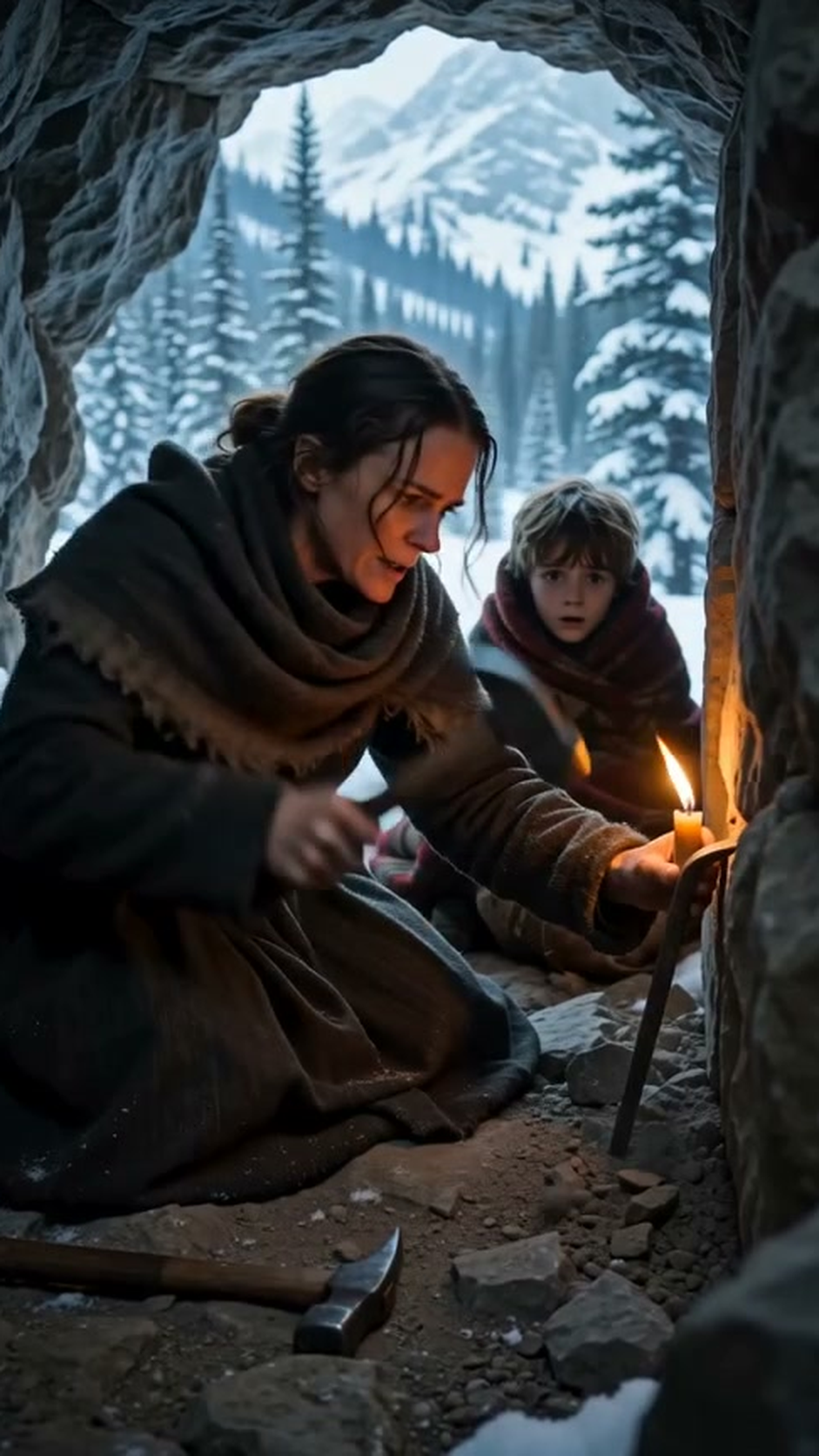
The storm hit them at noon like a wall falling. By the time Martha dragged the sled the last fifty yards over the rocks and got Samuel inside the cave mouth — howling wind, snow needling sideways, the pines below already swallowed white — the boy was shivering with a violence that terrified her more than the fever's heat had. She built the fire where the old ash lay, in the exact blackened ring of Isaac's survey fires, and as the first flame took and the cave breathed out its smell of stone and old smoke and shelter, Samuel opened his eyes and looked past her, at the rough inner wall, and said with a dreamer's perfect clarity:
"Papa's wall."
Then his eyes rolled back, and the fever took him down again, and Martha Sullivan was alone in the howling dark with a candle, a hammer's weight of questions, and a wall that her dying son had named like an old friend.