TAP.
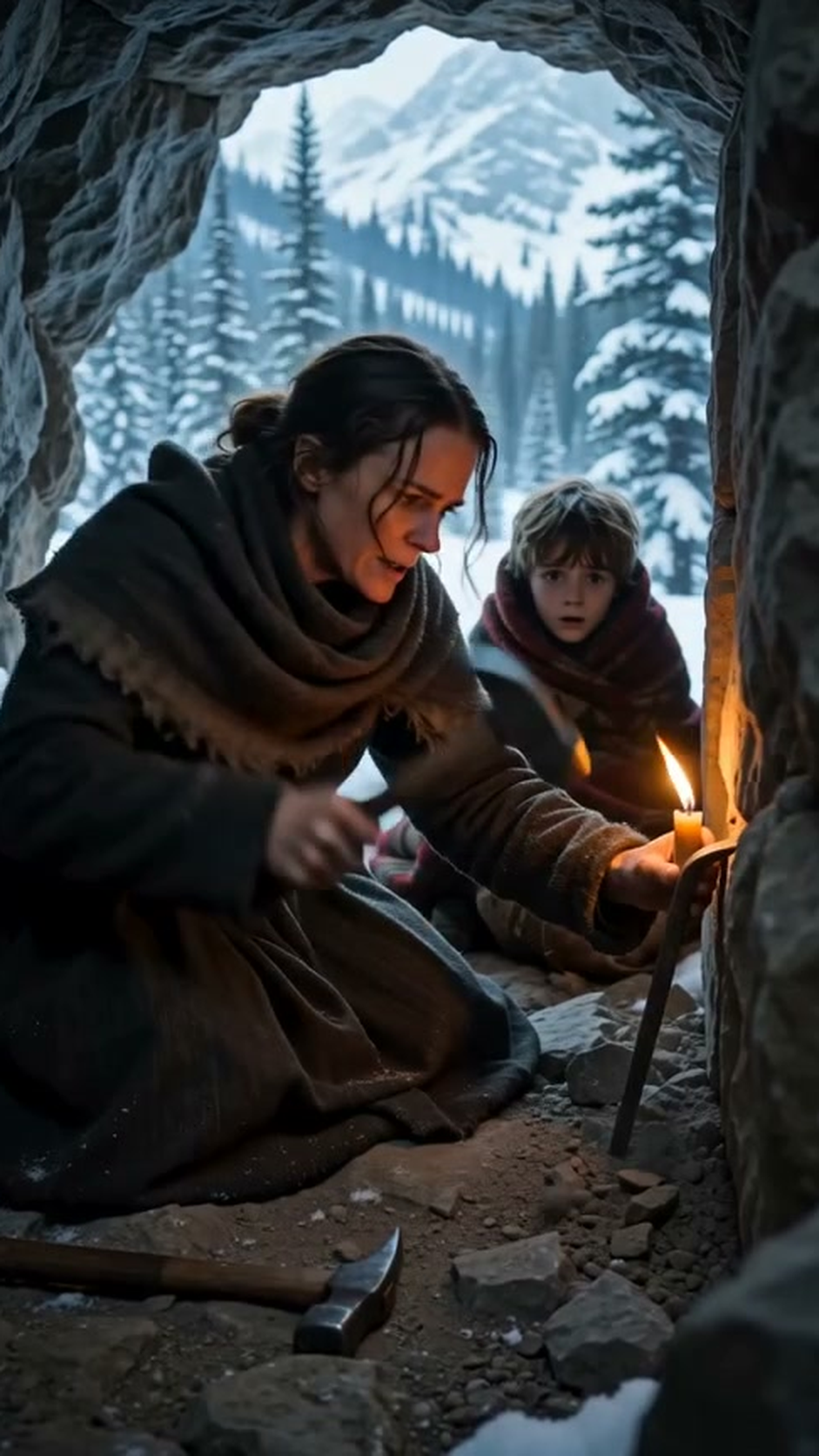
The hammer struck the smooth stone and the mountain answered wrong.
Martha Sullivan had swung a carpenter's hammer ten thousand times in her life — mending fence rails, shingling the cabin roof beside her husband, prying frozen nails out of barn boards in January. She knew the honest sound of iron on rock, a flat, final crack that died where it was born. This sound did not die. It traveled. It rolled away behind the stone and came back to her hollow and deep, the way a voice comes back across a canyon, and her whole arm went still with the hammer held inches from the wall.
Tiny fragments of ancient mortar sifted down through the candlelight and pattered onto the cave floor.
Behind her, wrapped to the chin in the red-and-brown patterned blanket, her son shifted on the bed of pine boughs.
"Mama… what was that?"
Samuel's voice was thin as thread. Three days of fever had burned the strength out of it, and the sound of that weakness did what no fear had managed to do all winter — it steadied her. Martha lowered the hammer slowly and turned her head just enough that he could see her face in the candle glow and know she was not afraid. She was afraid. But he could know she wasn't.
"Something your papa would have wanted to hear," she said. "Lie still now."
She brought the candle closer to the wall, cupping the flame with a palm already split and bandaged from hauling firewood, and the light found what her fingertips had found an hour before by accident: a seam. A narrow, straight, unnatural seam running between the stones of the cave's inner wall, too even for God or geology, with a breath of cold air sliding out of it that bent the candle flame sideways like a finger pointing into the dark.
"This isn't natural stone," she whispered.
She had been sheltering in this cave for two days, and she had believed it was only a cave — a survey camp her husband Isaac had used years ago, marked with a small cairn and remembered in a line of his field notes. A place to wait out the storm with a sick boy until the pass cleared. But the wall at the back of it, the wall she had leaned their supplies against without a thought, had been built. Stone by stone. By hands. Deliberately, the way men build a thing they intend to keep.
Her eyes went to the weathered wooden box beside her knee. She had found it under a shelf of old stores when she was hunting for dry kindling — a pry bar, an iron wedge, spare candles gone soft with age. And the hammer. She turned the hammer now toward the light, the way she had turned it a moment before the first strike, and read again the two words carved deep into the handle, blackened by decades of other men's sweat.
CALEB FOSS.
She knew that name. Every Sullivan knew that name. It lived in the front of Isaac's oldest survey book, written in a hand that was not Isaac's: For I. Sullivan — remember the mountain remembers. Caleb Foss, who had surveyed Blackstone Mountain beside Isaac's father when the territory was young. Caleb Foss, who had walked into these hills one October with his chain and his compass and never walked out of them again.
"Caleb Foss…" The words came out of her barely louder than the wind worrying the cave mouth. She looked at Isaac's worn leather satchel where it lay beside Samuel's bed, and something cold that had nothing to do with winter settled along her spine.
She set the wedge against the ancient mortar at the edge of the one rectangular stone that did not match its neighbors, and she raised the hammer.
CRACK.
The wedge bit. Dry mortar crumbled like old cake. She struck again, and again, until a narrow fracture came creeping out of the seam and spread between the stones like black ice on a pond. Her injured palm split fresh inside its bandage and she did not stop. Samuel had dragged himself closer, blanket and all, his eyes enormous in the firelight.
"Someone built that wall?" he asked.
"Yes."
She laid the hammer down and drove the pry bar into the widening crack with the heel of her hand, then leaned her whole starved weight on it. Her boots scraped on the rock floor. The wall gave back a low, grinding groan — and then, from behind the stone, faint and patient and impossible, came an answer.
TAP… TAP…
Samuel's hand locked around her sleeve. "Mama… there's something back there."
Together — she did not remember deciding; his small hands were simply beside hers on the iron — they pushed. The stone moved. GRRRRIND. Dust sifted from its upper edge and a current of freezing air rushed out through the gap, air that smelled of deep earth and old iron and time, and the candle flame bent nearly flat. Martha braced her shoulder, set her jaw, and pushed one final time, and the great stone shifted inward with a sound like a held breath released, and a narrow black opening stood where the wall had been whole.
Cold air spilled over her face. The candlelight reached three inches into that darkness and died. And in the black beyond it, something heavy shifted, faintly, the way a sleeper shifts — and a deep, hollow knock echoed out of the mountain's heart.
Martha raised the candle high. Her face, lit from beneath, was caught between terror and disbelief.
"What did they hide in here?" she whispered.
— SIX MONTHS EARLIER —
Isaac Sullivan came home three days before he died with snow on his shoulders, excitement in his eyes, and a lie ready on his tongue about where he had been.
Martha knew every one of his surveyor's moods the way she knew weather. She knew the flat look of a job that had gone badly, the tired look of a long chain line, the banked-fire look of a man checking figures he didn't trust. This was none of those. This was the look he'd worn the day he asked her to marry him, standing in her father's orchard with his hat in both hands — joy with fear underneath it, like gold under river gravel.
"Tell me," she said, and set down the iron.
"There's an error in the Pike survey," he said. "I've suspected it for a year. Now I can prove the width of it. The boundary line on the north face isn't where Harlan Pike's deed says it is, Martha. It isn't within a hundred yards of where it says it is. Somebody moved that line on paper, years ago, and everything Pike claims on the north face — the timber, the water, the silver showing — sits on the wrong side of it."
"On whose side of it, Isaac?"
He took her hands. His were shaking.
"Ours."
It should have sounded like a fairy tale, and part of her — the part that had married a land-poor surveyor for love in a county that thought her mad for it — heard it exactly that way. Six hundred acres. Timber beyond counting. The spring that fed the valley in dry years. Silver, showing in the north face in veins the assayers whispered about in Pinewood like a rumor of war. It was the difference between Samuel growing up a tenant on scraps and Samuel growing up a prince of one black mountain. It was the difference between Martha's widowhood, if widowhood ever came, being a beggary and being a fortress.
But she had also been a schoolteacher before she was a wife, and she knew the thing about fairy tales that children don't: there is always a part where somebody has to walk into the dark wood and say the true thing out loud, and the wood does not always let them walk back out.
"Who else knows you've proved it?" she asked.
"Nobody." He was already rolling the field book into its oilcloth, quick and practiced. "That's the whole of my plan, Martha, and I want you to hear it from me so you'll know I wasn't careless. I tell no one. I write to no one. In the spring, when the passes open, I ride to the capital with a witness — Judge Whitlock's own clerk has a brother who's a notary, a man even Pike can't buy — and I file Caleb's figures and mine together, in daylight, in an office with a flag on it. Until then—" he put the book into the tin box where they kept the deed to the cabin and the marriage lines and Samuel's baptismal record, the archive of their whole lives, and closed the lid with a sound like a small, firm door, "—until then, the mountain keeps it. The mountain's kept it thirty years. It can keep it a little longer, now that it's got company."
She wanted to make him say the other thing — the thing about Caleb Foss walking into the hills with the truth in his pocket and never walking out — but Samuel was stirring in the loft above them, mumbling in the first shallows of sleep, and Isaac was looking up at the sound of his son's voice with his whole heart in his face, and Martha decided, in the way of wives since the world began, to let the dark wood wait until morning.
It was the last ordinary night of their marriage. She would think about that later, all winter, on the nights when thinking was the only labor left to her. How the lamp had burned. How the figures had lain between them on the table like a map of a country they were about to emigrate to. How he had said ours.
That night, after Samuel was asleep, he showed her the field book. Column after column of his small, exact figures. The territorial survey of 1859, made by his father and by Caleb Foss, set against the recorded survey Pike's father had filed in '59, the one on which the Pike deed rested. Where the old line ran true, the new line bowed — a smooth, deliberate, profitable bow, swallowing six hundred acres of the Sullivan grant into the Pike claim as neatly as a snake swallowing an egg.
"Caleb saw it first," Isaac said. "Father always said so. Caleb Foss found the bow in that line when Pike's father filed the deed, and he went to the land office to swear to it, and he never came home. They found his horse. They never found him. Father spent twenty years being called a liar and a fool for saying the mountain was ours, and he died saying it, and everyone in this valley was too tired or too afraid of the Pikes to say it with him." His thumb moved over the carved initials inside the field book's cover. "But Caleb was no fool, Martha. A surveyor who knows he's about to be silenced doesn't carry his proof in his pocket. He puts it somewhere the mountain will keep it."
"You think he hid it," she said. "In the old survey cave."
"I think I've found where. And I think by spring I'll be standing in the land office with Caleb Foss's own figures in my hand, and Samuel will grow up on his own mountain, and no Pike will ever again—"
She put her fingers over his mouth, laughing and frightened at once. "Come home safe from it first," she said. "Promise me that first."
He promised. Three days later, in the last week of October, Isaac Sullivan went up Blackstone Mountain with his chain, his compass, and his guide — a quiet man named Doyle Rusk who worked sometimes for the railroad and sometimes, though Isaac didn't know it, for Harlan Pike.
Only Rusk came down.
A ledge had given way, Rusk said, on the north face traverse. A loose stone. A fall of two hundred feet onto the rocks above the tree line. He had wept, convincingly, at the graveside, and Harlan Pike had stood across the open grave from Martha with his hat over his heart and his eyes dry as paper, and when the service ended he had taken her elbow — gently, the way you'd steady a stranger — and said, "A widow with a boy needs friends, Mrs. Sullivan. When you're ready to talk about the south meadow, my door is open. A fair price. For the boy's sake."
She had understood him perfectly. The south meadow was not what he was buying. He was buying her signature under his, and her silence, and her son's mountain — priced at whatever grief would accept.
Martha Sullivan had buried her husband, and sharpened the axe, and begun to wait for winter.
On the third day after the funeral, when the last of the neighbors' casseroles had been scraped and the house had gone back to its own sounds — the stove ticking, the wind worrying the loose shutter Isaac had meant to fix, Samuel asleep at last with his wooden horse still fisted in one hand — she took the tin box down from the shelf and opened it on the table.
Marriage lines. Baptismal record. The deed to the cabin, in Isaac's grandfather's name, gone soft at the folds. And the field book, still in its oilcloth, smelling faintly of lamp oil and her husband's hands.
She did not open it. Not then. She understood, with a clarity that frightened her, that the book was the most dangerous object in the valley — that men had already died in the neighborhood of what was inside it, one thirty years ago and one three days ago — and that her safety and Samuel's, for exactly as long as she could manage it, consisted of the whole world believing it had gone down the mountain and into the ground with Isaac Sullivan.
So she did the thing Isaac would have done, the surveyor's thing, the patient thing. She wrapped the book in its oilcloth, and then in a second cloth, and put it in his old leather satchel with the brass buckles, and she set the satchel at the back of the pantry shelf behind the bean crocks, where a searching man would have to move a widow's whole winter to find it. And she stood a moment with her hand flat on the pantry door, in the cold, in the quiet, and spoke to the house, and to the mountain, and to whatever of Isaac Sullivan was still listening.
"You come home safe to me in the end," she said. "One way or another. I don't care what it costs. That's a promise back."
Then she blew out the lamp, and went to bed in the dark, and did not cry, because Samuel was asleep in the next room and she had decided about crying in the pantry with the pencil: it was a thing she did at night, silently, standing up, like work.
Winter was coming down off the mountain already. She could hear it in the chimney.