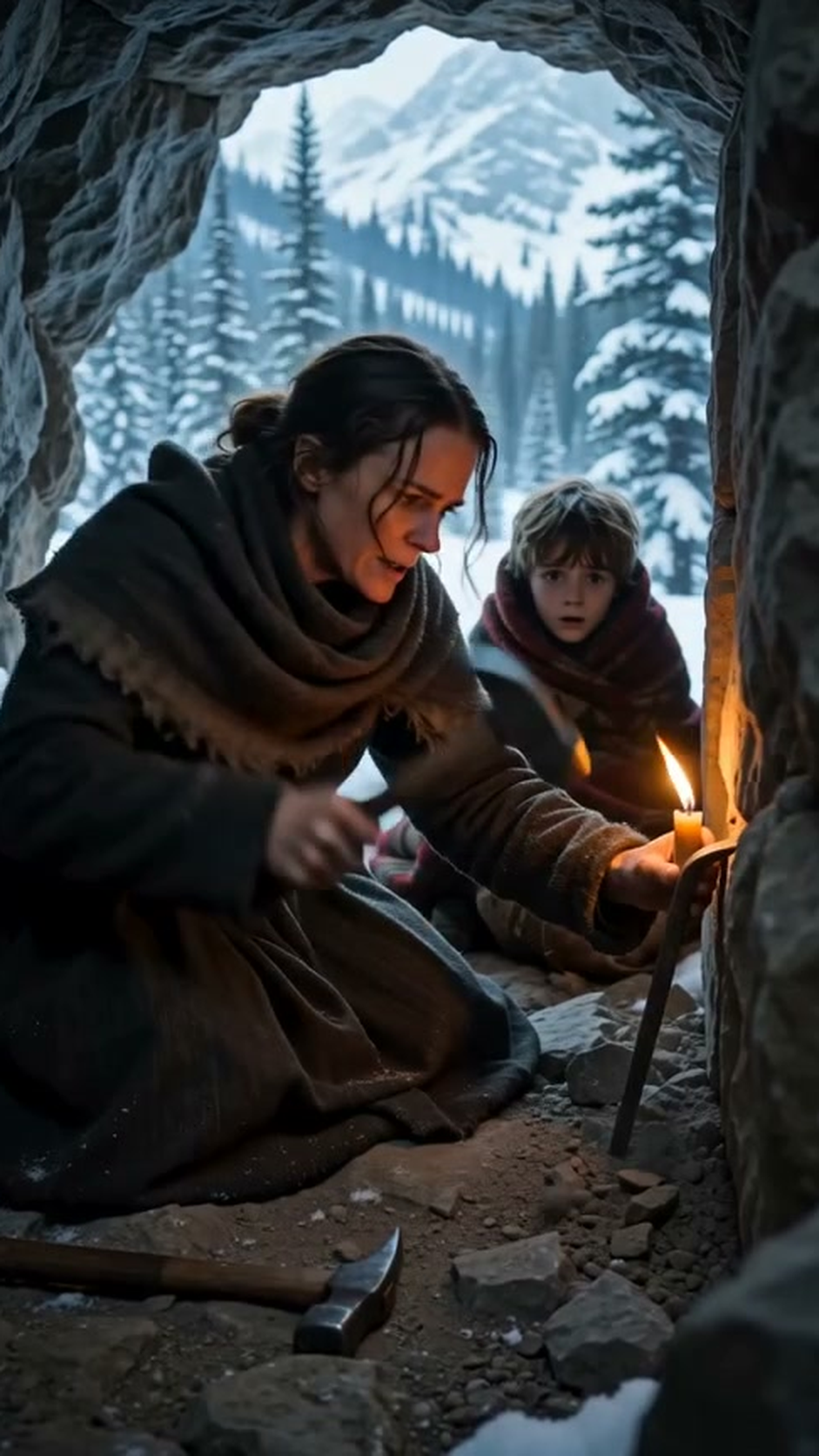
The fever broke on the second night in the cave, the way it had broken at home — in a flood of sweat and a sudden, exhausted peace — but this time it stayed broken.
Martha knew better than to trust it entirely, and she did not trust it entirely, but she let herself weep into her shawl for exactly the length of one hymn while Samuel slept the deep, slack sleep of a body that had won. Then she got up, banked the fire, melted snow for broth, and began, methodically, the way her husband had taught her to walk a survey line, to learn the cave.
It was bigger than it looked from the mouth. The entrance chamber ran back thirty feet beneath an overhang of black stone, dry as a church in the rear where the old survey camp had been: a shelf of rough planks, a store of split wood gone gray with age, tins whose labels had rotted to ghosts, a tripod's three legs bound with wire. Generations here — her husband's grandfather's people, then Isaac's father, then Isaac. Sullivans had been wintering their secrets in this cave since before there was a Pinewood. On the plank shelf, wrapped in oilcloth against the damp, she found a tin plate, a fork with two tines bent, and a surveyor's chain coiled like a sleeping snake, every link polished by dead men's hands.
She made a proper inventory then, because inventory was a form of prayer she understood. Dry wood for ten days, if she was careful, and more to be had from the deadfall at the cave mouth if the storm allowed. A seep at the rear of the entrance chamber where meltwater came down through the rock in a thread no thicker than yarn — clean, constant, and, she understood looking at it, the reason this cave had served four generations: a well that never froze and never had to be visited in the open. The old fire ring sat exactly where the draft drew the smoke up and out through a crack in the roof, so that from below, in the valley, a fire here would show as nothing but heat-shimmer over black rock. Somebody — Caleb, probably, or Isaac's grandfather — had thought about this place the way a general thinks about a fort. It was not a hole in a mountain. It was a position.
On the underside of the plank shelf, at the height of a kneeling man's eye, she found the tallies. Generations of them, cut with a knife in a patient hand: initials and years, a record of who had wintered in the cave and when. J.S. 1858. C.F. 1859 — and beside that year, a second mark, a line cut deeper than the rest, at an angle, like the start of a letter never finished. Then her husband's father's initials through the sixties and seventies, thinning out. Then, last of all, in a hand she would have known in the dark:
I.S. — and beneath it, dated two Octobers ago, a small, exact star.
Isaac had marked his place in the family record on his last visit to the cave, in the same week he wrote the final entries in the field book she hadn't yet read. He had stood where she was standing, knelt where she was kneeling, and cut his initials into the family tree of this stone room like a man signing a register he expected to be read. Martha put her fingertips into the cut of that star and stood there a long time, while Samuel slept and the fire settled and the storm gnawed at the mountain outside like something that had been promised a meal and meant to collect.
And behind the stacked stores, against the rear wall where she'd propped their flour sack the night they arrived — the box.
Weathered wood, iron-bound, heavy out of all proportion to its size. She worked the rusted hasp with the fork and lifted the lid on a smell of machine oil and old leather: a pry bar, oiled and bright. An iron wedge. Spare candles, a dozen, gone soft at the edges but sound. And lying across them all like a sleeping tool in a coffin, a carpenter's hammer with a handle of dark, dense wood, polished to silk by use.
She turned it to the firelight. Her heart was going strangely before she even read the words, because her hands already knew the weight of the thing — Isaac's hands had known it; she had watched him lift this very hammer, years ago, in this very cave, laughing about how a carpenter's tool had no business in a surveyor's kit, how his father swore by it for driving boundary stakes. Two words were carved deep into the handle, the cuts old and black:
CALEB FOSS.
"Well," Martha said softly, to the cave, to the winter, to all the patient dead. "There you are."
That night, with Samuel sleeping warm and breathing easy for the first time in a week, she read Isaac's last field book from the beginning, the way you read a letter you are finally ready for.
Most of it she knew — the figures, the two surveys laid side by side like dueling pistols, the bow in Pike's line swallowing six hundred acres. But the last pages she had never seen. Isaac had filled them in the final week of October, in a hand that got smaller and tighter as it went, as if he feared the book itself might be read over his shoulder.
Oct. 18. — Found Father's cairn line intact and followed it in a rising wind. The cave is as I remember it from boyhood, but smaller, the way all the rooms of childhood are smaller. The tallies are still under the shelf. I have added my mark. If Samuel ever stands here, God grant it is in better weather, and for a happier errand.
Oct. 19. — Tested the rear wall with the hammer, as Father taught me when I was twelve and swore me to silence about the sound of it. The sound has not changed in twenty years. Hollow from the third course to the seventh, solid at the corners, exactly as a built thing sounds. I did not strike above a whisper. I am not ready to be the man who opens it, and I will tell the truth about why: I am afraid. Not of what is behind it. Of what it will mean to be right. Father was right for twenty years and it fed him nothing but contempt at the saloon. Being right is a heavier chain than being wrong, and I intend to carry it straight to the capital and set it down in front of men with flags, or not carry it at all.
Oct. 20. — The box is where Father said Caleb left it. The hammer is in it. I held it a long time. The name is cut deep enough to read by touch. A man carves his name like that on the tool he'll be buried with, or the tool he means to be found by.
Oct. 21. — Worked the old cave. The wall is as Father described it, God rest him — built, not born. Counted nine courses. One stone at the center set in newer mortar than the rest, or older; cannot yet say which. Someone has been IN, since Caleb. Or someone was meant to think so.
Oct. 23. — Rusk asks too many questions about my schedule and none at all about the work. Noted.
Oct. 24. — If the figures in the territorial book are true, then Caleb's cache is behind that wall and the grant is behind it too, and this mountain was never Pike's — not the north face, not the spring, not the silver showing. It is Samuel's. All of it. By law and by blood. I will open it when I can come back with a witness I trust. Until then the wall keeps its own counsel, as it has for thirty years.
Oct. 25. — Rusk says the north traverse can be done in a day if the weather holds. It has never been done in a day. Noted, and wondered at.
The entries stopped there. The next page was blank, and the next, and Martha sat looking at the blank pages for a long time while the fire ticked and settled, understanding that she was holding the last week of her husband's life written out in surveyor's shorthand, and that the final entry was the whole of it: Rusk says the north traverse can be done in a day. It has never been done in a day.
It was not a ledge that had killed Isaac Sullivan. It was a schedule. A man in a hurry, herding a surveyor onto a dangerous face, on a day chosen for its dangers — and she'd have wagered the cabin, the mule, and her wedding ring that Doyle Rusk's hurry had been bought and paid for, in Harlan Pike's coin.
She closed the book with hands that did not shake, because she had decided, somewhere in the reading, that shaking was a luxury for women whose husbands had died by accident.
"Papa's wall," Samuel had said, out of his fever. Children heard things. Children in that weightless country between fever and sleep heard everything. Isaac had brought the boy up this mountain two summers ago, a six-year-old riding the mule's packsaddle, and had shown him the cave, the shelf, the black wall at the back — and had told him stories, the way fathers do, not knowing which ones would matter. Samuel knew. Samuel had always known; the knowledge had simply been waiting in him, like the cache behind the stone, for the hour it was needed.
On the third morning she climbed to the cairn above the cave mouth with Isaac's spyglass, meaning to check the pass, and stood a long time with the glass pressed to her eye and the wind worrying her skirts.
The valley lay below her in a bowl of blue shadow and brilliant snow, the cabin a dark thumbprint, Pinewood a thread of smoke on the horizon. And on the trail — the proper trail, the one her false note pointed away from — four riders were coming up the mountain in single file, strung out like beads on a string, in no hurry at all. Men who knew their quarry had nowhere further to run. Even at that distance she could pick out the long oilskin coat of the second rider, a coat she had last seen on a man standing across her husband's open grave with his hat over his heart and his eyes dry as paper.
Harlan Pike was not waiting for January. Harlan Pike was not waiting for men to have to come.
Harlan Pike had come himself.
Martha lowered the glass. Her heart was slamming, but her mind had gone very quiet and very clear, the way it had gone in the pantry with the pencil, counting flour. The riders were an hour below her, perhaps two in the snow. The pass behind the mountain was drifted shut and would stay shut till spring; the only road out of this cave ran down past those four men, and the only thing in this cave worth a rich man's climb in a storm was a secret behind a stone wall — a wall Isaac had died refusing to open without a witness.
She looked at her son, asleep in his blanket with color in his cheeks for the first time in days. She looked at the hammer where it lay by the box, patient as scripture. She looked at the wall — nine courses of stone, one rectangular block at the center, set in mortar of a different age.
A witness, Isaac had written. He'd wanted a witness before he'd open it.
"Samuel," Martha said quietly, and then, louder, waking him gently as the first thin thread of chimney smoke from her own fire rose up through the rocks to tell the whole valley exactly where she was, "Samuel, wake up, love. Mama needs your help. We have work to do before our visitors arrive — and you're the only witness your papa's got."