The wagon that met the Tuesday stage at Alder Creek was driven by a man of about sixty with a face like a kind hatchet, who took Edith's suitcase out of her hands before she could arrange to keep hold of it, and said, "Miss Mayburn. Amos Teller. I fetch for the Grady."
He did not stare. In nine miles of rutted road, with nothing to look at but her, the horizon, and his team, Amos Teller managed to look at the road with the steady courtesy of a man who had decided in advance that a person's face was her own property. Edith, who had been bracing since Missouri for the flinch, found the not-staring almost harder to bear. Somewhere around the fourth mile she said, all at once, "You may as well ask, Mr. Teller. Everyone does."
"Ask what, miss?"
"How it happened."
"Fire, I'd reckon," Amos said, to the road. "Old one. You'd have been a girl." He nodded once, as if a form had been correctly filled. "My wife — God rest her — had a sister burned worse, cooking over an open hearth. Lived to seventy-four and buried two husbands. You'll do how you do, miss. The boys'll come around to it." A pause with the reins. "Boss don't abide cruelty. You'll see that too."
Edith looked at the enormous sky and held on to both sentences the rest of the way in, one in each hand, like rails.
Then the yard. The barn, the long table under the open sky, the ranch house with its deep porch — and the men. She had known there would be men; she had not known they would all be there, arranged by their own curiosity along the fence and the table like a jury that had already heard the evidence. Amos set her suitcase down in the dust. Somebody's eyes found the left side of her face, and then everybody's did, the way a flock turns, and the laugh came — small, sideways, through a fist — and Edith Mayburn did the thing she had ridden four days and ten years to do.
She said it first, herself, before they could. "No one marries a scarred girl, sir." Not to the laughers. To the tall one coming out of the barn shadow with fence pliers still in his hand, who stopped several feet away and looked at her the way a man looks at weather he intends to stand in.
"But… I can cook."
"Can you feed fourteen?" said Coulter Grady.
"Yes, sir," Edith said, and something in her spine, which had been a rope for four days, became a spine again. "Show me the kitchen."
The kitchen nearly undid her, and it did it with hope. It was a good kitchen — a wood range with six lids, a pump at the sink, shelves waiting to be a pantry again — buried under three months of bachelors. There were beans fossilized in a pot. There was a skillet with something in it that she chose, professionally, not to identify. On the shelf by the stove there was an empty crock with STARTER painted on it in a dead man's careful letters, and the emptiness of it told her the whole history of the place more plainly than Amos had: somebody had kept this house like a heart, and then the heart had stopped, and everyone had been hungry and a little bit lost ever since.
Up at the house, Amos showed her the cook's room off the kitchen — small, clean-swept, a bed with a quilt folded at the foot — and then, because he was Amos, showed her the rest in four sentences while she tied her apron. "Boss's study there. Store room there. That door's kept shut; it's not locked against you, it's just shut, and it'll open when it opens." He did not say whose door it was. He did not have to. A house keeps its griefs in its floor plan, and Edith had lived in a house with a shut door of her own — the room in Herron's Ferry where her mother had died was kept shut for nine years, and Ruth had hung laundry in front of it. She nodded at Amos and asked where the well sweep was, and he looked at her with something that, in a younger man, would have been approval.
Before she lit the range, she went out to the pump with a basin, because four days of train were on her and she intended to meet this job clean. The water came up icy. She washed her face the way she always washed it — whole, both sides, no flinching, a discipline learned at fourteen in a doctor's office in front of a nurse who had cried — and she stood there a moment with the water running off her chin into the Nebraska dust, looking at the yard, the table, the men beginning to drift toward the smell of coffee like cattle toward a gate.
"Well," she said to no one, quietly, in her mother's voice, which she kept for occasions of consequence. "You've come this far on 'I can cook.' Cook, then."
Edith Mayburn knew exactly what to do with a house like that. It was, in the end, the only thing she had ever known what to do with.
She sent Ben — sixteen, the one who had carried her suitcase in and then hovered, stricken, because he had seen the yard and been ashamed of his friends — she sent him for flour, salt pork, potatoes, onions, coffee, and every egg the hens could be persuaded about. She cleaned as she went, the way her mother had taught her before the fire: a place for everything before a fire is lit under anything. She rolled her sleeves. She got flour under her nails and the range hot and the coffee on, and by the time the light had gone the color of a struck match she had biscuits rising and a skillet singing and a gravy that would have passed her mother's inspection, which was a sterner court than any thirteen cowboys.
Amos rang the bell himself. He did it, Edith would learn later, the way Gus used to, three slow strokes, because he had decided the evening deserved ceremony.
They came wary, the way men approach anything they've mocked before they knew it. They sat. They ate. The silence that took the table was not the silence of the yard; it was the other kind — the kind with forks in it. She watched Judd, the laugher, eat two biscuits with the concentration of a man defusing something, and reach for a third, and catch her watching, and color up to his ears.
"Ma'am," Judd said, to his plate, with the air of a man paying a debt in public, "that's the best meal I've had in years."
"There's more coffee," Edith said, because her voice would not yet do more than that, "if anybody can be bothered to fetch it like Christians."
It got the laugh — the good kind, the kind that has room in it for the person laughed near — and after that the table loosened all at once into men again: passing, reaching, telling Ben to slow down before he foundered. An old hand named Rafe, who had ridden for Coulter's father, pushed his empty plate an inch forward in the old signal and said, "Gus used to ring that bell and say grace over the weather, whatever it was. Said a man eating ought to thank something." He looked down the table at Coulter. "Reckon he'd allow we could thank the cook tonight."
"Thank the cook," said two or three of them, ragged, not quite in unison, and one of them was Judd, saying it loudest and worst-timed, like a man making up in volume what he owed in kind.
Edith stood in the kitchen doorway with the coffeepot in her hand and had to look hard at the lantern flame for a moment, because nobody, in nine years of Ruth's kitchen, had ever once thanked the cook — and because gratitude, she was discovering, is a much harder weather to stand in than laughter. Laughter she had armor for. This she had none. She fed them. She wrapped Ben's gashed palm after he'd tried to hide it, because a boy who'd been kind to her suitcase was not going to lose the use of a hand on her first night. She poured coffee. She served herself last, a small plate, standing by the kitchen door where the help stands, and she was so tired and so strange with a feeling she did not trust that she did not notice Coulter, at the far end of the table, not eating either — watching her take the last and least, and looking like a man revising a document he'd signed too fast.
The light went copper. The lanterns came on. She was carrying plates, three stacked, her sleeves still rolled, when Pierce spoke from the bench — low, not low enough, the way cruelty calculates: that Missouri must have a strange notion of sending a cook, sending out a Halloween mask with an apron on.
The plates stopped with her. Ten years stopped with her. Her eyes went down to them out of pure trained habit, and in that half-second she hated her own eyes worse than she had ever hated any man's tongue.
Boots in the dirt. Not hurried. A shadow crossing the lantern light, and Coulter Grady was standing between her and the bench, and the whole table had gone very quiet in the way of men who know a fence line when they see one drawn in front of them.
"You've got something to say about Edith? Say it so the table hears it."
Pierce said nothing. His smile had gone somewhere to die.
"She feeds you," Coulter said. "She cares for you. You'll show her respect." One step. The measured kind. "All of you. That's not a request I'm making twice."
Thirteen men looked at their plates. Amos, at the far end, looked at the sky instead, with the expression of a man whose private tally had just been confirmed in public. And Edith stood with the plates in her hands and a feeling rising in her chest that she had no name for, because in ten years no one had ever stood there. Not her father, God rest him, who had loved her and been tired. Not her brother, who was a child and then too young. No one. A stranger of eleven hours' standing had put his body between her and the oldest sentence in her life as casually as a man steps in front of a gate.
She set the plates down before her hands could shake them off.
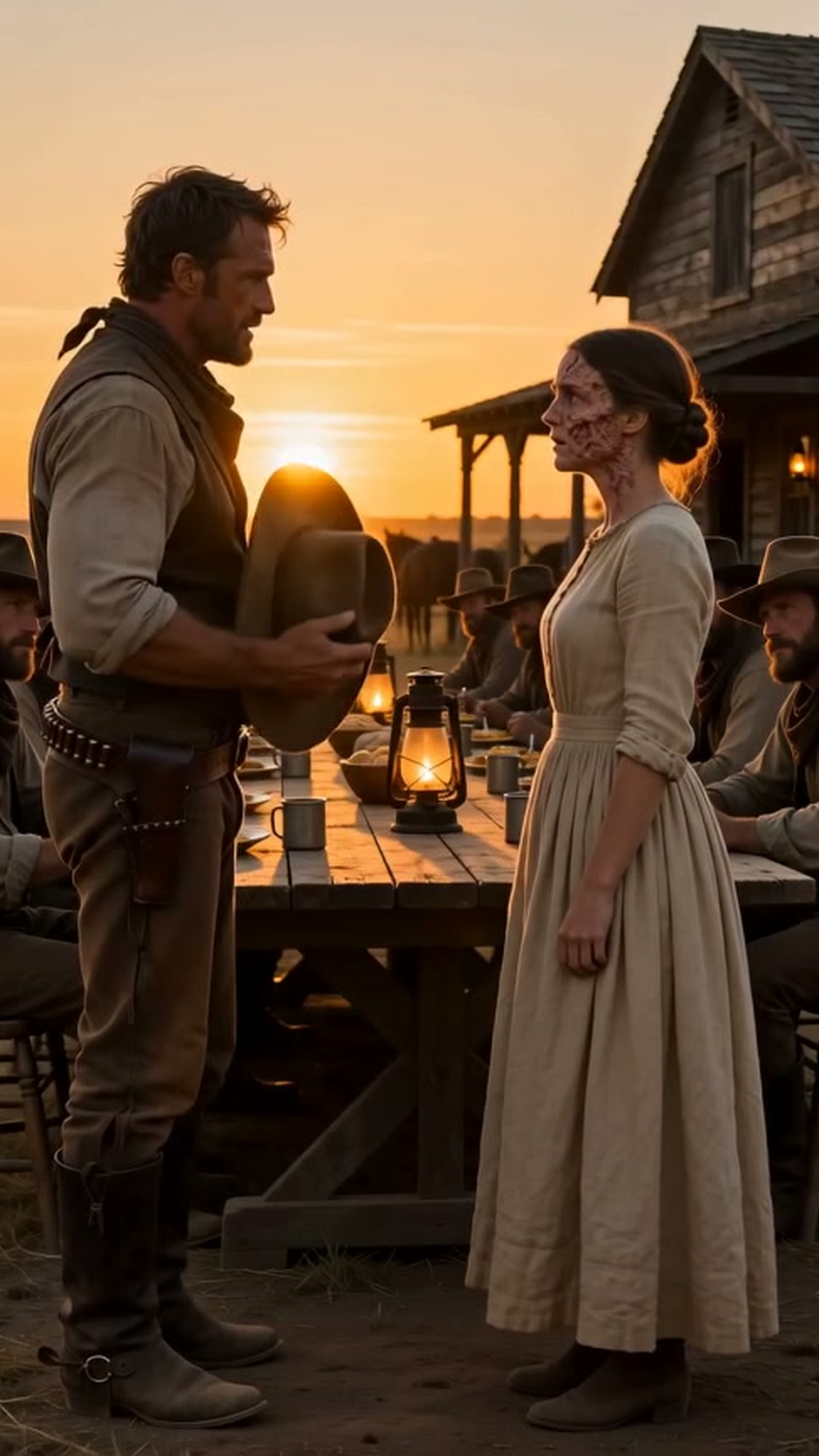
The yard had emptied of everything but lantern light and the smell of coffee and dust settling. Coulter came toward her across it, slowly, and as he came he took off his hat — the worn hat that had been part of his outline all day — and held it against his chest, and Edith understood, with a clarity that frightened her more than the laughter ever had, that men do not take off their hats to dismiss the cook.
He stopped a few feet from her. The cowboys had gone silent all down the table; even the horses seemed to have stopped at the fence to listen.
Edith's whole education stood up in her at once, every voice that had ever instructed her in what she was. Ruth at the table. Ruth at the church social. The widower in Calloway County with his two graves and his need of a third pair of hands, who had looked at her face across his own porch and said, well, she'd do for the work, in daylight, if she kept to the kitchen. The drummer on the train, staring a full minute. She braced the way she had braced at the wagon that morning — for the verdict, for the kindness that would turn out to be a dismissal, for the sentence a man delivers with his hat in his hands because he is about to be sorry at you.
And yet. He had stood between her and Pierce. He had eaten her food at the far end of the table and watched her feed his crew before herself, and whatever he was carrying across the yard toward her in his two hands with his hat, it did not feel — her heart was knocking too hard for her to be sure of anything, but it did not feel — like a dismissal.
"Whatever you're about to say, Mr. Grady," she managed, and her voice only shook on the name, "say it plain. I've had a long education in plain."
"I generally do," he said.
"Edith," he said. "This morning you told me something. You said—"
Her heart was a fist knocking. She knew the words. She had said them to mirrors, to Ruth, to God, to the dark of a train car. She had said them this morning as a shield. He was holding them now like something he intended to give back to her changed.
"No one marries a scarred girl…"
Coulter took one final step toward her.