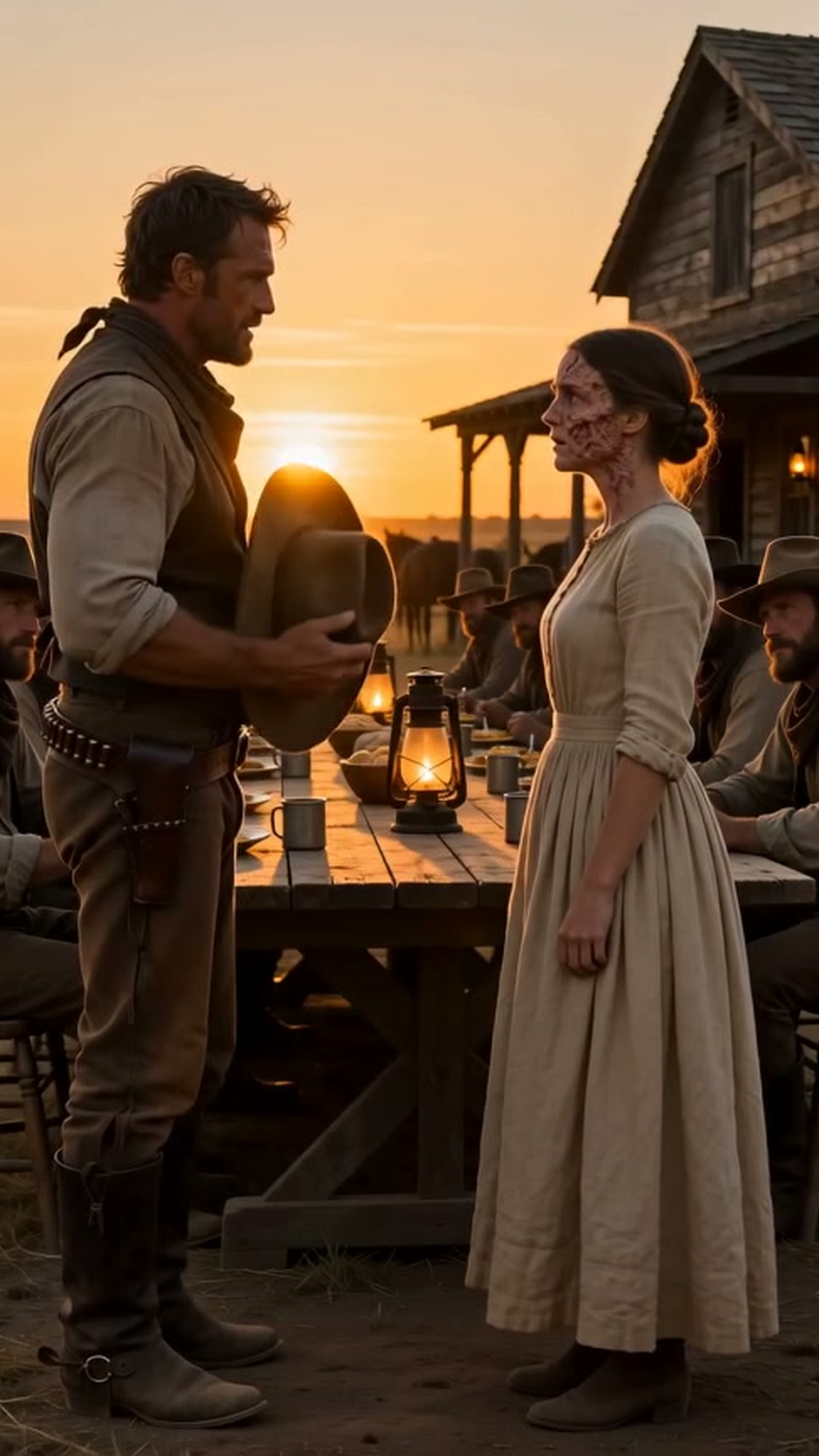
Coulter Grady had not placed the advertisement because he wanted a wife. He had placed it because his cook died, his men were mutinous, and Amos Teller had finally said the thing out loud.
"Boss," Amos said, in March, standing in the cookhouse doorway with a plate of beans that had the consistency of mortar, "Gus fed this outfit nineteen years. Since February we've had Judd burning water and Pierce poisoning us slow. A man can marry a cook or hire one, but a hire quits, and you can't afford a hire anyway. So."
The anyway was doing heavy work in that sentence, and both men knew it.
Grady Ranch was eleven hundred acres of good grass and better water along Alder Creek, and it was, in the spring of 1883, sixty days from being in serious trouble. The trouble had a name and a due date. The name was the First Bank of Alder Creek, which held a note for nine hundred dollars that Coulter's father had signed and Coulter had renewed twice; the due date was the first of June. Behind the bank, the way a big dog stands behind a small one, stood Harlan Beck. Beck owned the Bar B, the freight office, a third of the town's buildings, and — since the railroad surveyors had come through in the fall — a burning desire for the Grady water, because the railroad was going to need a water stop, and whoever held Alder Creek's year-round spring would hold the stop, the town's future, and a price per gallon that made cattle look like a hobby.
Beck had offered to buy the ranch in January, smiling, at a price that was an insult wearing a suit. In February he had offered to buy just the spring and the creek bottom, at a price that was worse. In March he had stopped offering and started mentioning the bank note in public, the way a man mentions weather he expects to turn.
Beck had come in person in March, the week before the advertisement, riding up in a buggy too good for ranch visiting, with his hat in his hand and his offer in his mouth like a second set of teeth.
"Sixty days to the note, Coulter," he said, pleasant as pie, standing in the yard where Coulter was shoeing the gray. "Bank's nervous. I'm prepared to be generous — take the whole place off your hands, clear the note, leave you enough to start over somewhere easier. A man alone, no wife, crew half-starved—" he let his eyes travel to the cookhouse, where something of Judd's was smoking, "—it's a young man's game, ranching. No shame in selling before the bank sells it for you."
Coulter set the gray's hoof down with great care, because his hands wanted other work. "My father took this valley when there was a price on his hair, Harlan. He didn't find it easier anywhere. Neither have I."
"Your father had a wife to run his house and sons coming up behind him." Beck put his hat back on. "You've got a grave and a bunkhouse, Coulter. Sixty days." He climbed into the buggy. "I'll keep the offer warm."
He had kept it warm the way a fire is kept warm in another man's field. Coulter had heard, since, that Beck's lawyers were asking in Lincoln about the original water filing on Alder Creek — the 1851 priority claim his father had recorded, senior to every claim in the county, including Beck's. What Beck wanted was not really the ranch. It was the paper. Whoever held the senior water right held the railroad's throat, and Harlan Beck intended to be holding it when the survey stakes became a depot.
Coulter's father had built the ranch out of a homestead claim and thirty years of dawn. Coulter had buried him, and then buried his mother, and then, six years ago, buried Mary.
Mary Grady had been twenty-two, a schoolmaster's daughter from Kearney with ink on her fingers and opinions about everything, and she had died in eleven hours of a childbed fever with their son dying ahead of her, in the room that was now Coulter's study because he could not sleep in it and could not give it away. For six years the ranch had run on his refusal to feel any of it. He worked. The men worked. Gus cooked. The machine held.
Then Gus died in his sleep in February, with the sourdough starter still warm on the stove, and the machine began, audibly, to come apart.
The six weeks between Gus's funeral and the advertisement were entered in no ledger, but every man on the place could have recited them. Judd's biscuits achieved a density that Amos claimed violated treaty. Pierce, assigned the stew, produced a pot that two men swore moved. The sourdough starter — Gus's starter, older than Ben, carried west in a crock in '64 — died of neglect in the second week, and the bunkhouse held a silence for it that was only half a joke. The men began riding into Alder Creek for suppers at the hotel and coming back poorer and uglier-tempered. Two hands quit in April. A ranch, Coulter understood, is held together by fences on the outside and meals on the inside, and both of his were failing at once.
So Coulter wrote the advertisement at the kitchen table, in his fence-post hand, and Amos read it over his shoulder and snorted.
"WANTED. A WIFE. MUST BE ABLE TO COOK FOR FOURTEEN MEN. AGE AND APPEARANCE OF NO IMPORTANCE." Amos shook his head. "You've wrote a bill for a mule, Coulter."
"I've wrote the truth," Coulter said. "I'm not courting. I've done my courting. I need a woman who'll keep this house and feed this crew and stand the country. The rest of it—" He stopped. "The rest of it's hers to say."
The letters came in over five weeks, nineteen of them, and Amos — because Coulter read the way a man crosses a river in the dark, slowly and with respect for the current — read them aloud at night. There were widows who wanted his acreage itemized. There were two sisters from Ohio who appeared to be auctioning themselves. There was a lady from St. Louis whose letter smelled of scent and mentioned, twice, that she had been told the Grady water would soon be very valuable, and Amos set that one aside without comment and Coulter burned it without reading the rest.
The eighteenth letter was from Missouri, and it was in a hand so clean it looked printed.
She wrote that she was twenty-four and strong and not afraid of work or weather. She wrote that she could cook for a harvest crew, keep a house, and keep a set of books in a fair hand. She wrote that she had raised her younger brother from six and buried her father in January and that she was, at present, her stepmother's unpaid cook, so the work would not be a novelty. She did not mention his land. She did not mention his water. She mentioned, in a postscript that Amos read twice, that she made gravy without lumps because she had been taught that gravy was where you could tell whether a cook was paying attention, and that she was, in all things, a person who paid attention.
"That one," Coulter said.
"She don't say what she looks like," Amos observed.
"Advertisement didn't ask."
"She don't ask what you look like neither."
"No," Coulter said. "She doesn't."
He wrote back eleven lines. It took him an hour. He sat in the study — Mary's room, with the cradle still in the corner under a sheet because there were some things a man could not burn and could not use — and he wrote and crossed out and wrote, because eleven lines to a stranger ought not to be hard for a man who had faced down blizzards and Beck, and they were the hardest writing of his life. Fare advanced. Wage until you decide. House is sound, crew is rough but not wicked. Country is hard. I am not a man for pretty letters. That was the best of him, and he sent it.
Amos, who had known him thirty years, watched him seal it and said nothing at all, which was the loudest thing Amos knew how to say.
The night before the wagon was due, Coulter did something he had not done in six years. He opened the door of Mary's room and stood in it a while, looking at the sheeted cradle, the empty chair, the peg where her apron had hung until the moths and his own endurance gave out in the same winter. "I'm not replacing you," he said to the room, which was not an apology and not a permission, just a man reporting in. "I'm feeding the crew. That's all this is." The room said nothing back, which he had learned to count as its way. He shut the door gently and went out to check the horses, and did not sleep much, and told himself it was the bank note keeping him awake, and was not so far gone in self-deception as to believe it.
The men found out, of course. Men on a ranch find out everything except what you tell them. By the time Edith Mayburn's train had crossed into Nebraska there was a pool in the bunkhouse — money on her age, money on her temper, money, from Judd, who was twenty and had a laugh where his judgment ought to be, on whether she'd last a week. Pierce, who had hired on in January and asked more questions about the spring and the bank than a cowhand had any business asking, put two dollars on her running by Sunday and said it like a man saying grace.
Amos, meanwhile, had taken to keeping a private tally, the way old foremen do. Pierce had ridden into town three Sundays running on errands no one had sent him on. Pierce had asked, casual as you please, whether the boss kept the old land papers in the study or in the bank's box in town. Pierce's boots were too good for his wages and his horse was better. Amos had said nothing yet, because thirty years teaches a man the difference between a suspicion and a rope, but he had begun sleeping with the tally open, so to speak, and when the new cook arrived he intended to know exactly where Pierce was standing at all times. A woman in the house changed the geometry of a place. Amos meant to be ready for the angles.
On the Tuesday of her arrival, Coulter worked the north fence until the light began to fail, and tried, with the discipline of six years' practice, not to think about what he was hoping for. He was not hoping for Mary. He had buried hope with Mary and he was not a man who dug things up. He was hoping for competence. For quiet. For a house that smelled like food instead of dust, and a crew that would stop looking at their plates like men at a funeral.
He was not — he told himself, riding in with the sunset going copper over the creek bottom — hoping for anything whatsoever in a cream-colored dress.
The bunkhouse pool had closed that morning at four dollars and thirty cents, held by Ben, who was too young to know what to do with dishonest money and had written every bet in a copybook in his round school hand. Judd had two bits on her being forty and one on her being a widow with a temper. Nobody — this was afterward remembered, and not kindly — nobody had put so much as a nickel on the possibility that the boss's Missouri cook would be twenty-four years old, would step down off that wagon with her chin up, and would feed them, inside of three hours, the best meal any of them had eaten since Gus died. Amos had not bet at all. Amos had a rule about betting on human beings, formed over thirty years, which was that it told you the odds on the bettors.
Amos met him at the barn door with the wagon dust still hanging in the yard behind him.
"She's here, boss," Amos said. "Wagon's just in. She's—" The old man hesitated, and Coulter, who had never in thirty years heard Amos Teller hesitate, felt the day tilt. "She's got a face that's been in a fire, Coulter. Half of it. Old scars. The boys have seen already."
Coulter set down the fence pliers. He thought about the letter in its clean hand. I am, in all things, a person who pays attention.
"Did she say anything?" he asked.
"Not yet."
"Then neither will I," Coulter said, and walked out of the barn into the yard, where a young woman in a cream dress stood beside a dusty wagon holding a battered suitcase in both hands, and thirteen men were looking at her face, and one of them had just begun to laugh.