The farm was dead. That was the first thing Lenora Vale understood as she stepped down from the buckboard into grass up to her knees.
The cabin leaned at the far end of the hollow with half its roof caved in like a kicked hat. The barn sagged worse, its ridgepole bowed, its doors hanging by one hinge each. A fence ran crooked down to a ribbon of creek and gave up halfway. Nothing moved. Nothing made a sound but the wind worrying the tall grass and the tired horse blowing behind her.
Everything she owned in the world was on that wagon. A rolled quilt her mother had stitched before the fever took her. An iron skillet. A worn sack of flour and beans. A small wooden supply box. And in her apron pocket, wrapped in a scrap of calico, the whole of her fortune: seventeen dollars, saved a nickel and a dime at a time over six years of other people's kitchens.
Lenora stood in the ruined yard with her hand on the wagon wheel and made herself breathe. Twenty-four years old, broad through the shoulders from work that would have bent a man, brown hair dragged back into a braid that was already coming loose, dress the color of old dishwater, apron stained by six years of somebody else's stove. She had bought this place sight unseen at a county tax sale, and the whole town of Cedar Flats had laughed at her for it.
Then, from inside the black mouth of the barn, a cow lowed.
It was a weak sound. Thin. The kind of sound an animal makes when it has almost decided not to make sounds anymore.
Lenora turned so fast her braid whipped her cheek.
She crossed the yard at a run, skirts snagging in the weeds, and stopped in the barn doorway with one hand on the frame. The dark inside smelled of dust and old manure and something worse — the sweet, hopeless smell of animals giving up.
One cow stepped out of the gloom.
Lenora's heart stopped.
The creature was a rack of bones in a dusty hide, ribs showing like the hoops of a barrel, hip bones sharp as stones in a sack. It moved the way the very old move, placing each hoof like the ground might not hold. Behind it, another silhouette. Then another. Shapes separated themselves from the dark one by one, drifting toward the light on legs that trembled, until she could count them all standing in the broken shade beneath the fallen rafters.
Six.
"Six of you?" she whispered.
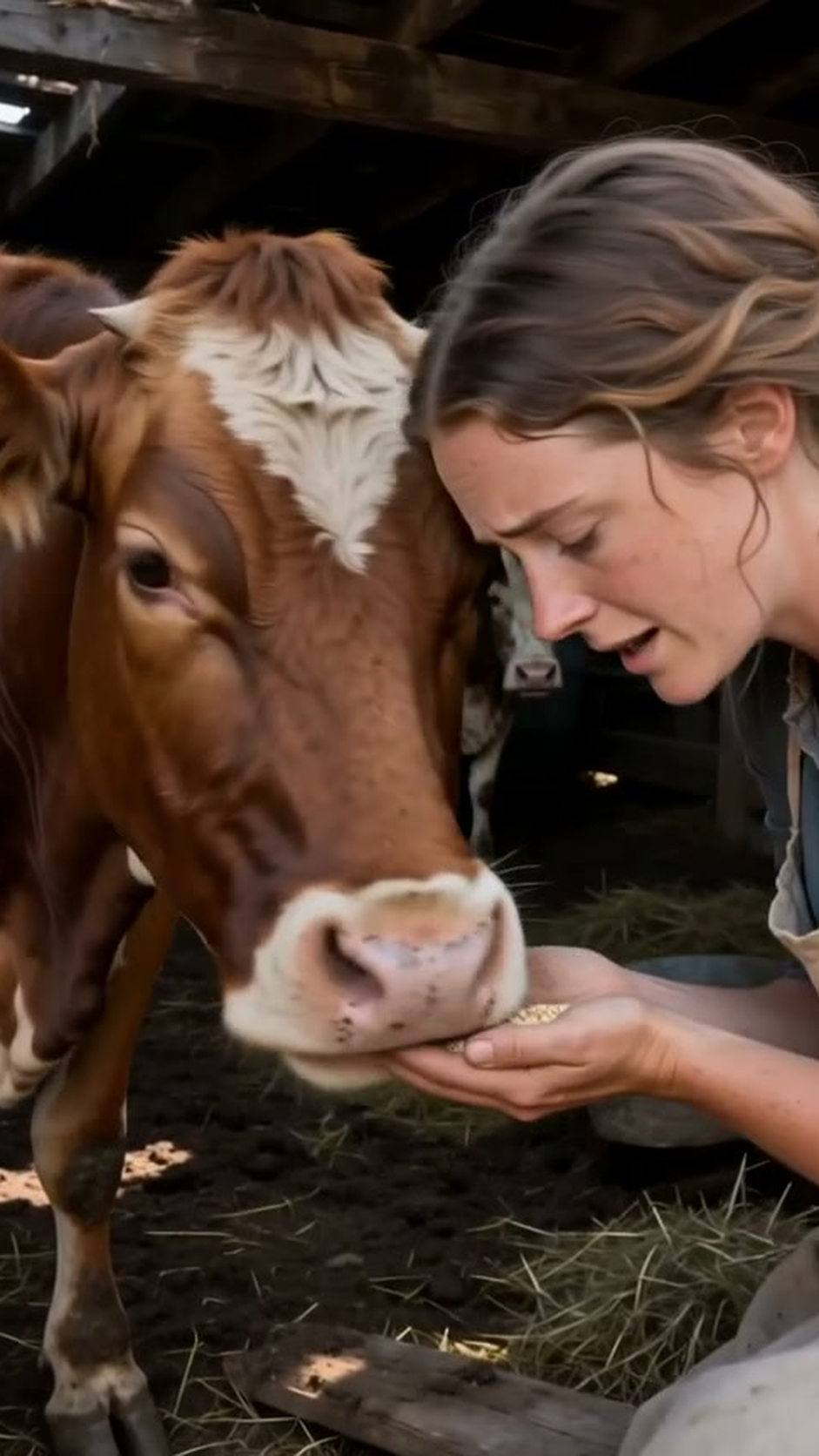
A red-brown cow, the strongest of the wreckage by a hair, came forward out of the others and stopped two paces off, regarding her with enormous wet eyes. Lenora's own eyes filled so fast she had to blink hard. She dug in her supply sack with a shaking hand, poured a little heap of grain into her palm — grain she had counted out for her own suppers — and held it out flat.
"Easy," she said. "Easy now. I haven't got much, but what I've got is yours."
The red cow stretched her neck. Hesitated. Then, with a trust that went through Lenora like a knife, the animal stepped the last step and pressed her broad forehead into Lenora's open hand, and began to eat.
Behind her, the smallest of the six stood apart — a little dun creature, barely more than a calf in size though she was full-grown, her head low, too weak even to be interested in grain while the others shuffled forward.
"All right," Lenora said softly, to the red cow, to the little one, to all of them. "I see you."
She looked from the starving animals to the dead farm around them — the fallen roof, the dry troughs, the fence down in three places — and something in her chest that had been fear since the auction turned over and became something else entirely.
She had come here with nothing. It turned out nothing was not what she had come to.
She had come to six lives that nobody else had wanted either.
"You stay alive," she told them, rough-voiced, untying her apron. "You hear me? Whatever it takes. You stay alive, and I'll do the rest."
The days that followed were the hardest of her life, and she had not had soft ones.
She hauled water from the creek in buckets until her shoulders screamed. She cut grass by hand and dragged it to the barn in her apron. She mended the fence along the creek so the cows could graze the good pasture and drink, driving staples with the flat of her skillet where the hammer should have been. She slept in the cabin under the sound half of the roof with her quilt over a door laid across two crates, and in the black hours before dawn she was up again, coaxing, feeding, doctoring fly-sores with lard and patience.
The red cow she named May, for the month that had nearly killed her. The little dun one she named Button, because she was no bigger than one and twice as easy to lose. The others got names as they earned them: Pearl, Clover, Bess, and Dolly, and they learned the sound of her step before they learned to trust it, and then one gray morning May gave a thin stream of milk into the pail, and Lenora sat down in the straw and cried into her apron like a child.
Milk. Then more milk. Then enough to churn, and the butter came up gold and sweet in the churn her mother had taught her on, and Lenora stood in the cabin door with a jar of it in her hand and laughed out loud at the sky.
But summer on the plains does not care about a woman's luck.
Three days later she lifted a jar of that morning's milk and found it already turning in the heat. The butter in its crock had slumped soft and greasy, weeping whey. In this weather, milk soured between the barn and the cabin. Butter died where it stood. Everything she could make would rot before it could be sold, and a farm that cannot sell is only a slower kind of starving.
She stood in the yard with the spoiling jar in her hand and said it under her breath, like a prayer or a curse.
"I need cold."
The creek ran cool but not cold, and shallow. The cabin's little root cellar was caved and full of rubble. She was still turning the problem over that afternoon, hoeing the weed-choked patch behind the cabin where a garden had been a hundred years ago, sweat darkening her dress between the shoulders, when she noticed the grass.
One piece of ground, no bigger than a bed quilt, was green.
Not summer-green. Spring-green. Lush and dark and impossible, in the middle of a scorched July, in a hollow where every other blade had gone the color of old straw. Lenora stopped hoeing. She knelt down in it and pressed her palm flat against the soil.
The earth was cold.
Not cool. Cold, the way the floor of a deep well is cold, breathing up through her hand in the middle of a blazing afternoon, and her heart began to beat very hard and very slowly. She scraped the weeds back with the hoe, once, twice —
CLANG.
The hoe struck something that was not rock. The sound rang too clean for rock, too flat, too made. Lenora went down on both knees and tore at the dirt with her hands, and under a hand's breadth of soil a rectangle of cut stone came into the light, fitted, deliberate, laid by human hands a lifetime before she was born. And in its center, half-buried, a ring of rusted iron.
She gripped the ring with both hands and pulled. Nothing. She braced one boot against the earth and pulled with her back and her shoulders and everything six years of other people's work had put on her, and the buried stone door shifted with a deep grinding groan she felt in her teeth — and opened.
Cold air rose out of the ground into her face.
Not cellar-cool. Winter-cold, pouring up out of a flight of stone steps that went down and down into a blackness that had not seen light in decades, and underneath the cold and the smell of wet stone came a sound she could not at first believe.
Water. Running water, somewhere down in the dark.
Lenora lit the oil lantern with hands that shook so badly she nearly dropped the match. She went down the steps one at a time, lantern held high, into a room built of fitted stone — a chamber, a deliberate room, with empty stone shelves standing along its walls. And through the middle of its floor, in a channel cut straight as a ruler, ran a stream of water so clear and so cold it seemed to shine in the lantern light, flowing out of the rock on one side and away into the rock on the other, and it had run there, she understood in one stunned instant, every day and every night for a hundred years, underneath the ruined farm, underneath the starving cows, underneath everything.
She knelt. She reached down. She touched the water with her fingertips and jerked her hand back with a gasp at the shocking, living cold of it.
Then her eyes went to the shelves.
And then — like the sun coming up inside her skull — to the jar of milk going sour in her satchel at the top of the steps.
"Cold," she breathed.
The lantern flame stood straight up in the still, freezing air, and Lenora Vale, who owned seventeen dollars and six dying cows and a farm the whole county had laughed at, began to understand that she might be kneeling in the most valuable room in three counties.
But that is the end of the story's first day. To understand how a woman with nothing came to own a dead farm and six abandoned cows, you have to go back to the spring — to a kitchen that wasn't hers, and a name written in a courthouse book.
— SIX WEEKS EARLIER —
The Dawson ranch sat four miles out of Cedar Flats, and for six years Lenora Vale had run its kitchen, its dairy, its laundry, and most of its tempers, for wages Mrs. Dawson described as generous and paid as though they were a personal insult.
She had come there at eighteen with her mother's churn, her father's hands, and a carpetbag, three weeks after the fever took the last of her people. She was the hired girl. Hired girls in Cedar Flats did not leave; they wore out in place, gray at thirty, married to some widowed farmer at forty if luck ran unusually kind.
Lenora had a tin box under her bed with a slit in the lid.
A nickel a week when she could manage it. A dime when the Dawsons sold a calf and Mr. Dawson's conscience briefly flowered. The coins she earned churning butter for the Ellery widow on her one free afternoon a month. Seventeen dollars was not the half of what six years of thrift had put in that box, because in April, at the county courthouse in Cedar Flats, the sheriff had read out a list of properties to be sold for back taxes — and third on the list, in a voice so bored it barely carried, was one hundred and sixty acres in Brenner Hollow, with buildings, formerly the property of Amos Hart, deceased.
The Hart place. The dead place. The place local boys dared each other to ride past after dark.
Lenora had walked into the courthouse with her tin box under her arm and her heart trying to climb out of her throat, and she had bid six dollars for it, and then eight, and then — when a sunburned farmer at the back halfheartedly said nine — eleven dollars, in a voice that shook only a little, and the gavel had come down while the whole room was still laughing at the idea that the price of a farm could be less than the price of the suit the auctioneer was wearing.
Eleven dollars. Six left in the box. Seventeen dollars in the world, counting both.
She was crossing the courthouse steps with the deed folded against her heart when a shadow fell across her path, and she looked up into the face of Silas Crowe.
Everyone in Cedar Flats knew Crowe. He ran the Bar-T's crews and the Bar-T's business in the county, which amounted to the same thing, and he had the soft voice and hard eyes of a man accustomed to being agreed with. He had come for the sale — the Bar-T had grazed cattle in Brenner Hollow for a decade and considered paperwork a formality — and he had come twenty minutes too late.
"Girl," he said pleasantly, looking at the deed in her hand the way a man looks at a snake in his path, "you've just bought yourself a grave with a roof on it. There's no water in that hollow fit to speak of in a dry year, the stock's all dead or scattered, and the land itself couldn't grow a rumor. I'll give you twenty dollars for that paper right now, and you'll have doubled your money and saved your life in the same minute."
Lenora's fingers tightened on the deed. "Then it's strange you rode in so fast to buy a grave, Mr. Crowe."
Something moved behind his eyes — not anger. Recalculation.
"That land will kill you before winter," he said, still pleasant, and stepped aside to let her pass. "Remember I offered."
She rode out of Cedar Flats at dawn the next morning in a borrowed buckboard, with a quilt, a skillet, a sack of flour, and six dollars in her apron, toward a dead farm in a hollow the whole county had written off — and three days later, in a black barn nobody had opened in two months, six animals the whole county had written off with it were waiting for her in the dark.