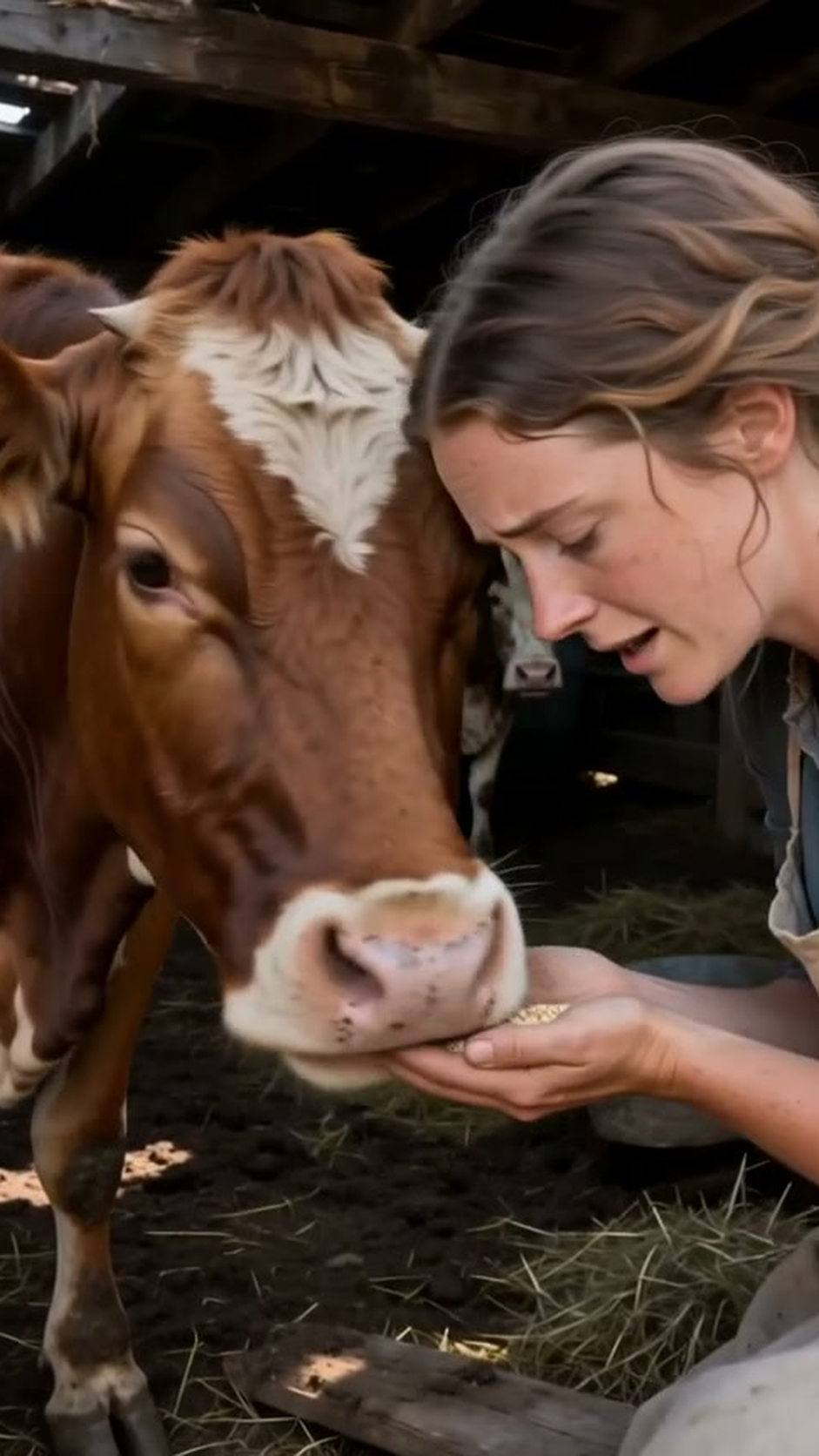
The first week, Lenora worked like the farm was on fire and she was the water.
She learned the place the way you learn a person — by its wounds. The cabin had been a good cabin once, built by hands that cared: dovetailed logs, a real stone chimney, a floor of puncheon boards worn smooth as soap. The roof had failed where a cottonwood limb came down in some spring storm, and the rain had been coming in ever since, rotting a corner of the floor and ruining the little room at the back where Amos Hart had kept his stores. She dragged the limb off with the horse's help, patched the hole with cedar shakes split from the woodpile and canvas from her own wagon sheet, and slept dry for the first time on the fourth night, listening to a summer rain tick on the canvas like fingers on a table, absurdly happy.
The cows taught her their own curriculum.
May ruled them. There was no other word for it. The red cow walked first to water, first to feed, and the others arranged themselves around her judgment like courtiers. She had a white star on her forehead and one notch in her left ear and opinions about everything. Pearl was the beauty, cream-colored, vain as a cat, forever rubbing her neck on the gatepost. Clover and Bess were sisters by some lights — both black-and-white, both stubborn, indistinguishable until you noticed Bess limped a whisper on her right hind from an old injury. Dolly was the fool of the family, sweet-natured and simple, who would follow Lenora around the yard like a dog whenever she was loose.
And Button.
Button was a small dun cow with a face too young for her years and ribs like a washboard, and Button was dying by inches in a way the others were not. The rest of them, given grass and water and a little grain, had turned the corner in a week — heads up, eyes brightening, the desperate edge going out of them. Button ate without appetite and stood apart at the trough, and twice Lenora found her lying down in the middle of the day, which no cow with the will to live does in daylight.
"Now you listen to me," Lenora told her on the sixth morning, kneeling in the straw with a warm mash of bran and molasses water, coaxing it into the little cow a handful at a time. "I did not haul you back from wherever you were going just to have you quit on the doorstep. You eat. That's your whole job. You eat and I'll do everything else."
Button's ear flicked. She licked halfheartedly at the mash. It wasn't much. Lenora chose to call it a negotiation.
The rest of that first week she spent taking the measure of what Amos Hart's death had left her, and it amounted to a strange inventory of ruin and riches. The well behind the cabin was sweet and deep and had never been known to fail. The barn, under its sag, had good bones — cedar posts a man could barely reach around — and in its loft she found a fortune in small things: milk cans, dented but sound; a butter churn with Amos's initials burned into the paddle; harness leather still supple in its oil; hand tools hung in a row so orderly it made her throat ache, each one cleaned by a man who had expected to use it in the morning. The cabin's root cellar had caved in on one side, but the other half stood dry, and she cleared it of rubble stone by stone and stored her flour and beans there like a dragon settling on a hoard. There was even a garden patch behind the cabin, gone to weeds and volunteer sunflowers, where the soil — when she dug into it to set fence posts — came up dark and rich and oddly cool for July, though she thought nothing of that at the time.
The cows, she doctored like a field surgeon. She cleaned fly-sores with lard and carbolic. She trimmed hooves grown long as Chinese slippers. She learned each animal's damage and each animal's temper the way she had once learned the Dawson household, and by the end of the week the herd had begun to sort itself into a society: May ruling, Pearl preening, Clover and Bess plotting their identical stubbornness, Dolly following Lenora from fence to barn like a large devoted dog, and Button — Button eating a little more each day, standing a little longer, watching Lenora with the huge, doubtful eyes of a creature deciding whether the world had finished being cruel to her or was only resting.
On the seventh morning Lenora stood in the yard with her hands on her hips and surveyed a farm that was no longer, strictly speaking, dead. The fence held. The roof was patched. Smoke rose from the chimney. Six cows grazed the creek pasture in the early light, and the smallest of them lifted her head and looked at Lenora across the grass with something that was not yet trust but was no longer despair.
It wasn't a living yet. But it was a beginning with a pulse in it, and Lenora — who had begun with six dollars and a deed to a graveyard — knew exactly how much a beginning was worth.
She was in the barn with Button's morning mash when a voice from the yard made her jump out of her skin.
"Well. Either I'm dreaming, or Amos Hart's cows have come back from the dead."
The woman standing at the barn door was sixty if she was a day, built like a fence post in a calico dress, with white hair skinned back into a knot and eyes that missed nothing at all. She carried a basket over one arm and a coffeepot wrapped in a towel in the other hand, like a woman visiting a sickroom, which, Lenora supposed, was exactly what she was doing.
"Ruth Ellery," the woman said. "I hold the claim north of the ridge. I saw your smoke." She looked past Lenora into the barn, and her weathered face did something complicated. "Lord have mercy. It IS them. That's May. That's Amos's May, I'd know that star anywhere. Girl — do you know what you've got here?"
"Six cows nobody fed for two months, near as I can tell," Lenora said, standing up and wiping her hands on her apron, "and one of them trying to die on me out of habit."
Ruth Ellery laughed — a real laugh, startled out of her — and then she came into the barn and rolled up her sleeves like a woman arriving at a disaster she'd been expecting for years, and for the next hour the two of them worked Button over together: warm water, a blanket off Lenora's own bed, a drench of molasses and salts that Ruth mixed from memory with the confidence of a general.
"Amos Hart kept the best little dairy herd in the county," Ruth said, as they worked. "Sold butter in Cedar Flats when nobody else's butter was fit to sell — sweet as spring, every time, and nobody ever knew how he managed it in the heat of summer. His wife died in '81. After that it was just him and the cows and that boy of a nephew writing letters from Omaha he never answered." Her hands didn't stop. "Fever took Amos in April. Quick. The nephew inherited and never even came to bury him — we did that, the neighbors. He paid a drover named Laramie to gather the herd and drive them to the railhead to sell."
"Laramie," Lenora said. "And Laramie never drove them anywhere, did he."
"Laramie took the money and was seen in the saloon in Cedar Flats three nights running, buying rounds and telling the room he'd come into an inheritance." Ruth's mouth thinned. "After that, nobody asked. The tax men listed the place, the county said the stock was sold off, and those six poor beasts were standing in a shut barn the whole time — except the back gate of the pasture pen had rotted off its hinges, which is the only reason they're alive to argue about. They could get to grass and creek water. Just barely enough, and just barely is a hard way to live for two months."
"Why didn't anyone come and look?" Lenora asked quietly.
Ruth was silent a moment. "Because Silas Crowe told the whole county the herd was gone and the hollow was finished," she said at last. "And because it's easier to believe a thing is finished than to ride out and look at it." She sat back on her heels and regarded Lenora with an expression that had respect in it now, plain as print. "You rode out and looked. That's the whole difference between you and this county, and don't let anybody tell you different."
That evening Ruth's son came by on his way home from shoeing in the valley — Tom Ellery, thirty years old, quiet in the way of men who work with animals and fire, with his farrier's box on his shoulder. He shod Lenora's tired horse for nothing but supper, checked Button standing in the barn with a practiced hand, and told her the little cow had turned a corner and not the wrong one. He ate her skillet cornbread at the cabin table by lantern light and praised it in a way that made her color up like a schoolgirl, which annoyed her so much she nearly burned the coffee out of spite.
Before he left he walked the yard with her in the dusk, past the cabin, and stopped at the great beam over the cabin door. He reached up and brushed a decade of dust off the wood with his thumb.
Under the dust, cut deep into the oak by a careful hand, were letters and a date:
BRENNER — 1863
"First family in the hollow," Tom said. "Germans. Built this cabin, dug the well, planted those willows by the creek. My grandfather said old Johann Brenner was a man who built everything like the end of the world was scheduled for Tuesday." He glanced at her sidelong. "Place has been here a long time, Lenora. Longer than anybody remembers right. Who knows what all is under it."
She thought about that all evening, cleaning the cabin's back room by lantern light — Amos Hart's things, a dead man's leavings: a German Bible with two families' births written in it, Hart names written over Brenner names like one river written over another. A child's wooden horse. A tintype of a woman laughing in front of this very cabin when the roof was new and the barn stood straight. A ledger in Amos's cramped hand, columns of butter sales going back twenty years, the figures holding steady and strong straight through the hottest summers — through drought years when every other dairy in the county had sold sour butter or none.
Straight through the heat. Every summer. Twenty years.
Lenora sat looking at the ledger a long time, with the hair rising a little on the back of her neck, and thought about a sentence Ruth had said in the barn and let fall like it was nothing: nobody ever knew how he managed it in the heat of summer.
She closed the ledger softly.
"Amos," she said to the empty room, "what did you know?"
She found out the next evening that she was being watched.
She came up from the creek at dusk with two full buckets and stopped in the yard with the water sloshing, because the hair on her neck had risen again — and there, on the ridge north of the hollow, black against the last of the light, a rider sat his horse without moving, looking down at her farm the way a man looks at a hand of cards.
He sat there a long moment. Then he turned his horse and was gone over the ridge, unhurried as smoke.
Lenora set the buckets down carefully. Her gate — the yard gate she had wired shut at noon with her own hands — stood open.
Open, and swinging a little, in a wind that had died an hour before.