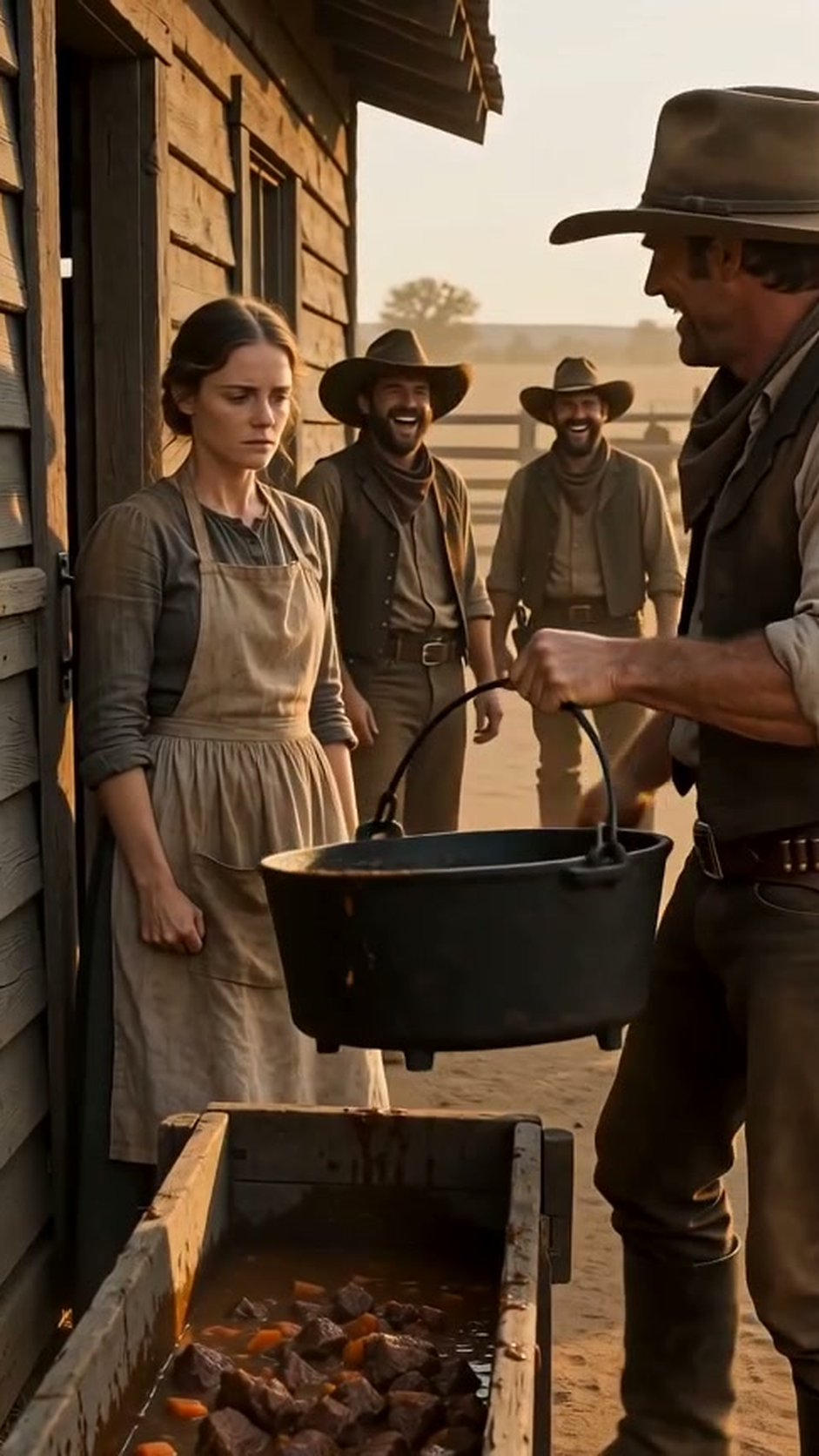
The stew came out of the pot the way a river comes out of a broken dam.
Bertha Platt stood in the doorway of the cookhouse with her hands hanging at her sides and watched thirty men's supper — four hours of her work, beef she had trimmed and browned piece by piece, potatoes and carrots and onions from the root cellar, broth she had skimmed until it shone — pour in a thick, steaming stream out of her mother's black iron pot and into the hog trough.
Buck Thorp held the pot with both hands. He was not a weak man and the pot was not a light one, and he tilted it slow, the way a man pours out something he wants everybody to get a good long look at. The stew splashed and steamed in the rough wooden trough where the hogs rooted at sundown. A piece of carrot landed on the rim and sat there, bright orange against the gray wood, and Bertha could not stop looking at it.
Behind Buck, the crew stood in a dusty half-circle in the late light, and the crew laughed.
Not all of them. Most of them. Enough of them.
Buck gave the pot a final shake. The last of the meat knocked loose and fell. He held the empty pot out toward her, handle first, the way you'd hand a bucket to a servant, and his eyes found hers over the top of it with a cold little smirk tucked into the corner of his mouth.
"Boys aren't eating this," he said.
Bertha stepped down off the cookhouse step and took the pot. It was still hot through her apron where it pressed against her. Her fingers found the handle and closed on it carefully, because if she gripped it the way she wanted to grip something, her hands would shake, and she would not give him that.
"Try again tomorrow," Buck said.
Then he whistled, one sharp note, and the men turned the way cattle turn — all together, without deciding to — and went for their horses. Boots crossed the yard. Saddles creaked. Somebody was still laughing about it as he swung up, and the laugh carried across the corral fence and died somewhere out by the barn.
"Come on," Buck called. "We're eating in town."
Bertha stood in the yard holding her mother's empty pot against her body like a shield and watched thirty men ride for the Dryfork road. The dust they raised hung in the gold light a long time after the sound of them was gone.
Only when she turned back to the cookhouse did she see that one man had not ridden out with the rest.
Andrew Coburn stood by the corral gate with his hat in his hands, watching her. He was not laughing. He had not laughed — not at the trough, not once — and something in his face said he was sorry about standing there, and sorrier still that sorry was all he had brought.
He nodded to her, once, like a man paying a debt he couldn't cover, and went to catch up his horse.
Bertha carried the pot inside and set it on the stove and stood a moment with her palm flat against its black side, feeling the last of the heat go out of the iron.
Then she rolled her sleeves up and began to wash it.
—
The following evening, the cookhouse table was set for thirty.
Bertha had worked since before dawn. She had baked two pans of biscuits and a pan of cornbread. She had made a stew again — a different one, beef and barley, because she would not cook the same supper twice for men who had fed the first one to the hogs; she had her pride, even if she kept it where nobody could see it. She had fried apples with brown sugar. She had made coffee strong enough to stand a spoon in.
And she had set the table.
Plate. Cup. Fork. Plate. Cup. Fork. Thirty times down the long plank table, her hands moving the way her mother's hands had moved, straightening each tin plate a quarter inch this way, a quarter inch that, until the whole table ran true as a fence line.
Andrew Coburn stood in the doorway while she worked, hat turning slow in his hands.
"They've made their choice, Bertha," he said gently.
Bertha polished the final fork on her apron. The lamplight made a warm country of her tired face, and she looked down the long table at thirty places waiting for men who were not coming, and her voice, when it came, was quiet enough that the crackle of the cookstove nearly took it.
"So have I."
Outside, hooves. Then footsteps in the yard — and the footsteps stopped.
Bertha raised her eyes.
Buck Thorp stood in the doorway, filling it, and for the first time since she had known him there was no mockery on his face at all. His gaze traveled down the long table the way a man counts fence posts after a storm. She could see the count moving behind his eyes. Ten. Twenty. Thirty. And when it reached the far end, his jaw tightened like a cinch strap.
Something about those thirty plates frightened him. She did not know why. She only knew that it did — that a table set for supper scared Buck Thorp worse than anything she had ever put in front of him, and that a thing which scared Buck Thorp was a thing worth setting out again tomorrow.
"You expecting company?" he asked.
Bertha laid the polished fork down beside its plate, gentle as a hand on a sleeping child's shoulder.
"I was hired to feed thirty men."
Outside, beyond him, the crew sat their horses in the yard, waiting on his signal to ride for town — the same signal, the same road, the same as every night that week. Buck looked at her. Bertha looked back. A horse stamped the dirt, impatient, and somewhere out in the dark a steer lowed and was not answered.
Buck's hand tightened, slow, around his belt.
He did not speak. Neither did she.
And the thirty plates waited between them, white in the lamplight, patient as an accusation.
—
SIX WEEKS EARLIER
Bertha came to the Bar Seven on the first Monday of April, riding in the back of a freight wagon with her mother's pot nested in straw at her feet and everything else she owned in one carpetbag.
She was twenty-four years old, and she had buried Martha Platt in February, in the hard ground behind the little church at San Tomas, with the wind coming down off the plains so cold the preacher had to hold his hat and his Bible both.
Martha Platt had cooked for the Bar Seven for fifteen years. She had cooked for Silas Merritt when his hair was black and his wife was living, cooked through drought years and fat years, cooked for trail crews of forty and winter crews of twelve, and her name on that ranch was a kind of scripture: men who had ridden for a dozen brands would tell you, in the tone men use for weather and scripture, that Martha Platt's table was the best in three counties. When the letter reached San Tomas — written in Merritt's own hand, which shook a little these days — it said the ranch had gone through two cooks since Christmas, that the crew was eating in town more often than not, that it was costing him money and costing him men, and that if Martha's girl could cook half what her mother cooked, the job and the cookhouse cottage were hers at twenty-five dollars a month.
Bertha could cook. Her mother had seen to that the way other mothers saw to piano lessons — thoroughly, daily, and without the smallest interest in whether the pupil enjoyed it. Bertha had been skimming broth since she was tall enough to see into the pot, and she had her mother's hands: quick, scarred, and honest.
The freight wagon let her down at the ranch gate at noon, and the first person she saw was Buck Thorp.
He was coming out of the barn with a rope over his shoulder, a man gone fifty with a face the sun had been working on for all of it, broad hat, vest, a gun belt worn the way some men wear a signature. He looked at the wagon, and at the carpetbag, and at the black pot when the driver lifted it down, and his expression arranged itself into something that was almost a welcome and entirely wasn't.
"You're the Platt girl," he said.
"I'm Bertha Platt," she said. "Mr. Merritt hired me to cook."
"Did he." Buck looked at the pot again. "Your mama's?"
"Yes, sir."
"Huh." He jerked his chin toward the weathered cookhouse across the yard, its door hanging open on a dark room. "Cookhouse ain't been fit to step in since February. You'll want to start with a broom, I'd guess. Crew's thirty when we're full. Supper's at six." He turned away, then turned back, like a man remembering a chore. "They eat in town a fair amount, this crew. Don't take it personal if the table's light. Town's got its attractions."
He walked off toward the corrals before she could answer, and Bertha stood in the yard with her mother's pot in her arms and understood two things all at once: that Buck Thorp had not wanted her hired, and that he had just warned her — politely, deniably, in the tone of a man giving directions — not to succeed.
She carried her bag into the cookhouse cottage and her pot into the cookhouse, and she started with a broom.
It took her two days to make the cookhouse a kitchen again. She scoured and scrubbed and burned out the stove and blacked it. She found her mother's handwriting still penciled inside the pantry door — measures, in Martha's neat school figures: coffee, so much to the gallon; beans, soak overnight, never salt till the end. Bertha stood in the pantry with her fingertips on those numbers a long time. Then she rolled her sleeves and went to work, and if she cried a little over the first fire she lit in her mother's stove, the smoke was a sufficient excuse and nobody was there to need it.
Her first supper was fried chicken, mashed potatoes with gravy, green beans with salt pork, biscuits, and dried-apple pie.
Thirty men came in out of the yard dust at six o'clock, washed at the trough by the door — the water trough, the clean one — and sat down the length of the table, and the cookhouse went quiet in the way it only does when men are eating food that deserves silence. Then the talk started, and it was the kind of talk Bertha had heard through kitchen doors her whole childhood: men telling a cook, with their mouths full and their hats in their laps, that this was the best supper they had had since — and here several of them said it outright — since Martha Platt.
An old hand named Gus Henley, white-whiskered, sixty if he was a day, leaned back at the far end and said, "Boys, we're in groceries again," and the table laughed and agreed and called for more coffee.
Bertha stood by the stove with her apron twisted in her hands and her mother's pot gleaming black on the back burner, emptied fair and square by honest appetites, and she felt the grief of February loosen in her chest for the first time — not gone, but loosened, like a knot a rope gives up a quarter inch at a time.
Buck ate standing in the doorway. He ate a full plate, which she noticed. He ate it without a word of praise and without a word of complaint, and when he was done he set the plate down on the side table and looked at her across the lamplit room with an expression she had no name for yet — the expression of a man watching a fence go up across a road he had been using.
That night, long after the bunkhouse lamps went out, Bertha woke in the cottage to the sound of a single horse leaving the yard at a walk, quiet as a secret, heading east. Toward Dryfork.
She lay in the dark and listened to it fade, and she did not know — not yet — why the foreman of the Bar Seven would ride to town alone in the middle of the night, with his saddlebag hanging flat and empty on the near side of his horse.
She only knew the sound it made coming back, two hours later.
It made the sound of a saddlebag that wasn't empty anymore.