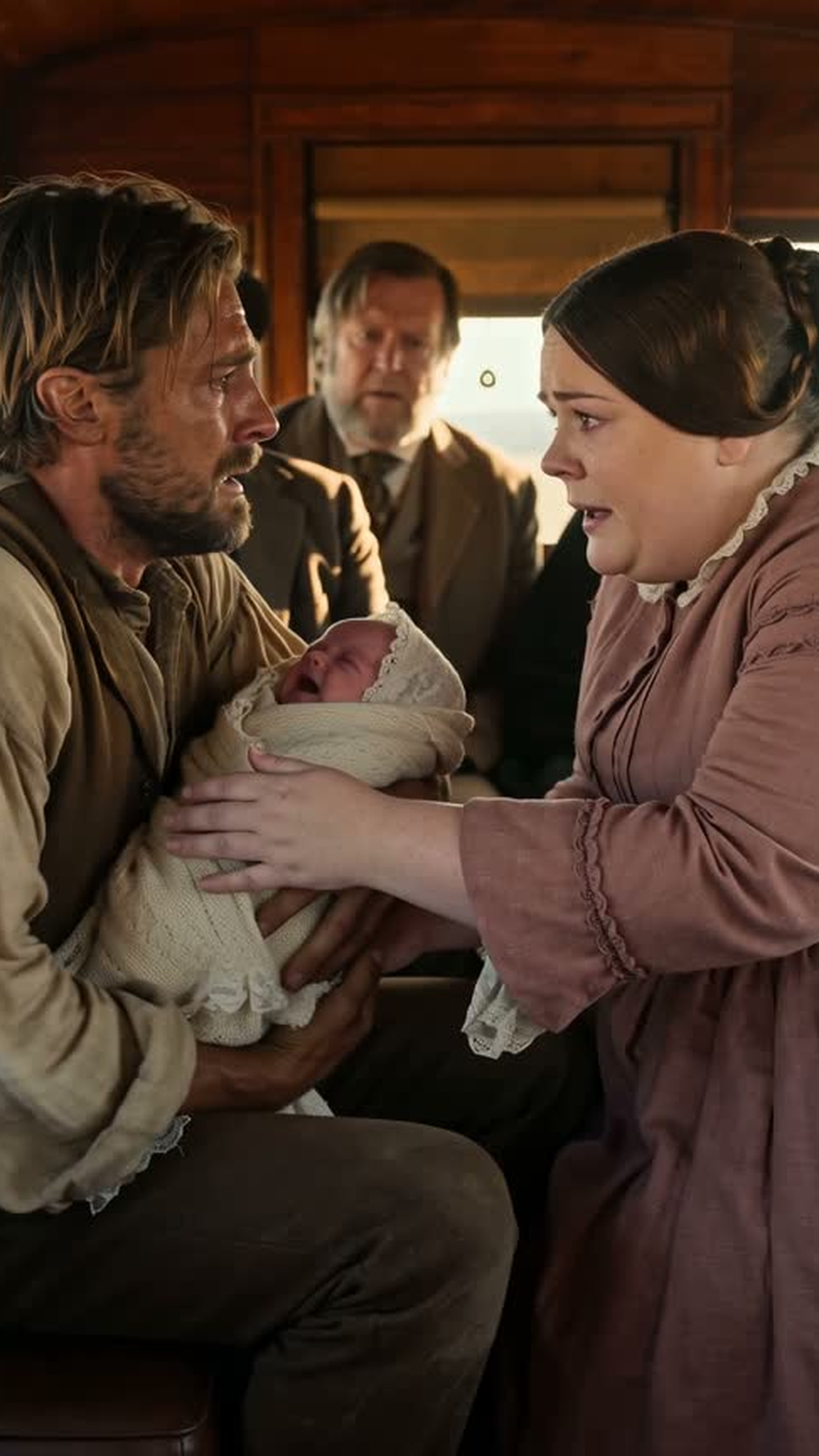
Afterward, Caleb would remember the transfer in pieces, the way a man remembers falling.
He remembered his hands not wanting to open. Three weeks of holding were in those hands — three weeks of *don't drop him, don't fail him, don't let go of the last piece of Margaret on this earth* — and they had to be argued with, one finger at a time, by a man who no longer believed his own judgment about anything. Eliza did not hurry him. She kept her arms extended and her voice low, and she waited with the patience of a woman who knew exactly what it cost to hand over a child, and when at last he leaned forward and laid Samuel into her arms, she received him the way you receive something falling — completely, and without flinching.
The baby's cry, up close, was a thread of sound.
"There now," Eliza said — to Samuel, to Caleb, to herself, it was never clear. "There now. We're going to fix this."
What happened next happened the way such things have happened on frontiers and in wagons and in besieged cities since the beginning of the world: practically, modestly, and with the cooperation of everyone present. Mrs. Henderson — the same woman who had called the whole situation indecent not two hours before — understood first. Without a word she took her own black shawl from her shoulders, rose as much as the low coach roof allowed, and held it up as a screen, and her face as she did it wore an expression that dared Pritchard, the driver, God, or the state of Colorado to make a remark.
Pritchard, to his own visible astonishment, turned his whole body to face the window and kept it there, studying the empty plains with the intensity of a man reading scripture in the landscape. His ears were red. He did not turn back for a long time.
Behind the shawl, in the rocking, sun-striped dimness of the coach, Eliza Moore unwrapped the ivory blanket and gathered a stranger's dying son to her breast — and Samuel Warren, who had refused the bottle, refused the cloth, refused everything his father's love had been able to invent for three weeks, turned his face with the last of his strength toward the warmth and the heartbeat and the thing his body had been screaming for since yesterday morning, and he fed.
The sound he made was not crying. It was a small, desperate, rhythmic working, almost a sob, and Caleb Warren — who had not wept at his wife's graveside, who had held himself together with fence wire and promises for twenty-one days — put both of his rough hands over his face and came apart silently in his seat, shaking, while the woman across from him fed his son back to life.
Eliza felt the milk let down like a door opening in a house she thought was empty. She felt the little jaws working, the tiny fist come up and rest, trusting, against her. And over the top of the baby's dark head she met Caleb's ruined eyes, and she did the thing she had not known she was capable of doing that morning: she smiled at him, steady and plain, the way you smile at a man who has been carrying something too heavy down a long road and has just, finally, been allowed to set it down.
"He's taking it," she said quietly. "Look at him. He's taking it fine."
Samuel fed for a long time. The coach rocked on toward Fort Collins over the dirt road, and nobody spoke, and the crying that had ruled that little wooden world for hours was replaced by a silence so complete that the creak of the harness and the pounding of the hooves seemed to arrange themselves around it. When at last the baby slackened and slept — really slept, with the deep, milk-drunk heaviness of a fed newborn, one fist still curled against Eliza's dress — she wrapped him again in his mother's ivory blanket with a competence that made Caleb's chest hurt to watch, and she held him a moment longer than necessary, and then, deliberately, she gave him back.
"You'll want to hold him while he's sleeping it off," she said. "They're sweetest then."
He took his son. He looked down at the face that had been gray with hunger at noon and was now flushed and slack with sleep, and he said, in the voice of a man reading his own name off a rescued document: "You saved his life."
"I fed a hungry baby," Eliza said. "That's all that happened here."
"It is not all," Caleb said. "But all right."
Mrs. Henderson folded her shawl with great precision and sat down, and after a moment she remarked, to no one, that her sister in Ohio had nursed a neighbor's child through a whole winter in '59 and the families had been close as kin ever since, and that was simply what women did, and anyone who thought otherwise could keep it to themselves on the subject. Pritchard, still facing the window, said hoarsely that he'd once sold a plow to a family outside Sterling on nothing but a handshake, and times being what they were, decency wasn't as scarce as people claimed. Nobody replied. The coach rolled on.
It was an hour later, with Samuel sleeping like a stone and the sun standing high, that the front wheel found the rock.
There was no crash — only a crack like a rifle shot, a lurch that threw everyone against the leather, and then the slow, grinding protest of a coach sitting wrong on its axle. The driver brought the team down to a walk and then a stop, in the middle of the plains, with dust settling around them like the end of a sentence.
He climbed down. He was gone a while. When he came back his face was the face of a man delivering weather.
"Wheel's split a spoke and the axle's sprung," he said. "There's a way station six miles on — we'll limp there at a walk, and that's where today ends. They'll send a wheelwright from the fort tomorrow. Fort Collins," he added, looking at Caleb with something like apology, "is tomorrow evening now, at the soonest. Maybe the day after."
Six miles at a walk. A night at a way station. A day — perhaps two — added to a journey that had already taken everything Caleb had.
He looked down at Samuel, sleeping the first real sleep of his short life. A fed baby wakes hungry. In three hours, four at the most, that small body would ask again for the only thing on earth that had ever answered it — and the woman who could answer sat across from him with her bonnet back on and her hands folded, already retreating into her silence, having done, as she saw it, the one merciful thing and expecting to be allowed to disappear back into her own life at the end of the road.
The six miles at walking pace took two hours, and they were the strangest two hours of Caleb's life.
Nothing about the coach's company had changed — same benches, same bodies, same dust — and yet everything had. Pritchard, who had discovered an unsuspected well of decency in himself, dug a peppermint drop out of his sample case and offered it gravely to Mrs. Henderson, who accepted it as one accepts a treaty. The old lady asked Caleb — politely, as if asking after the weather — how old the child was, and what his name was, and when he told her three weeks, and Samuel, for Margaret, she nodded slowly and said that he was a fine size for three weeks and that his mother had clearly carried him well, and Caleb had to look out at the plains for a while before he could answer that yes. Yes, she had.
Eliza said almost nothing. She sat with her carpetbag at her feet and her restored stillness wrapped around her like a fence going back up, and only once, when the coach dropped into a rut and Samuel stirred and whimpered in his sleep, her hand came halfway across the space between the benches — before she caught it, and folded it back into her lap, and looked out the window at the grass going by at walking speed.
Caleb saw the hand. He saw her catch it. He understood both halves of it, because he had spent three weeks living inside the same war: the instinct that reaches, and the grief that pulls it back.
*Don't,* he thought, and then, immediately, ashamed of the desperation in it: *Please don't go back behind the fence. Not yet. Not until Fort Collins.*
The way station appeared the way everything appears on the plains — first as a smudge, then as a roof, then all at once as a low adobe building with a corral, a well, a windmill going round in the heat, and a stationmaster coming out wiping his hands, shading his eyes at the sight of a coach arriving broken and four hours early. There was a small crowd instantly: hostlers, the stationmaster's wife, two soldiers off a freight wagon. There was the business of the team, the wheel, the telegram that could not be sent because there was no wire. There were bunks in the long room for the men, and the stationmaster's wife — a Mexican woman named Rosa with silver in her braids — took one look at Eliza, at Mrs. Henderson, at the bundle in Caleb's arms and the story written all over his face, and she took charge of the whole party the way weather takes charge of a landscape.
"You," she said to Caleb, "the baby stays where the women are tonight. Babies do not sleep in the bunk room with snoring men. Señora—" to Eliza, with a respect that expected no argument "—you will take the little room off the kitchen. It has a door. Whatever the baby needs in the night, you are closest."
It was arranged in thirty seconds, by a woman who had never met any of them, with the clean authority of someone for whom a fed baby was a simple fact of a well-run world. Caleb stood in the yard in the heat with his son waking up in his arms — stirring, rooting, beginning to wind up toward the hunger — and felt the situation arrange itself around Eliza Moore with a force like water finding its course, and he knew that what Rosa had just done by instinct, he was going to have to do on purpose.
He crossed the yard to where Eliza stood with her carpetbag, holding herself apart from the bustle the way a stone holds itself apart from a river. Samuel's whimpering was building, minute by minute, toward the real thing. Every soul in that yard could hear it. Eliza could hear it most of all — Caleb could see her body answer it, the small flinch she hid — and she looked at the baby, and then at him, and he saw her decide that she would not let him walk into the question unprepared, like a man stepping off a bank into deep water in the dark.
So she spoke first.
The team was already being led away unhitched, the coach standing crippled at an angle in the yard. Caleb did the arithmetic that a father does. Then he looked up at Eliza Moore, and Eliza — who knew exactly what the arithmetic was, who had been doing it herself for the last ten minutes — met his eyes with the expression of a woman bracing for the question she had just spent her whole grief learning how to refuse.
"Mr. Warren," she said, before he could speak.
Her voice was steady. Her hands, in her lap, were not.
"Before you ask me anything — you should know what it is you're asking. You're asking a woman who put her own baby in the ground fifteen days ago to spend the night — and after tonight, who knows how many miles — with yours at her breast instead. I am not saying no. I am saying that if I do this, I will love him a little before we ever reach Fort Collins, and there is no way to stop that happening, and you should know it before you ask — because I did not get to choose what my heart did the first time, and I am trying, this once, to choose with my eyes open."
The baby in his arms found his voice then, properly, and began to cry in earnest — hungry, and alive enough to say so.