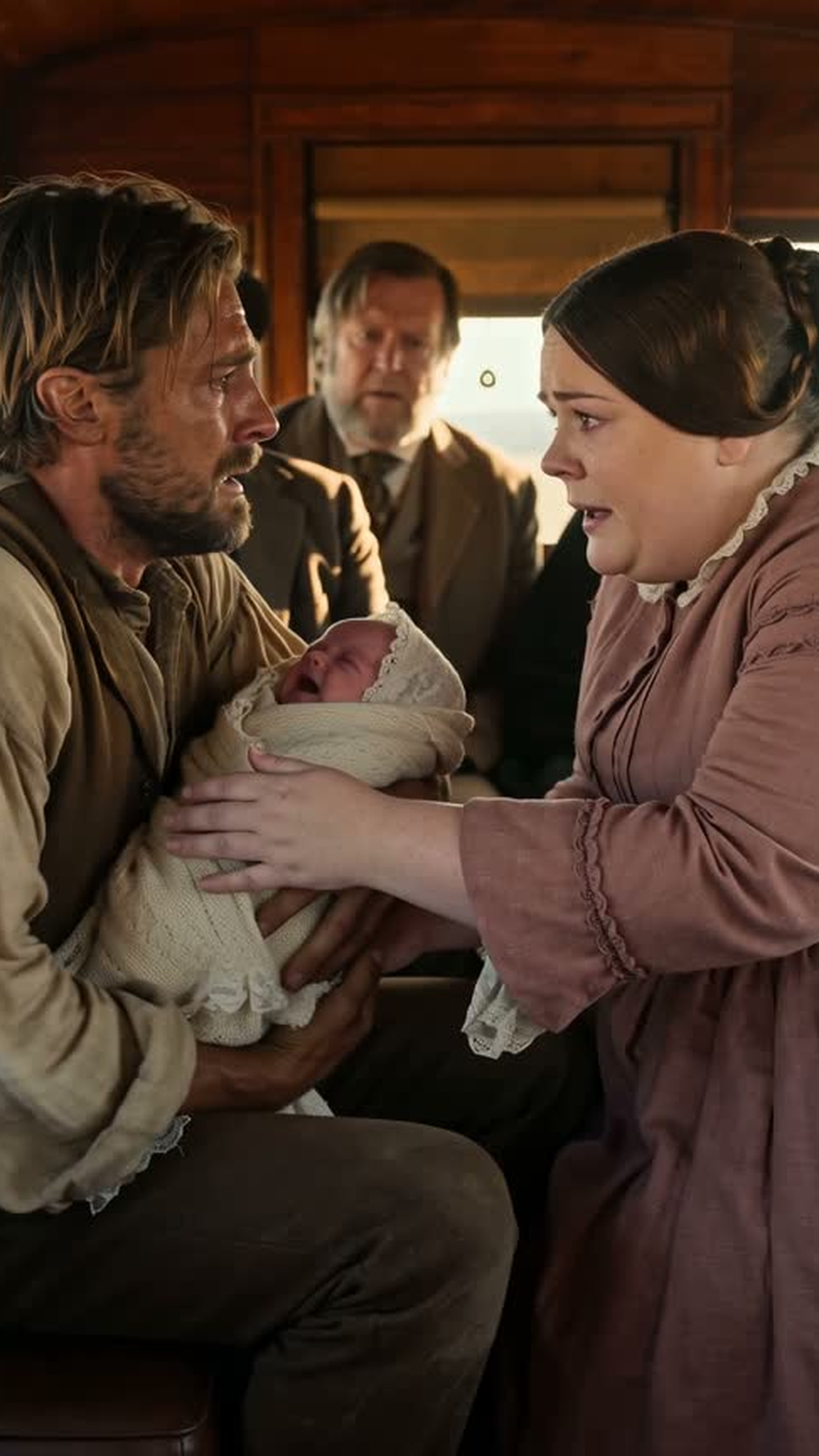
Caleb came out of the bunk room at Eliza's knock with his boots in his hand and his face already knowing.
What followed was not panic. Panic is a luxury of people who have somewhere to run. There was nowhere to run — no doctor within twenty miles, no wire, no wagon faster than a fever in a three-week-old — so the little room off Rosa's kitchen became a battlefield organized by two women who had never met before that day and who worked, within ten minutes, like a crew that had drilled together for years.
Rosa brought cool water from the well and cloths, and lit the lamp high. Eliza unwrapped the baby down to his skin and laid the cool cloths on him — neck, armpits, the hot little belly — changing them as they warmed, again and again, with a rhythm like bellows. Samuel cried weakly at the cold and then, worse, stopped crying at it.
"Talk to him," Eliza said to Caleb, without looking up. "He knows your voice. He's heard it through the wall of the world. Talk."
So Caleb talked. Kneeling on the floor of that small room in his shirtsleeves, with his son burning under strangers' hands, he talked — about the ranch, about the dog, about Margaret's laugh, about the hill and the wind — a river of low, steady words, nonsense and gospel mixed, and Samuel's fluttering heartbeat, under Eliza's palm, seemed to lean toward the sound of it the way the whole of him had leaned, that morning, toward her.
And when the baby's mouth began its blind, rooting search — the oldest reflex there is, arguing with the fever for possession of him — Eliza gathered him up despite the heat and put him to her breast, because milk was the one medicine they had: fluid, strength, and whatever mysterious protection a nursing woman's body lends against sickness, all in one. He fed weakly. He fed again an hour later, less weakly. Rosa, watching from the doorway with the water bucket, crossed herself and said something in Spanish that needed no translation.
Toward dawn the heat began, degree by degree, to let go of him.
Caleb knew the moment before Eliza said it. Samuel, who had been a limp coal all night, kicked — once, decisively, with temper in it — against his father's hand, and opened his eyes, and focused, with a newborn's drunken concentration, on Caleb's face, and then let out a cry of such ordinary, outraged, healthy hunger that Eliza sat down hard on the edge of the narrow bed and laughed and cried at the same time, with the gray light coming in the little window and the cool cloth slipping off her shoulder to the floor.
"He's through it," she said. "He's through it, Mr. Warren. Look at him. He's *hungry*. After everything, the boy is simply hungry."
"Call me Caleb," he said, hoarse, looking at his son like a man reprieved on the scaffold. "After this night — call me Caleb."
"Then call me Eliza," she said, and took the baby, and fed him in the dawn light like it was the most ordinary morning in the world.
Rosa, when they finally parted from her at noon with the coach made whole, did a thing that Eliza carried with her for the rest of her life. The stationmaster's wife took Eliza's big hands in her own small brown ones, turned them over, looked at them the way a fortune-teller looks, and then closed them gently, as if putting something inside.
"These hands buried one and saved one," Rosa said. "Both things are true. Do not let anyone — " and she looked, pointedly, past Eliza at the whole state of Colorado "— tell you the second one cancels your right to grieve the first. You keep both. That is the whole of my advice, and I have buried four, señora, so I know."
"I will keep both," Eliza said, and found that standing in the noon sun with her eyes streaming she believed she actually could.
* * *
The wheelwright's partner arrived at noon with a wheel, an axle, apologies, and a crew's worth of work, and by three o'clock the coach stood whole again in the yard. The driver, who had opinions about wasted daylight, announced they would roll at four and make the creek crossings by evening light rather than sleep a second night — and every passenger, consulted, agreed, because the whole party had passed some border together in the night and nobody was willing to say a smaller word than *onward* in front of the others.
They reached the first creek at six, in the long golden light, and it was running the color of coffee and the temper of a mule.
The driver walked the ford first with a pole, water to his knees, testing. He came back streaming. "It's up but it's passable, if we keep her moving and keep her nose to the current. Everybody stays seated. Weight low. Nobody stands, nobody leans out, and whatever happens—" his eyes went to Eliza and the blanket "—you keep that baby high and dry, ma'am."
Caleb was out of the coach before the sentence ended, stripping off his coat. "I'll walk the near wheel," he said. "If she stalls mid-ford, you'll want a man on the wheel and not a prayer."
It very nearly was not enough. A third of the way across, with the water boiling around the hubs and the team plunging and straining in the current, the repaired wheel found the hole the freight wagon had warned about — a scoured pit in the ford bed — and the coach lurched, stopped, and began, with the slow majesty of a falling tree, to lean.
Inside, the water came up through the floor seams in a dark rush around their ankles. Mrs. Henderson screamed once, sharply, and then — in the finest hour of her life — seized her own traveling bag and Pritchard's sample case and held them both high on the seat like an altar. Pritchard was out the far door into water to his waist without being asked, putting his shoulder to the bodywork beside the driver. And Eliza — Eliza lifted Samuel clear, up against her shoulder, high against her heart, and braced her big body across the bench like a sandbag wall between the child and the leaning side, and sang to him — actually sang, low and steady, in the noise of the water, an old hymn about crossing Jordan — while outside the coach her fate and his hung on wood and horseflesh and the man in the water at the wheel.
Caleb went under once, to the shoulder, getting his back under the axle bed, and came up streaming and shouting at the team in a voice that belonged to roundups and stampedes, and the horses heard something in it they obeyed. The wheel climbed. The coach groaned, shuddered, righted by degrees, and dragged itself up the far bank in a sheet of water and mud, and stood dripping in the sunset while six soaked, shaking people discovered they were all, improbably, alive, and the baby — dry to the skin inside his mother's blanket, furious at the noise — was crying with all the strength of a boy who had survived a fever and a river in a single day and considered both of them beneath his dignity.
They camped that night in the open, around a fire of wet wood, closer to Fort Collins than to anywhere behind them, drying their clothes and their documents and their wits. Pritchard produced, from somewhere in his resurrected sample case, a tin of peaches he had been saving, and opened it with ceremony and served it around the fire as if it were communion at a cathedral, and no one laughed at him for it.
Around that fire, the party finished becoming what the road had been making of it since Julesburg junction. Pritchard, dried to a steamy approximation of himself, told them without being asked that he had buried a wife in Ohio in '71 and had been a drummer ever since because a moving man doesn't have to answer an empty house at night, and that he had been rude about the baby in the coach because a crying child on a road he had chosen precisely for its childlessness had seemed, for an hour, like the world mocking him personally. "It wasn't the boy I couldn't stand," he said, into the fire. "It was everything the boy reminded me of. I apologize to the company. I apologize to the boy."
"Apologize to his nurse," said Mrs. Henderson crisply. "She's the one who kept her temper." And then, turning to Eliza with the air of a woman deploying reserves, she produced from her reticule a card with an address written in a fine, old-fashioned hand. "My sister. In Fort Collins. A widow, comfortable, no nonsense — well, considerable nonsense, but the useful kind. If that boarding-house cousin of your husband's proves unsuitable, Mrs. Moore, you will go to this address and give my name, and you will be housed while you decide your affairs. A woman who has done what you have done on this road does not sleep in a depot on my account. I have written it out. Take it."
Eliza took the card. Her eyes were full again; she had cried more, she reflected, in two days of other people's kindness than in fifteen days of her own catastrophe, and there seemed to be no end of it scheduled. "Mrs. Henderson, I don't know what to say."
"Then say nothing, and eat your peaches," said the old lady. "Sentiment before supper is a waste of both."
It was the stationmaster from the *next* stop, riding back from Fort Collins with mail, who stopped at their fire near midnight, took their news, and gave them his — and Caleb watched the man's face change as he named their destination and their errand, and understood before a word of it was spoken that the ground at the end of the road had moved.
"Mrs. Beal?" the rider said. "With the twins? Friend, I'm sorry to tell you. The Beal house has the fever in it — took it last week. She's nursing her own two through it and her sister's besides, and she's in no state—" he shook his head slowly, looking at the blanket in Eliza's arms by the firelight "—she can't take another child. She can't take a letter. That whole house is quarantined, near enough. Whoever you're counting on in Fort Collins, son — it isn't her."
The fire cracked. Forty miles of road lay behind them. Twenty lay ahead. And the woman Samuel Warren's whole journey had been aimed at — the entire reason for the coach, the blanket, the goat's milk, the letter, the road — could not receive him.
No one said anything for a long moment. Pritchard looked stricken on Caleb's behalf. Mrs. Henderson studied the fire with the expression of a chess player whose opponent has removed a piece she was counting on.
Caleb looked at his son in Eliza's arms — fed, sleeping, *alive*, twenty miles from a town where nothing now waited for them but his sister's house and a problem with no shape yet. Then he looked at Eliza. She was watching him think, and he could watch her doing her own arithmetic at the same time: she had agreed to nurse the boy *to Fort Collins*. To the Beal woman. To the end of the road and the handover. The handover no longer existed. Everything past the Fort Collins depot was a blank page, and the two of them were riding toward it at the speed of horses.
He opened his mouth. Across the fire, Eliza shook her head, very slightly — *not tonight, not in front of everyone, not before we've slept* — and he closed it again, and nodded, and banked the fire, and neither of them said one word about what would happen when the coach stopped rolling.