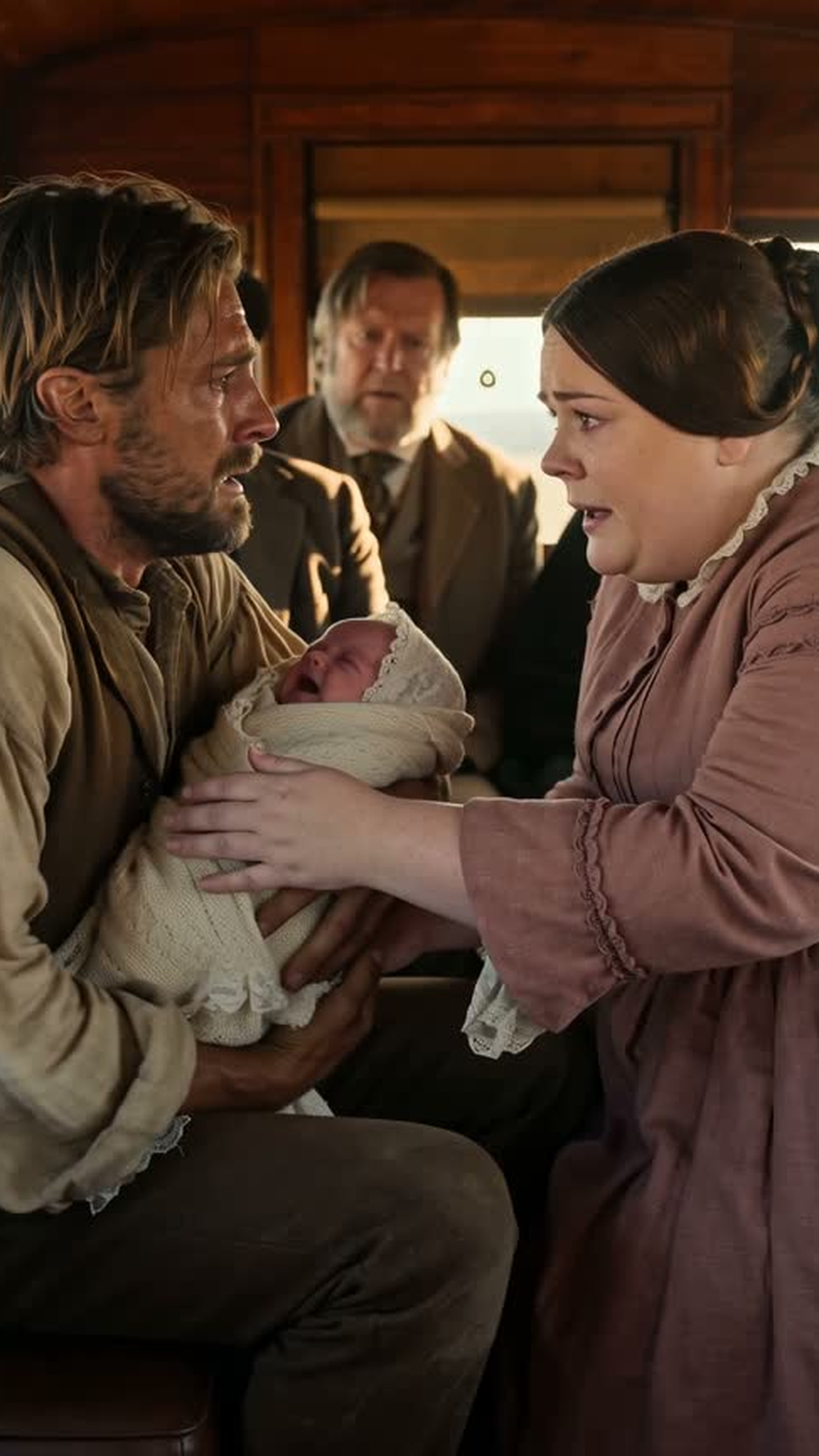
Fort Collins received them at noon on the third day, in a wash of dust and relief, and Ruth Hale received them on her porch with all five of her children arranged behind her like a fence.
Ruth was Caleb with the edges planed smooth — same weathered face, same directness, a decade more practice at both. She took Samuel from Eliza's arms before anyone had properly dismounted, stripped the blanket back with a sister-in-law's authority, and examined him head to toe in the sunlight while the baby screamed his opinion of the procedure.
"Thin," she pronounced. "Scrawny at the edges. But his color's good, his cry's a war cry, and his eyes are tracking." She looked up at Caleb over the baby's head. "The Beal house has the fever, so that plan's in the ground. Who kept him alive, little brother?"
"This is Mrs. Eliza Moore," Caleb said. "She's kept him alive."
Ruth looked at Eliza — really looked, the way she had looked at the baby, head to toe and through — and Eliza stood on that porch in her road-dusted rose dress, three hundred pounds of exhaustion and grief, waiting to be judged by yet another stranger, and Ruth Hale reached out and took her carpetbag out of her hand.
"Then this house owes you a dinner and a bed and a bath, in that order of honesty if not of sequence," she said. "Come in, Mrs. Moore. You'll tell me everything at the table, and you'll leave out nothing about my brother, because I can see there's a portion he's planning to leave out himself."
The doctor came that afternoon — a young Scotsman, Dr. Craig — and examined Samuel in Ruth's kitchen with the whole party holding its breath in the doorway. His verdict, delivered while Samuel fed with single-minded violence, was the verdict Caleb had ridden a hundred miles to hear.
"The boy's turned a corner," Craig said. "Fevers like last night's kill babies who aren't fed. He was fed. Whatever else happens, Mr. Warren, understand me: this woman is the difference between that child and the hill next to his mother. He needs her milk another two months at least. Three would be better. After that, God and goat's milk can argue it out." He washed his hands. "What you do about the arrangements is your affair. But medically, my advice is simple. Do not let her get on a stagecoach going the other way."
* * *
So the arrangements were argued, over two days, in Ruth's kitchen, with the practicality of people moving furniture.
Eliza's cousin-by-marriage, Mrs. Vane, kept the boarding house and received Eliza's visit with the air of a woman honoring a contract she regretted: the small room was smaller than small — a closet off the scullery — the cooking was for eleven boarders, the laundry was for the town, and the wages mentioned in the letter had, somehow, shrunk in the telling. It was survivable. It was the life Eliza had pictured on the train: narrow, gray, and safe from feeling anything ever again at full strength.
Against it stood Caleb's offer, made formally, in Ruth's kitchen, with Ruth appointed witness and Tomas's distant respectability produced as chaperone like a flag: Eliza would come to the Warren ranch as Samuel's nurse and the house's housekeeper, at wages Ruth herself pronounced more than fair, with the big front room that had been — here Caleb's voice did a difficult thing — with a room of her own with a door that locked from inside, and Sundays to herself, and the arrangement to run until Samuel was weaned, and then to be discussed again as free people discuss things.
"And what will people say?" Eliza asked. It was not a small question in 1879, and everyone in the kitchen knew its weight. "A widower. A widow. A ranch forty miles from anywhere, and me in his wife's house, nursing his son at my breast. You know what they'll say. They'll say it at church. They'll say it about *him*, and they'll say it about Samuel when he's old enough for school, and they'll say the worst of it about me — that I buried my baby and went shopping for a family with the milk still—" She stopped, because Ruth had put a hand flat on the table.
"People," Ruth said, "said things about the Virgin Mary. People are not eligible to vote on this. My nephew is alive. When he's grown, if some fool at school tells him talk, he'll have the answer ready: *she saved my life before I was a month old.* There's no gossip invented that stands up against that sentence." She looked at her brother. "But it's not my name and it's not my house. It's hers to choose. Eliza. Choose with your eyes open, like you told him."
Eliza chose the ranch. She chose it with her eyes open, knowing about the grief that would be waiting in that house with its unopened door; knowing she would love the boy past all wisdom; knowing the valley of talk she would have to walk. She chose it the way she had opened her hands in the way-station yard: as the bravest decision available to her on earth.
She signed nothing — there was nothing to sign — but she shook Caleb's hand across Ruth's kitchen table like a contract, and Samuel, asleep in his basket by the stove, made the small sighing noise that babies make when the world, for the moment, is exactly as it should be.
* * *
On the fourth day at the ranch, Caleb did the thing he had not been able to do in a month of trying. He stood in the hall outside the closed door — Margaret's room, the room where Samuel had been born and Margaret had died — with the key in his hand and Eliza, summoned by Tomas at Caleb's request, standing witness because he had discovered he could not do it unwitnessed, like a man signing a treaty with the past.
"It isn't right, the boy sleeping in a drawer of my sister's spare furniture in his own father's house," he said. "And it isn't right, you in the front room like a — like a traveling person. This house has rooms. It's time it used them." He put the key in the lock. His hand was steady; everything else about him was not. "Whatever's in there, Mrs. Moore, you're to use what's useful for him and put the rest by. She — " He stopped. "Margaret knitted that ivory blanket while she was carrying him. She'd have a low opinion of me keeping her son's cradle behind a locked door to spare my feelings. She never had any patience with my feelings when they got in the way of sense."
The room smelled of lavender and dust. The cradle stood by the window — plain pine, well made by some earlier Warren — with a folded quilt in it. On the dresser: a brush, a Bible with a ribbon in it, a sewing basket with the work still in it, Margaret's wedding ring where the midwife had taken it off her hand and laid it down, a month ago, in the last hour.
Eliza looked at the ring and then, deliberately, at Caleb, who was looking at it too.
"I won't touch her things beyond what's needful," she said. "And I'll keep them dusted. She isn't an obstacle to me, Caleb. I want you to know that. She's his mother. She'll be in this room and in this boy as long as she needs to be, and I won't be the woman who tried to sand her off the walls."
"Sand her off," Caleb repeated, wonderingly. "Your Thomas carved a cradle with his own hands for Clara. You've held this same door from the other side. That's what I'm trying to say. You understand it from the inside."
"I understand it from the inside," Eliza agreed.
She moved the cradle into the light, and that evening Samuel slept in it for the first time, in the room where he was born, with the lamp lit and both his father's grief and his nurse's grief standing in the doorway together like two sentries who had agreed, without discussion, to guard the same door. It was on the fifth day that the boy, fed and solemn in Eliza's arms in that room, produced — unmistakably, twice, at nothing but her foolish talking face — his first true smile, and Eliza laughed out loud alone in the nursery, and then wept a little, and then laughed again, and thought: *There you are. There you are at last. Stay.*
It took eleven days for the talk to reach her. Not at the ranch — the ranch was heaven and hell in the proportions she had expected: heaven in Samuel, who fed and slept and began, unmistakably, to fatten; hell in the small daily resurrections of grief that lived in a house full of another woman's things, kindly kept, impossible to resent. Tomas treated her like a duchess. Caleb treated her like a business partner and a rescuer and a guest, all at once, with a care so deliberate it was its own kind of tenderness.
The talk came by wagon, with the supplies, via a neighbor's wife who had it from a cousin who had been at church in Fort Collins: a sermon, of all things, against *hasty consolations* — against widows and widowers who dishonored fresh graves by arranging new comforts before the earth had settled; and after the sermon, in the yard, a woman whose name Eliza never learned had said the thing itself, out loud, in the hearing of half the county: *Some women bury a baby on Monday and acquire a whole family by the end of the month. It's the milk, you see. She had something to sell.*
The neighbor's wife repeated it as gossip, not malice — which somehow made it worse. Eliza thanked her for the supplies, and served Samuel his evening with steady hands, and sat up that night in the front room with Clara's little white cap in her lap and did the arithmetic that shame does, which is the opposite of the arithmetic of the road. On the road, everything had pointed one way: *live, feed, stay.* In the night, everything pointed the other: *your staying is the thing they're using against him. Against the boy. A nurse can be replaced — Mrs. Beal recovered by now; there are other women. But a boy's name, and a good man's name, can't be un-spoiled. You know what you have to do. You've always known this was borrowed.*
At dawn she packed the carpetbag. She left the wages Caleb had paid her for the ranch days in an envelope on the kitchen table, because taking them felt like the other woman's sentence made true. She took the cap. She left instead a letter, in her plain round hand, on the table under the envelope, and she stood a long time in the doorway of the nursery looking at Samuel asleep in his cradle, in the room that had finally been opened — and she did not wake him, because if he woke she would not go, and going was the last gift she had to give him.
"Be good," she whispered. "Grow. Forget me kindly."
There was no one awake to see her go. She walked the two miles to the neighbor's gate in the cold dawn with her carpetbag, to beg a ride to Fort Collins like any departing servant, and she was at Henderson's sister's door by noon with the card in her hand and her story at the ready, and Caleb Warren woke at six to a silent house, an envelope, and a letter that began: *Do not follow this. It is better this way. Tell him, when he is old enough, that there was a woman once who was glad — so glad, whatever it cost — that the coach was crowded, and the wheel broke, and the river rose. Tell him his mother knitted the blanket. Tell him the rest as little as you can.*
Caleb read it twice in the cold kitchen. Then he set it down, very carefully, the way a man sets down something explosive, and he went and saddled his horse.