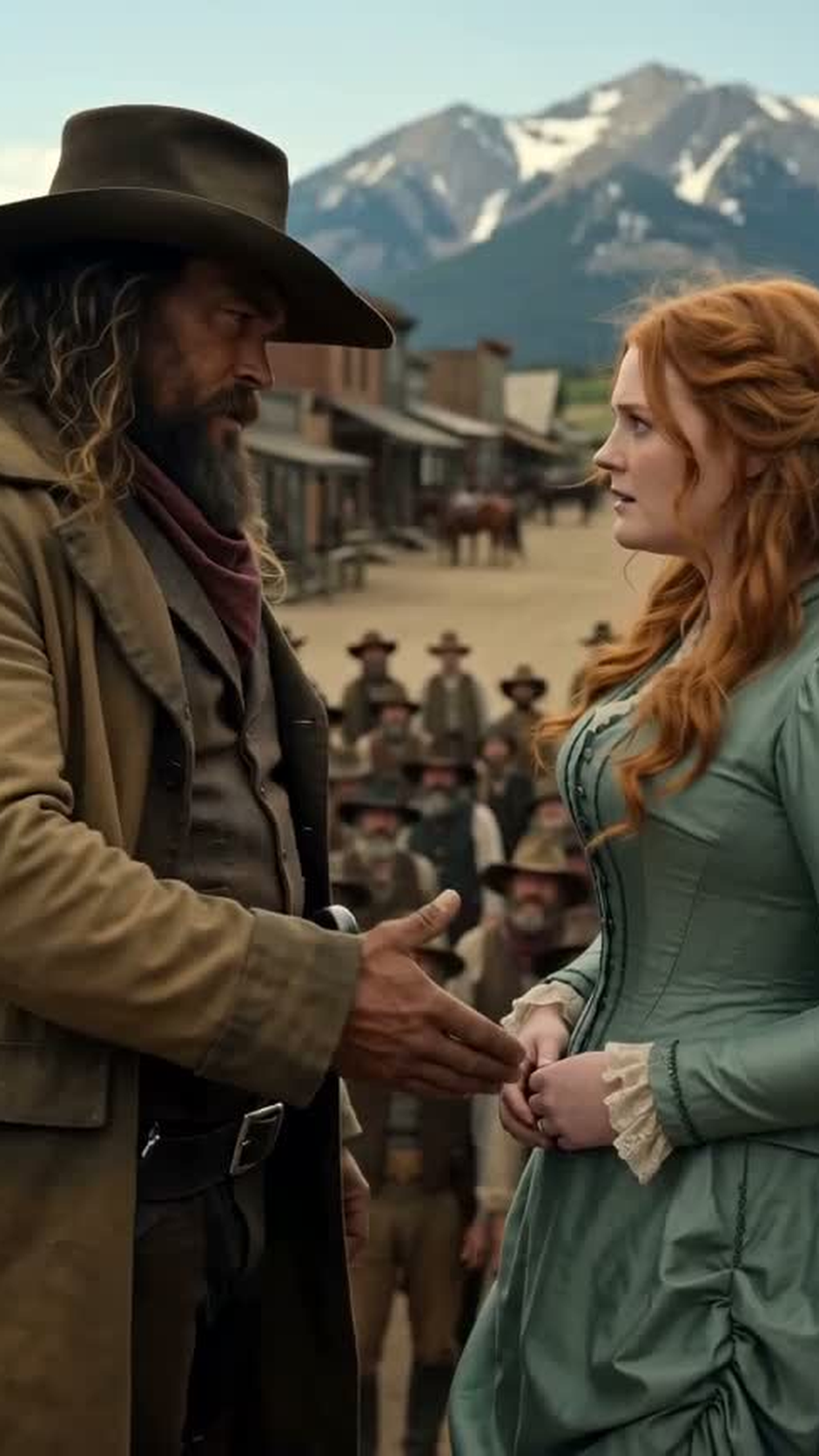
She got the fire built up first. Natalie would be proud of that, later, in the telling — prouder of it, some days, than of anything else she did that night: that with the pain coming on her in waves like a tide with a grudge, four weeks early and utterly alone, she had got the fire built up and the kettle on and the good linen out of the chest before she permitted herself one single moment of being afraid. A Zimmerman stands straight. A Zimmerman also, it turns out, boils water.
Then she sat down in her chair — her chair, built to her measure — and set herself to wait out the storm of two weathers at once: the one screaming down the defile outside, filling the crack in the rock with drifted snow and burying the world, and the one inside her, older than mountains, that had its own timetable and no interest whatsoever in April.
Dominic found the cabin lit at dusk because he had seen it, from the ridge, through a rent in the storm — one window of lamplight in a white world, when no lamp should have been lit at that hour in that quantity. He came down the north slope in the dark on snowshoes he'd cut as a boy, half falling the last mile, and through the door with snow packed into his beard and his eyes white-ringed with a terror she had never seen in them, in the defile, under fire, anywhere.
Not at the storm. At her face.
"Natalie—"
"Four weeks early," she said, from the chair, in the voice she used for ledgers, because she had decided during the long afternoon that one of them had to be a table the other could set things on, and it was going to be her. "The waters broke at noon. Dominic. Look at me. I am not Mary, and this is not eight years ago, and you are not the boy who didn't know. You told me yourself: everything you didn't know then, you know now. So know it." She held out her hand across the room, and it was steady, and she was proud of that too. "We're going to have this baby in this cabin, tonight, you and I, and you are going to stop looking at those pines out the window and be the man who stood in the square in front of the whole town. Come here."
He came. The mountain knelt by her chair in its melting snow, and took her hand, and Natalie Brennan — sold for five hundred dollars in gold to a stranger in September, worth every cent of it and considerably more — commenced the hardest night's work of her life with the partner she had chosen off a platform in front of a laughing town.
It was long. Nothing in this telling will make it shorter than it was. The storm beat the cabin like something trying to get in, and the baby — their daughter, though neither of them knew it yet — had inherited, it would appear, the family dimensions, and every inch of her arrival had to be negotiated. Dominic did everything. He did it badly at first, with hands that shook, and then better, the way he'd learned everything in his life, by watching once and understanding forever: he boiled and carried and braced her shoulders through the pains that bent her like a green tree, he talked — the man of fifty words a year talked for eleven hours straight, a low unbroken river of talk, telling her the names of every star he'd wintered under and every book on his shelf and the whole history of the valley, because she had ordered him once to not let the silence do the thinking.
Twice he went out into the storm for wood, and came back white to the waist, and built the fire up until the cabin glowed like a lantern in the waste of the night. He kept the kettle singing and the cloths warm and a lamp trimmed at her shoulder, so that whenever she surfaced from the pain she found light first, and his face in it, and the room ordered around her like a held breath. "Talk to me," she said once, through her teeth. "I am talking," he said, astonished. "Woman, I have talked more tonight than in the whole of my life before it."
And in the last hour, when the thing went wrong — because it did go wrong, in the way it had gone wrong for Mary, the child turned and stuck and Natalie's strength, which had never failed her at anything, began to go out of her like heat from iron — it was not Dominic who saved them, and it was not luck.
It was Natalie. Deep in the worst of it, with her husband's voice going ragged above her and the storm suddenly, strangely quiet outside, as if the whole valley were holding its breath with her, Natalie Zimmerman Brennan reached down the length of her own great body with her long blacksmith's hands — hands that had held fractious horses and corrected merchants' ledgers and fired a Henry rifle off a pulpit rock — and did the thing that frontier women had done since there were frontiers: she turned her own child, herself, the way a midwife's hands are taught to do it and the way her hands simply knew, from a lifetime of delivering calves in her father's barn by lantern light.
"Now," she said to Dominic, with her eyes shut, in a voice that came from the foundations of her. "Now. Catch her."
He caught her.
The crying filled the cabin the way the fire filled it, all at once and everywhere. A girl — enormous, furious, auburn-haired already, with her mother's lungs and her father's grip, fastening one tiny fist around Dominic's finger while he stood in the wreckage of the night making a sound that was not, strictly speaking, a word in any language he knew. Nine pounds and better. Alive, entire, and loud enough to argue with the storm.
Then came the bleeding, and with it the thing Dominic had dreamed of in terror for eight years — and this is where the story of that night bends away from the story of the other one, and stays bent. Because this time he knew. Eight years of reading the white-spined medical book by firelight, eight years of rehearsing in his memory the hour he had failed, had left him knowing the thing he had not known: the cold. The valley's own remedy, packed in cedar at the spring box since August, the sweet cold water of the creek that ran bright over gold stones. He worked with snow water and cold cloths and pressure and prayer, all of it at once, the way a man fights a fire with everything in the room — and the bleeding, which had taken Mary Brennan in forty minutes in 1870, slowed against the cold and his hands, and slowed again, and stopped.
Natalie slept then, the deep clean sleep of a woman who has spent everything and been repaid. Dominic sat in her chair — it was the only seat in the cabin that fit either of them, and they would laugh about that for fifty years — with his daughter asleep on his chest in a nest of his own great hands, and watched the window. The storm had blown itself out sometime before dawn. The light came up slow and rose-colored over the valley, over the tended graves in the pines, over the whole hidden world, and the melt would open the defile in a week, and the Widow Abernathy would scold them both and pronounce the baby a miracle of engineering, and all of that was still to come.
"Anna," he said quietly, to the sleeping girl, trying the name he'd heard Natalie speak in her sleep — her mother's name, carried two thousand miles and one generation to arrive here. "Your mother stood up in front of the whole town, and the town laughed, and she didn't bend. I paid five hundred dollars in gold for her and it was the cheapest thing I ever bought." The fist around his finger tightened, reflex and prophecy at once. "They didn't know her worth," Dominic Brennan told his daughter, as the sun came into his valley. "But they'll know yours. Your mother will see to it. She stands up."
* * *
They rode down to Willow Ford in the first week of May, when the defile ran with meltwater and the valley behind them was greening at the edges: Dominic on the gray, Natalie on the steady mare, and Anna Brennan — six weeks old and already famous in three counties — riding in a sling against her mother's chest, under the sage-green silk, asleep through the whole descent like a person who finds mountains unremarkable.
The town saw them coming from a long way off. Towns do.
No one laughed. That is the smallest way to put it, and it is also the whole of it. Men took off their hats along the main street of Willow Ford — took them off without thinking, the way you do for a funeral or a flag — for the woman on the mare with the child at her breast, and if Tobias Crane, coming out of his office with his ledgers under his arm, looked for a moment like a man seeing his own arithmetic returned to him with interest, he had the grace to hold his hat over his heart while he did it. On the platform in the square — bare of bunting now, an ordinary timber stage waiting for the next sale day — an elderly farmer sat mending a harness: the same farmer who had bid twenty-five dollars, half-ashamed, the previous September.
He rose, slowly, as they passed. He took off his hat. He did not say anything, being a man of few words and those mostly about weather — but he stood with his hat off until they had passed entirely out of the square, and Dominic, riding beside his wife, nodded to him once, solemnly, gravely, as one man acknowledges another who has corrected an error at some cost to himself.
Natalie rode straight-backed through it all with her daughter asleep against her heart, in her mother's lace, in the town that had priced her at thirty dollars. She did not duck. She had never ducked for a lintel in spirit in her life, whatever the doorways of Missouri had required of her body, and she was not going to begin in the square at Willow Ford.
She was nearly six feet of woman, and every inch of her was exactly the size of the life she had gone and gotten.
"Dominic," she said, as the town fell behind them and the trail bent toward home — toward the crack in the rock no traveler could see, and the valley beyond it that was theirs.
"Mm."
"You never did say, you know. Not properly. In the square, you said they didn't know my worth." She looked across at the biggest man in Idaho Territory, riding beside her through the spring sagebrush with his hat in his hand like a boy. "What am I worth, then? Precisely. I've kept books all my life. I'd like a figure."
Dominic Brennan considered the question with the seriousness it had been asked in, for exactly as long as it deserved, which was no time at all.
"Five hundred dollars," he said, "was the bid that got you off the platform. There's no figure for the rest of it, Natalie. I checked." A pause, and the corner of his mouth did the thing it did so rarely that she had learned to watch for it the way farmers watch the sky. "I had the gold. I'd have paid the creek."
Behind them, the town went on with its morning. Ahead of them, the mountains opened, in their hidden place, like a door built at last to measure.
She had been worth a plow joke, once, to men who sounded bored. She had been worth five hundred in gold to the one man who looked twice.
She was worth, in the end, precisely what she had always been worth — and Natalie Zimmerman Brennan, riding home in the spring sunlight with her whole life in her arms, found that the figure, at last, was not one she needed anyone else to compute.
THE END